Market Orders Explained: How They Work and Why They Matter in Crypto Trading
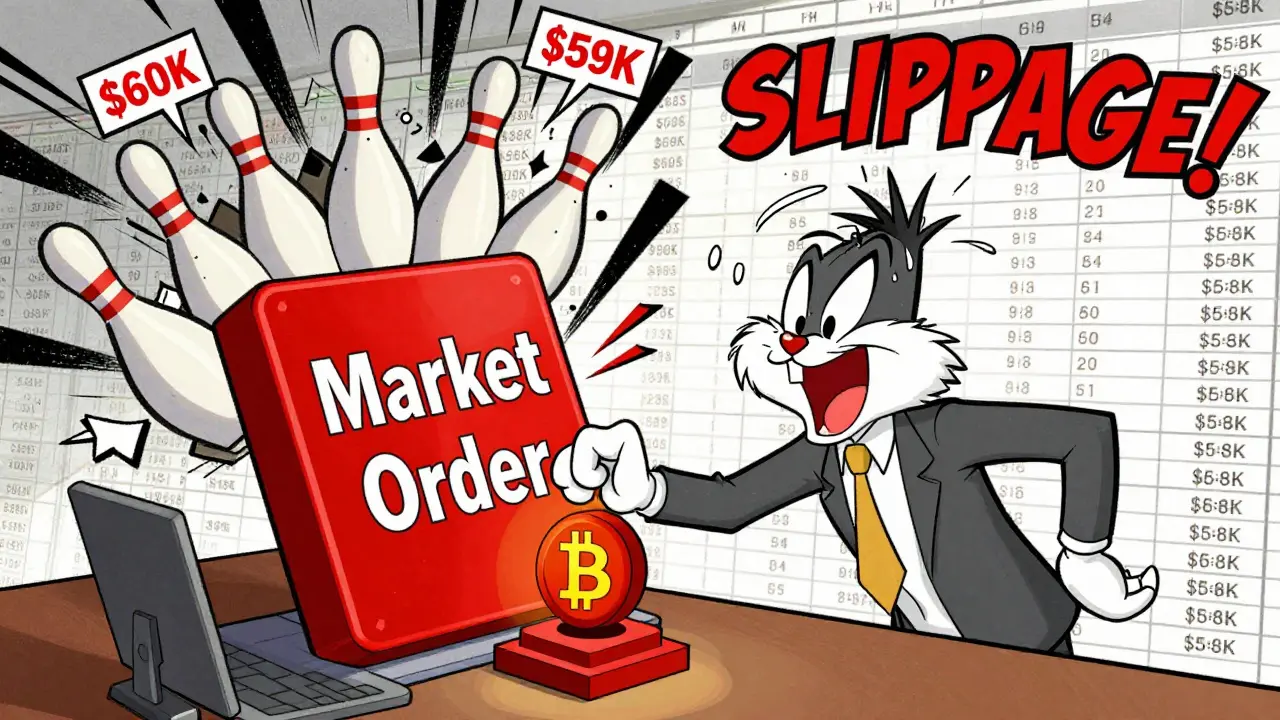
When you trade crypto and click market order, you're saying: market order, a trade instruction to buy or sell immediately at the best available price. Also known as instant order, it’s the fastest way to enter or exit a position—no waiting, no price negotiation. It’s simple, but that simplicity hides risk. If the market is moving fast—like when a big news drop hits—your market order might fill at a price way worse than you expected. This isn’t theory. It’s what happened to traders on MEXC and Binance during the 2024 Bitcoin flash crash when a single large sell order dragged prices down 15% in under 30 seconds.
Market orders don’t care about your ideal price. They care about speed. That’s why they’re perfect for high-liquidity assets like Bitcoin or Ethereum on big exchanges. But on smaller DEXs like Aster or Polkadex, where trading volume is thin, a market order can tank your entry price—or even trigger a slippage of 5% or more. That’s why smart traders use limit order, an instruction to buy or sell only at a specific price or better. Also known as conditional order, it gives you control over your entry point. A limit order says: "I’ll buy PDEX at $0.45 or lower." If the price never hits that level, you don’t buy. No surprises. Then there’s the stop order, a trigger that turns into a market order once a price level is reached. Also known as stop-loss order, it’s your safety net when the market turns against you. If you own DMT and want to bail out if it drops below $0.02, a stop order does that automatically. But here’s the catch: if the market gaps down hard—say from $0.03 to $0.01 in one tick—your stop order becomes a market order and sells at $0.01, not $0.02. That’s slippage again.
Most of the posts here show how beginners get burned by not understanding these basics. People chase airdrops like BTH or SNE, then panic-sell using market orders when the price drops. Others trade on fake exchanges like EvmoSwap or IMOEX, thinking they’re getting a deal—only to find their orders filled at terrible prices because the platform has no real liquidity. Even on legit platforms like Echobit or GIBXChange, using market orders without checking the order book is like driving blindfolded. The truth? Market orders have their place. They’re great for quick exits during a rally or when you’re certain about the trend. But if you’re trading anything with low volume—or if you’re holding a token with zero trading activity like DragonMaster (DMT)—you’re playing Russian roulette.
What you’ll find below are real-world breakdowns of crypto platforms, tokens, and trading traps—all tied to how market orders behave in different environments. Some posts show you how to avoid scams that exploit order confusion. Others explain why certain DEXs make market orders dangerous. And a few reveal how even big exchanges like MEXC or Binance can make your market order fill at a price you didn’t expect. This isn’t about theory. It’s about what actually happens when you click "Buy Now"—and how to make sure you’re not the one who loses.