

You’ve probably heard of Dogecoin or maybe even Shiba Inu. But have you heard of Yee Token (YEE)? It’s not just another random coin popping up on your feed. YEE is a specific type of cryptocurrency called a memecoin, built on the Ethereum blockchain. Unlike coins that promise complex technology or real-world utility, YEE exists for one reason: to celebrate an old internet joke and ride the wave of community hype.
If you are wondering what makes this token tick, why it claims to be "fighting Pepe again," and whether it is worth your attention, you are in the right place. We will break down exactly what YEE is, how it works, and the risks involved before you think about buying any.
The Origin Story: Why Does YEE Exist?
To understand Yee Token, you first need to understand the meme itself. The "Yee" meme features a pixelated dinosaur character that became famous online long before cryptocurrencies were a household name. It represents a specific era of internet culture-quirky, nostalgic, and slightly absurd.
Yee Token was created as a tribute to this legacy. According to market analysis from platforms like Binance Square, YEE isn't trying to invent a new viral trend from scratch. Instead, it acts as a "resurrection" of a pre-existing cultural artifact. The project explicitly states it has no formal roadmap, no venture capital backing, and no complex utility. Its entire value proposition rests on "meme energy" and community participation.
This approach is distinct from many modern tokens that try to layer DeFi (Decentralized Finance) features onto a meme brand. YEE embraces simplicity. As noted by OpenSea, the token thrives on social momentum rather than technical features. It appeals to traders who want pure exposure to internet humor without navigating an elaborate ecosystem.
Technical Basics: How YEE Works on Ethereum
Under the hood, YEE is technically straightforward. It is an ERC-20 token deployed on the Ethereum network. This classification matters for two reasons:
- Compatibility: Because it follows the standard ERC-20 protocol, you can store YEE in almost any Ethereum-compatible wallet, such as MetaMask, Trust Wallet, or Phantom (when configured for EVM chains).
- Security Model: YEE inherits the security of the Ethereum blockchain. This means its transactions are secured by Ethereum’s Proof-of-Stake consensus mechanism. However, while the network is secure, the smart contract governing YEE itself may not have undergone extensive third-party audits, which is common for pure meme projects.
There are no staking mechanisms, governance votes, or yield-farming integrations advertised for YEE. You buy it, you hold it, or you sell it. That’s it. This lack of complexity is intentional-it keeps the barrier to entry low for newcomers who just want to join the fun.
Tokenomics: Supply and Market Data (June 2026)
When evaluating any crypto asset, you need to look at the numbers. Here is the current snapshot of YEE’s economic structure based on data from mid-June 2026:
| Metric | Value |
|---|---|
| Total Supply | 1,000,000,000 YEE |
| Circulating Supply | 1,000,000,000 YEE (100%) |
| Market Cap | ~$4.2 Million USD |
| Number of Holders | ~6,876 |
| Network | Ethereum (ERC-20) |
A few things stand out here. First, the supply is fully circulating. There are no locked tokens waiting to be released later, which eliminates the risk of sudden inflation from team unlocks. Second, with a market cap in the low single-digit millions, YEE is considered a small-cap asset. This means it has high volatility; a relatively small amount of money flowing in or out can cause significant price swings.
Note that prices vary across exchanges. While Phantom reported a market cap around $4.2 million, other aggregators like Crypto.com and Bitget showed slight variations due to different trading venues and data collection times. Always check the live price on the platform you intend to use.
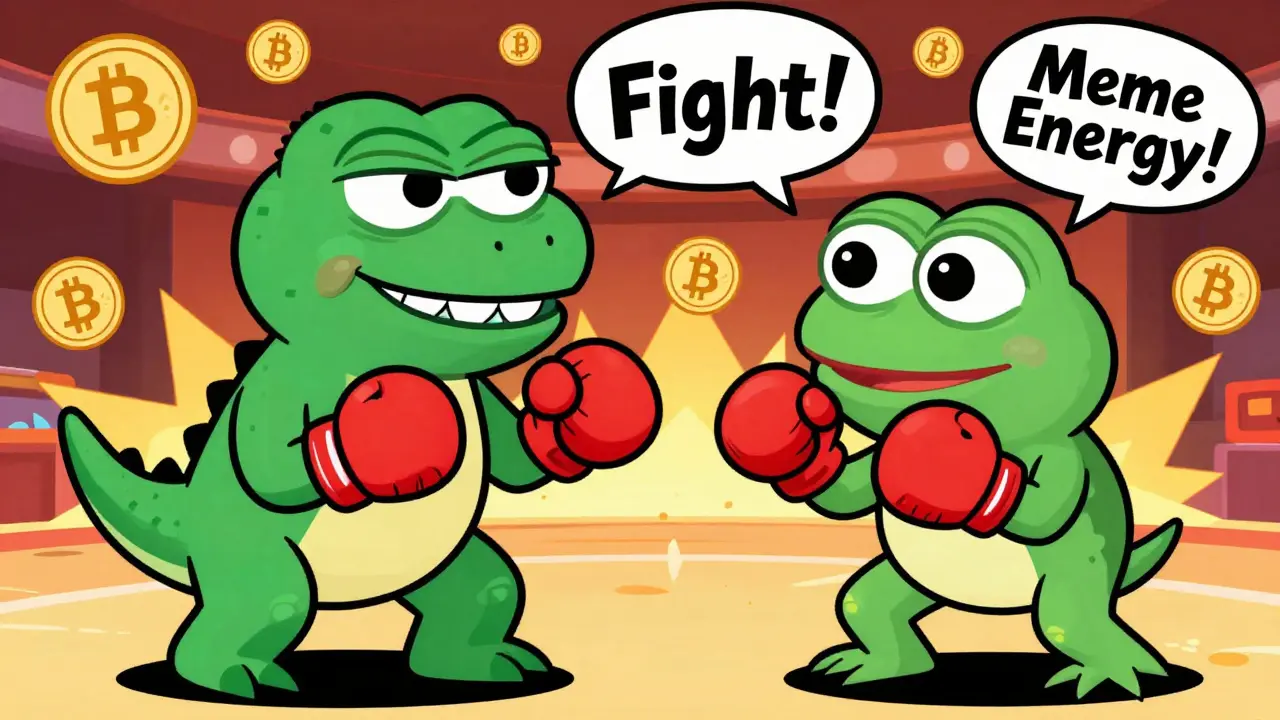
The "Fight Pepe" Narrative and Community Culture
One of the most defining characteristics of YEE is its branding against Pepe (PEPE). Coinbase describes YEE’s mission as "to fight Pepe again." This refers to the long-running internet rivalry between the Yee dinosaur and Pepe the Frog.
In the world of memecoins, narratives drive value. By positioning itself as a rival to one of the biggest names in the space, YEE taps into existing fanbases and tribal loyalty. It’s not a literal conflict, but a playful competition for attention and market share. This strategy helps YEE stand out in a crowded field where thousands of new tokens launch daily.
The community around YEE is described as having a "cult-like status" among niche followers. Engagement comes through humor, fan-made content, and shared nostalgia. If you enjoy participating in online subcultures, this aspect of YEE might appeal to you more than the financial metrics.
Important Warning: Beware of Legacy Tokens
Here is where things get tricky, and why you must pay close attention. There is more than one token using the ticker YEE on Ethereum.
Data from CoinMarketCap shows a legacy token associated with the "Yee Foundation" that has a total supply of 10 billion tokens. This older version trades at a much lower price point (around $0.00016) and has different fundamentals. The newer, meme-focused Yee Token discussed in this article has a supply of 1 billion.
Why does this matter? If you accidentally buy the wrong YEE, you could lose money because the liquidity and community support are entirely different. Always verify the contract address before swapping. Never rely solely on the ticker symbol. Check official social media channels or reputable listing pages to ensure you are interacting with the correct 1-billion-supply token.
How to Buy YEE Token
Since YEE is an ERC-20 token, you generally won’t find it on every major centralized exchange immediately. However, it is trackable and tradable on several platforms. Here is how you typically acquire it:
- Set Up a Wallet: Download an Ethereum-compatible wallet like MetaMask or Phantom. Ensure you have some ETH in your wallet to pay for gas fees (transaction costs on the Ethereum network).
- Choose a Platform: YEE is available on decentralized exchanges (DEXs) and some centralized platforms like Phantom’s integrated swap feature, Crypto.com, Kraken, and Bitget. Check which platform offers the best liquidity and lowest fees for your region.
- Verify the Contract: Before connecting your wallet, double-check the token contract address against official sources to avoid scams.
- Execute the Swap: Enter the amount of ETH you wish to trade for YEE, review the slippage tolerance (usually 0.5% to 1% for stable tokens, higher for volatile ones), and confirm the transaction.
Remember, trading memecoins involves high risk. Prices can drop rapidly if community interest wanes. Only invest what you can afford to lose.
Is YEE a Good Investment?
Let’s be clear: YEE is not an investment in the traditional sense. It has no revenue model, no product, and no underlying assets. Its value is derived entirely from collective belief and speculation.
Pros:
- Nostalgia Factor: Taps into a well-known, long-standing meme.
- Simplicity: No complex mechanics to learn; easy to understand.
- Community: Active niche following engaged in creative content.
Cons:
- High Volatility: Small market cap means large price swings.
- No Utility: Value depends solely on hype.
- Confusion Risk: Multiple tokens with similar names/tickers exist.
If you are looking for steady returns, YEE is likely not for you. If you are a speculative trader who enjoys riding meme trends and understands the risks, YEE offers a unique entry point into the "OG meme" revival narrative.
What is the main purpose of Yee Token (YEE)?
Yee Token is a pure memecoin designed to celebrate the "Yee" internet meme and compete culturally with other meme coins like PEPE. It has no functional utility, roadmap, or technical innovations beyond being an ERC-20 token on Ethereum.
Is YEE the same as the Yee Foundation token?
No. There are two distinct tokens. The newer meme-focused YEE has a total supply of 1 billion tokens. The legacy YEE associated with the Yee Foundation has a supply of 10 billion tokens. Always verify the contract address to ensure you are buying the correct one.
Which blockchain is YEE built on?
YEE is built on the Ethereum blockchain as an ERC-20 token. This means you need an Ethereum-compatible wallet and ETH to pay for transaction fees.
Does YEE have a roadmap or future development plans?
No. The project explicitly states it has no roadmap, no VC narrative, and no planned utility features. Its value is driven entirely by community engagement and meme culture.
Where can I buy YEE token?
YEE is available on various platforms including Phantom, Crypto.com, Kraken, and Bitget. You can also trade it on decentralized exchanges (DEXs) that support Ethereum ERC-20 tokens.