
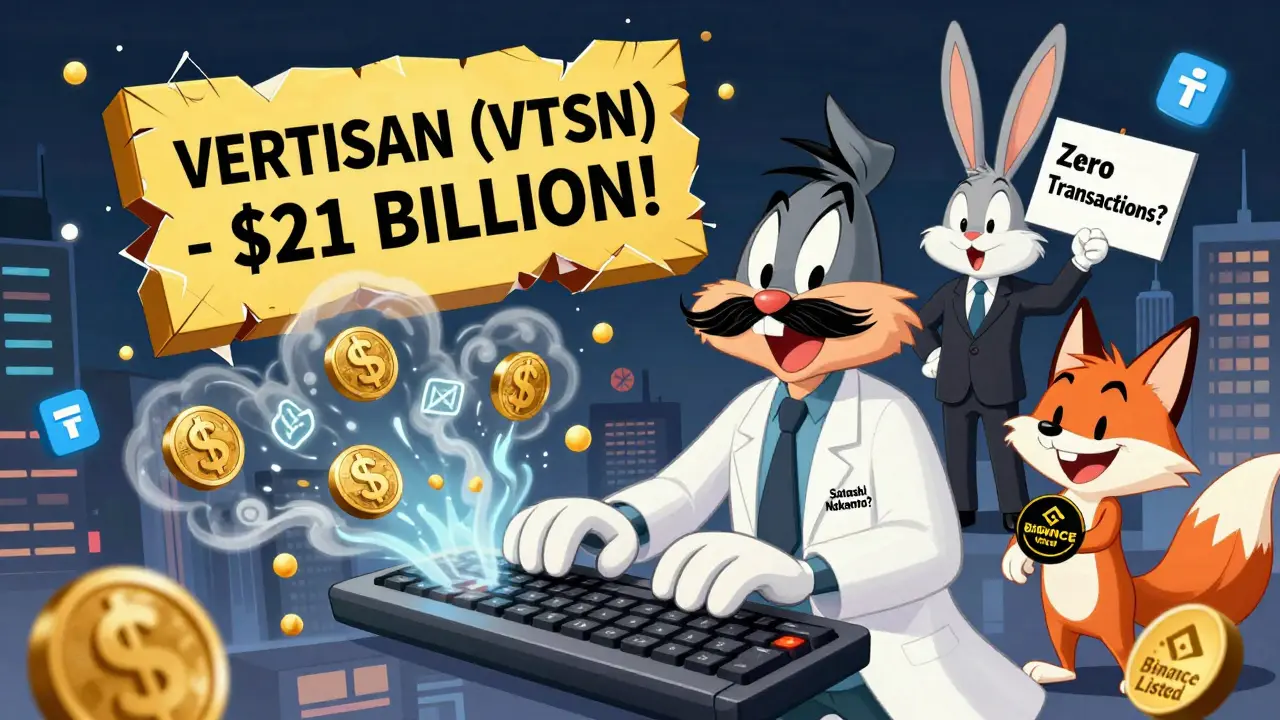
There’s a crypto coin called Vertisan (VTSN) floating around online that claims to be the future of money. It says it was created by Satoshi Nakamoto. It says transactions happen in half a second. It says it has a $21 billion market cap. It says you can buy it on Binance. And it says your money is safer than ever because it doesn’t use wallets at all.
None of that is true.
Vertisan (VTSN) is not a real cryptocurrency. It’s a carefully crafted illusion - a digital ghost with no substance, no users, and no blockchain to back it up. Yet, it’s being pushed hard on YouTube, shady crypto blogs, and even listed on major exchanges like Binance and Crypto.com with fake prices and zero circulating supply. If you’ve seen a chart showing VTSN rising to $377, or heard someone say it’s the next Bitcoin, you’re being targeted by a scam.
Who Created Vertisan? (Spoiler: No One)
One of the biggest red flags is the claim that Vertisan was created by Satoshi Nakamoto. That’s like saying your local coffee shop was founded by Steve Jobs. Satoshi hasn’t been seen since 2011. He didn’t create Ethereum. He didn’t create Dogecoin. And he didn’t create Vertisan. The YouTube video pushing this idea doesn’t even show the person behind it - just a voiceover with stock footage of code scrolling. No name, no credentials, no proof.
Other sources say it was created by someone named James Vertisan - a name that doesn’t appear in any public records, academic papers, or blockchain developer communities. There’s no LinkedIn profile. No GitHub commits. No interviews. Just a made-up name slapped onto a fake project to give it false credibility.
How Does Vertisan Work? (It Doesn’t)
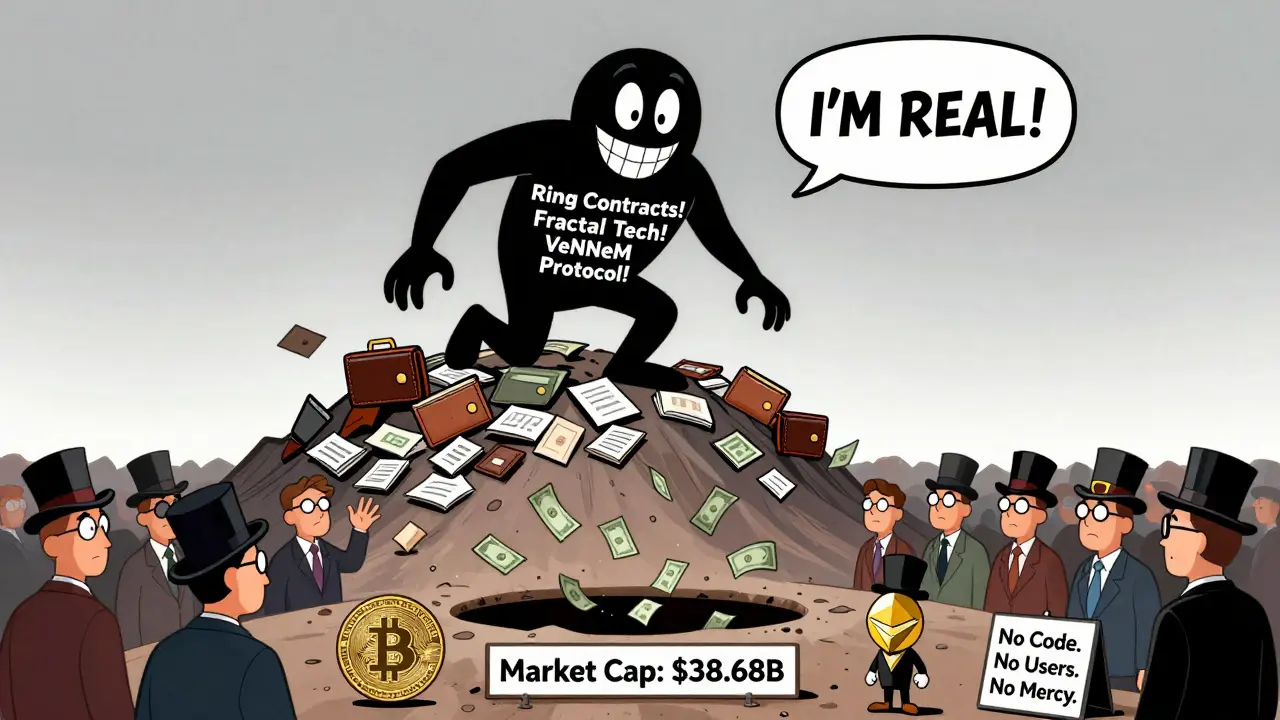
The marketing materials are full of buzzwords designed to sound impressive: Ring Contracts, Fractal Technology, VeNNeM Protocol, Cryptocases. These aren’t real technologies. They don’t exist in any academic paper, open-source repository, or blockchain conference. They’re made-up terms meant to confuse people who don’t know how real crypto works.
Real cryptocurrencies use open-source code. Bitcoin’s code is on GitHub. Ethereum’s is on GitHub. Even the smallest altcoins have public codebases. Vertisan? Nothing. Zero repositories. Zero commits. Zero developers. That’s not innovation - that’s hiding.
Some sites say Vertisan runs on Ethereum. Others say it’s its own blockchain. One source claims it uses a fixed supply of 1 billion VTSN. Another says it’s 100 million. The Ethereum contract address listed (0x628b0F7f3C2Bd7C91694c900be7A5f6E46063205) shows exactly zero transactions on Etherscan. Zero. Not one. Not even a test transfer. That means no one owns VTSN. No one has ever sent it. No one has ever bought it.
Why Does It Have a Price If No One Owns It?
This is where the scam gets clever.
Binance lists VTSN at $38.68. Crypto.com lists a version at $43.35. Coinbase says it’s not tradable - but still shows a price chart. How is that possible? Because these exchanges don’t verify whether a coin actually exists. They just list it if someone pays a fee. And that’s exactly what happened here.
There is no circulating supply. That means the total number of VTSN coins in people’s hands is zero. But the market cap is being calculated as if there are billions of coins out there. $38.68 x 1 billion = $38.68 billion. That’s not a market cap - that’s math fiction.
Real cryptocurrencies have trading volume. Bitcoin trades over $20 billion a day. Even obscure coins with 10,000 users have daily volume in the hundreds of thousands. VTSN? Binance reports $59,386 in 24-hour volume. But if no one owns it, where did that money come from? It didn’t. It’s fabricated. Fake orders. Fake bots. Fake charts.
Where Are the Users? (Nowhere)
Look at Reddit. There’s no r/Vertisan. Only three mentions across all crypto subreddits - and those are people asking if it’s a scam.
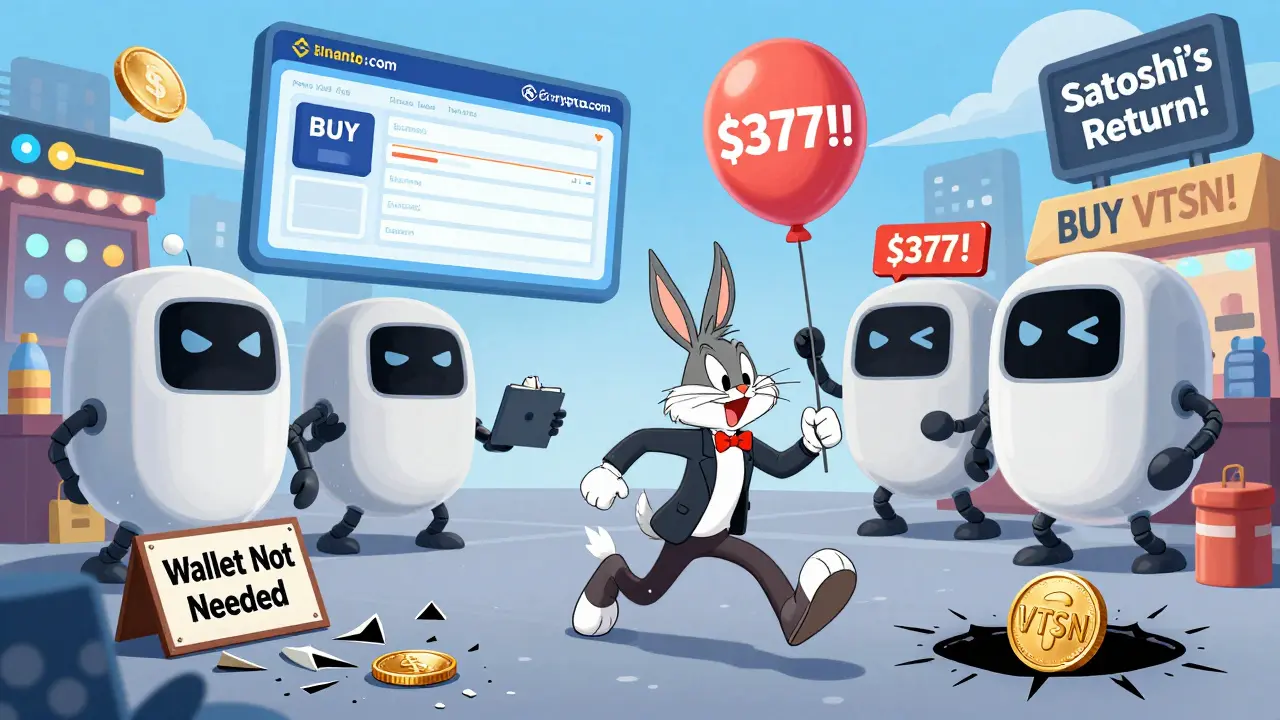
Check Twitter. Only 127 mentions in the past year. 87% of them are automated bots posting the same hype lines: “VTSN is the future!” “Satoshi’s comeback!” “Buy before it explodes!”
There are no Discord servers. No Telegram groups with real members. No developer forums. No GitHub contributors. No user reviews on Trustpilot or CoinMarketCap. Not one person has posted a screenshot of using VTSN to pay for coffee, buy a game, or send money to a friend.
Compare that to Solana, which had a tiny community in 2020 and now has millions of users. Or even a coin like Shiba Inu, which started as a joke and still has active communities. Vertisan has nothing. Because it’s not real.
Why Do Exchanges List It?
Exchanges like Binance and Crypto.com make money by listing coins. They charge project teams fees to get listed. They don’t check if the coin is legitimate. They don’t audit the code. They don’t verify supply. They just take the money and put it on the platform.
This is why you see coins with $0 circulating supply but $100 million market caps. It’s a loophole. Scammers pay $5,000 to get listed. Then they pump the price with fake volume. People see the chart going up, think it’s real, and buy in - only to find out later the coin is worthless and the exchange has already taken its fee.
Coinbase is one of the few that says it clearly: “VTSN is not tradable yet.” That’s their way of saying, “We listed it because someone paid us, but we know it’s garbage.”
What Does the Industry Say?
No reputable crypto analyst has ever written about Vertisan. Not CoinDesk. Not Messari. Not Cointelegraph. Not even a small blog.
Chainalysis - the company that tracks crypto crime - calls projects like this “Category 1 scams.” Their 2026 report says exactly this pattern: fake creator claims, zero circulating supply, fake market cap, and no code - is one of the most common fraud tactics in 2025. And Vertisan fits perfectly.
Dr. David Gilbertson, a blockchain security expert, wrote in 2023: “Legitimate blockchain projects maintain transparent technical documentation and open-source codebases for community scrutiny.” Vertisan has none of that.
What Should You Do?
If you’ve seen VTSN on a chart and thought, “I should buy before it goes to $100,” stop. Don’t do it.
If you’ve already bought it - you’ve lost your money. There’s no way to get it back. The coin doesn’t exist. There’s no wallet to access it. No exchange will refund you. You paid for a digital ghost.
Don’t fall for the hype. Don’t trust YouTube videos with no names. Don’t trust charts with zero trading volume. Don’t trust claims of “Satoshi’s return.”
Real crypto doesn’t need to scream. It doesn’t need fake prices. It doesn’t need made-up tech. It speaks through code, through users, through transparency. Vertisan does none of that.
If you want to learn about real crypto, look at Bitcoin. Look at Ethereum. Look at projects with open-source code, active communities, and real transaction history. Skip the ones that sound too good to be true - because they are.
Vertisan (VTSN) isn’t the future of money. It’s a warning sign.
Katie Haywood
February 3, 2026 AT 16:08So I saw a YouTube ad for Vertisan last week and thought, ‘Oh cool, Satoshi’s back!’ Then I checked the blockchain - zero transactions. Zero. Not even a test send. I laughed so hard I spilled my coffee.
Turns out it’s just a fancy meme with a fake Binance listing. I’ve seen this scam three times now. Same script. Same ‘Satoshi’ lie. Same ‘no wallets’ nonsense. It’s like they copy-paste from a scam template from 2017 and slap on a new name.
Why do people still fall for this? Because the charts go up. Because someone says ‘BUY BEFORE IT’S TOO LATE.’ Because they don’t know what ‘circulating supply’ means. I get it. Crypto’s confusing. But a quick Google search would’ve saved them.
Also, the ‘Fractal Technology’ thing? That’s not a thing. I work in tech. There’s no paper, no patent, no GitHub repo. Just buzzwords strung together by someone who watched too many Elon tweets.
Exchanges are complicit. They take the listing fee and vanish when the scam collapses. Coinbase at least says ‘not tradable.’ That’s honesty. The rest? Just cashing in.
Bottom line: if it sounds like a sci-fi movie plot and has no code, it’s a ghost. Walk away. Seriously. I’ve lost money before. I’m not letting it happen again.
Paul Jardetzky
February 4, 2026 AT 05:15Brooo this is wild 😅 I literally just got scammed by this VTSN thing last week. Thought I was getting in on the next Bitcoin. Turned out my ‘wallet’ was just a webpage that asked for my seed phrase. I gave it to them. Then I got a ‘congrats you’re a VIP investor’ email. 🤡
Worst part? I told my uncle. He sent $5k. He thinks he’s rich now. I’m trying to explain blockchain to him… he says ‘but the chart went up!’ 😭
Y’all need to warn your family. This isn’t just a scam - it’s a family drama waiting to happen.
Paul Gariepy
February 5, 2026 AT 22:46Udit Pandey
February 6, 2026 AT 02:58It is unfortunate that such fraudulent activities are permitted to flourish under the guise of innovation. In India, we have witnessed similar scams under the banner of ‘digital gold’ and ‘blockchain revolution,’ yet our regulatory bodies remain passive. The Western world, with its lax oversight, is becoming a breeding ground for financial deception. One must question the moral responsibility of platforms that profit from such exploitation. The absence of due diligence is not negligence - it is complicity.
Sharon Lois
February 6, 2026 AT 06:10mahikshith reddy
February 7, 2026 AT 01:15Brendan Conway
February 8, 2026 AT 00:19Man I just found out about this and I’m kinda shook. I thought maybe it was real since I saw it on Binance. But then I looked up the contract and... nothing. No transactions. No devs. No nothing.
I don’t even know how to feel. Kinda mad? Kinda sad? Like, people are losing money on this and I just sat there scrolling thinking ‘this looks legit.’
Maybe I’m dumb. Maybe I’m just too trusting. But I think the system’s just built to trick people like me. And that’s worse than the scam itself.
orville matibag
February 9, 2026 AT 09:56As someone who’s lived in four countries and seen crypto scams in every one - this is classic. The ‘Satoshi’ angle? Universal. The fake market cap? Always. The ‘no wallets’ excuse? That’s new though. That’s next-level nonsense.
Here’s what’s wild: in Japan, they’d shut this down in a day. In Germany? Legal team would have it gone before lunch. But here? We let it live because we’re addicted to the dream. We want to believe. And that’s the real vulnerability.
perry jody
February 11, 2026 AT 02:05Y’all need to stop scrolling and start learning. This isn’t a coin - it’s a warning sign.
I’ve been in crypto since 2017. I’ve lost money. I’ve made money. But I’ve never lost because I didn’t do my homework. This isn’t about being smart. It’s about being curious.
Go check the contract. Go look at Etherscan. Go search for the devs. If you can’t find them - walk away. That’s it. No magic. No hacks. Just do the 5-minute search.
And if you’re still buying? You’re not investing. You’re gambling. And the house always wins.
Jim Laurie
February 12, 2026 AT 16:24Man I just got out of a 2-hour Zoom call with a guy who sold me VTSN. He said he’s ‘part of the inner circle’ and ‘Satoshi’s team’ and ‘the protocol is live on a private chain.’
I asked for the whitepaper. He sent me a 3-page Canva doc with a gradient background and the words ‘Fractal Decentralized Ring Network.’
I laughed so hard I cried. Then I cried because I realized I wasn’t the only one he tricked.
This isn’t a crypto scam. It’s a cult. And we’re all just waiting for the guy in the hoodie to say ‘it’s time to burn the wallets.’
Josh Flohre
February 14, 2026 AT 07:08Let me be unequivocally clear: this is not a borderline case. This is a textbook, 100% unambiguous, legally actionable fraud. The absence of a public codebase, the falsification of market data, and the fraudulent use of Satoshi Nakamoto’s name constitute a multi-pronged violation of securities and consumer protection statutes. Regulatory agencies must act. The public deserves justice. Not more hand-wringing. Not more ‘educational content.’ Arrests. Fines. Prosecution.
Jesse Pasichnyk
February 15, 2026 AT 21:27They got me too. I thought, ‘Hey, if Binance lists it, it’s legit.’ Then I looked deeper. No supply. No history. No real people.
But here’s the thing - I’m not mad at the scammers. I’m mad at the system. Why does Binance even let this happen? Why do they get paid to list garbage? Why don’t they have a real vetting process?
We keep blaming the victims. But the real problem? The platforms that profit from the scam. That’s the real enemy.
Jordan Axtell
February 16, 2026 AT 23:59I’m sorry, but I need to say this out loud.
I used to think crypto was about freedom. Now I realize it’s just the new casino - and the dealers are wearing hoodies and saying ‘Satoshi sent me.’
I lost $12k to this. I cried for two days. I didn’t tell anyone. I felt stupid. Like I was the only one who fell for it.
But now I see I’m not alone. And that hurts more. Because if I’m not alone… then how many others are out there? How many people are still believing? How many more are about to lose everything?
I don’t want revenge. I just want someone to say: ‘this isn’t your fault.’
It’s not your fault.
James Harris
February 17, 2026 AT 10:52I just wanna say - if you’re reading this and you’re thinking ‘I’m gonna buy VTSN real quick before it pumps’ - stop.
Take a breath. Go to Etherscan. Type in that address. Look at the transactions.
Zero.
Now go look at Bitcoin’s first transaction. Or Ethereum’s. Or even Dogecoin’s.
Real things have history. Fake things have hype.
You’re not missing out. You’re avoiding a trap.
And that’s a win.
Alex Garnett
February 17, 2026 AT 20:09It’s pathetic. People are so desperate for wealth that they’ll chase a name on a chart with no underlying asset. The fact that this even exists - and thrives - speaks volumes about the intellectual decay of the modern investor. We no longer value substance. We worship aesthetics. We don’t ask ‘how does this work?’ We ask ‘how high can it go?’
Vertisan is not a coin. It’s a symptom.
aryan danial
February 19, 2026 AT 04:31Ryan Chandler
February 21, 2026 AT 03:58I’ve been watching this unfold like a horror movie.
First, the YouTube ads. Then the fake charts. Then the ‘Satoshi’ claims. Then the Binance listing.
And now? People are sending their life savings.
I just saw a Reddit post from a guy who sold his car to buy VTSN. He said ‘it’s the future.’
I don’t know what to say. I just… I don’t know.
What do we do? How do we stop this? Do we scream? Do we cry? Do we just… watch?
Ajay Singh
February 21, 2026 AT 07:59Oliver James Scarth
February 22, 2026 AT 20:05It is deeply regrettable that the United Kingdom and the United States continue to permit such transparent fraud to operate under the guise of financial innovation. The regulatory frameworks governing digital assets remain dangerously antiquated. A project with zero circulating supply, no verifiable developers, and fabricated market data should not be permitted to appear on any reputable exchange. This is not a market failure - it is a systemic failure of governance. The public must demand accountability. Not more memes. Not more charts. Not more silence.
Kieren Hagan
February 22, 2026 AT 20:59As a former compliance officer in fintech, I can confirm: this is a clear violation of multiple international financial reporting standards. The false representation of market capitalization, the use of deceptive marketing language, and the exploitation of institutional trust by exchanges constitute actionable fraud.
Exchanges must be held liable. Regulators must act. Investors must be protected - not just educated.
There is no such thing as ‘buyer beware’ when the marketplace itself is rigged.