
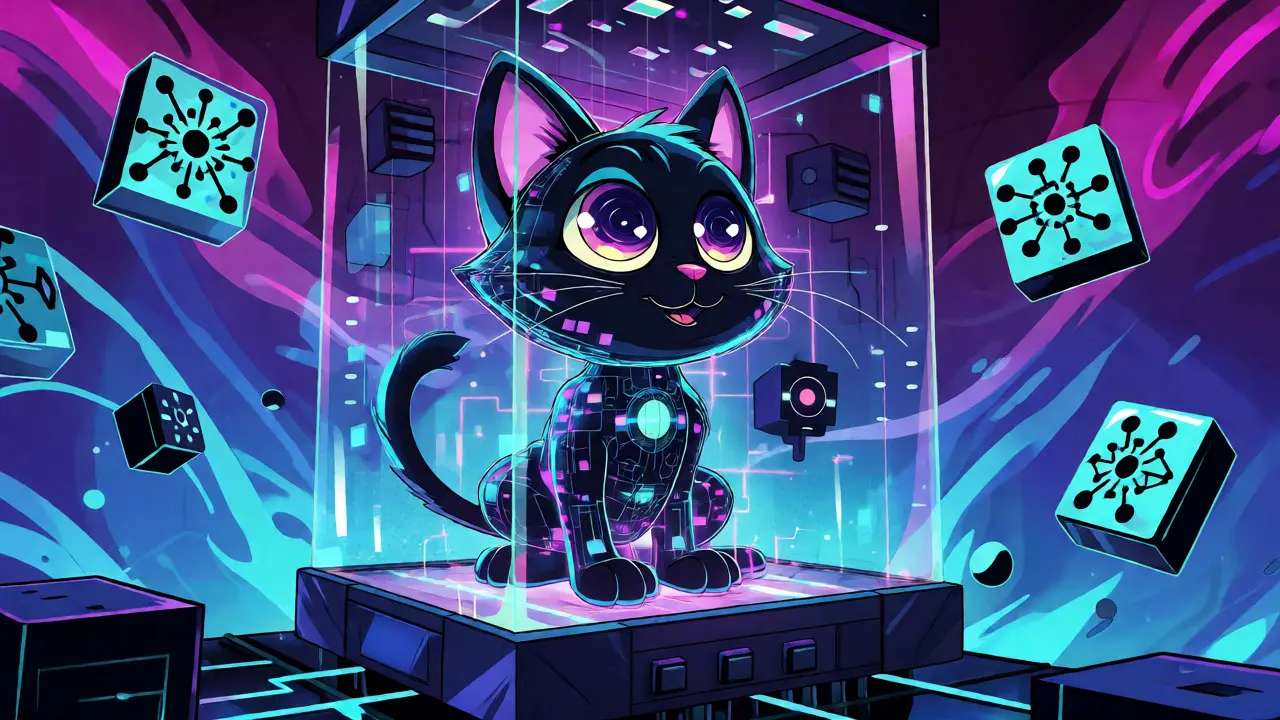
Imagine a digital asset that isn't just a static picture but a living entity that evolves based on how you interact with it. That’s the core promise behind Schrödinger (SGR), a cryptocurrency token that serves as the fuel for the Schrödinger's Cat Project. If you've been scrolling through your feed and wondering why a coin named after a famous physics thought experiment is popping up in niche crypto circles, you're not alone. It sits at the messy, exciting intersection of Non-Fungible Tokens (NFTs), Artificial Intelligence, and decentralized finance.
But here is the kicker: despite its ambitious tech stack, SGR has struggled to maintain momentum since its launch in early 2024. Is it a hidden gem waiting for the next AI-NFT bull run, or just another experimental token fading into obscurity? Let's break down exactly what this coin does, how it works under the hood, and whether it holds any real value today.
The Core Concept: Dynamic NFTs Powered by AI
Most NFTs are static. You buy a JPEG, it stays the same forever unless the artist manually updates it. The Schrödinger's Cat Project challenges this status quo. It uses AI-driven mechanics to create dynamic, evolving digital assets. Think of it less like buying a painting and more like adopting a digital pet that changes its appearance and behavior based on market conditions, community interactions, or specific algorithmic triggers.
The project claims to "transcend the limitations of static digital art." How? By integrating artificial intelligence directly into the smart contracts governing these NFTs. This means the "cats" in the collection aren't just random images; they have emergent properties. They can evolve, react, and potentially even die or transform depending on user actions and network activity. This blurs the line between gaming, art, and investment, creating a new category often referred to as "dynamic NFTs."
Technical Deep Dive: ERC-20 Meets ERC-404
If you look at the technical specs, things get a bit murky, which is common in experimental crypto projects. Officially, SGR operates as an ERC-20 token on the Ethereum blockchain. Its contract address is 0x478156DeAbfAc918369044D52A6BdB5Cc5597994, and it features 8 decimal places. However, data aggregators like CoinMarketCap describe it using an "experimental ACS-404" standard. What does that mean for you?
It suggests the token is trying to bridge the gap between fungible tokens (like Bitcoin or USDT, where every unit is identical) and non-fungible tokens (like unique artwork). The ERC-404 standard is a relatively new concept that allows a single token to behave as both. You can split your NFTs into fractional shares (making them liquid like stocks) or recombine those shares back into a unique NFT. This hybrid approach aims to solve two major problems in the NFT space: lack of liquidity and high barriers to entry.
| Attribute | Detail |
|---|---|
| Token Type | Hybrid (ERC-20 / Experimental ACS-404) |
| Blockchain | Ethereum Mainnet |
| Total Supply | 21,000,000 SGR |
| Launch Date | March 5, 2024 |
| Key Feature | Fractional Ownership & AI Evolution |
Utility: What Can You Actually Do With SGR?
A coin without utility is just speculation. So, what do you use SGR for? The token acts as the primary currency within the Schrödinger ecosystem. Here are the three main functions:
- Minting Cats: Users spend SGR to mint new "cat" NFTs from the collection. This creates demand for the token whenever users want to join the ecosystem.
- Evolution Mechanics: To make your NFT cat evolve or change its state, you likely need to burn or spend SGR. This introduces a deflationary pressure if the mechanism involves burning.
- Undo Functionality: One of the more unique selling points is an "undo" feature. In traditional blockchain transactions, mistakes are permanent. The project claims to allow users to revert certain NFT actions, like accidental mints or trades, using SGR as a fee for this convenience.
This utility model tries to incentivize holding the token rather than just flipping it immediately after launch. However, the effectiveness of this loop depends entirely on active user engagement. If people stop minting or evolving cats, the demand for SGR drops rapidly.
Market Performance: A Volatile Ride
Let's talk numbers, because this is where the story gets sobering. SGR launched with significant hype during its Initial Exchange Offering (IEO) in March 2024. It raised roughly $53,350 at a price of $0.508 per token. Early investors hoped for a moonshot.
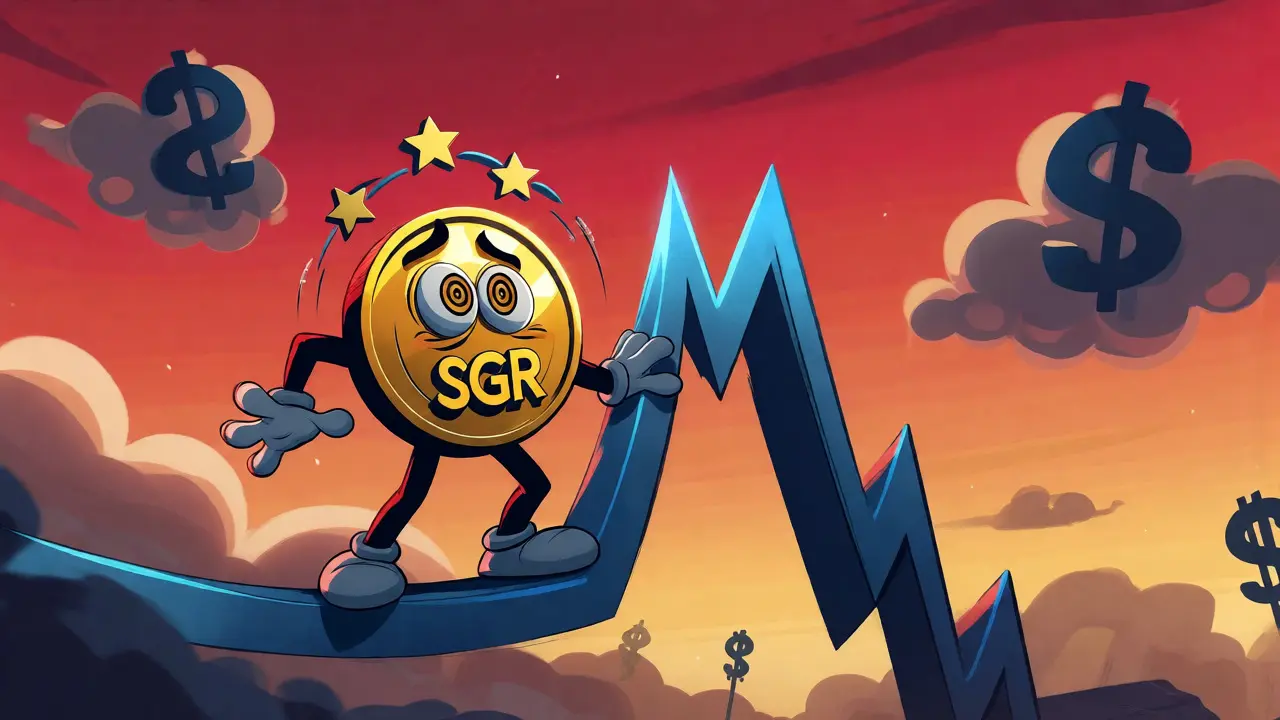
For a brief moment, it looked promising. On March 20, 2024, SGR hit an all-time high (ATH) of approximately $3.70. But almost immediately, it crashed. On that very same day, it recorded an all-time low of around $0.22. This extreme intraday volatility highlights the speculative nature of the asset. As of late 2026, the price hovers around $0.30 to $0.33 USD. This represents a decline of over 90% from its peak and a slight loss compared to its initial offering price.
Market capitalization estimates vary wildly across tracking platforms due to low trading volumes and inconsistent circulating supply data. Some sources report a market cap near $600,000, while others suggest figures closer to $9 million. This discrepancy usually indicates that most tokens are locked, vested, or simply not being traded actively. The 24-hour trading volume is often below $20,000, which signals thin liquidity. If you try to sell a large amount of SGR quickly, you might face significant slippage.
Risks and Challenges for Investors
If you are considering buying SGR, you need to weigh the innovative tech against serious risks. First, the project is still in its infancy. While the vision of a platform for AI-powered dynamic NFTs is compelling, concrete evidence of mass adoption is missing. There are few major partnerships or developer milestones documented publicly since the launch.
Second, the competition is fierce. Other projects are also experimenting with ERC-404 standards and AI integration. Without a strong brand moat or exclusive IP, SGR could easily be overshadowed by larger competitors with bigger marketing budgets.
Third, regulatory uncertainty looms over all hybrid tokens. Because SGR blends characteristics of securities-like fractional ownership with utility tokens, regulators could scrutinize its classification differently than pure ERC-20 tokens. Finally, the team's transparency regarding long-term roadmaps remains a point of concern for many analysts who prefer detailed public development logs.
Future Outlook: Can SGR Survive?
Predictions for SGR are all over the place. Some algorithms forecast a recovery to nearly $1.00 by the end of 2026, driven by potential renewed interest in AI-NFT hybrids. Others predict continued stagnation or further decline if the project fails to deliver on its roadmap promises.
The key to survival lies in execution. Does the AI actually work well? Are the NFTs genuinely fun or engaging to own? If the "evolution" mechanic feels gimmicky rather than substantive, users will leave. For now, SGR remains a high-risk, high-reward play for those who believe that static NFTs are dead and dynamic, interactive assets are the future.
Is Schrödinger (SGR) an ERC-20 or ERC-721 token?
SGR is primarily classified as an ERC-20 token on the Ethereum blockchain. However, it utilizes experimental standards (often cited as ACS-404) that allow it to interact with NFT functionality, effectively bridging the gap between fungible and non-fungible assets.
What is the total supply of SGR coins?
The total fixed supply of Schrödinger (SGR) is 21,000,000 tokens. Not all of these are currently in circulation, which affects the market cap calculations across different data providers.
How does the AI feature work in the Schrödinger project?
The AI component drives the "evolution" of the NFT cats. Instead of remaining static, the NFTs change their attributes or visual traits based on algorithms, user interactions, and possibly external data feeds, making them dynamic digital assets.
Where can I buy SGR tokens?
SGR is traded on smaller decentralized exchanges (DEXs) and select centralized exchanges that support niche altcoins. Due to low liquidity, always check the order book depth before placing large orders to avoid high slippage.
Why did SGR price drop so much after launch?
Like many meme-adjacent or experimental launches in early 2024, SGR experienced massive volatility. After hitting an all-time high shortly after its IEO, profit-taking and low sustained demand led to a sharp correction, dropping the price significantly from its peak.