
The term Mooncat (MOONCAT) isn’t just one cryptocurrency-it’s two very different projects that share a name but nothing else. If you’ve seen MOONCAT pop up on CoinGecko or a crypto forum and wondered if it’s worth your time, you’re not alone. Most people assume it’s a single coin, but the truth is messier. One version is tied to a historic NFT collection with real technical innovation. The other? A low-volume meme coin with almost no utility. Knowing the difference isn’t just helpful-it could save you from losing money.
The Ethereum version: MOONCAT as an NFT liquidity token
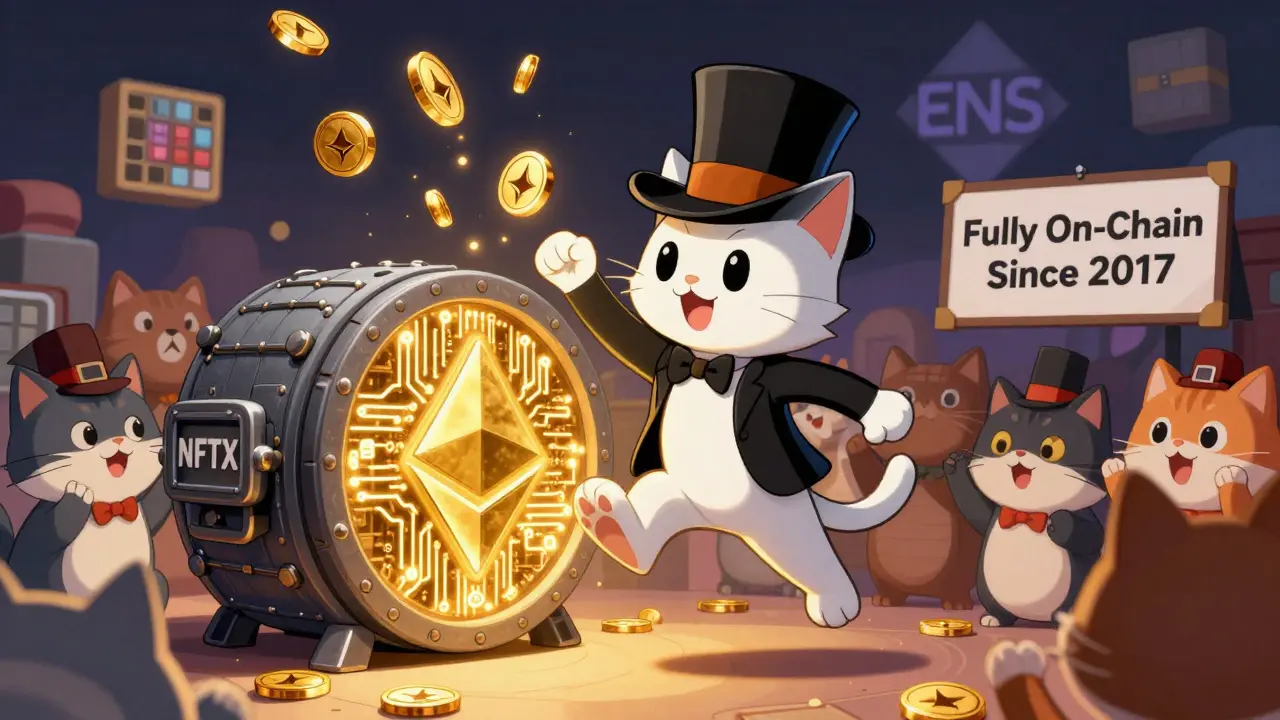
The original and far more significant MOONCAT token is built on Ethereum and acts as a vault token for the MoonCats NFT collection. It doesn’t exist on its own. Instead, it represents fractional ownership of MoonCats NFTs locked inside an NFTX vault. Think of it like this: if you own a rare collectible toy but can’t easily sell it, you deposit it into a box (the vault) and get a receipt (the MOONCAT token) that you can trade on exchanges. That’s exactly what this token does.
MoonCats themselves are one of the earliest on-chain NFT projects, launched in May 2017 by the team behind Ethereum Name Service (ENS). Unlike most NFTs that rely on external servers to store images, MoonCats are fully generated on the blockchain. Each cat’s unique look-its fur pattern, eye shape, hat, and color-is calculated from a string of data stored directly on Ethereum. No centralized server. No broken links. Even today, if you know a MoonCat’s token ID, you can rebuild its image from scratch using just the blockchain data. That’s rare, and it’s why collectors value them.
The MOONCAT token was created in July 2021 when NFTX launched its second version of vaults. Users deposit one or more MoonCats NFTs into the vault and receive MOONCAT tokens in return. These tokens can then be traded, lent, or used in DeFi protocols. Each MOONCAT token represents a share of the entire MoonCats collection, not a single NFT. The vault charges a 0.5% fee on deposits and withdrawals, which goes to token holders as a reward. As of late 2023, the vault holds over 2,100 MoonCats NFTs, with the token trading around $0.002 per unit and a market cap near $2.3 million.
The Solana version: Just another meme coin
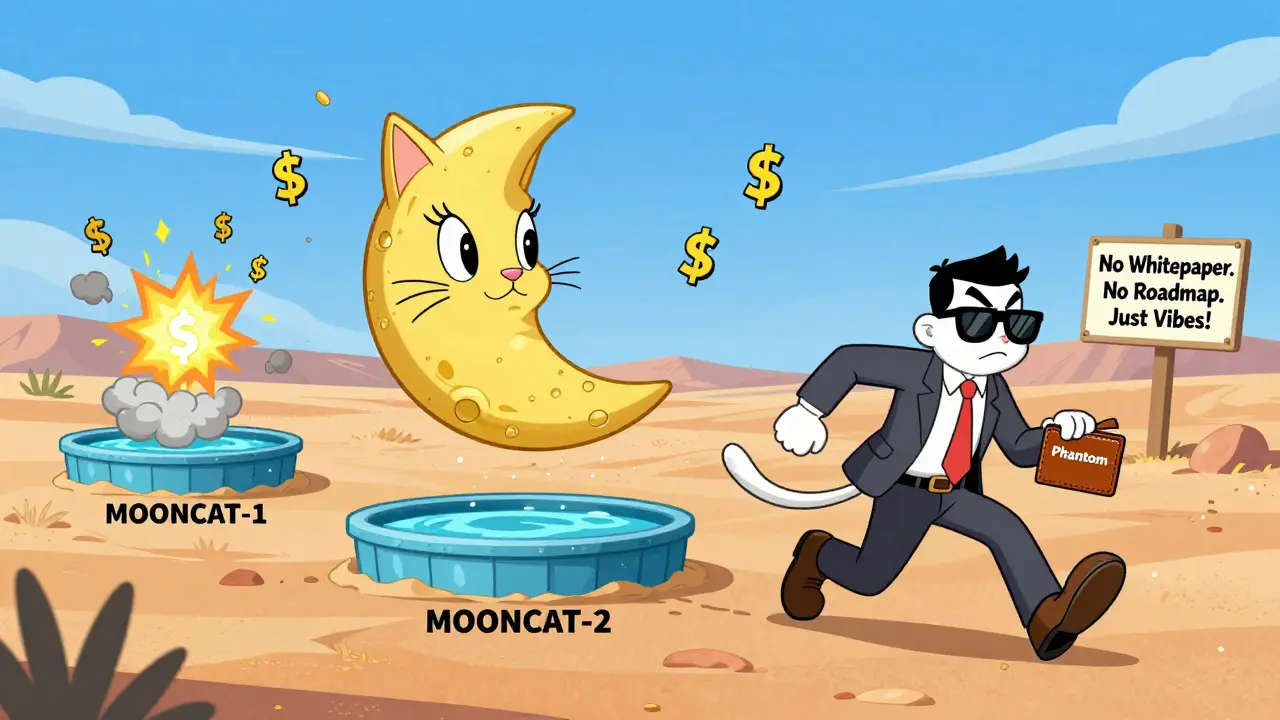
Meanwhile, on Solana, there’s a completely separate token also called MOONCAT. It has no connection to the Ethereum MoonCats NFTs. Its contract address is FNP2Dw2GU5wPBZgVCcerbEemV9dVfvQrThEor1jmoon. It’s marketed as a "digital collectible" with no real utility beyond speculation. There’s no NFT backing, no vault, no historical significance. It’s a classic meme coin-named after the popular "moon" crypto slang, hoping to ride hype.
Its price is erratic, trading volume is tiny, and it has almost no community. Unlike the Ethereum version, which has a 12,500-member Discord and detailed documentation, the Solana version has barely any public resources. Analysts like Wendy O have called it out directly: "Another generic Solana meme coin using popular terminology-extreme caution advised." In fact, 92% of tokens like this disappear within six months. If you’re seeing it on a decentralized exchange with no whitepaper or roadmap, walk away.
Why the confusion? And why it matters
The name overlap is intentional chaos. The Ethereum MOONCAT benefits from the MoonCats NFT brand’s reputation. The Solana version piggybacks on that recognition to attract unsuspecting traders. You’ll find both on CoinGecko, CoinMarketCap, and even some wallets. But they’re not interchangeable. If you’re trying to trade your MoonCats NFTs for liquidity, you need the Ethereum version. If you’re just buying a token because it sounds cool, you’re probably getting the Solana one-and that’s a gamble.
Real users of the Ethereum MOONCAT token say it saved them during the 2022 NFT bear market. One Reddit user wrote: "Used MOONCAT tokens to provide liquidity when NFTs weren’t moving-saved me from having to dump my MoonCats at fire sale prices." That’s real utility. Meanwhile, users of the Solana version report losing money to scams. One forum user described finding three different liquidity pools with the same name, one of which vanished with $8,000 in just two days.
Who should care about MOONCAT?
If you own MoonCats NFTs and want to unlock value without selling your assets, the Ethereum MOONCAT token is worth exploring. It’s not a get-rich-quick scheme. It’s a tool for NFT holders who want flexibility. But it’s complex. You need MetaMask, ETH for gas fees, and a willingness to learn how NFTX vaults work. DeFi Education Project estimates it takes 8-10 hours of study to understand the system fully.
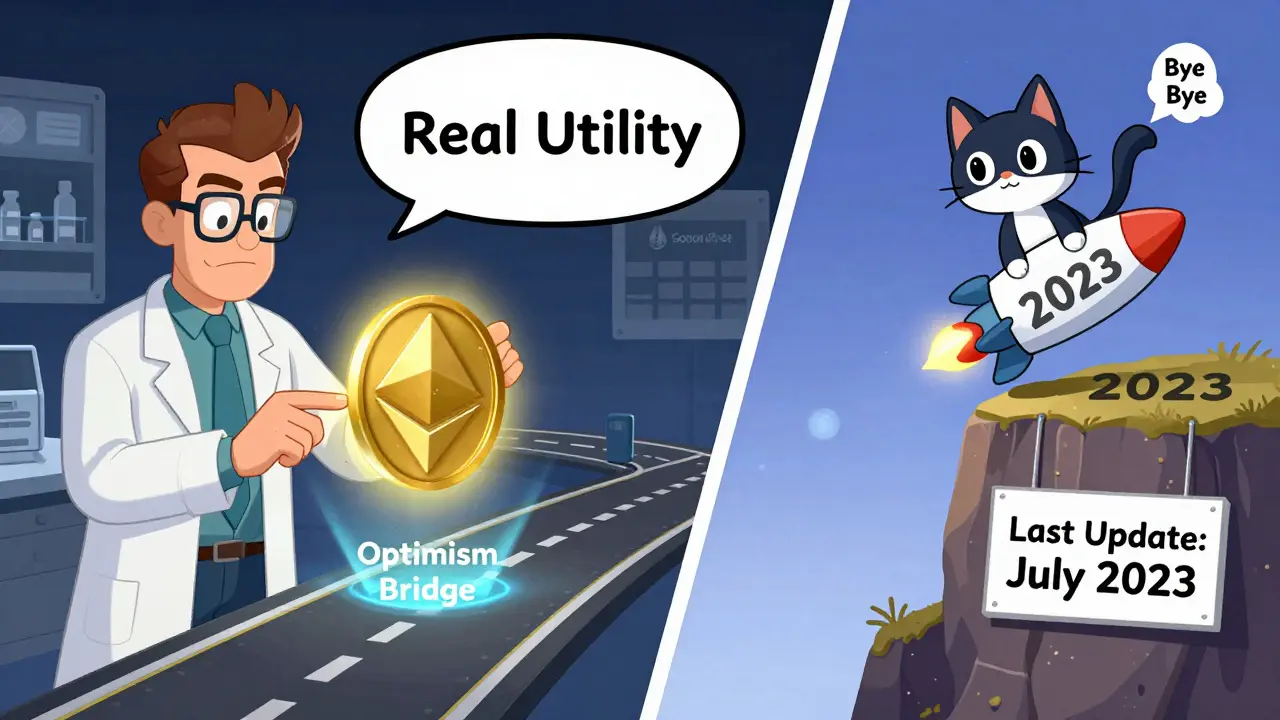
If you’re a casual trader looking for the next 100x, avoid the Solana version. It has no roadmap, no team updates, and no real community. It’s a coin with a name, not a project. The Ethereum version has a chance. It’s backed by a historic NFT collection, has a working bridge to Optimism planned for early 2024 to cut gas fees, and is still actively maintained. The Solana version? Its last GitHub update was in July 2023-and it was just a basic token deployment script.
The bigger picture: NFT-backed tokens are struggling
Mooncat isn’t unique in its challenges. The entire category of NFT-backed tokens is under pressure. The NFT market dropped from $24.9 billion in 2022 to $11.3 billion in 2023. Tokens like MOONCAT, which rely on NFT prices to hold value, suffer when collectors pull back. The MOONCAT token’s price fell 73% between its 2021 peak and late 2023, mirroring the collapse of similar vault tokens like SHARK (for Cool Cats NFTs).
Experts are divided. David Hoffman from The Long podcast praises MoonCats’ technical innovation as "one of the few truly on-chain NFT projects that survived the 2018 bear market." But Nansen analyst Matthew Graham warns: "Vault tokens for mid-tier NFT collections create artificial liquidity without solving fundamental valuation issues." The truth? MOONCAT only has value if MoonCats NFTs have value. And right now, those NFTs trade for 0.2-1.5 ETH each-far below the 55 ETH average for CryptoPunks.
What’s next?
The Ethereum MOONCAT token has a clear path forward: the Optimism bridge launching in Q1 2024 will make vault interactions cheaper and faster. That’s a real upgrade. The Solana version has no announced updates, no community-driven development, and no roadmap. If you’re looking at MOONCAT in 2026, focus on the Ethereum version. Ignore the Solana one unless you’re prepared to lose your entire investment.
The lesson here isn’t about MOONCAT specifically. It’s about crypto names. The same name can mean two totally different things. Always check the contract address. Always verify the blockchain. Always ask: "What is this actually for?" If the answer is "it’s a meme," walk away.
Is Mooncat (MOONCAT) a good investment?
It depends on which version you mean. The Ethereum-based MOONCAT token isn’t a speculative asset-it’s a liquidity tool for MoonCats NFT holders. If you own MoonCats and want to unlock value without selling, it can be useful. But it won’t make you rich. The Solana version is a meme coin with no utility and extremely high risk. 89% of similar tokens become worthless within 18 months. Avoid it unless you’re gambling intentionally.
How do I buy MOONCAT tokens?
For the Ethereum version, you need a wallet like MetaMask, some ETH for gas, and access to an exchange that lists MOONCAT (like Uniswap or SushiSwap). You can also get it by depositing MoonCats NFTs into the NFTX vault. For the Solana version, use Phantom wallet and buy it on Solana-based DEXs like Raydium or Jupiter. But again-only do this if you know you’re buying the Solana token and understand the risk.
Are MoonCats NFTs still valuable?
Yes, but not like they were in 2021. MoonCats NFTs now trade between 0.2 and 1.5 ETH, down from peaks of 15 ETH. Their value comes from historical significance-they’re among the first fully on-chain NFTs. Collectors still buy them for their tech legacy, not for speculative gains. If you’re buying them, treat them as digital artifacts, not investments.
Can I convert my MoonCats NFTs into MOONCAT tokens?
Yes, through the NFTX vault. You deposit your MoonCats NFTs into the vault, and it mints MOONCAT tokens proportional to the collection’s total value. You can later burn those tokens to withdraw your NFTs. This lets you trade liquidity without selling your original assets. But be warned: gas fees on Ethereum can be high, and the process requires understanding smart contracts.
Why does MOONCAT have two different prices on different sites?
Because there are two different tokens. CoinGecko and CoinMarketCap list both versions separately, but many users don’t realize they’re different. The Ethereum MOONCAT trades around $0.002-$0.003. The Solana version trades around $0.0001-$0.0005. Always check the contract address before buying. The Ethereum one is 0x5b5a4a37d4b8e2b1e4b3c5e4d6f7a8b9c0d1e2f3. The Solana one is FNP2Dw2GU5wPBZgVCcerbEemV9dVfvQrThEor1jmoon.
Lucy Simmonds
February 23, 2026 AT 01:52Maggie House
February 23, 2026 AT 08:26Dana Sikand
February 24, 2026 AT 06:43Cameron Pearce Macfarlane
February 25, 2026 AT 13:18Elizabeth Smith
February 26, 2026 AT 14:35Robert Kromberg
February 28, 2026 AT 02:59Daisy Boliaan
March 1, 2026 AT 09:39Nicki Casey
March 2, 2026 AT 15:17Jessica Carvajal montiel
March 4, 2026 AT 06:36Sean Logue
March 4, 2026 AT 10:44Carl Gaard
March 4, 2026 AT 14:53bella gonzales
March 5, 2026 AT 17:25Paul Reinhart
March 7, 2026 AT 08:20Samantha Stultz
March 7, 2026 AT 12:20Robert Conmy
March 8, 2026 AT 06:34Lilly Markou
March 8, 2026 AT 21:03McKenna Becker
March 9, 2026 AT 11:10Lucy Simmonds
March 10, 2026 AT 08:36