
Lumi Finance Slippage Calculator
Based on Lumi Finance's reported $700 daily liquidity (Sep 2023)
Note: This simulates real-world conditions from Lumi Finance's September 2023 data. Actual slippage may vary based on market conditions.
Lumi Finance (LUA) isn’t another meme coin or speculative token chasing hype. It’s a crypto project built around a single, bold promise: your investment won’t vanish. Unlike Bitcoin or Ethereum, where prices can crash 80% overnight, Lumi Finance claims to guarantee a minimum floor price for its LUA token. That’s the hook. But is it real, or just clever marketing dressed up as innovation?
How Lumi Finance Claims to Protect Your Money
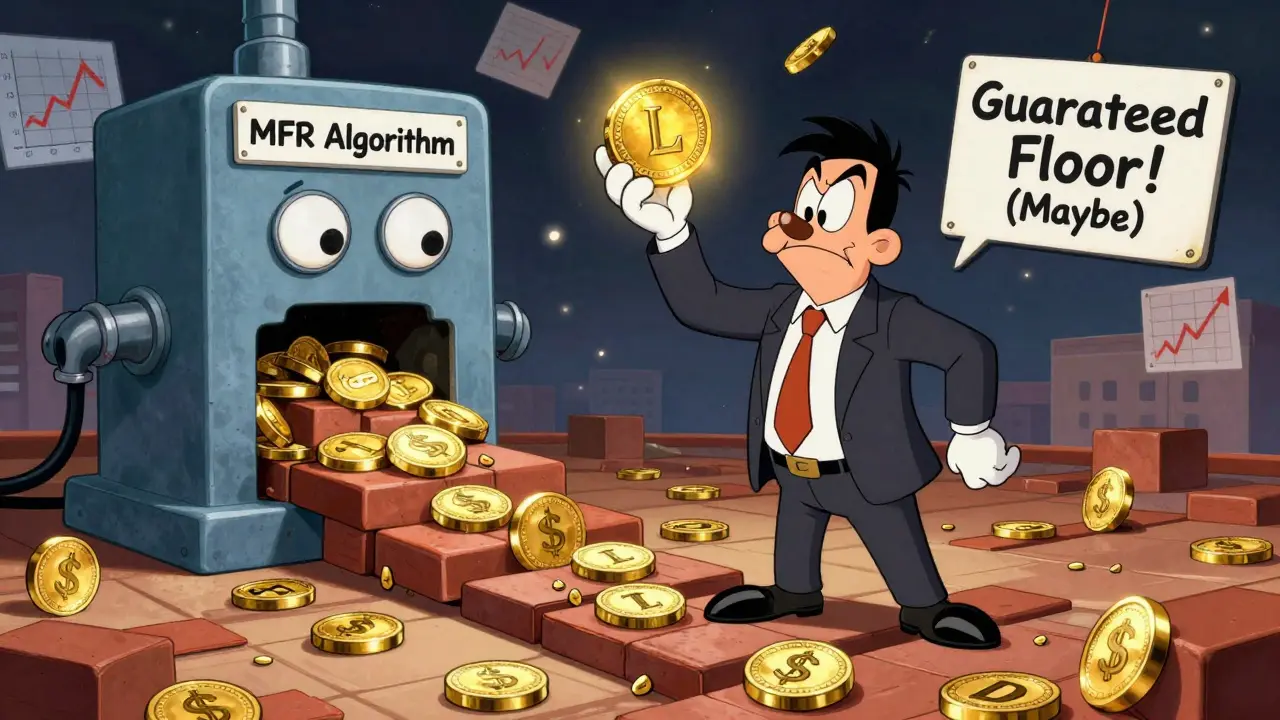
Lumi Finance launched in March 2022 with a system called the MFR (Minimum Floor Reserve) Algorithm. At its core, it works like this: every time someone buys LUA, the protocol uses stablecoins-like USDC, DAI, or USDT-to buy and hold more LUA tokens in a reserve. This reserve isn’t just sitting idle. It’s used to back the token’s minimum value. If the price of LUA starts dropping, the protocol automatically steps in to support it by buying back tokens from the market, keeping the floor price from falling below a certain level.
This isn’t the same as an algorithmic stablecoin like Frax, which tries to stay pegged to $1. Lumi Finance doesn’t care about keeping LUA at $3.12. It just says: no matter what, your LUA token will never be worth less than X dollars. And that floor price? It actually goes up over time as more people buy in. The more demand, the higher the floor. That’s the “unbounded financial expansion” part they talk about. It sounds like insurance for your crypto portfolio.
The Mechanics: Staking, Options, and Smart Contracts
If you hold LUA, you can stake it. But here’s where it gets unusual. Staking doesn’t just earn you more LUA. It gives you LUA Option tokens. These aren’t regular yield tokens. They’re like call options with strike prices that shift based on market conditions. If the price of LUA rises, your option’s strike price rises too. That means you can potentially sell your options at a profit even if the main token doesn’t move much.
Technically, LUA runs as an ERC-20 token on Ethereum. That means you need a wallet like MetaMask to interact with it. You won’t find it on Coinbase or Binance. You have to use decentralized exchanges like De.Fi or Uniswap. That’s already a barrier for most people. You need to understand slippage, gas fees, and how AMMs (Automated Market Makers) work. For beginners, it’s a steep climb.
Numbers Don’t Lie: Liquidity Is the Big Problem
Let’s talk numbers. As of September 2023, the total supply of LUA is just under 2.3 million tokens. But only about 1.75 million are circulating. That’s fine. The real issue? Trading volume. On some days, the 24-hour volume was under $700. Compare that to Uniswap, which trades over $1 billion daily. That’s a 1.4 million times difference.
What does that mean for you? If you try to buy or sell LUA, you’ll likely face massive slippage. One Reddit user reported needing to set slippage tolerance at 15% just to get a trade to go through. That means if you think you’re buying at $3.12, you might end up paying $3.59. Sell? You might get $2.65 instead of $3.12. That’s not trading. That’s gambling on the price moving in your favor before the market eats your order.

Who’s Behind It? And Why It Matters
Lumi Finance has no public team. No LinkedIn profiles. No Twitter handles tied to real names. The website is lumi.finance, the docs are on GitBook, and that’s it. No whitepaper signed by a founder. No interviews. No roadmap updates from a CEO. In crypto, anonymity isn’t always bad-but when you’re promising guaranteed price floors backed by reserves, transparency becomes non-negotiable.
There’s been no independent security audit published. No proof-of-reserves. No public ledger showing exactly how many USDC or DAI are locked in the reserve. Dr. Elena Rodriguez from the University of Zurich called this a “significant concern.” Without knowing what’s backing your floor price, you’re trusting code and promises-not assets.
Real User Experiences: Relief or Regret?
Some users swear by it. One Bitcointalk poster said they held through the June 2023 crypto crash while Bitcoin dropped 25%. Their LUA only lost 8%. That’s the dream. But the reality? Most reviews on Trustpilot and Reddit are negative. “Impossible to sell without massive slippage,” one user wrote. “Customer support never responds,” said another.
Telegram has under 2,000 members. Twitter has around 2,300 followers. That’s not a community. That’s a whisper. For a project claiming to be the future of risk-free crypto, that’s alarmingly quiet. The sentiment on LunarCrush shows more negative than positive. People aren’t just skeptical-they’re frustrated.
Is Lumi Finance Right for You?
If you’re looking for a high-growth crypto play, walk away. Lumi Finance isn’t designed to make you rich fast. It’s designed to help you avoid being wiped out. That’s valuable-if it works.
But here’s the catch: it only works if the reserve holds up. What happens if the price of stablecoins like USDC depegs? What if the protocol can’t keep buying back LUA during a prolonged bear market? The reserve could run dry. Then the floor disappears. And you’re left holding a token with no backing, no liquidity, and no buyers.
It’s like buying a life insurance policy from a company with no assets. The promise is good. But can they pay when you need it?
The Road Ahead: Hope or Hype?
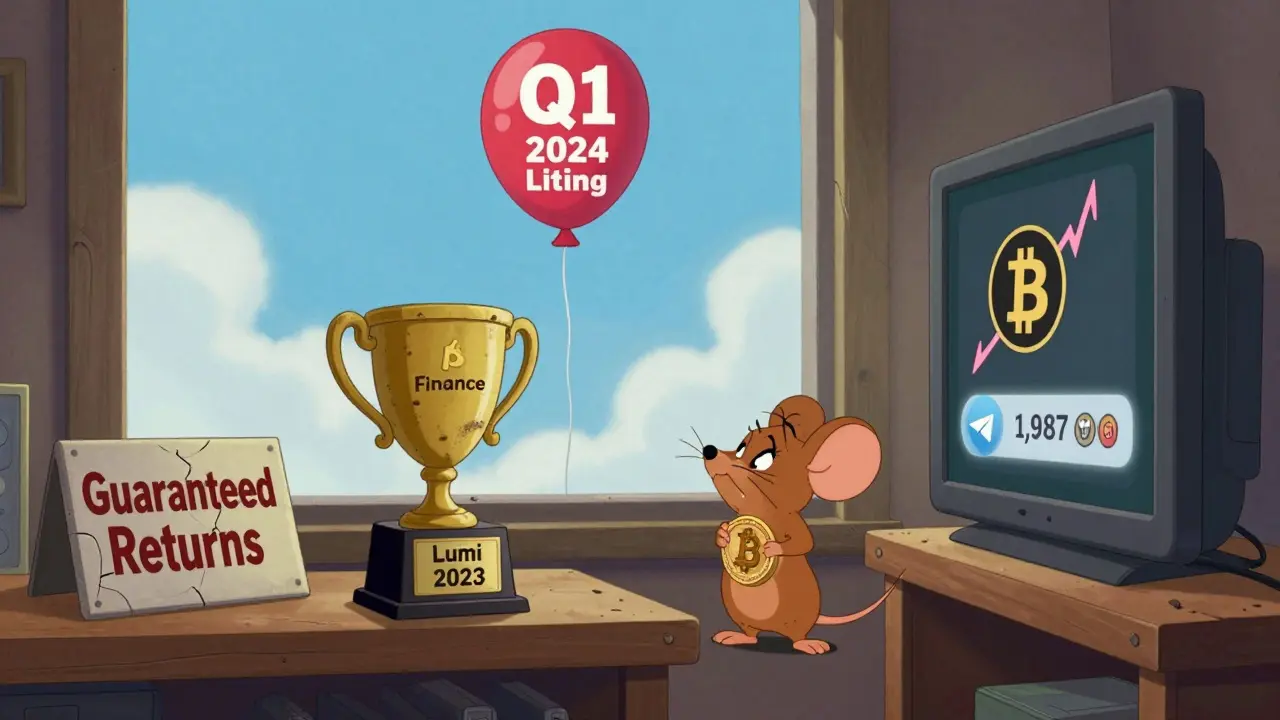
Lumi Finance’s roadmap says it plans to list on centralized exchanges in Q1 2024 and integrate with Trust Wallet by Q2 2024. That could help. More liquidity. More visibility. More trust.
But history doesn’t favor these kinds of projects. Projects that promise guaranteed returns or price floors have a terrible track record. Most collapse when markets turn. The biggest risk isn’t the code. It’s the lack of real-world adoption. Without volume, the whole system becomes a theoretical exercise.
Some analysts, like Michael Chen from Blockworks, believe the dynamic option system could attract risk-averse investors during downturns. That’s possible. But it’s a tiny niche. And right now, that niche is barely breathing.
As of September 2023, Lumi Finance had a market cap of $4.62 million. That’s less than 0.001% of the entire crypto market. It’s not a contender. It’s a curiosity. A bold experiment. But not a safe bet.
Bottom Line: A Novel Idea, Unproven Reality
Lumi Finance (LUA) isn’t a scam. It’s not a Ponzi. The idea behind the MFR Algorithm is clever. It tries to solve a real problem: crypto’s volatility. But clever doesn’t mean safe. The lack of transparency, the tiny liquidity, the unverified reserves, and the silent team make it a high-risk, low-reward play.
If you have money you can afford to lose, and you understand DeFi well enough to handle slippage and gas fees, you might experiment with a small amount. But don’t expect returns. Don’t expect liquidity. And definitely don’t expect it to be your main crypto holding.
For now, Lumi Finance is a proof of concept. Not a product. Not a platform. Not a safe haven. Just a quiet experiment in a corner of the crypto world, hoping someone will notice before the lights go out.
Tisha Berg
December 8, 2025 AT 20:48Lumi Finance feels like a safety net made of tissue paper. I get the idea-protect your investment-but if no one’s auditing the reserve, how do you know it’s even there? I’m not saying it’s fake, but I’m not putting my rent money in it either.
Been in crypto since 2017. Seen a hundred ‘guaranteed floor’ projects. None survived a real bear market. This one’s just quieter than the rest.
Nelson Issangya
December 9, 2025 AT 08:00Bro, this isn’t finance-it’s a magic trick. You’re telling me a token with $700 in daily volume can somehow ‘guarantee’ a price floor? That’s like saying your lemonade stand can stabilize the global coffee market because you’ve got $5 in the jar.
And no team? No audits? No transparency? You’re not investing-you’re volunteering to be the last guy holding the bag when the lights go out.
Joe West
December 9, 2025 AT 14:14Let me break this down simply: if the reserve is supposed to back the floor price, where’s the public ledger showing USDC/DAI holdings? No proof = no trust.
Also, slippage at 15%? That’s not trading, that’s a tax. You’re paying 15% just to get in or out. That’s worse than most meme coins.
And yes, the option staking system is clever-but clever doesn’t mean sustainable. If the volume stays this low, the whole thing’s a ghost town with a fancy algorithm.
nicholas forbes
December 11, 2025 AT 05:21Why does everyone act like this is some revolutionary idea? Every ‘guaranteed floor’ crypto has failed. Why? Because it’s mathematically impossible to sustain without insane liquidity.
And if the reserve runs out? Poof. Your ‘safe’ token becomes a pumpkin. This isn’t innovation-it’s a trap wrapped in whitepaper jargon.
Cristal Consulting
December 12, 2025 AT 14:50Small investment? Maybe. Big dreams? Nope.
If you’re just playing with spare change and you understand slippage, go for it. But don’t call this a safe haven. It’s a sandbox. Fun to play in, but don’t build your house there.
Uzoma Jenfrancis
December 13, 2025 AT 03:20Western crypto culture is so obsessed with ‘guarantees’ they forget risk is part of the game. Africa doesn’t need your safety nets. We build from scratch. This feels like a child’s fantasy dressed in blockchain clothes.
Mairead Stiùbhart
December 13, 2025 AT 18:55So let me get this straight-you’re paying gas fees to buy a token that’s backed by… what? A secret wallet? A fairy? The ghost of Satoshi?
And you think this is ‘innovation’? Honey, this is a PowerPoint deck from 2018 with a new logo.
Doreen Ochodo
December 14, 2025 AT 03:03Low volume = death sentence. No team = red flag. No audit = trust no one.
Try it with $10 if you’re bored. But don’t call it investing. Call it entertainment.
Josh Rivera
December 15, 2025 AT 20:30Oh wow. A crypto project that doesn’t want to make you rich. How DARING. How ORIGINAL. How… suspiciously boring.
It’s like someone took the worst parts of DeFi-slippage, no liquidity, no team-and added a ‘guarantee’ sticker like a kid putting a Band-Aid on a broken leg.
And the fact that people are still falling for this? I’m starting to think the market’s just a giant game of hot potato with a whitepaper.
Neal Schechter
December 17, 2025 AT 15:20I’ve looked into this. The MFR algorithm is technically sound-if the reserve is real. But here’s the kicker: no one’s shown the reserve balances. Not even a snapshot.
And the fact that it’s only on DEXes? That’s not ‘decentralized’-that’s ‘avoiding regulation.’
Bottom line: the idea is cool, but the execution is a house of cards. Don’t bet your future on it.
Madison Agado
December 19, 2025 AT 13:07There’s a philosophical question here: if a price floor exists but no one can verify it, does it exist at all?
This project is a mirror. It reflects our collective desire to escape volatility-not to understand it. We don’t want to learn how to navigate risk. We want someone else to remove it.
But risk isn’t a bug in crypto. It’s the feature. Lumi Finance is trying to sell us a world without friction. And that world doesn’t exist. Not here. Not ever.
miriam gionfriddo
December 19, 2025 AT 17:04SOOOO… LUMI FINANCE IS JUST A TERRIBLE SCAM BUT WITH A FEW SMART WORDS? OH MY GOD I DIDN’T REALIZE WE WERE STILL IN 2018. THE RESERVE IS GONE. THE TEAM IS GONE. THE VOLUME IS GONE. THE WHOLE THING IS A GHOST. I SWEAR TO GOD IF ONE MORE PERSON TALKS ABOUT ‘UNBOUNDED FINANCIAL EXPANSION’ I’M GOING TO SCREAM.
AND THE FACT THAT PEOPLE ARE STILL BUYING THIS?!?!?!
Brooke Schmalbach
December 20, 2025 AT 15:05Let’s be real-this isn’t finance. It’s a psychological experiment in human gullibility. You’ve got a token with less liquidity than a small-town bakery, backed by invisible reserves, managed by invisible people, promising invisible safety.
The only thing ‘innovative’ here is how efficiently they’ve weaponized hope. And that’s not a feature. That’s a flaw in the species.
Shane Budge
December 21, 2025 AT 16:51How many people actually trade this? Like, daily? The volume is laughable. If you can’t even buy or sell without getting ripped off, what’s the point?
sonia sifflet
December 22, 2025 AT 13:59Everyone here is acting like this is a new thing. Newsflash: this is exactly how every ‘stable’ crypto died. Terra. Ampleforth. All of them. They promise safety. They deliver silence. Then the floor cracks. And you’re left holding a token worth nothing.
Don’t be the next statistic. Walk away.
Chris Jenny
December 24, 2025 AT 05:41THIS IS A GOVERNMENT OPERATION. THEY WANT YOU TO THINK THIS IS ‘DECENTRALIZED’ SO YOU’LL PUT YOUR MONEY IN WHILE THEY MONITOR EVERY TRANSACTION. THE ‘RESERVE’ IS FAKE. THE ‘ALGORITHM’ IS A BACKDOOR. THEY’RE TRACKING EVERY WALLET. YOU THINK THEY LET A PROJECT LIKE THIS LIVE WITHOUT PERMISSION? NO. THEY’RE USING YOU TO COLLECT DATA. AND WHEN THEY’RE DONE? THEY’LL CRASH IT AND SAY ‘OH, THE MARKET DID IT.’
THEY’RE WATCHING YOU RIGHT NOW.
Adam Bosworth
December 24, 2025 AT 13:26Oh my god. Another one. Another ‘safe’ crypto. Another ‘guaranteed’ floor. Another team that vanished into the ether like a bad Tinder date.
And now people are calling it ‘innovative’? Bro. It’s not innovation. It’s delusion with a whitepaper.
I’ve seen this movie. The ending is always the same: a bunch of people crying in a Discord channel asking ‘WHERE’S MY MONEY?’ while the devs laugh in a villa in Bali.
Renelle Wilson
December 25, 2025 AT 05:24While the structural design of Lumi Finance’s MFR algorithm presents a theoretically elegant solution to the problem of crypto volatility, one must critically evaluate the ontological basis of its claimed guarantees. The absence of verifiable proof-of-reserves, coupled with the non-disclosure of the development team, introduces a profound epistemic uncertainty into the system’s operational integrity. In philosophical terms, this constitutes a failure of ontological transparency-where the promise of security is divorced from empirical substantiation. Consequently, the project functions not as a financial instrument, but as a symbolic artifact of collective wish fulfillment within a market increasingly dominated by performative innovation rather than substantive value.
One might argue that the low liquidity and minimal community engagement reflect not merely market neglect, but a deeper cultural aversion to risk mitigation mechanisms that lack institutional legitimacy. In this light, Lumi Finance may be less a failed token and more a sociological case study in the pathology of trust in decentralized ecosystems.
Elizabeth Miranda
December 25, 2025 AT 10:53I read the whole thing. Honestly? It’s not a scam. It’s just… dead. Like a plant in a windowless room. The idea’s nice, but nobody’s watering it. No volume. No team. No buzz.
It’s not going to make you rich. But it’s not going to steal your money either. It’s just… there. Quietly fading.
Chloe Hayslett
December 25, 2025 AT 15:33Why are Americans so obsessed with safety in crypto? We don’t need guarantees. We need winners. This is what happens when you give people a spreadsheet and call it finance.
Go play with your ‘floor prices.’ I’ll be over here making real money.
Noriko Robinson
December 27, 2025 AT 04:21Low volume is the killer here. If you can’t sell without losing 15%, it doesn’t matter if the floor is $3 or $300. You’re trapped.
And if the reserve runs out? You’re stuck with a token no one wants. I’d rather hold Bitcoin and sleep at night.
ronald dayrit
December 28, 2025 AT 19:50What Lumi Finance reveals isn’t about crypto-it’s about us. We crave certainty in a system built on chaos. We want to believe that code can replace trust, that algorithms can substitute for accountability. We want to be told we’re safe.
But safety in crypto is an illusion. The only real safety is knowing you can lose it all-and still be okay.
Lumi Finance doesn’t offer security. It offers the comfort of denial. And denial, in the end, is the most expensive investment of all.