
Have you heard about Lion Cat (LCAT), a new meme coin promising adventure and community spirit? It sounds exciting, but before you throw money at it, you need to know what’s really going on. LCAT isn’t just another shiny object in the crypto world; it’s a specific type of asset with distinct risks and characteristics. This guide breaks down exactly what Lion Cat is, how it works on the blockchain, and whether it has any real value beyond hype.
The Basics: What Exactly is Lion Cat (LCAT)?
At its core, Lion Cat (LCAT) is a community-driven meme cryptocurrency token built on the BNB Smart Chain. If that sounds technical, let’s simplify it. Think of LCAT as a digital collectible that trades like money, but its value comes mostly from what people believe it’s worth, not from any underlying technology or utility. It belongs to the "meme coin" family, sitting alongside giants like Dogecoin and Shiba Inu.
The project positions itself around the idea of a "bold and adventurous spirit," drawing inspiration from lions. But here’s the catch: unlike Bitcoin, which aims to be digital gold, or Ethereum, which powers smart contracts, LCAT doesn’t have a complex roadmap or enterprise partnerships. Its primary driver is community enthusiasm. When you buy LCAT, you’re betting on the community growing larger and more vocal, which could push the price up. If the interest fades, the price follows suit.
Why BNB Smart Chain Matters for LCAT
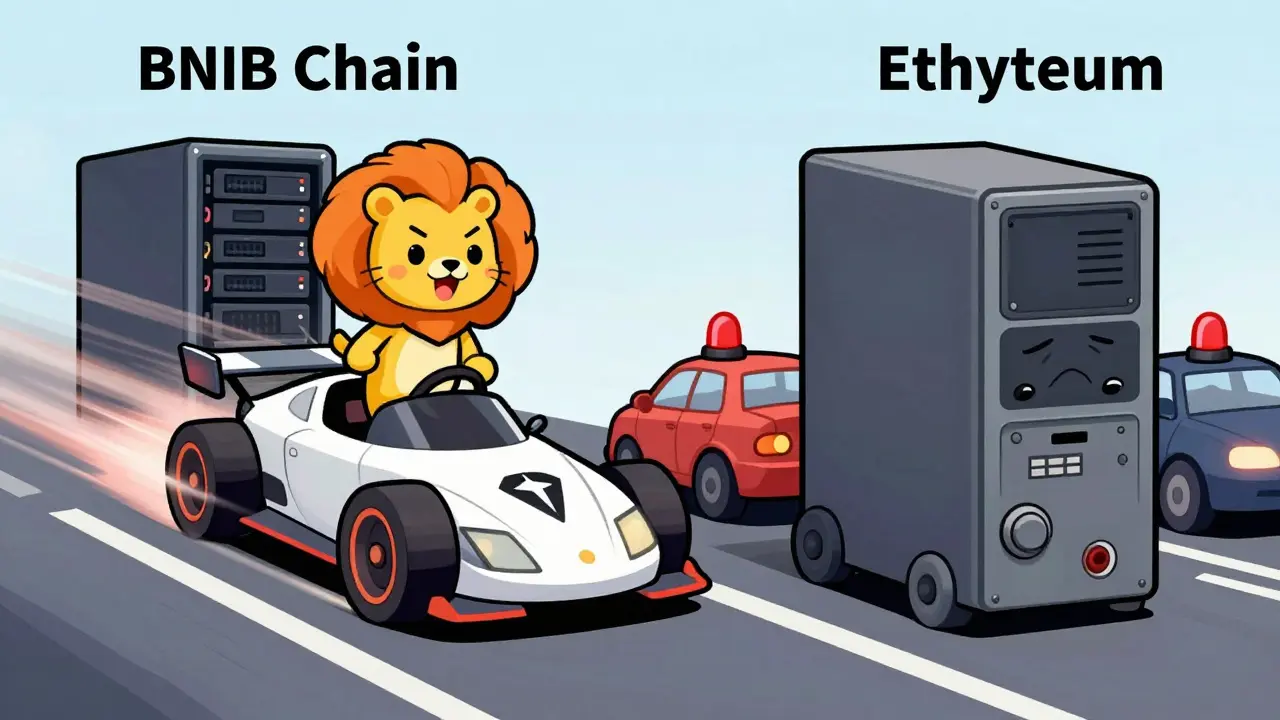
You might wonder why LCAT chose the BNB Smart Chain instead of Ethereum. The answer lies in speed and cost. Ethereum is famous but often expensive due to high "gas fees"-the transaction costs paid to miners. During busy periods, sending $10 worth of crypto on Ethereum can cost more than $10 in fees. That’s a dealbreaker for small investors.
BNB Smart Chain (formerly Binance Smart Chain) solves this. It allows for:
- Faster transactions: Blocks are produced every few seconds, so your trade settles quickly.
- Lower fees: Gas fees are typically a fraction of a cent, making micro-transactions viable.
- BEP-20 Standard: LCAT functions as a BEP-20 token, meaning it’s compatible with wallets like Trust Wallet and exchanges integrated with the Binance ecosystem.
This infrastructure makes LCAT accessible to retail traders who want to move in and out of positions without losing significant capital to fees. However, being on BNB Smart Chain also means sharing space with thousands of other tokens, many of which are scams or abandoned projects. Due diligence is critical.
Current Market Performance and Price Volatility
If you check different platforms right now, you’ll see conflicting prices. This is normal for low-market-cap coins. As of early 2026, data varies significantly:
| Platform | Price (USD) | Market Cap Estimate |
|---|---|---|
| CoinMarketCap | $0.01076 | ~$4.6M |
| CoinCodex | $0.01168 | Varies |
| CoinStats | $0.00932 | $4.6M |
| SwapSpace | $0.01216 | N/A |
These differences arise because smaller coins don’t have deep liquidity pools on major exchanges. Instead, they trade on decentralized exchanges (DEXs) where prices can slip depending on the volume of the trade. With a 24-hour trading volume hovering around $38,000 to $40,000, LCAT lacks the stability of top-tier cryptocurrencies. A single large sell order can drop the price by 5% or more in minutes.
Technical indicators paint a neutral picture. The 14-day Relative Strength Index (RSI) sits at 50.23, neither overbought nor oversold. However, the 200-day Simple Moving Average (SMA) is at $0.040, while the current price is around $0.01. This suggests the token has declined significantly from previous highs and is currently in a bearish long-term trend. Traders watching these metrics should be cautious.
Token Supply Confusion: What You Need to Know
One of the biggest red flags for potential investors is the confusion surrounding LCAT’s supply. Different sources report vastly different numbers:
- SwapSpace: Reports a total supply of 600,000,000 LCAT.
- CoinStats: Lists a circulating supply of 494,250,000 LCAT.
Why does this matter? Market cap is calculated as Price × Circulating Supply. If the circulating supply is lower than reported, the market cap is inflated, making the coin appear more valuable than it is. Conversely, if there are hidden unlocked tokens, future inflation could crash the price. For LCAT, this discrepancy suggests either poor transparency from the developers or outdated data on tracking sites. Always verify supply details directly on the blockchain explorer (like BscScan) rather than trusting aggregator websites blindly.
Is LCAT a Good Investment? Risks vs. Rewards
Let’s be direct: LCAT is a high-risk speculative asset. It is not an investment in the traditional sense. Here’s how it compares to established meme coins:
Dogecoin (DOGE) and Shiba Inu (SHIB) have multi-billion dollar market caps, celebrity endorsements, and listings on major centralized exchanges like Coinbase and Binance. LCAT, ranked #1475 on CoinMarketCap, has none of these advantages. It relies entirely on grassroots community marketing. This means growth is possible if the community goes viral, but collapse is equally likely if interest wanes.
Consider the "Fear and Greed Index" for LCAT, which currently reads 48 (Neutral). This indicates a balanced but unenthusiastic market sentiment. There’s no FOMO (Fear Of Missing Out) driving massive inflows, nor is there panic selling. For a trader, this might mean sideways movement. For an investor looking for 100x gains, it might mean waiting for a catalyst that may never come.
Price Predictions: Hype vs. Reality
Many websites offer price predictions for LCAT, but you should treat them with extreme skepticism. AI models and algorithmic forecasts often fail to account for human behavior and market manipulation.
Some optimistic models suggest LCAT could reach $0.023 by 2025 or even $0.024 in 2026. Others predict a drop to $0.008. These wide ranges highlight the uncertainty. No one knows if LCAT will survive the next market cycle. Unlike Bitcoin, which has institutional backing, LCAT has no fundamental utility. Its value is purely psychological. If the narrative shifts away from "lion-themed meme coins," the price could become irrelevant.
For 2026 and beyond, conservative analysts suggest a trading channel between $0.005 and $0.022. This implies modest volatility but no explosive growth unless a major event occurs. Remember, past performance in meme coins is not indicative of future results. Many coins from 2021 are now worthless.
How to Buy and Store LCAT Safely
If you decide to proceed despite the risks, here’s how to do it safely:
- Set up a wallet: Use a non-custodial wallet like Trust Wallet or MetaMask. Ensure it supports BNB Smart Chain.
- Get BNB: You’ll need BNB (Binance Coin) to pay for gas fees and swap for LCAT. Buy BNB on a reputable exchange and send it to your wallet.
- Use a DEX: Connect your wallet to a decentralized exchange like PancakeSwap. Search for the LCAT contract address. Double-check the contract address to avoid fake tokens.
- Swap: Exchange your BNB for LCAT. Set slippage tolerance appropriately (usually 1-3%) to ensure the trade executes.
- Secure your assets: Never share your private keys. Consider using a hardware wallet for long-term storage, though most meme coin holders keep funds in hot wallets for quick trading.
Be aware that once you buy LCAT, you control your own security. If you lose your seed phrase, your money is gone forever. There is no customer support to call.
Is Lion Cat (LCAT) a scam?
There is no definitive proof that LCAT is a scam, but it carries high risk. Like many meme coins, it lacks utility and transparent team information. The discrepancy in supply reports raises concerns about transparency. Always assume you could lose 100% of your investment.
Where can I buy LCAT?
LCAT is primarily traded on decentralized exchanges (DEXs) like PancakeSwap on the BNB Smart Chain. It is not listed on major centralized exchanges like Coinbase or Binance, which limits accessibility and liquidity.
What is the total supply of LCAT?
Reports vary. SwapSpace lists 600 million tokens, while CoinStats shows ~494 million in circulation. This inconsistency suggests some tokens may be locked, burned, or held by developers. Verify on-chain data via BscScan for the most accurate info.
Will LCAT go to the moon?
It’s highly unlikely. Without major exchange listings, celebrity endorsements, or unique utility, LCAT faces stiff competition from established meme coins. Most small-cap meme coins fail to sustain long-term growth. Treat any investment as high-risk speculation.
How does LCAT compare to Dogecoin?
Dogecoin has a multi-billion dollar market cap, widespread adoption, and strong brand recognition. LCAT is a micro-cap token with limited liquidity and no mainstream presence. Investing in LCAT is significantly riskier and less liquid than investing in DOGE.