
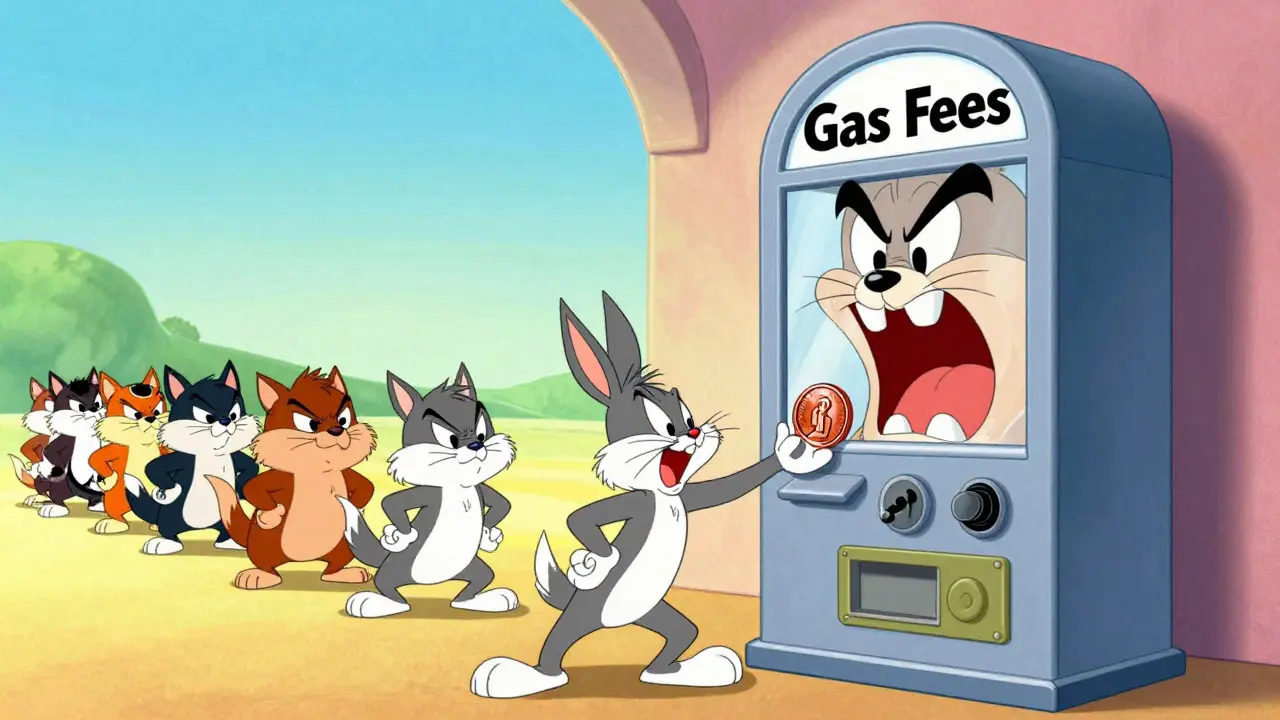
Imagine a world where you can send crypto or interact with a decentralized app without paying a single cent in gas fees. That is the core promise of Ethereal (ETRL) is a Layer-1 blockchain project designed to offer scalable, gas-free transactions while staying fully compatible with the Ethereum Virtual Machine (EVM). It aims to solve the biggest headache for Ethereum users: those unpredictable and often expensive network fees that make small transactions impractical.
But here is the catch: if you look at the actual market data, there is a massive gap between what the project claims on paper and what is happening in the real world. While its technical goals sound like a dream for gamers and DeFi traders, the project's footprint is incredibly small, leaving many investors wondering if it is a hidden gem or a ghost chain.
Key Takeaways: The ETRL Snapshot
- The Big Idea: A Layer-1 network that eliminates gas fees for users.
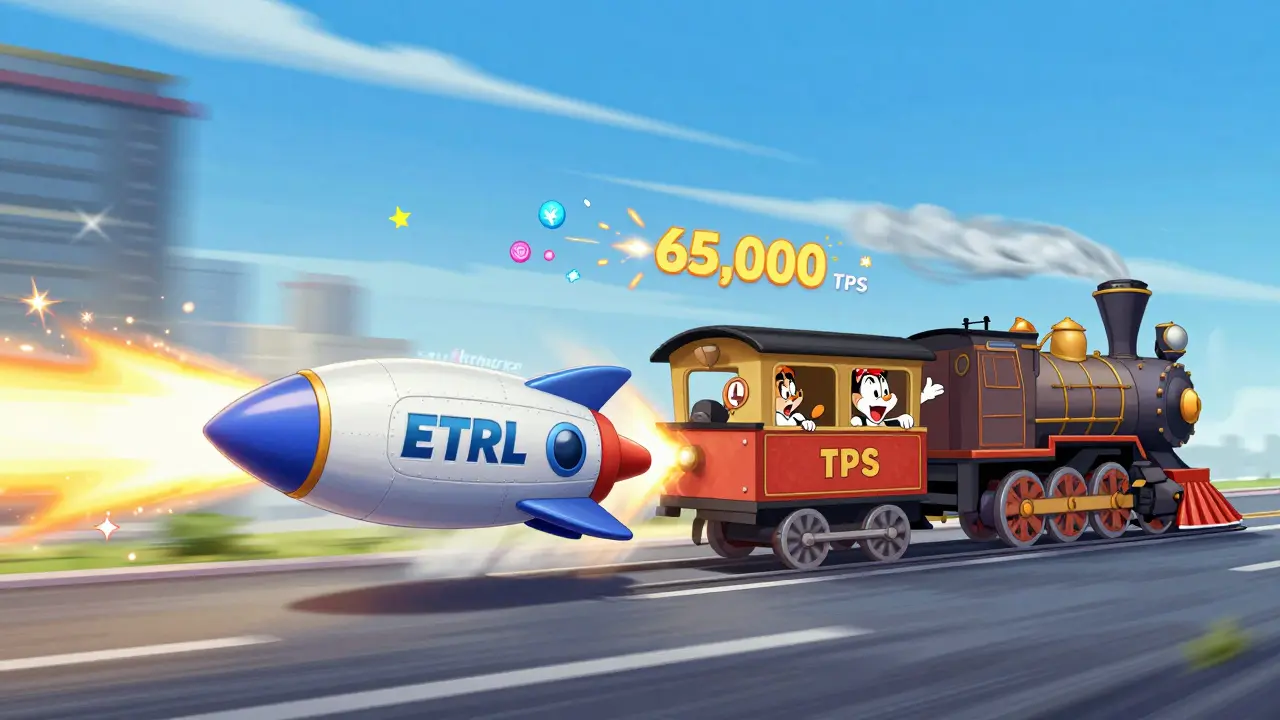
- Technical Hook: Claims potential speeds of 65,000 transactions per second (TPS) using zkSnarks and roll-ups.
- Interoperability: EVM compatibility means developers can easily port apps from Ethereum.
- The Red Flag: Massive contradictions in its origin (some sources say 2017 token, others say a new L1) and extremely low market adoption.
- Current Status: Very low liquidity and a market ranking that puts it far behind established giants.
How Ethereal Actually Works
At its heart, Ethereal isn't just another token; it positions itself as a foundational layer. It uses a Proof-of-Stake Byzantine Fault Tolerance (PoS BFT) consensus mechanism. Unlike some networks where a transaction might be "probably" finished, PoS BFT provides absolute finality. This means once a block is confirmed, it cannot be reverted. For a business processing thousands of payments, this certainty is non-negotiable.
To hit those high speeds, Ethereal leans on several scaling tools. It doesn't just rely on one method; it integrates zkSnarks (zero-knowledge succinct non-interactive arguments of knowledge), optimistic roll-ups, and side-chains. In theory, this allows the network to scale up to 65,000 TPS, putting it in the same speed bracket as Solana , but without the gas fees that plague Ethereum.
The ecosystem is built around five main pillars:
- Blockchain Integration: Running on its own high-performance network.
- Token Utility: Using ETRL for payments and participation.
- Smart Contracts: Automating rewards and staking.
- Governance: Letting token holders vote on how the network evolves.
- Passive Income: Offering staking and yield farming opportunities.
Ethereal vs. The Giants: A Comparison
When you put Ethereal next to the "big dogs" of the blockchain world, the technical specs look impressive, but the market reality is humbling. While Ethereum is the gold standard for security and decentralization, its fees can be astronomical. Ethereal tries to bridge that gap by keeping the EVM compatibility (so the apps work the same) but removing the cost of entry.
| Feature | Ethereum | Solana | Polygon | Ethereal (ETRL) |
|---|---|---|---|---|
| Avg. Speed (TPS) | 15-30 | 65,000 | 7,000 | Up to 65,000 (Claimed) |
| Gas Fees | High/Variable | Very Low | Low | Gas-Free |
| EVM Compatible | Yes | No | Yes | Yes |
| Market Status | Dominant | High Growth | Established | Very Low Adoption |
The Elephant in the Room: The Red Flags
If you are considering investing in Ethereal ETRL, you need to look closely at the discrepancies in its data. For one, there is a confusing identity crisis. Official documents call it a Layer-1 blockchain, but some data aggregators list it as a simple token launched on the Ethereum blockchain back in 2017. These aren't the same thing. A Layer-1 is a whole new road; a token is just a car driving on someone else's road.
Then there is the circulation mystery. Some reports show a total supply of 50 million tokens, but 0 tokens actually in circulation. If no tokens are moving, how is the network being secured? How is the market price being determined? When a project has a market cap ranking as low as #23,962, it means it is virtually invisible to the broader crypto community.
Furthermore, the "community" is surprisingly quiet. For a project aiming to be the go-to for Web3 gaming and DeFi, there is almost zero discussion on Reddit and very few followers on X (formerly Twitter). In the crypto world, community is everything. Without developers building dApps and users chatting about the project, a blockchain is just a fancy piece of code with no purpose.
Is it Right for You?
Depending on who you are, ETRL looks very different. If you are a developer, the idea of a gas-free, EVM-compatible chain is attractive because it lowers the barrier for users to try your app. However, the lack of active GitHub repositories or developer forums makes it a risky place to build. You might spend months coding for a network that has no users.
For the average investor, the risk profile is extremely high. The project lacks verifiable real-world applications. While the Gitbook mentions "upcoming features" and "future events," these are promises, not products. In a market where projects like Ethereum support over 4,000 dApps, Ethereal's lack of a visible ecosystem is a major warning sign.
How to Interact with ETRL
If you still want to explore the project, the process is relatively straightforward but requires a Web3 wallet. Since ETRL operates on the BNB Smart Chain (BSC), you will need a wallet that supports BSC addresses.
The general path for onboarding involves:
- Using a compatible wallet like the Bitget Wallet or Binance Web3 Wallet.
- Connecting to a decentralized exchange (DEX) that lists the ETRL contract address.
- Verifying the contract address (0x22714c3532b4D52256f3c683e34170266b888D55) to ensure you aren't buying a fake version of the token.
What exactly is Ethereal (ETRL)?
Ethereal (ETRL) is a project that claims to be a Layer-1 blockchain. Its primary goal is to provide a fast, scalable environment for decentralized apps and games while completely removing gas fees for users. It is designed to be compatible with the Ethereum Virtual Machine (EVM), allowing developers to move their projects over easily.
Are the transactions on Ethereal actually free?
The project markets itself as a "gas-free" transaction model. While this is the stated goal in their technical documentation, it is important to verify this through actual network usage, as very few real-world applications have been deployed to prove this at scale.
Is ETRL a safe investment?
Investing in ETRL carries significant risk. It has an extremely low market ranking, contradictory information regarding whether it is a Layer-1 or an ERC-20 token, and very little community engagement or verifiable development activity. Always do your own research and be wary of projects with low liquidity.
How fast is the Ethereal network?
Ethereal claims to reach transaction finality in about 2 seconds. Furthermore, it asserts that by using technologies like zkSnarks and roll-ups, it can potentially scale up to 65,000 transactions per second (TPS), which would make it competitive with networks like Solana.
Where can I buy ETRL tokens?
ETRL is primarily available through decentralized exchanges (DEXs) on the BNB Smart Chain. You can use Web3 wallets such as Bitget Wallet or Binance Web3 Wallet to connect to these exchanges and swap other tokens for ETRL.
Next Steps and Troubleshooting
If you are a developer looking to test the waters, your first step should be searching for their official Gitbook and checking if there is a public testnet available. Don't deploy any mainnet capital until you've verified the network's stability and the actual
Greg Reynolds
April 22, 2026 AT 19:48Claiming 65k TPS while having zero circulating supply is just a fancy way of saying the project is a ghost. Most of these 'Layer-1' clones just copy-paste a whitepaper and hope for the best.
Keith Garcia
April 24, 2026 AT 05:31The sheer audacity of presenting a project with a market rank in the twenty-thousands as a viable investment is simply breathtaking 🙄. It is an absolute carnival of incompetence to even call this a 'blockchain' when it's essentially a dormant token masquerading as infrastructure. The cognitive dissonance required to ignore the lack of GitHub activity is truly a feat of modern imagination 🤡✨.
Miranda Jamieson
April 25, 2026 AT 11:10Wake up people! This is a textbook rug pull waiting to happen. If there is no community and no liquidity, you are just donating money to a scammer. Stop being so naive.
Robert Mosolygo
April 27, 2026 AT 04:10Notice how they mention BSC. It's not a Layer-1, it's a puppet project designed to harvest liquidity from unsuspecting retail investors before the developers vanish into the ether. The 'gas-free' promise is the bait, the lack of circulating supply is the trap, and the 2017 origin story is just a smoke screen to make it look established. They want you to believe in a ghost chain because ghosts don't have to prove their math actually works in a live environment. It is all a choreographed play to manipulate the market cap.
Larry Yang
April 28, 2026 AT 13:35the math is totaly cooked lol
Guy Bianco
April 30, 2026 AT 00:13It is quite concerning that the project lacks a verifiable testnet. I would encourage any aspiring developers to exercise extreme caution before committing time to this ecosystem. (•_•)
praveen subbiah
May 1, 2026 AT 13:39This sounds like a dream for my country's tech scene! We could lead the world in gas-free gaming if we just move fast! 🇮🇳
Doc Coyle
May 3, 2026 AT 12:06People need to realize that free things in crypto usually come with a hidden cost. It's just basic common sense.
Gary Lingrel
May 4, 2026 AT 01:54another day another fake l1 scam lol... why do people even fall for this stuff :|
Findlay Duncan Lyon
May 4, 2026 AT 02:53Quite a mess, really.
Sarah Fisher
May 5, 2026 AT 17:50It's interesting to think about the philosophy of a gas-free world. If the barrier to entry is removed, we might see a true democratization of DeFi, though the technical red flags here are hard to ignore.
Alex Wan
May 7, 2026 AT 12:31I belive we should all work together to verify the contract address before anyon buyin!! It is vital for the communitty safety!!!
Paige Raulerson
May 9, 2026 AT 06:39I've seen this pattern before with five other coins this month. It's honestly embarrassing that people still try to market '65k TPS' as a selling point when they can't even get a Twitter follower.
Jennifer Taylor
May 10, 2026 AT 05:06The 2017 date is a lie. They are just trying to trick us into thinking they have history. Be careful everyone.
Clair Geary
May 11, 2026 AT 05:22maybe there's a small team just starting out? sometimes these gems need a little push and a friendly community to grow
Sara Ellis
May 11, 2026 AT 09:42money is just energy anyway and this looks like a void
Ali Tate
May 11, 2026 AT 12:12pure garbage. US tech would never let a joke like this fly if it wasnt for the degenerates in the crypto space
Sarah Ingrams
May 11, 2026 AT 22:30hope everyone stays safe out there
Ellie Drews
May 12, 2026 AT 14:27Let's try to keep the discussion civil while we look at the facts. It definitely seems risky, but it's good to share information.
jill huyo-a
May 13, 2026 AT 02:34I'm just curious if there's any way to actually test the gas-free claims without risking real funds. Maybe there's a hidden faucet somewhere?