
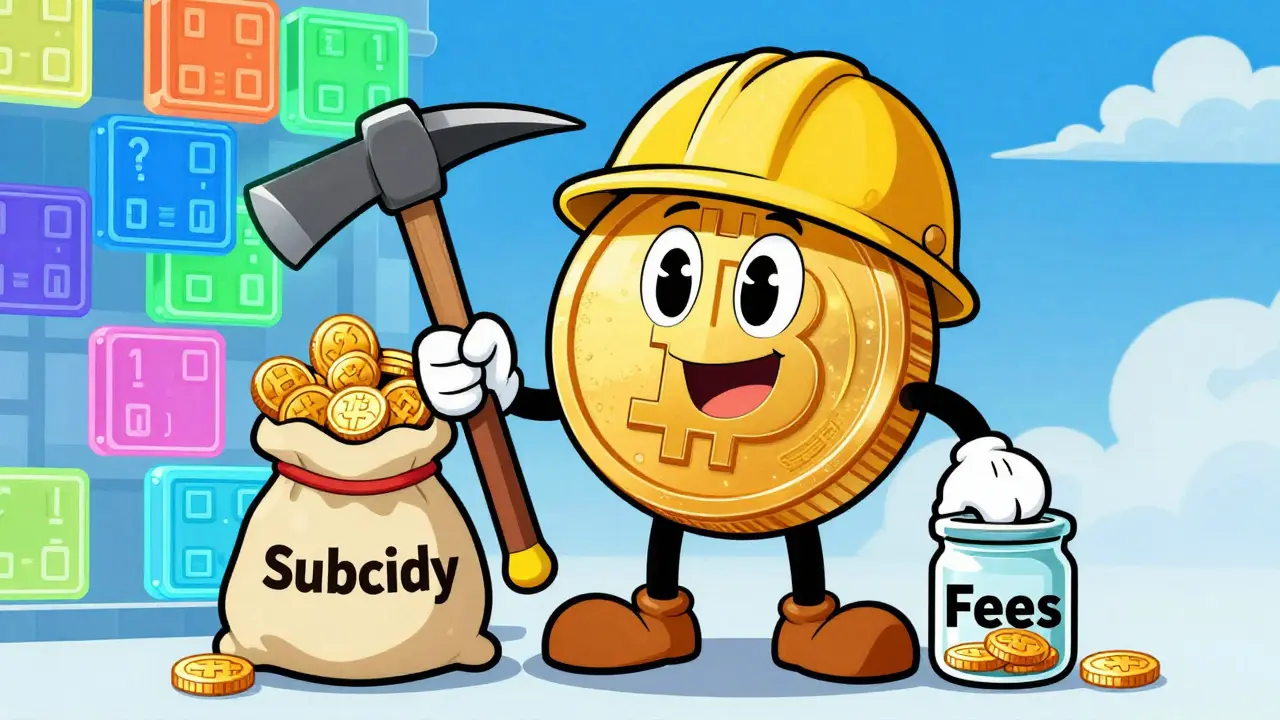
You might have heard that Bitcoin miners get paid for doing their job. That’s true, but it’s not as simple as getting a paycheck for hours worked. The Bitcoin block reward is the compensation mechanism that incentivizes miners to secure the network by validating transactions and adding new blocks to the blockchain. It consists of two distinct parts: newly created bitcoins (the subsidy) and the fees users pay to prioritize their transactions.
If you are trying to understand why Bitcoin has value, or why mining difficulty changes so often, the answer lies in this reward structure. It is the engine of Bitcoin’s monetary policy. Without it, the network would stop functioning. Let’s break down exactly how this system works, why it halves every four years, and what it means for the future of the currency.
The Two Parts of the Block Reward
Every time a miner successfully solves the complex mathematical puzzle required to add a new block to the blockchain, they receive a payout. This payout is not arbitrary; it is strictly coded into the Bitcoin protocol. It comes from two sources:
- The Block Subsidy: This is the "new money." When a block is mined, the protocol allows the miner to create a specific amount of fresh bitcoins out of thin air. These coins did not exist before. This is the primary source of revenue for miners today.
- Transaction Fees: Every time you send Bitcoin, you attach a small fee to your transaction. Miners collect these fees as a tip for including your transaction in the block they are building. As the subsidy decreases over time, these fees become increasingly important.
Think of it like a business startup. In the early days, the company relies on venture capital funding (the subsidy) to keep the lights on. As the company matures, it needs to generate enough profit from its actual products and services (transaction fees) to survive. Bitcoin is currently in a transition phase where it still relies heavily on the subsidy, but the fees are growing in significance.
How the Halving Changes Everything
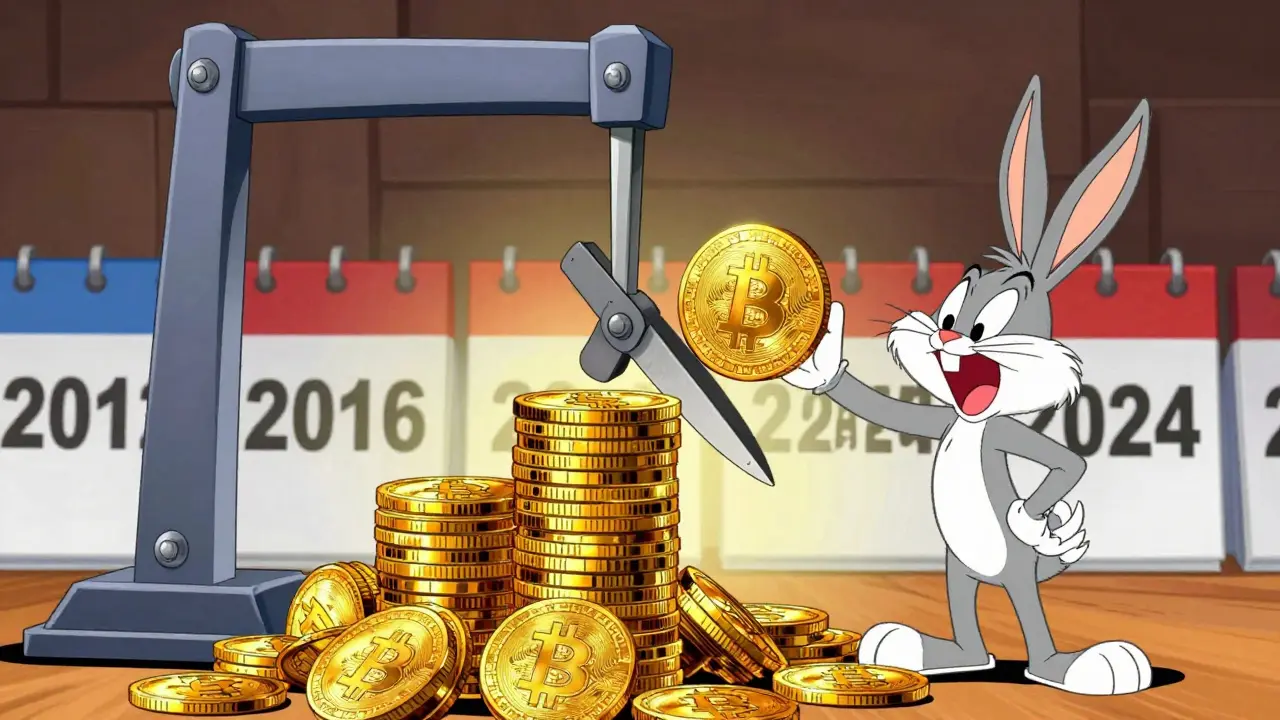
The most unique feature of Bitcoin’s economic model is the Halving, which is a programmed event that cuts the block subsidy in half every 210,000 blocks, or approximately every four years. This is not a decision made by a central bank or a CEO. It is hard-coded into the software.
When Bitcoin launched in 2009, the reward was 50 BTC per block. Here is how it has changed:
| Date | Block Height | Reward Before | Reward After |
|---|---|---|---|
| November 28, 2012 | 210,000 | 50 BTC | 25 BTC |
| July 9, 2016 | 420,000 | 25 BTC | 12.5 BTC |
| May 11, 2020 | 630,000 | 12.5 BTC | 6.25 BTC |
| April 20, 2024 | 840,000 | 6.25 BTC | 3.125 BTC |
The next halving is projected for around 2028, when the reward will drop to 1.5625 BTC. Why does this matter? Because it creates scarcity. By reducing the rate at which new bitcoins enter circulation, the supply becomes tighter. If demand stays the same or increases, basic economics suggests the price should rise. This predictable issuance schedule is what many investors compare to gold, calling Bitcoin "digital gold."
Why Do Miners Risk Losing Money?
You might wonder: if the reward keeps dropping, why do people still mine Bitcoin? Isn’t it too expensive?
Mining is a competitive race. The network adjusts its difficulty roughly every two weeks (every 2,016 blocks) to ensure that a new block is found every 10 minutes, regardless of how much computing power is added to the network. If more miners join, the puzzle gets harder. If miners leave, it gets easier.
Miners stay in the game because they believe the long-term value of Bitcoin will outweigh their costs. However, it is a high-stakes business. To be profitable in 2026, professional miners need electricity costs below $0.045 per kWh. They use specialized hardware called ASICs (Application-Specific Integrated Circuits), like the Antminer S21, which can cost up to $15,000 per unit. These machines generate massive amounts of heat-over 3,500 watts per unit-requiring serious cooling infrastructure.
When the halving happens, the immediate income of miners drops by 50%. This often leads to a shakeout. Less efficient miners with higher electricity costs or older equipment shut down. Only the most efficient operations survive. This consolidation ensures that the network remains secure, even as rewards decrease.
The Future: When the Subsidy Disappears
Eventually, the block subsidy will become negligible. Around the year 2140, all 21 million bitcoins will have been mined. At that point, the subsidy will effectively be zero. Will miners stop working? If they do, the network becomes vulnerable to attacks.
This is the great question facing Bitcoin. The community believes that transaction fees will take over as the primary incentive. For this to work, the usage of Bitcoin must be high enough that users are willing to pay significant fees to include their transactions in blocks.
Currently, transaction fees make up a small portion of miner revenue-around 28% during peak congestion periods post-2024 halving. Analysts predict that by 2100, average transaction fees may need to reach $15-$25 to maintain current security levels. This seems high for buying coffee, which is why solutions like the Lightning Network is a second-layer payment protocol built on top of Bitcoin that enables instant, low-cost microtransactions off-chain. The Lightning Network handles small payments quickly and cheaply, while the main blockchain handles large, high-value settlements where users are willing to pay higher fees. This separation could sustain the fee market needed to secure the network indefinitely.
Bitcoin vs. Other Blockchain Models
Not all cryptocurrencies work like Bitcoin. Understanding the difference helps clarify why Bitcoin’s model is unique.
| Feature | Bitcoin (PoW) | Ethereum (PoS) | Dogecoin (PoW) |
|---|---|---|---|
| Consensus Mechanism | Proof-of-Work (Mining) | Proof-of-Stake (Validation) | Proof-of-Work (Mining) |
| Supply Cap | 21 Million (Fixed) | No Hard Cap (Deflationary/Burn) | Infinite (Inflationary) |
| Reward Source | New Coins + Fees | Staking Rewards + Fees | New Coins + Fees |
| Halving Event | Yes (Every 4 Years) | No | No |
| Energy Usage | High (Electricity intensive) | Low (Minimal energy) | High (Electricity intensive) |
Bitcoin’s Proof-of-Work requires physical energy expenditure, which ties the digital asset to real-world resources. Critics point to the environmental impact, noting Bitcoin’s annual electricity consumption rivals that of medium-sized countries. Proponents argue that this energy cost is what makes Bitcoin secure and immutable-you cannot fake the work. In contrast, Ethereum’s Proof-of-Stake uses validators who lock up coins as collateral, using far less energy but relying on different economic incentives.
Key Takeaways for Investors and Users
Understanding the block reward isn’t just for miners. It affects everyone who holds or uses Bitcoin.
- Scarcity Drives Value: The halving reduces inflation. Bitcoin’s annual inflation rate dropped to ~1.8% after the 2024 halving, making it one of the least inflationary assets globally.
- Security is Economic: The cost of attacking the network is tied directly to the block reward. Higher rewards mean more miners, which means higher security.
- Fees Matter More Now: As subsidies shrink, user behavior regarding fees will change. Expect higher fees during congested times.
- Long-Term Horizon: Bitcoin is designed for decades, not days. The final bitcoin won’t be mined until 2140. Patience is part of the strategy.
The block reward is the heartbeat of Bitcoin. It aligns the interests of miners, users, and holders. While the mechanics are technical, the outcome is simple: a secure, decentralized, and scarce digital currency that operates without a central authority.
What is the current Bitcoin block reward in 2026?
Following the April 2024 halving, the base block subsidy is 3.125 BTC. However, the total reward a miner receives also includes transaction fees, which vary based on network congestion. So, the total reward is always slightly higher than 3.125 BTC.
When is the next Bitcoin halving?
The next halving is expected to occur around 2028. It happens every 210,000 blocks, which typically takes about four years. At that time, the subsidy will drop from 3.125 BTC to 1.5625 BTC.
Will miners stop mining when the subsidy runs out?
Not necessarily. As the subsidy approaches zero (around 2140), transaction fees are expected to become the primary source of miner revenue. For this to work, Bitcoin must remain widely used for settlements, and users must be willing to pay fees. Technologies like the Lightning Network help facilitate this by moving small transactions off-chain.
How does the block reward affect Bitcoin's price?
The block reward affects supply. Halvings reduce the rate of new supply entering the market. Historically, if demand remains constant or increases while supply growth slows, the price tends to rise. Many investors view halvings as bullish events due to this increased scarcity.
Is Bitcoin mining profitable for individuals in 2026?
It is very difficult for individual hobbyists to mine profitably today. You need industrial-grade ASIC hardware, extremely cheap electricity (below $0.045/kWh), and efficient cooling. Most individuals are better off buying Bitcoin directly rather than attempting to mine it, unless they have access to free or very low-cost renewable energy.