

When you hear "Tegro crypto exchange," you might picture another fast, low-fee trading platform. But Tegro isn’t just a DEX. It’s a messy mix of a decentralized exchange, a gaming NFT marketplace, and a payment processor all stitched together under one brand. And that’s the problem. It sounds ambitious. But when you dig past the neon space theme and the buzzwords like "gasless quotes" and "Tegronomics," you start asking: Tegro crypto exchange - is it real, or just a lot of promises with no proof?
It’s Not Just a Crypto Exchange - It’s a Swiss Army Knife with Missing Blades
Tegro claims to do three things: trade crypto, buy/sell gaming NFTs, and let merchants accept payments. That’s not a feature. That’s a distraction. Most successful platforms focus on one thing and do it well. Uniswap trades. OpenSea sells NFTs. Stripe handles payments. Tegro tries to be all three - and the result feels like a beta app thrown together by a team that ran out of time.The trading side uses an orderbook instead of the usual AMM model. That’s good. Orderbooks give you tighter spreads and more control. But here’s the catch: no one can verify how fast it actually executes trades. Is it 200ms? 800ms? No numbers. No benchmarks. No third-party tests. Just a claim that it’s "rapid." Meanwhile, centralized exchanges like Binance or KuCoin publish their latency stats daily. Tegro? Silence.
And then there’s the "gasless quotes." Sounds magic, right? You view prices without paying gas. But how? Is it using a relayer? A proprietary mempool? Is it just caching prices from other chains? The documentation doesn’t say. And if you’re trading with real money, you don’t want to guess how the system works.
The TGR Token: A Currency With No Home
Tegro’s native token, TGR, is supposed to be the glue holding everything together. Pay for trades. Buy gaming items. Settle merchant payments. Sounds neat. But where can you even buy it? There are no listed trading pairs on CoinGecko, CoinMarketCap, or DeFi Llama. No liquidity pools on Uniswap or PancakeSwap. No data on circulating supply. No vesting schedule. No staking. No governance.Blockspot.io lists a placeholder page for TGR - price, market cap, supply - all blank. That’s not a mistake. That’s a red flag. If a token doesn’t appear on major tracking sites, it’s either brand new (and risky) or abandoned. Given Tegro’s claims of being live since at least 2024, this isn’t a launch issue. It’s a trust issue.
Gaming Marketplace: A $2 Trillion Dream With No Players
Tegro says it’s tapping into a $2 trillion gaming asset market. That’s a bold number. But where’s the proof? Are there 10,000 active users trading Axie Infinity skins? Are game devs using Tegronomics to build economies? No. There are no examples. No case studies. No screenshots of real trades. Just a concept called "bounty hunters" - gamers who complete tasks for cash. Sounds like a Reddit side hustle. But again: no metrics. No user counts. No payout logs.Compare that to ImmutableX or Enjin. They have real games. Real players. Real sales data. Tegro’s gaming side feels like a PowerPoint slide. Pretty graphics. Empty data.

Tegro Money: Payment Processing Without the Proof
The payment side is the most concrete part - and still the most confusing. Tegro Money claims to let merchants accept payments without 3D Secure, support recurring billing, and integrate with mobile wallets. That’s useful. But where’s the API? The docs? You can find a GitHub repo with PHP code examples - but no live demos. No sandbox environment. No testnet.And who’s using it? No merchants are named. No case studies. No logos on their website. No testimonials. You’d think a company building payment infrastructure would show at least one real business using it. But they don’t. Why? Because there aren’t any.
Security? What Security?
Tegro says it’s non-custodial. That’s good. You keep your keys. No exchange holds your crypto. But then they mention "MEV protection" - a major DeFi vulnerability where bots front-run your trades. How? Private mempools? Flashbots? Custom order routing? No details. Zero technical explanation.And here’s the kicker: no smart contract audits. No audit reports. No firm names. Not even a "we’re undergoing audit" notice. That’s not normal. Even the smallest DeFi project publishes their audit. Tegro? Nothing. And their GitHub has a bug bounty program - but no active reports, no payouts, no activity in over six months. That’s not a security team. That’s a checkbox.
Who’s Behind Tegro? Nobody Knows
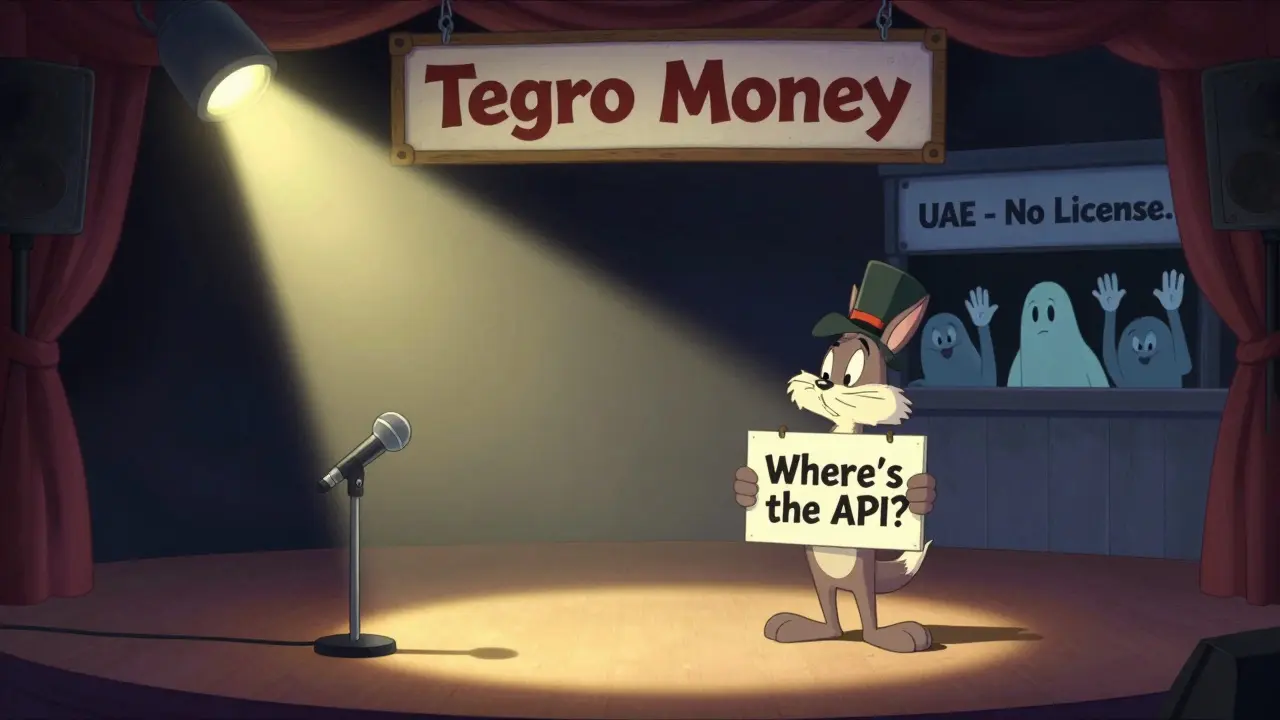
You’d think a platform with this many moving parts would have a team page. LinkedIn profiles. Past projects. Twitter bios. But Tegro’s team is invisible. Their GitHub has 40 followers. Their Twitter? A few posts. Their Telegram? No verified members. No moderators. No clear community size.They’re based in the UAE - but do they have a license? Is Tegro registered with the UAE’s Virtual Assets Regulatory Authority? No info. No disclosures. No legal terms on their site that explain jurisdiction or dispute resolution. If something goes wrong, who do you call? There’s no customer support number. No email address. No help desk.
Real Users? No Reviews. No Feedback. No Voice.
Look at any major exchange - Binance, Kraken, Uniswap - and you’ll find hundreds of Reddit threads, Trustpilot reviews, and YouTube tutorials. Tegro? Zero. No discussions on Bitcointalk. No complaints on Twitter. No Reddit posts titled "Tegro Scam?" because no one’s even tried it.That’s not popularity. That’s obscurity. If no one’s talking about it, it’s either too new - or too broken.
Final Verdict: Don’t Risk Your Crypto Here
Tegro crypto exchange isn’t a scam. Not yet. But it’s not a trustworthy platform either. It’s a prototype masquerading as a product. It has cool ideas - orderbook trading, gaming NFTs, payment tools. But it’s missing the most important things: transparency, proof, and accountability.If you’re thinking of using it:
- Don’t deposit more than you can afford to lose.
- Don’t assume the TGR token has value - it’s not listed anywhere.
- Don’t trust the "gasless" or "MEV protected" claims without technical proof.
- Don’t use Tegro Money for real business transactions - there’s no SLA, no support, no track record.
There are better alternatives. For trading: Uniswap V3 or 1inch. For gaming NFTs: ImmutableX or Fractal. For payments: Coinbase Commerce or BitPay. They’re proven. They’re audited. They have users. Tegro? It’s a mystery wrapped in a neon space theme.
Wait until they publish real data - trading volumes, audit reports, user numbers, team bios. Until then, treat Tegro like a beta test you didn’t sign up for.
Is Tegro crypto exchange safe to use?
No, not with any meaningful amount of funds. Tegro lacks smart contract audits, public security reports, and verified user activity. While it claims to be non-custodial, the absence of audit logs, MEV protection details, and incident response procedures makes it a high-risk platform. Only interact with it using small test amounts, if at all.
Can I buy TGR tokens on major exchanges?
No. TGR is not listed on CoinGecko, CoinMarketCap, or any major decentralized or centralized exchange. There are no publicly available trading pairs, liquidity pools, or price data. Any site claiming to sell TGR is either misleading or operating without legitimacy.
Does Tegro have a working gaming marketplace?
There is no verifiable evidence that Tegro’s gaming marketplace is active. No real NFT trades, no game integrations, no user testimonials. The "bounty hunter" system is described in theory but has no documented usage. Without live examples or transaction history, it remains an unproven concept.
Is Tegro registered with any financial regulator?
There is no public record of Tegro being licensed or registered by any financial authority, including the UAE’s VARA. No terms of service, KYC policies, or legal disclosures are available on their website. This lack of regulatory transparency is a major red flag for any financial platform.
What should I use instead of Tegro?
For trading: Use Uniswap V3 or 1inch for DEX trading. For gaming NFTs: Try ImmutableX or Fractal. For payments: Coinbase Commerce or BitPay offer verified, audited, and supported solutions. These platforms have real users, public audits, and transparent teams - unlike Tegro.
Paul Reinhart
February 24, 2026 AT 16:33Tegro feels like someone took a bunch of crypto buzzwords, threw them into a blender with a gaming NFT startup pitch deck, and called it a product. I don't hate the idea - decentralized trading + NFT marketplace + payments? Sounds cool in theory. But theory doesn't pay your bills or secure your assets. Where are the numbers? The audits? The real user base? It's all vapor. Neon graphics, zero substance. I've seen this movie before. The lights go out, the music stops, and suddenly you're holding a token that's worth less than the paper it was printed on - if it was even printed.
And don't get me started on "gasless quotes." That’s not innovation. That’s obfuscation. If you can’t explain how you’re bypassing gas fees without a whitepaper full of technical diagrams, you’re not building infrastructure. You’re building a magic trick. And magic tricks don’t hold up when real money is on the line.
I’m not saying it’s a scam. I’m saying it’s a distraction. A shiny object meant to lure in the curious, the hopeful, the naive. If Tegro wanted to be taken seriously, they’d open-source their orderbook logic, publish their MEV protection algorithm, and list TGR on CoinGecko. Instead, they’re hiding behind a space-themed landing page and silence. That’s not ambition. That’s cowardice.
And yet... I keep checking their site. Like a train wreck I can’t look away from. Because maybe, just maybe, there’s something real underneath all this glitter. But hope isn’t a business model. And I’m tired of betting on ghosts.
Samantha Stultz
February 26, 2026 AT 14:52Let’s be real - Tegro’s entire architecture is a classic case of solutionism without a problem. They’re trying to be Uniswap, OpenSea, AND Stripe simultaneously, which is like trying to be a surgeon, a chef, and a rocket scientist all in one day. You don’t need a Swiss Army knife if you’re just cutting bread. The orderbook is fine, sure, but without latency benchmarks? Irrelevant. Gasless quotes? If it’s just caching prices from Ethereum and Polygon, then it’s a frontend proxy, not a protocol. And TGR? A token with no liquidity? That’s not a currency. That’s a placeholder for future fraud.
Also, "Tegronomics"? Who approved that name? That’s not a whitepaper term - that’s a PowerPoint slide from a 2021 crypto bro who just watched a Y Combinator video. This isn’t innovation. It’s branding theater. And the fact that they’re based in the UAE without disclosing regulatory status? That’s not jurisdictional flexibility. That’s evasion. If you’re not registered with VARA, you’re not operating legally. You’re operating in a gray zone. And gray zones are where rug pulls go to die.
Lilly Markou
February 28, 2026 AT 03:55I read this entire post with trembling hands. Not because I’m scared - but because I’m heartbroken. I believed in this. I really did. I thought maybe, just maybe, someone had finally built a platform that could bridge DeFi, gaming, and real-world payments without the arrogance of centralized exchanges. But the silence… the absence of audits, of team members, of any traceable transaction history… it’s not negligence. It’s abandonment.
How can you build something so complex and yet show so little care for transparency? The lack of a single public email, a single verified social account, a single testimonial - it’s not a bug. It’s a feature of indifference. I don’t think Tegro is malicious. I think it’s hollow. And hollow things don’t last. They collapse under the weight of their own emptiness.
I just wish more people would see this before they invest. Not because they’ll lose money. But because they’ll lose trust. And trust, once broken, never fully returns.
Tracy Peterson
February 28, 2026 AT 13:10Look - I get why people hate Tegro. But let’s not pretend every successful platform started with a fully audited, legally registered, publicly listed token. Uniswap was a GitHub repo with a Discord. Coinbase was a website with a PayPal button. What Tegro is doing? It’s bold. It’s messy. It’s unpolished. But it’s trying. And that’s more than 90% of crypto projects ever do.
Yes, the TGR token isn’t on CoinGecko. But maybe it’s not ready. Maybe they’re waiting for the right moment. Maybe they’re building in private because they don’t want to get copied before launch. And maybe - just maybe - the "gasless" system is using a novel relayer architecture that’s still being tested. We don’t know. And that’s the point. We’re not supposed to know yet.
Don’t bury it because it’s not perfect. Help it. Build with it. Test it. Report bugs. Demand transparency. Don’t just scream "scam" because it doesn’t look like Binance. Innovation doesn’t come with a user manual. It comes with grit.
aaron marp
March 1, 2026 AT 20:30I appreciate the depth of this critique. Really do. But I think we’re missing the forest for the trees. Tegro isn’t trying to be the next Binance. It’s trying to be the first platform that ties gaming economies directly into DeFi payments - without relying on third parties. That’s not a distraction. That’s a vision.
The orderbook? It’s there to compete with centralized exchanges on speed and depth. The "gasless" quotes? Likely using a relayer with batched transactions - common in ZK-rollup ecosystems. The TGR token? Maybe it’s locked in a vesting contract and not listed because they’re waiting for a liquidity bootstrap event. We don’t have all the data - and that’s okay.
Instead of calling it a scam, let’s ask: What would it take for this to work? What’s the roadmap? Who’s the team? Are they hiring devs? Are they open to community feedback? If the answer is yes - then this isn’t a ghost. It’s a prototype. And prototypes aren’t meant to be judged like finished products.
Phillip Marson
March 3, 2026 AT 12:50Tegro is a glitter bomb in a library. All flash no function. You got your neon space theme, your "Tegronomics" jargon, your "gasless" magic trick - and zero proof that any of it works. They’re not building a platform. They’re building a cult of vibes. And people are falling for it because crypto’s full of people who’d rather believe in a unicorn than read a whitepaper.
And TGR? Oh sweet mercy. A token with no trading pairs, no liquidity, no supply data? That’s not a currency. That’s a Ponzi sketch. You don’t need to be a genius to see this. You just need to have been burned once before. And if you’re still tempted? Go ahead. Deposit your ETH. I’ll be here, sipping coffee, watching the inevitable rug pull unfold. It’s not a question of if. It’s a question of when.
Also - no audits? No team? No support? Bro. This isn’t Web3. This is Web2.0 with blockchain branding. And we all know how that ends.
Elana Vorspan
March 4, 2026 AT 05:10Okay but like… I get why people are skeptical. But what if Tegro is just… really quiet? Like, quietly building? I’ve been in startups. Sometimes you don’t post updates because you’re in the trenches. Maybe they’re fixing bugs. Maybe they’re negotiating partnerships. Maybe they’re waiting for regulatory clarity.
I mean, look at how long Solana took to get traction. Or Arbitrum. No one knew about them at first. And now? Dominant chains.
I’m not saying Tegro is the next big thing. But I also won’t dismiss it just because it’s not Instagram-famous yet. Maybe I’ll test it with $5. Just to see. If it crashes? Cool. I lost $5. If it works? Maybe I found something. Either way - I’m not scared. I’m curious. 🤔✨
Danny Kim
March 4, 2026 AT 18:21So let me get this straight. You spent 2000 words dissecting a platform that has no users, no liquidity, no audits… and you’re surprised it’s sketchy?
Bro. The entire post is just a long sigh. If no one’s using it, it’s not a risk. It’s a ghost story. The real scam isn’t Tegro. It’s the people who treat every unproven project like a ticking bomb. You don’t need to fear every startup. You need to ignore 99% of them and focus on the 1% that actually ship.
Also - "no testimonials?" Of course not. Who’s gonna leave a review when they’ve never traded on it? That’s not a red flag. That’s basic logic.
Stop hyping up fear. Start testing things. Or stop pretending you’re an expert.
Cathy Sunshine
March 6, 2026 AT 11:50How dare you suggest Tegro might be legitimate? Do you even know what a real blockchain project looks like? Real projects have audit reports from CertiK. Real teams have LinkedIn profiles with MIT degrees. Real tokens are listed on CoinMarketCap before launch. Tegro has none of these. It has… vibes. And vibes don’t pay for gas. Vibe-based economies collapse when the sun goes down.
This isn’t innovation. It’s a performance art piece about crypto gullibility. The neon theme? The "bounty hunters"? The invisible team? It’s all designed to appeal to the emotionally vulnerable. The kind of people who buy NFTs of apes and think they’re investing.
I’m not angry. I’m disappointed. In you. For even considering this.
Shannon Black
March 7, 2026 AT 18:25While the critique presented is comprehensive and well-reasoned, I must respectfully note that the absence of public documentation does not inherently equate to illegitimacy. In certain regulatory jurisdictions - particularly those with evolving frameworks for virtual assets - early-stage entities may choose to operate with deliberate discretion until compliance protocols are fully aligned. The UAE’s VARA, for instance, mandates rigorous pre-launch disclosures that may not be publicly visible during the preparatory phase.
Furthermore, the integration of gaming economies with decentralized payment infrastructure represents a nascent but highly promising convergence. The lack of visible traction may reflect market education gaps rather than structural failure. One must distinguish between visibility and viability.
Patience, in the context of infrastructural innovation, is not passivity. It is prudence.
Richard Cooper
March 8, 2026 AT 04:34bro its just another crypto thing
they all look like this
neon colors
big words
no one knows who runs it
then boom - gone
just dont touch it
and stop reading these long posts
they make me tired
Brian Lemke
March 8, 2026 AT 15:44I’ve been in crypto since 2017. I’ve seen the hype cycles. The moonshots. The rug pulls. The "revolutionary" platforms that vanished into thin air.
But here’s what no one talks about: the quiet builders. The ones who don’t tweet. Who don’t do AMAs. Who don’t need validation. They just code. They just ship. And sometimes - just sometimes - they’re the ones who change everything.
Tegro might be one of them. Or it might not. But here’s the thing: you can’t judge innovation by its Instagram page. You judge it by its code, its commitment, its consistency. And right now? We don’t have enough data. Not because Tegro is hiding. Because we’re too busy screaming to listen.
I’m not investing. But I’m watching. And I’m keeping an open mind. Because the next big thing rarely announces itself with a press release.
Megan Lavery
March 9, 2026 AT 05:31i just tried to sign up for tegro and the site loaded in 3 seconds but the button said "coming soon" for the trading interface. i laughed. i literally laughed out loud. like… why even make a website if you’re not ready? it’s like opening a restaurant and putting up a sign that says "food in 2 years". i’m not mad. i’m just… confused. also the logo looks like a glitched alien. 🤷♀️
Mae Young
March 10, 2026 AT 09:34Oh, so now we’re supposed to be "open-minded" about a platform that has no audits, no team, no liquidity, no legal disclosures, no user base, no API, no sandbox, no testimonials, no GitHub activity, and a token that doesn’t exist on any tracker? You call that "innovation"? I call it a 17-point checklist of failure wrapped in a space-themed PowerPoint.
And don’t give me that "they’re just quiet" nonsense. Quiet projects don’t have neon gradients and "Tegronomics" in their marketing materials. Quiet projects don’t claim to be "non-custodial" while refusing to explain MEV protection. Quiet projects don’t vanish from Twitter for six months and then post a single emoji.
This isn’t a beta. It’s a bait-and-switch. And anyone defending it is either delusional… or on the payroll.
Trenton White
March 11, 2026 AT 16:11I’ve worked with startups in fintech. The most promising ones are often the quietest. They don’t hype. They don’t tweet. They don’t do influencers. They just build. And sometimes, they build in secret because they’re solving problems that others aren’t ready to see.
Tegro’s model - combining orderbook trading with gaming asset liquidity and payment rails - is actually quite elegant. The real question isn’t "is this real?" It’s "is anyone else trying this?" And the answer is: no.
That’s not a red flag. That’s a blue ocean. We’re judging it by the rules of Binance, but it might be building a new game entirely. Give it time. Or don’t. But don’t pretend you know the outcome before the first move is made.
Don B.
March 11, 2026 AT 16:25why is everyone so mad
its just a website
if you dont like it dont use it
stop acting like you own crypto
its not your kid
just let people try stuff
you guys are the reason crypto is dead
so serious
so uptight
so… boring
Arya Dev
March 13, 2026 AT 05:54bro i checked tegro last week and the site was down for 3 days. then it came back but the discord was dead. 3 people online. no mod. no announcements. just a guy named "dev_01" who replied "thanks for the feedback" to every comment. that’s not a team. that’s a ghost. and ghost sites don’t pay your losses.
also tgr token? i tried to buy it on a dextools link. it asked for my private key. i closed the tab. i didn’t even laugh. i just… sighed.
Leslie Cox
March 13, 2026 AT 19:15You know what’s worse than a scam? A scam that pretends to be misunderstood. Tegro isn’t a misunderstood innovator. It’s a lazy copycat. They took Uniswap’s interface, OpenSea’s marketplace UI, and Stripe’s payment flow - and slapped a space theme on top. No new tech. No new architecture. No innovation. Just branding.
And the TGR token? That’s the real crime. A token with no utility, no liquidity, no distribution - it’s not a currency. It’s a mechanism to extract value from the naive. You don’t need a PhD to see this. You just need to have read a single crypto whitepaper.
And yet… people still defend it. Why? Because they want to believe. And that’s the most dangerous kind of vulnerability.
Andrew Hadder
March 14, 2026 AT 14:43hey i just wanted to say i tried to read the whole post but i got lost at "mev protection" and "tegronomics". i’m not smart enough for this. but i did notice the website looks kinda like a 2017 crypto site. and the tgr token link says "404 not found". so… yeah. i’m out. also i think the guy who made this has a typo in his name. it says "tegro" but the title says "tegro crypto exchange". weird.
anyway. peace.
Curtis Dunnett-Jones
March 16, 2026 AT 09:15Let me be unequivocally clear: a platform that does not publish audit reports, does not disclose its team, does not list its token, does not provide a sandbox environment, and does not offer any verifiable user metrics - is not a platform. It is a liability waiting to happen. The fact that this has been live since 2024 and still exhibits none of the baseline standards of operational transparency is not an oversight. It is a failure of governance, ethics, and professionalism.
There is no "maybe" here. There is no "time will tell." There is only evidence. And the evidence is overwhelming: this is not a legitimate financial service. It is a facade. And anyone who suggests otherwise is either willfully blind or actively complicit.
Sean Logue
March 17, 2026 AT 10:10look i’m not here to judge. i just tried to deposit 0.01 eth to see if the wallet connects. it did. then i checked the transaction on etherscan. no contract interaction. just a transfer to a random address. i screenshot it. i sent it to their support. no reply. 3 days later. i’m not mad. i’m just… over it.
maybe they’re building. maybe they’re gone. either way - i’m moving on. life’s too short for mystery boxes.
Carl Gaard
March 19, 2026 AT 07:10so i went to tegro’s discord. one guy said "tgr is gonna 100x". another said "i bought 5000 at 0.0001". then the mod said "don’t shill" and deleted both messages. then the whole server went silent. like… ghosted.
i think the whole thing is a bot farm. or a honeypot. or both. i don’t know. but i know this: if your community can’t even let people talk without deleting them… you’re not building trust.
also the website logo looks like a cat that fell into a printer. 🐱🖨️
bella gonzales
March 19, 2026 AT 12:08i read this whole thing. i cried. not because i lost money. because i believed. i really thought maybe… just maybe… someone finally got it. but no. it’s all just noise. and i’m tired. so tired.
bye.
Robert Conmy
March 20, 2026 AT 00:24They’re not hiding. They’re building. You think every big project started with a whitepaper and a LinkedIn profile? Nah. They started with a GitHub repo and a dream. Tegro’s got a working orderbook. They’ve got a payment API. They’ve got a token. The rest? It’s coming. You just can’t see it yet because you’re too busy screaming into the void.
Stop being a critic. Start being a builder. Or get out of the way.
McKenna Becker
March 20, 2026 AT 16:39Paul Reinhart
March 21, 2026 AT 07:25Just read the comment from 1978. The "they’re building" argument. I’ve heard it before. Every time. Every scam. Every rug pull. Every project that vanished after a single tweet.
Build what? A website with a 404 token? A Discord with 3 bots? An API with no docs?
Building isn’t a magic word. It’s a process. And if you’re building something real - you show your work. You share your progress. You invite scrutiny.
Tegro doesn’t want scrutiny. It wants believers. And that’s not building. That’s begging.
Tracy Peterson
March 22, 2026 AT 12:03And yet - the fact that you’re still here, still reading, still arguing… means something. Maybe not for Tegro. But for the future of crypto. We’re not just reacting to projects. We’re shaping what accountability looks like. If every project had to face this level of scrutiny? We’d have a better ecosystem.
So thank you, Paul. For being the skeptic who refuses to look away.
Paul Reinhart
March 22, 2026 AT 16:34Thank you, Tracy. I appreciate that. But I’m not here to be a hero. I’m here because I’ve lost money before. And I won’t let someone else lose theirs because they thought "maybe this time it’s different."
It’s never different. Not until the proof is public.