

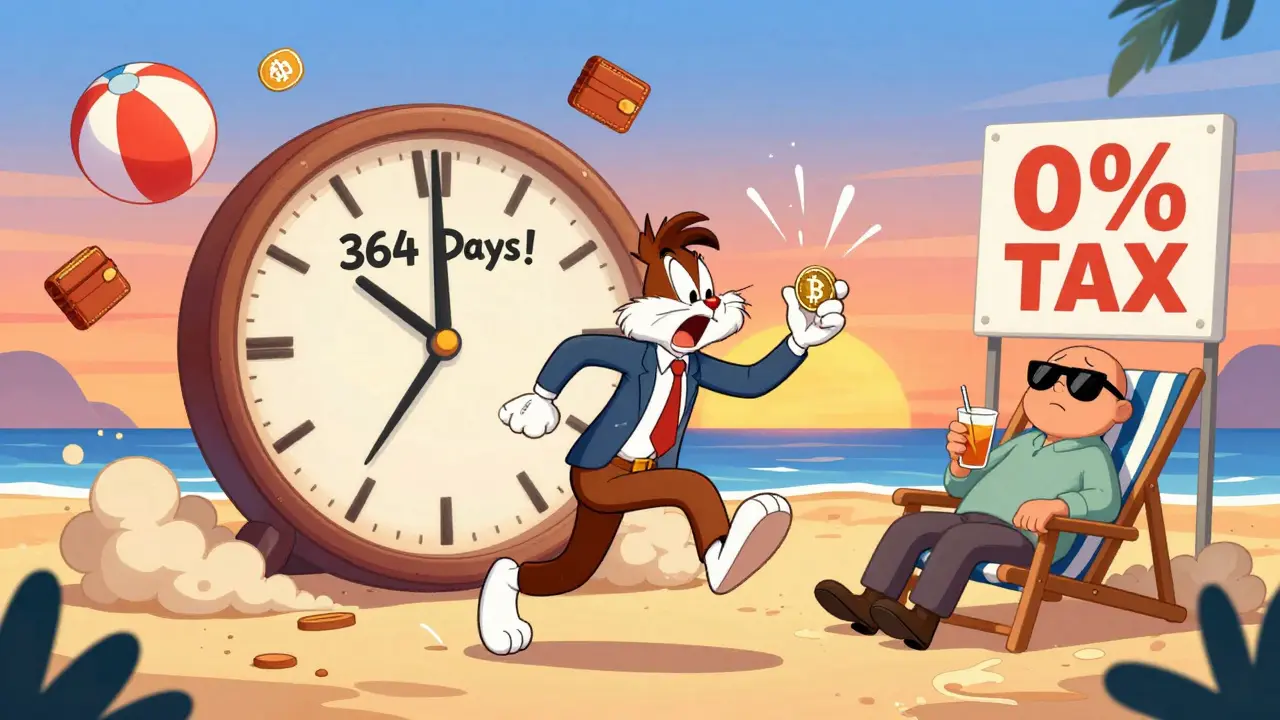
If you're holding cryptocurrency for the long term, Portugal might be the most tax-friendly place in Europe right now. Forget the confusing rules in other countries. In Portugal, if you hold your crypto for more than 365 days, you pay zero tax when you sell it. That’s it. No hidden fees. No progressive rates. Just pure, clean profit.
How Portugal’s Crypto Tax Rules Actually Work
Portugal didn’t always have clear crypto rules. For years, there was no tax on crypto gains at all. That changed in 2023, but not in a way that hurts long-term investors. The government introduced a new system that targets traders, not holders. Here’s the breakdown:- Long-term gains (over 365 days): 0% tax. Period. Whether you made €1,000 or €1 million, if you held it for a year or more, you keep it all.
- Short-term gains (under 365 days): 28% flat tax. This applies when you buy and sell within a year.
- Crypto-to-crypto trades: No tax. Swapping Bitcoin for Ethereum? No taxable event.
- Staking or lending rewards: Taxed at 28% as capital income, regardless of how long you held the asset.
- Professional trading or mining: Treated as self-employment income, taxed between 14.5% and 53% based on your total yearly income.
What Counts as a Holding Period?
The 365-day rule isn’t just a suggestion-it’s the law. But here’s what most people get wrong: the clock starts when you acquire the crypto, not when you first buy it on an exchange. For example:- You buy 1 BTC on January 15, 2025.
- You sell it on January 16, 2026. That’s 366 days. Tax-free.
- You sell it on January 14, 2026. That’s 364 days. 28% tax applies.
When Does Tax Actually Trigger?
Portugal doesn’t tax unrealized gains. You don’t pay tax just because your Bitcoin went from €30,000 to €60,000. You only pay when you cash out-or spend it. Taxable events in Portugal:- Selling crypto for Euros (or any fiat currency)
- Using crypto to buy goods or services
- Exchanging crypto for another crypto if it’s considered a security or traded outside the EEA
- Transferring crypto between your own wallets
- Buying crypto with fiat
- Crypto-to-crypto swaps (as long as neither asset is classified as a security)
How Portugal Compares to the Rest of Europe
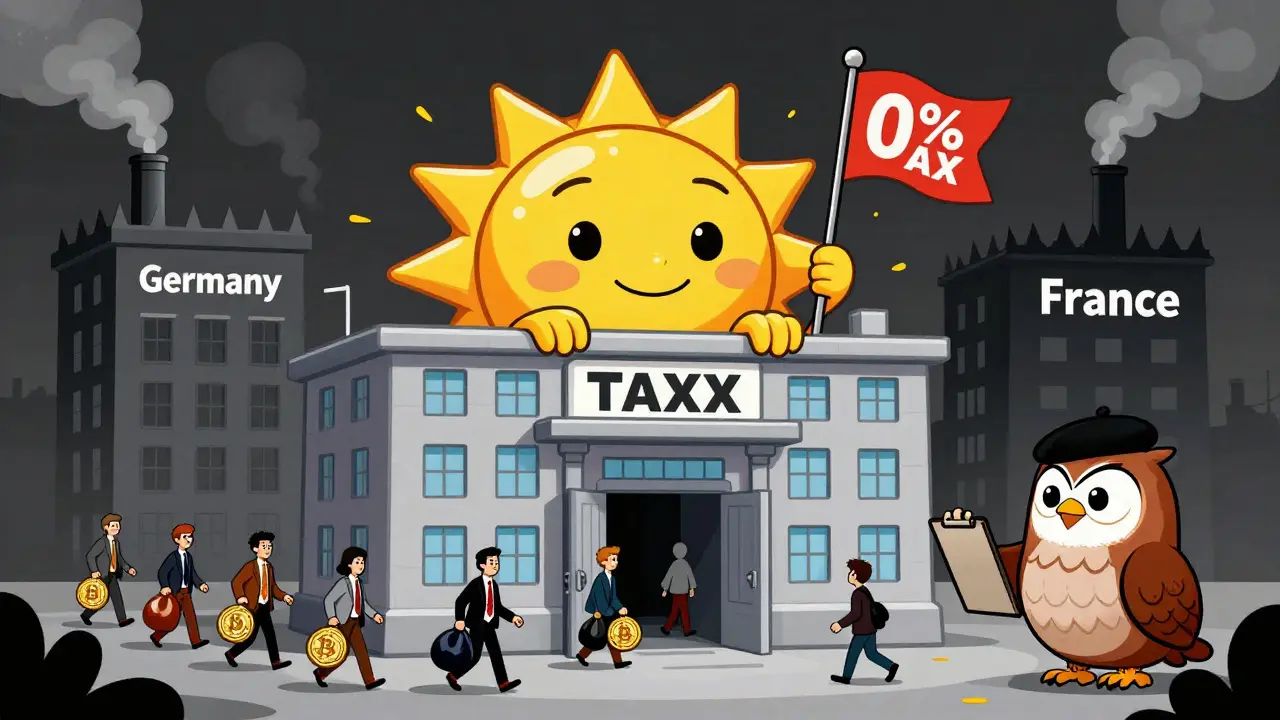
In 2025, Portugal still leads Europe in crypto tax friendliness. Here’s how it stacks up:| Country | Short-Term Gains | Long-Term Gains | Staking/Lending Tax |
|---|---|---|---|
| Portugal | 28% flat | 0% | 28% flat |
| Germany | Up to 45% (income tax) | 0% (if held >1 year) | Up to 45% |
| France | 30% flat | 30% flat | 30% flat |
| Spain | 19%-28% (progressive) | 19%-28% (progressive) | 19%-47% |
| Italy | 26% flat | 26% flat | 26% flat |
| Belgium | 33% (personal income tax) | 0% (only if private investor, strict conditions) | 33% |
What You Need to Keep Records Of
The Portuguese tax authority doesn’t require you to file crypto reports separately. But if you’re audited-and they do audit high-net-worth individuals-you need to prove your holding periods. You must keep:- Exact date and time of each crypto purchase
- Amount purchased and price in EUR
- Wallet address or exchange used
- Date and time of each sale or spend
- Amount sold and sale price in EUR
- Transaction IDs or receipts
Who Should Consider Moving to Portugal?
You don’t need to be a Portuguese citizen to benefit. Non-residents who become tax residents can claim the same rules. To qualify as a tax resident, you must:- Live in Portugal for more than 183 days in a calendar year, OR
- Have a home in Portugal that you intend to use as your main residence
What Doesn’t Work in Portugal
There are limits. The tax exemption doesn’t apply if:- Your crypto is classified as a security (like some tokenized stocks or utility tokens with equity features)
- You hold assets outside the European Economic Area (EEA) and trade them through non-EEA platforms
- You’re a professional trader (earning over €10,000/year from crypto)
Real-World Example: How Much You Save
Let’s say you bought 5 ETH in January 2024 at €2,000 each. Total cost: €10,000. By January 2026, ETH is worth €4,000 each. You sell all 5.- Hold period: 2 years → 730 days → tax-free
- Proceeds: €20,000
- Profit: €10,000
What’s Next for Portugal’s Crypto Tax Rules?
Portugal is watching the EU’s MiCA regulation closely. MiCA sets standards for crypto asset issuance and AML compliance, but it doesn’t override national tax laws. Portugal has made it clear it will keep its long-term exemption. Experts expect updates on DeFi, NFTs, and CBDCs, but the core rule-365-day exemption-won’t change. Why? Because it works. It attracts investment. It keeps people in the country. It reduces tax evasion by giving people a clear, legal path. The message is simple: hold. Don’t trade. Portugal rewards patience.Do I need to be a Portuguese citizen to get tax-free crypto gains?
No. You just need to be a tax resident of Portugal. That means living there for more than 183 days a year or having a home you use as your main residence. Non-citizens, including digital nomads, can claim the same tax exemption as long as they meet residency rules.
What if I sell crypto after 364 days by accident?
You’ll owe 28% on the profit. Portugal doesn’t round up or give grace periods. The rule is exact: 365 full days. If you’re close, it’s better to wait. The tax savings on a large gain can be tens of thousands of euros.
Are NFTs taxed the same as crypto in Portugal?
No. NFTs are treated separately. If an NFT is considered a collectible or unique digital asset, it may fall under different rules. Gains from selling NFTs are generally taxed as capital gains at 28% if held less than a year, and exempt if held longer. But if the NFT represents ownership in a company or generates income (like royalties), it may be treated as business income.
Can I avoid tax by using a crypto wallet outside Portugal?
Not if you’re a Portuguese tax resident. Where you store your crypto doesn’t matter-only where you live and where the sale happens. If you’re a resident and sell crypto for euros, it’s taxable based on your holding period, regardless of wallet location. However, if you trade crypto on a non-EEA platform and the asset is classified as a security, you may lose the exemption.
Do I need to declare crypto holdings if I didn’t sell?
No. Portugal only taxes realized gains. If you haven’t sold, swapped, or spent your crypto, you don’t need to report it. The tax authority doesn’t ask for your wallet balances. You only report transactions that triggered a taxable event.
What happens if I move out of Portugal after holding crypto for 360 days?
You lose the exemption. The tax rule applies only if you’re a Portuguese tax resident at the time of sale. If you move to another country before hitting 365 days, your new country’s rules will apply. For example, if you move to Germany and sell after 368 days total, Germany may still tax you if you held less than a year as a resident there. Timing your move matters.
josh gander
January 30, 2026 AT 09:39Portugal is basically the crypto paradise we all dream about 🌴💰
Hold for a year, cash out, and just… keep it all. No taxes, no drama, no IRS breathing down your neck. I’m seriously considering a move to Lisbon just to lock in this 0% rule. Who needs New York when you’ve got sun, surf, and zero capital gains tax?
Also, swapping ETH for SOL tax-free? That’s the kind of freedom that makes you want to hug your wallet. 🤗
Tom Sheppard
January 30, 2026 AT 10:01bro i just sold my btc after 364 days and cried for 3 hours 😭
then i bought back in and waited another day. now i’m chillin’ like a villain. portugal’s rules are stupid simple. hold >365 = free money. no cap. no bs. just math.
also, fifo is kinda annoying but at least it’s clear. no guessing games. i use koinly now. it’s a lifesaver.
Devyn Ranere-Carleton
February 1, 2026 AT 03:14wait so if i buy crypto in march 2024 and sell in april 2025, but i moved to canada in january 2025, do i still get the 0%? or does canada tax me based on when i acquired it?
also, what if i hold it for 366 days but sell while visiting portugal on vacation? does the location of the sale matter or just my tax residency?
someone pls explain this to me like i’m 12.
Jerry Ogah
February 2, 2026 AT 06:59THIS IS WHY AMERICA IS FALLING BEHIND. WE LET WALL STREET AND THE IRS SCAM US OUT OF OUR HARD-EARNED GAINS WHILE EUROPEANS LAUGH ALL THE WAY TO THE BANK.
Portugal isn’t just tax-friendly-it’s morally superior. You want to hold your assets? You should be rewarded. Not punished.
And yet, here in the US, we’re still taxing people for being patient. Pathetic.
Andrea Demontis
February 2, 2026 AT 11:43There’s something deeply philosophical about this system. It doesn’t just incentivize holding-it rewards patience as a virtue. In a world that glorifies speed, liquidity, and instant gratification, Portugal says: wait. Reflect. Let value unfold.
And the fact that they distinguish between speculation and investment? That’s not just policy-it’s wisdom.
It treats crypto not as a casino chip but as a form of digital capital. And that shift in mindset? That’s what makes this law revolutionary, not just convenient.
Raju Bhagat
February 3, 2026 AT 15:24bro i just moved to portugal last year and my crypto portfolio doubled since then
no taxes no stress no cap
now i’m buying a villa in algarve with my eth profits
who needs a 9 to 5 when you can just hold and chill
also if you dont have a wallet you are not living
send me your btc i will help you with your life
love u all 🤝
laurence watson
February 3, 2026 AT 23:44Really appreciate how clear this is. So many people get overwhelmed by crypto taxes, but Portugal makes it feel… human.
It’s not about tricking the system-it’s about giving people a fair shot. Holding for a year isn’t a loophole, it’s a signal that you believe in the asset.
And honestly? That’s the kind of policy that builds real trust. Not fear. Not fines. Just fairness.
Elizabeth Jones
February 4, 2026 AT 23:43One thing often overlooked: this system reduces tax evasion. When the rules are simple and beneficial, people comply voluntarily. There’s no incentive to hide transactions or use offshore exchanges. It’s elegant governance.
Compare that to countries with convoluted capital gains structures-where people either pay exorbitant rates or risk audits. Portugal’s model is a masterclass in behavioral economics.
Pamela Mainama
February 5, 2026 AT 00:21Hold for a year. Keep the profit. Simple.
Why is this so hard for other countries to get?
Rachel Stone
February 6, 2026 AT 11:39So… you’re telling me the entire US tax code could be replaced with ‘wait a year’?
Wow. Mind blown. 🤖
Nickole Fennell
February 6, 2026 AT 19:56THIS IS A TRAP. PORTUGAL IS A SOFT POWER MOVE BY THE EU TO LURE IN CRYPTO MILLIONAIRES SO THEY CAN TAX THEM LATER.
Just wait. They’ll introduce a 5% wealth tax next year. They always do. First they give you freedom, then they take it back with ‘fairness’.
Don’t fall for it. They’re grooming you for the next phase.
Edward Drawde
February 7, 2026 AT 06:240% tax? lol. you think they dont track your wallet? they got your ip, your exchange logs, your phone number. its all connected. its just a matter of time before they come for you.
trust me. i know how this works.
Richard Kemp
February 9, 2026 AT 05:56Used koinly to track my buys. Had a few small trades in 2023 that the exchange didn’t log right. Took me 3 weeks to fix it. But once I did, the FIFO calc was spot on.
Also, don’t forget to export your reports in Portuguese format if you ever file. The IRS doesn’t care, but the Finanças does.
Elle M
February 9, 2026 AT 22:33Of course Portugal has zero tax. They’re a tiny country that can’t afford to tax their own citizens, so they lure in rich foreigners and call it ‘economic growth’. Classic. It’s not freedom-it’s exploitation dressed up as policy.
Meanwhile, real nations like the US build infrastructure with taxes. You think those roads and schools are free?
Rico Romano
February 11, 2026 AT 01:07Let’s be real: this isn’t ‘tax-friendly’. It’s a tax haven for oligarchs and crypto bros who couldn’t handle real financial responsibility. Portugal is essentially saying: ‘Come here, launder your money, and we’ll pretend you’re not rich.’
Meanwhile, actual investors in Germany pay their dues and still get the same long-term exemption. The difference? They don’t brag about it on Reddit.
Crystal Underwood
February 11, 2026 AT 18:08you think this is safe? you think the eu is gonna let this fly? MiCA is coming and they’re gonna classify ALL crypto as securities. then boom-28% becomes 47% and you’re left holding the bag.
also, staking rewards are already taxed. so you’re not getting ‘free’ anything. you’re just delaying the inevitable.
and don’t even get me started on NFTs. they’re gonna come for you.
Raymond Pute
February 13, 2026 AT 02:39Everyone’s acting like Portugal invented something new. Newsflash: Germany’s had the same 0% long-term rule since 2009. The only difference is Portugal doesn’t make you fill out 17 forms just to prove you didn’t trade.
But here’s the twist: if you’re not a resident, you’re just a tourist with crypto. And tourists don’t get to vote on tax policy. So who’s really benefiting? The same people who always do-the ones with passports, bank accounts, and lawyers.
It’s not a revolution. It’s a relocation service.
Jack Petty
February 13, 2026 AT 16:58They’re using this to build a crypto surveillance state. Every wallet address you use? Logged. Every transaction? Monitored. The ‘0% tax’ is just the bait. The real game is data collection.
Next thing you know, your crypto holdings are tied to your national ID. Welcome to the new Portugal: where your freedom is free… until it’s not.
Brianne Hurley
February 15, 2026 AT 11:02So let me get this straight-you’re gonna move to Portugal, hold your crypto for a year, then cash out and live like a king… while the rest of us are stuck paying 30% just to survive?
And you call that ‘fair’? That’s not capitalism. That’s elitism with a beach view.
Also, NFTs are trash. But you knew that already.
christal Rodriguez
February 15, 2026 AT 13:46Portugal’s rule is elegant, but it assumes you’re not a professional. What if you’re just good at trading? Does ‘holding’ become a loophole for people who trade daily but pretend to be investors?
It’s a fine line between strategy and abuse. And the system doesn’t have teeth to tell the difference.
Gavin Francis
February 16, 2026 AT 06:49Been holding since 2021. Sold half this year after 368 days. Zero tax. Just sent the money to my mate in Lisbon to help him start a crypto café.
Portugal’s not perfect, but this rule? Pure gold. 🏆
Also, swap ETH for SOL? Do it. No one’s watching. 😎