

Imagine watching your screen turn red as a sudden market dip wipes out 20% of your account balance in minutes. You didn't make a bad call; the market just moved against you. In spot trading, where assets are bought and sold for immediate delivery at current prices, this scenario is not an anomaly-it is a constant threat. Unlike futures or options, spot trading involves instant settlement. There is no waiting for a future date to hedge or adjust. When you buy Bitcoin or EUR/USD on the spot market, you own it now, and you bear the full brunt of every price swing immediately.
This immediacy creates a unique danger. While it offers quick profit opportunities, it exposes traders to sudden volatility without the buffer of time. Many beginners think that because they are buying the actual asset, they are safe from the complexities of leverage. They are wrong. The risk in spot trading isn't about liquidation due to margin calls; it's about capital erosion through poor entry points, emotional panic selling, and lack of structural protection. Effective risk management is not optional here. It is the difference between surviving a bear market and blowing up your account in a bull run.
The Psychology of Preservation
Before looking at charts, you need to look at your behavior. The biggest enemy in spot trading is not the exchange or the whale; it is your own brain. Human psychology is wired for fear and greed. When prices drop, the instinct is to panic sell to stop the pain. When prices surge, the instinct is to FOMO (fear of missing out) buy at the top. Both reactions destroy accounts.
Risk management serves three critical purposes: protecting capital, ensuring longevity, and enhancing decision-making. By removing emotion from the equation through pre-defined rules, you create a system that protects you from yourself. Successful traders do not have better predictions than unsuccessful ones. They have better discipline. They treat trading as a business of probability, not a casino of luck. If you cannot follow a plan when things go wrong, you will never succeed when things go right.
Position Sizing: Your First Line of Defense
If there is one rule that separates professionals from gamblers, it is position sizing. This is the amount of capital you allocate to a single trade. Most new traders put too much money into one bet because they are confident-or desperate-to win big. This is a fatal error.
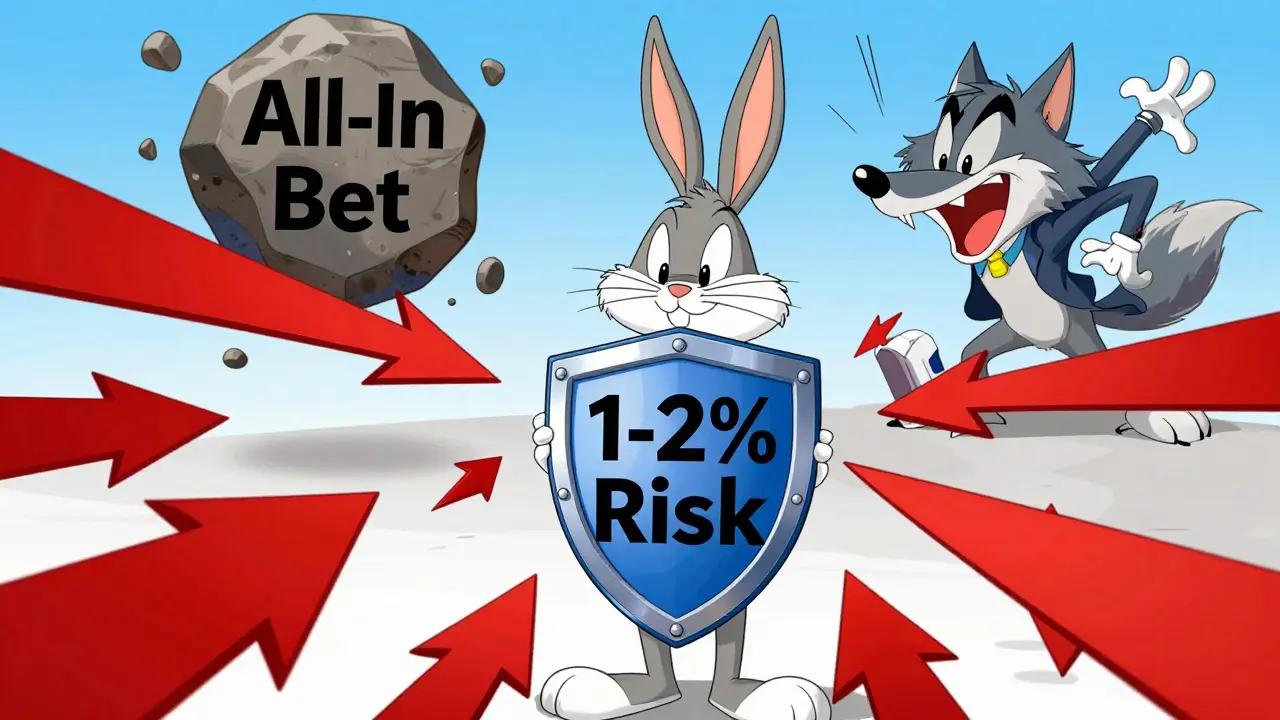
The industry standard for risk per trade is 1-2% of your total capital. Let’s break that down. If you have $10,000 in your account, you should only risk losing $100 to $200 on any single trade. This doesn't mean you only buy $100 worth of Bitcoin. It means that if your stop-loss is hit, the maximum loss is capped at that percentage. Why so low? Because even the best traders lose 40-50% of the time. If you risk 10% per trade, five losses in a row wipe out half your account. Recovering from a 50% loss requires a 100% gain. That is mathematically brutal. With 1-2% risk, ten losses in a row only cost you 10-20%, leaving you plenty of room to recover.
To calculate position size correctly, use this formula:
- Determine your total account balance.
- Decide your risk percentage (e.g., 1%).
- Identify your entry price and stop-loss price.
- Calculate the distance between entry and stop-loss as a percentage.
- Divide your risk amount by the stop-loss percentage to find your position size.
This ensures that no single trade can significantly impact your overall portfolio performance. It forces you to think in terms of series of trades, not individual wins.
Stop-Loss Orders: Automating Discipline
A stop-loss order is a tool that automatically sells a security when its price falls to a predetermined level. Think of it as an insurance policy. You pay nothing upfront, but if disaster strikes, the policy triggers to limit your damage. Many traders skip this step, thinking, "I'll just sell manually if it drops." But when the market crashes, manual selling becomes emotional paralysis. You hesitate. You hope. And then you watch your gains vanish.
Setting a stop-loss converts emotional decision-making into an automatic protective mechanism. It must be defined before you enter the position. Never move a stop-loss further away to avoid being triggered. That is known as "hope trading," and it leads to catastrophic losses. Instead, place your stop-loss below key support levels identified through technical analysis. If the price breaks that support, your thesis was wrong. Get out. Preserve capital. Wait for the next setup.
Diversification: Don't Put All Eggs in One Basket
Diversification is the practice of spreading investments across various assets to reduce exposure to any single asset's risk. In crypto, this might mean holding Bitcoin, Ethereum, and stablecoins. In forex, it could involve trading different currency pairs like EUR/USD and GBP/JPY. The goal is correlation reduction. If one asset crashes due to specific news, others may remain stable or even rise.
However, diversification is not just buying ten random coins. That is called "diworsification." True diversification involves mixing uncorrelated assets. For example, during high inflation, gold might rise while stocks fall. During tech booms, small-cap growth stocks might outperform utilities. Understand how assets relate to each other. A portfolio of five different altcoins that all move with Bitcoin is not diversified; it is concentrated risk disguised as variety. Mix asset classes. Mix sectors. Mix geographies if possible.
Technical Analysis for Entry and Exit
Technical analysis helps predict future market movements by studying past price action. While it doesn't guarantee outcomes, it provides probabilistic edges. Key tools include support and resistance levels, trendlines, and indicators like the RSI (Relative Strength Index).
The RSI measures momentum. Readings above 70 suggest an asset is overbought and may reverse downward. Readings below 30 suggest it is oversold and may bounce upward. Traders using mean reversion strategies wait for RSI to dip below 30 and cross back up before entering. This treats the dip as a temporary discount rather than a crash. Always combine RSI with price structure. An RSI divergence-where price makes a lower low but RSI makes a higher low-can signal weakening downside momentum and a potential reversal.
Use these signals to define your entry and exit points precisely. Enter near support with a stop-loss just below. Take profit near resistance. This creates a clear risk-reward ratio. Aim for at least 1:2. If you risk $100, aim to make $200. This way, you can be wrong more often than right and still be profitable.

Liquidity and Slippage Risks
Liquidity refers to how easily an asset can be bought or sold without affecting its price. High liquidity means tight bid-ask spreads and deep order books. Low liquidity means wide spreads and significant slippage. Slippage occurs when your order executes at a worse price than expected because there aren't enough buyers or sellers at your target price.
In spot trading, always prioritize high-volume assets. Bitcoin, Ethereum, and major forex pairs like EUR/USD offer immense liquidity. You can enter and exit large positions instantly with minimal slippage. Avoid low-cap altcoins or obscure currency pairs unless you are prepared for massive spreads and unpredictable price jumps. Illiquid markets are traps for retail traders. Whales can manipulate them easily, causing fakeouts that trigger your stop-losses before reversing direction.
Hedging Strategies for Advanced Protection
Hedging involves taking an offsetting position to mitigate potential losses. For example, if you hold a large long position in Bitcoin, you might buy put options on Bitcoin. If the price crashes, the puts increase in value, offsetting the loss in your spot holdings. Alternatively, you could short a correlated asset or use inverse ETFs.
While hedging adds complexity and costs (like option premiums), it provides peace of mind during uncertain times. It allows you to keep your core position while protecting against black swan events. However, hedging is not for beginners. It requires understanding derivatives, implied volatility, and delta. Start with simple stop-losses and position sizing before attempting complex hedges.
| Tool | Function | Best Use Case | Complexity |
|---|---|---|---|
| Stop-Loss Order | Automates exit at loss threshold | Every trade, regardless of confidence | Low |
| Position Sizing | Controls capital exposure per trade | Portfolio longevity and drawdown control | Medium |
| Diversification | Reduces single-asset dependency | Long-term portfolio stability | Medium |
| RSI Indicator | Identifies overbought/oversold conditions | Timing entries and exits | High |
| Hedging (Options) | Offsets losses with inverse positions | Protecting large holdings during volatility | Very High |
Monitoring and Adapting
Risk management is not a set-it-and-forget-it task. Markets evolve. Volatility changes. Regulations shift. You must regularly review your strategies. Keep a trading journal. Record every entry, exit, reason, and outcome. Analyze your win rate, average risk-reward, and max drawdown. Adjust your position sizes or stop-loss distances based on current market conditions. In high volatility, widen stops or reduce size. In low volatility, tighten stops or increase size slightly.
Stay informed about macroeconomic events. Interest rate decisions, earnings reports, and geopolitical tensions can cause sudden spikes. Set economic calendars alerts. Avoid opening new positions right before major news unless you are specifically trading the event with appropriate sizing.
What is the most important rule in spot trading risk management?
The most important rule is position sizing. Never risk more than 1-2% of your total capital on a single trade. This ensures that a string of losses does not devastate your account, allowing you to stay in the game long enough to capitalize on winning setups.
How do I determine where to place my stop-loss?
Place your stop-loss below key support levels for long positions or above resistance levels for short positions. Use technical analysis to identify these zones. The stop-loss should be placed where your trade thesis is invalidated, not at an arbitrary dollar amount. Always set it before entering the trade.
Is diversification necessary for spot trading?
Yes, but it must be done correctly. Diversifying across uncorrelated assets reduces the impact of a single asset's failure. However, buying multiple similar assets (like five different meme coins) does not provide true diversification. Mix asset classes and sectors to effectively spread risk.
Why is liquidity important in risk management?
Liquidity ensures you can enter and exit positions quickly without significant slippage. Low liquidity leads to wider spreads and unpredictable price movements, increasing the risk of executing trades at unfavorable prices. Always trade high-volume assets to maintain control over your execution.
How often should I review my risk management strategy?
Review your strategy regularly, ideally after every significant market move or monthly. Analyze your trading journal to identify patterns in losses and wins. Adjust position sizes and stop-loss distances based on current volatility levels. Markets are dynamic, so your risk parameters must adapt accordingly.