
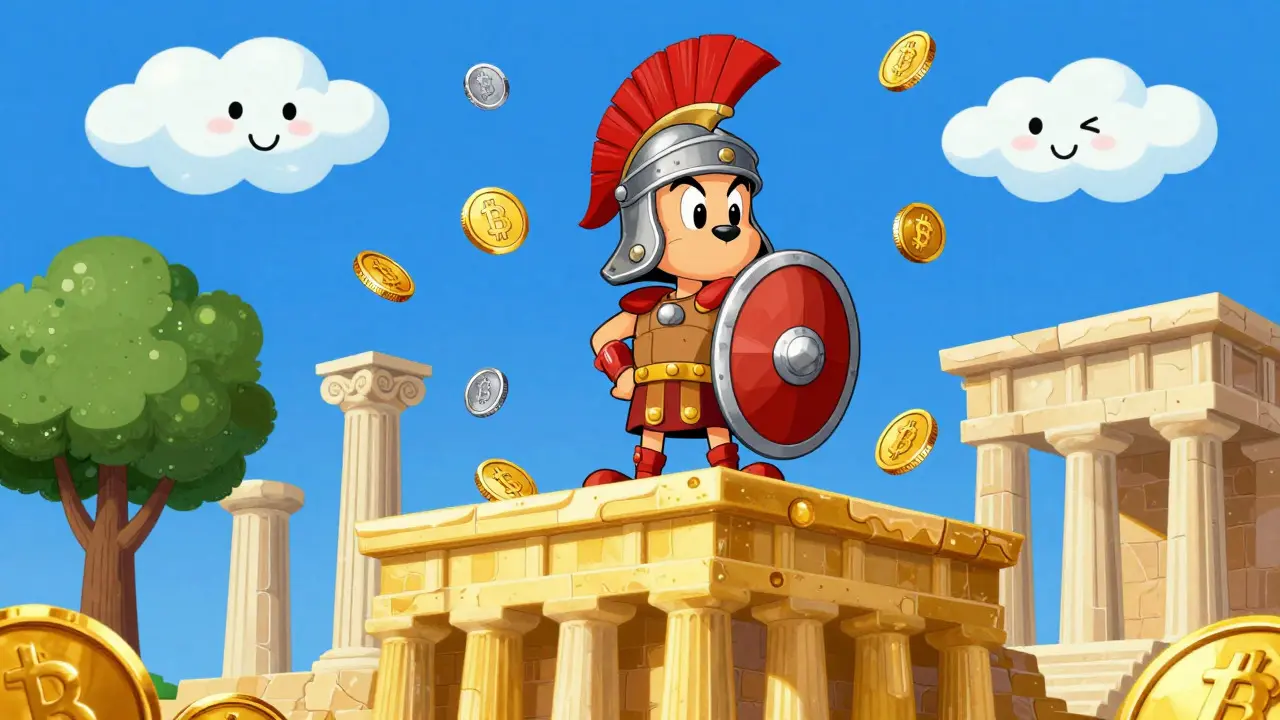
Imagine a world where providing liquidity to a crypto exchange feels less like watching a spreadsheet and more like commanding an ancient Greek city-state. That is the pitch for SpartaDEX, a hybrid platform that blends decentralized finance with strategy gaming. Launched in 2023 on the Arbitrum network, this project attempts to solve one of DeFi's biggest headaches: user retention. By turning passive staking into active gameplay, SpartaDEX aims to keep investors engaged longer, potentially boosting their returns through a unique NFT system called 'Polis'.
But does it actually work? For casual traders looking for deep liquidity and fast execution, the answer might be no. However, for those interested in the intersection of GameFi and DeFi, SpartaDEX offers a compelling, if complex, alternative. In this review, we break down the mechanics, the risks, and the real-world performance to help you decide if your time (and money) is better spent here or on established giants like Uniswap.
How SpartaDEX Actually Works
SpartaDEX is a gamified decentralized exchange where users mint a free 'Polis' NFT to manage a virtual city while providing liquidity to earn rewards. The core loop is simple in concept but intricate in execution. You don't just deposit tokens; you build a civilization. Your 'Polis' NFT tracks your progress, from basic resource gathering to advanced military defense. As you level up your Polis through the 'Senate' ranks, your financial incentives increase. Specifically, higher Senate levels unlock up to 33.3% higher Annual Percentage Rate (APR) when staking Liquidity Provider (LP) tokens.
The platform operates exclusively on Arbitrum, a Layer-2 solution known for low fees and high speed. To start playing, you need to provide at least $100 worth of liquidity to whitelisted pools. Once you do, you can begin allocating resources within your game interface. You have to balance two main priorities: economic development, which boosts your yield generation, and military expansion, which protects your assets from 'raids' by other players. If you neglect defense, other users can attack your city, potentially reducing your efficiency or requiring you to spend extra resources to rebuild. This creates a dynamic ecosystem where community interaction directly impacts individual financial outcomes.
Tokens and Economic Model
SpartaDEX uses a dual-token structure to govern its economy. The first is SAS, the native governance and utility token. Holders use SAS to vote on protocol changes and participate in decision-making processes. The second is SPARTA, the reward token distributed to users for completing game tasks and providing liquidity. SPARTA has a hard cap of 1 billion tokens, a design choice intended to limit inflation over time. As of late 2023, the circulating supply was reported around 5.3 million, suggesting significant room for future distribution or buybacks.
The revenue model relies on standard DEX transaction fees, currently set at a 0.615% bid-ask spread. These fees are generated from trades across the platform's eight active pairs. Unlike traditional exchanges that distribute all fees to LPs, SpartaDEX routes a portion of these earnings into the game economy, funding seasonal tournaments and prize pools. For example, the 'Olympiad 2.0' update introduced competitive seasons with $50,000 prize pools, funded partly by trading volume. This creates a feedback loop: more players mean more engagement, which drives more trading volume, which funds bigger rewards, attracting even more players.

Performance and Market Position
When looking at raw numbers, SpartaDEX is a niche player compared to industry titans. In September 2023, data from CoinGecko showed a 24-hour trading volume of approximately $488,000. While this figure fluctuates, it places SpartaDEX far behind Uniswap, which routinely processes over $1 billion daily, or PancakeSwap, which exceeds $500 million. However, volume isn't everything. SpartaDEX holds 8 listed coins and 8 active trading pairs, a deliberately limited selection designed to maintain focus and liquidity depth in specific assets rather than spreading thin across thousands of tokens.
| Feature | SpartaDEX | Uniswap | PancakeSwap |
|---|---|---|---|
| Primary Network | Arbitrum | Ethereum, Arbitrum, Base | BSC, Ethereum, Polygon |
| Daily Volume | ~$488k | $1B+ | $500M+ |
| Listed Assets | 8 | 8,000+ | 1,000+ |
| Gaming Integration | Yes (Core Feature) | No | Limited (Lottery/NFTs) |
| Min. LP Entry | $100 | None | None |
The user base reflects this niche positioning. DappRadar reported 8,342 unique active wallets interacting with the protocol weekly in September 2023. This represents about 0.17% of Arbitrum's total DEX user base. While small, the community is highly engaged, with a Discord server boasting over 12,500 members. Sentiment analysis from LunarCrush indicated 58% positive sentiment among monthly mentions, though nearly a third of negative comments cited gas fees during peak gameplay hours, a common pain point on Layer-2 networks during congestion.
User Experience and Learning Curve
Getting started with SpartaDEX is not plug-and-play. Most users report spending 3 to 5 hours to complete the onboarding process, significantly longer than setting up a wallet on Uniswap. You need to understand three interconnected systems: standard DEX operations, liquidity pool management, and Greek city-building strategy. The official documentation provides guides for each of the seven Senate levels, but many early adopters found the initial steps confusing.
One Reddit user, 'CryptoSpartan23', shared a positive experience, earning 0.042 ETH ($127) in rewards during their first month by dedicating 20-30 minutes daily to manage their Polis while providing $500 in liquidity. This suggests that consistent, moderate engagement can yield tangible results. On the other hand, 'LiquidityLoser' complained about losing 15% of their initial investment to impermanent loss before fully grasping the game mechanics. This highlights a critical risk: the game layer adds complexity that can obscure standard DeFi risks. If you are new to both DeFi and strategy games, expect a steep learning curve. The Trustpilot rating sits at 3.7/5 based on 47 reviews, with praise for the 'addictive gameplay' balanced by complaints about slow customer support, which averages 72 hours for a response.
Risks and Security Considerations
As with any new protocol, security is a primary concern. Alexei Volkov from CertiK noted in a September 2023 blog post that integrating game mechanics with financial protocols increases the attack surface. At the time of writing, the contract audit status was described as 'unclear,' which is a red flag for conservative investors. Always verify the latest audit reports on the official site before depositing significant capital. Additionally, the SEC's ongoing scrutiny of 'token-as-securities' creates regulatory uncertainty around the SPARTA token's classification, particularly for US-based investors.
Impermanent loss remains a constant threat, amplified by the strategic decisions in the game. If you allocate too many resources to military defense, your economic yield drops, potentially increasing your exposure to price divergence between paired assets. Conversely, neglecting defense leaves you vulnerable to raids, which can disrupt your liquidity provision. The complexity means that 'set and forget' strategies are less effective here; active management is required to maximize returns and minimize losses.
Who Should Use SpartaDEX?
SpartaDEX is not for everyone. It excels in community-building scenarios where projects need loyal liquidity providers who are willing to engage deeply with the ecosystem. It is ideal for:
- GameFi Enthusiasts: Users who enjoy strategy games and want to combine them with DeFi yields.
- Long-Term Holders: Investors willing to commit to a multi-week or multi-month cycle to climb Senate levels and unlock higher APRs.
- Community Builders: Projects seeking to incentivize stable liquidity through gamified rewards rather than pure financial incentives.
It may not be suitable for:
- Institutional Traders: Those requiring deep order books, advanced charting tools, or instant execution without interface clutter.
- Casual Users: Individuals who prefer simple interfaces and dislike managing multiple variables simultaneously.
- Short-Term Speculators: Traders looking for quick flips, as the value proposition relies on sustained engagement and progression.
The roadmap indicates plans for cross-chain expansion to Optimism and Base by Q1 2024, along with AI-powered strategy advisors to assist new users. If these features materialize, the platform could lower the barrier to entry and expand its reach beyond the current Arbitrum-centric user base. However, long-term viability assessments vary, with some analysts estimating only a 38% probability of maintaining top-50 DEX status beyond 2026 due to intense competition from established players.
What is the minimum amount needed to start using SpartaDEX?
You need to provide at least $100 worth of liquidity to a whitelisted pool to begin gameplay and mint your free Polis NFT.
Which blockchain does SpartaDEX operate on?
Currently, SpartaDEX operates exclusively on the Arbitrum network. Expansion to other chains like Optimism and Base is planned for future updates.
How does the game affect my financial returns?
Your 'Polis' NFT levels determine your Senate rank. Higher ranks unlock up to 33.3% higher APR on staked LP tokens. Neglecting defense can lead to raids, which may reduce efficiency or require resource expenditure.
Is SpartaDEX safe to use?
Security depends on smart contract audits and team transparency. As of late 2023, audit status was unclear, so users should verify recent reports. Standard DeFi risks like impermanent loss and smart contract bugs apply.
How long does it take to learn how to play?
Most users report spending 3 to 5 hours on onboarding. The process involves learning DEX basics, liquidity management, and game strategy simultaneously.