
Scam Airdrop Checker
Check Airdrop Legitimacy
Enter a URL or token name to verify if it's a potential scam. Never click unknown links or interact with suspicious tokens.
Free crypto tokens sound too good to be true? They are-when they’re fake. In 2024 and early 2025, users lost over $9.9 billion to cryptocurrency scams, and airdrop fraud was one of the biggest drivers. Scammers don’t need to hack your wallet. They just need you to click a link, sign a transaction, or hand over your seed phrase. And it’s happening right now-on Telegram, Discord, Twitter, and even fake websites that look like Uniswap or Coinbase.
How Airdrop Scams Work
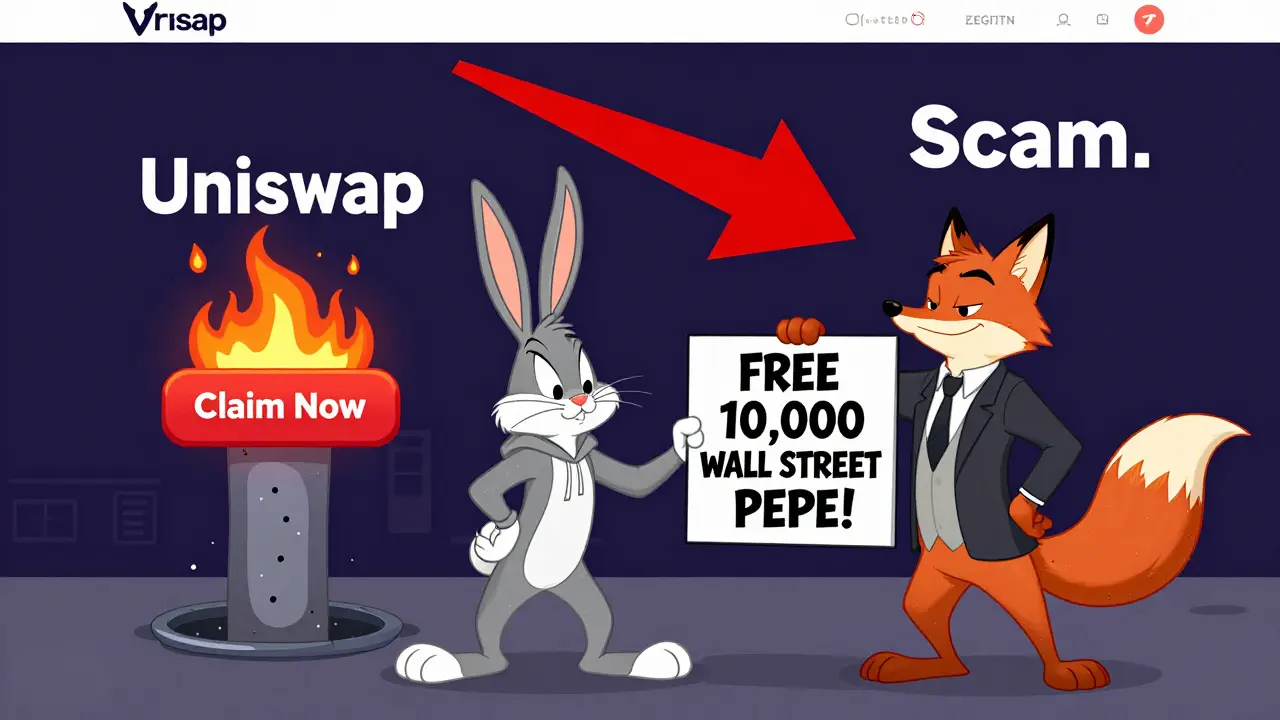
Legitimate airdrops exist. Projects like Uniswap, Arbitrum, and ApeCoin have used them to reward early users and spread adoption. But scammers copied the idea-and made it deadly. They don’t create new tokens. They steal yours. Here’s how it usually goes:- You get a DM on Telegram: "You’re eligible for the Wall Street Pepe airdrop! Claim now before it’s gone!"
- The link takes you to a site that looks exactly like the real project’s page-same logo, same colors, even fake Twitter feeds.
- You connect your MetaMask wallet to "verify eligibility."
- You’re asked to sign a transaction labeled "Claim Airdrop" or "Enable Token Access."
- That transaction? It’s a drainer contract. It gives the scammer unlimited access to your entire wallet. Every ETH, every token, every NFT-gone in seconds.
Red Flags That Mean It’s a Scam
Real airdrops are quiet. They don’t scream. They don’t beg. They don’t message you first. Here’s what to watch for:- Requests for private keys or seed phrases. If they ask for this, close the tab. Walk away. This is the #1 sign of fraud.
- Links from random DMs or unverified accounts. Legit airdrops are announced on official websites and verified social media. If you got it from a stranger on Discord or a Twitter bot, it’s fake.
- Grammar mistakes or awkward English. Professional projects hire writers. Scammers use AI or Google Translate. Typos, strange capitalization, and broken sentences are huge red flags.
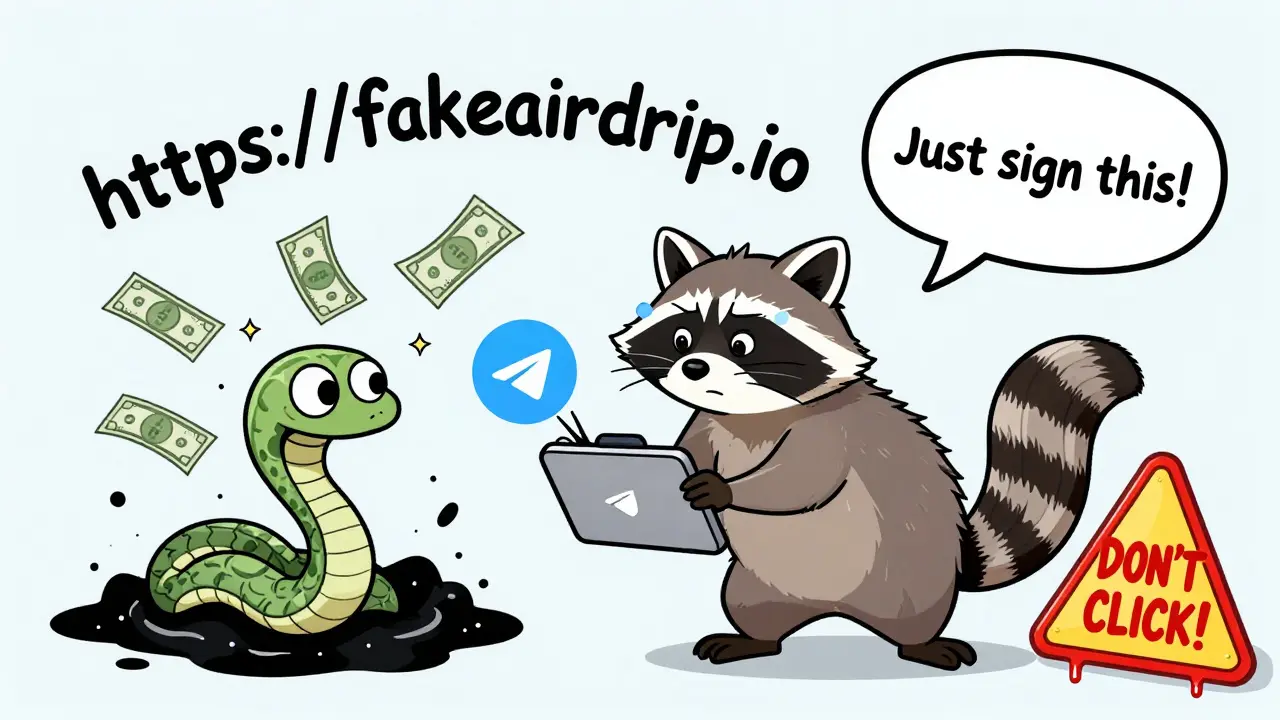
- Token names with URLs. If you see a token called "https://wallstreetpepe.io" or "claim-airdrop.net" in your wallet, that’s not a token-it’s a trap. These are designed to trick you into clicking.
- Too-good-to-be-true rewards. "Get 10,000 tokens worth $50,000 for connecting your wallet?" That’s not an airdrop. That’s a robbery.
- Urgency tactics. "Only 2 hours left!" or "Limited spots!"-these are pressure tactics. Real airdrops last weeks or months.
How Legit Airdrops Are Different
If you’re unsure, compare what you’re seeing to how real projects operate:- They announce on official channels. Check the project’s website, their verified Twitter/X account, and their official Discord server. No third-party links.
- They don’t ask for wallet connections upfront. Many legit airdrops require you to hold a token or complete an action (like staking or using their app) over time. They don’t ask you to connect your wallet just to "claim."
- They’re transparent. They list eligibility rules, timelines, and distribution methods. No vague promises.
- They don’t use AI deepfakes. In May 2025, scammers used AI-generated videos of Coinbase executives to trick users into giving up access. Real companies don’t do that.
What to Do If You Already Connected Your Wallet
If you signed a transaction or connected to a sketchy site, act fast:- Do NOT interact with any tokens in your wallet. Don’t click "Swap," "Unlock," or "Send." Even looking at them can trigger a drainer.
- Hide unknown tokens. In MetaMask, go to "Assets" > "Hide Tokens" and add any unfamiliar tokens. This stops them from auto-displaying and reduces accidental clicks.
- Check your transaction history. Look for any recent "Approve" or "Transfer" actions you didn’t authorize. If you see one, your wallet is compromised.
- Move your funds. Send all your crypto to a new wallet. Never reuse the same seed phrase. Create a fresh wallet with a new 12-word phrase and send everything there.
- Report the scam. Share the link and screenshots on Twitter/X and Reddit’s r/CryptoCurrency. Others might be about to get hit.
How to Protect Yourself Long-Term
The best defense is simple: don’t play.- Use a separate wallet for airdrops. Keep a small amount of ETH (like $20-$50) in a wallet you only use for testing or claiming airdrops. Never put your life savings there.
- Never click links from DMs. Even if it looks like your friend sent it. Their account was hacked.
- Use hardware wallets wisely. Ledger and Trezor keep your keys safe-but they can’t stop you from approving a malicious contract. You still have to say "yes" to the transaction.
- Enable 2FA everywhere. On your exchange, email, and wallet accounts. It won’t stop airdrop scams, but it makes account takeovers harder.
- Follow trusted sources. Stick to official project blogs, CoinGecko, CoinMarketCap, and verified crypto news outlets like The Block or CoinDesk. Ignore random influencers pushing "exclusive" drops.
- Assume every airdrop is fake until proven real. Take 10 minutes to Google the project name + "scam." You’ll often find Reddit threads, Twitter threads, or blog posts warning others.
Why This Keeps Happening
People want free money. That’s human nature. Scammers know that. They don’t need to be smart. They just need to find someone who’s excited, rushed, or new to crypto. The more people believe "free crypto is real," the more scammers thrive. And with AI now generating fake websites, deepfake videos, and even convincing chatbot responses, it’s getting harder to tell real from fake. But here’s the truth: if you’re not the one who created the token, you’re not getting free money-you’re giving away yours.Final Rule: If It Feels Off, It Is
You don’t need to be a hacker to stay safe. You just need to pause. Ask: "Why would they give me this?" "Who benefits?" "What’s the catch?" Legit airdrops reward loyalty and participation. Scams reward greed. The next time you see a "free airdrop," don’t click. Don’t sign. Don’t even open the link. Walk away. Your wallet will thank you.Can I get my money back if I fall for an airdrop scam?
No, you cannot recover funds lost to airdrop scams. Blockchain transactions are irreversible. Once a scammer drains your wallet, the crypto is gone forever. There is no central authority to contact, no refund process, and no way to reverse the transaction. The only thing you can do is stop further damage by moving remaining funds to a new wallet and reporting the scam to warn others.
Are all airdrops fake?
No, not all airdrops are fake. Legitimate projects like Uniswap, Arbitrum, and Optimism have run successful airdrops to reward early users. But real airdrops never ask for your private key, seed phrase, or upfront payment. They also don’t message you first. Always verify through the project’s official website and verified social media accounts before participating.
What should I do if I see a token with a URL in its name?
Hide it immediately. Tokens with URLs in their names (like "https://fakeairdrop.io") are designed to trick you into clicking a malicious link. These are not real tokens-they’re scam tokens. Do not interact with them in any way. Use your wallet’s "Hide Tokens" feature to remove them from view. Never try to swap, send, or claim them.
Can a hardware wallet protect me from airdrop scams?
Not fully. Hardware wallets like Ledger or Trezor keep your private keys secure, but they can’t stop you from approving a malicious transaction. If you connect your hardware wallet to a scam site and sign a contract that grants access to your funds, the scammer can still drain your wallet-even with your keys locked safely on the device. Always review transaction details carefully before approving anything.
Why do scammers target airdrops instead of hacking wallets directly?
Because it’s easier. Hacking a wallet requires technical skill and tools. Airdrop scams exploit human behavior-greed, fear of missing out, and trust in familiar branding. You give the scammer access yourself by clicking a link or signing a transaction. They don’t need to break in. They just need you to open the door.
Is it safe to join a Telegram group for an airdrop?
Only if you’re 100% sure it’s the official group. Most airdrop-related Telegram groups are fake. Scammers create them to spread links, build fake credibility, and pressure you into acting fast. Even if the group has hundreds of members, it doesn’t mean it’s real. Always cross-check the group link with the project’s official website before joining.
Can I trust airdrops promoted by influencers?
No. Influencers are often paid to promote scams. Some don’t even know they’re promoting fraud-they’re given fake links by scammers. Always verify the airdrop through the project’s official channels, not through a tweet or YouTube video. If an influencer says "I got this for free," they’re probably lying.
What’s the safest way to participate in a real airdrop?
Use a dedicated wallet with only a small amount of ETH. Never use your main wallet. Only interact with airdrops through the project’s official website-never through links in messages or ads. Read the official documentation. If it asks for anything unusual, skip it. The safest airdrop is the one you don’t claim.
Joe B.
December 4, 2025 AT 03:42Bro, I just lost $12k last month to a "Wall Street Pepe" airdrop. Thought it was legit because the site had the same font as Uniswap. I didn’t even notice the URL was "wallstreetpepe[.]io"-not .org. Now I’m just trying to forget I ever connected my wallet. 🤦♂️
Sarah Locke
December 5, 2025 AT 17:47Y’all need to stop acting like this is new. I’ve been warning people since 2021 that airdrop scams are the new phishing. The fact that people still click links from random DMs? That’s not ignorance-that’s willful stupidity. You want free crypto? Work for it. Don’t be a sheep.
Also, hardware wallets don’t save you. They just make you feel safe while you sign a drainer contract. Wake up.
Rod Filoteo
December 5, 2025 AT 21:36AI deepfakes are the real threat now. I saw a video of a Coinbase exec saying "claim your $50k airdrop now"-looked 100% real. Voice, mannerisms, even the background. I almost clicked. Then I noticed the reflection in his glasses was glitching. That’s not a scam. That’s a war. And we’re losing.
Who’s funding this? Big Tech? The Fed? Someone’s profiting off our greed. And they’re not using bots-they’re using AI trained on our behavior. We’re not being scammed. We’re being engineered.
Mani Kumar
December 6, 2025 AT 23:01Legitimate airdrops are rare. Most are scams. The only safe approach is zero engagement. Do not connect wallets. Do not sign anything. Do not even open links. The blockchain is not a lottery. It is a ledger. Treat it as such.
Tatiana Rodriguez
December 8, 2025 AT 03:38I just want to say to all the newbies out there: you’re not alone. I fell for this too. I thought I was smart because I held ETH since 2020. But when that Telegram DM popped up saying "You’ve been selected for the Arbitrum airdrop!"-I clicked. I signed. I lost $8k.
It took me months to get over it. But now I help others avoid it. If you’re reading this and you’re scared? That’s good. Fear keeps you alive. Pause. Breathe. Google the project name + "scam." Nine times out of ten, you’ll find someone who already got burned. Don’t be number ten.
Lawal Ayomide
December 8, 2025 AT 08:55Scammers don’t care about your wallet. They care about your trust. That’s why they copy logos. That’s why they use real names. That’s why they sound nice.
You think you’re safe because you know crypto? That’s exactly what they want you to think.
justin allen
December 9, 2025 AT 01:27Why are we even talking about this? It’s 2025. If you can’t tell a fake website from a real one, you shouldn’t be holding crypto. This isn’t a "how to avoid scams" guide-it’s a "how to stop being an idiot" manual. America’s crypto education system is a joke. And now the world is paying for it.
Darlene Johnson
December 9, 2025 AT 19:59They’re using AI to mimic real project admins in Discord now. I saw a guy in a "Uniswap Support" channel who answered questions perfectly. Same tone, same replies. I asked him to verify his identity-his answer was flawless. Then I checked his account creation date: 3 hours ago. He was an AI bot trained on 10,000 real support logs. The future is terrifying.
Ivanna Faith
December 10, 2025 AT 03:40Why do people still fall for this? It’s the same script since 2017. Fake link. Fake logo. Fake urgency. If you didn’t learn by now, you never will. Just delete your wallet and go back to stocks. At least there’s a SEC to cry to
samuel goodge
December 10, 2025 AT 18:25There’s a deeper truth here: the scam isn’t the link. It’s the belief that wealth can be distributed without labor. We’ve been conditioned to expect something for nothing. The blockchain merely reflects that cultural sickness. The airdrop scam is a mirror. What we see in it is not the scammer’s greed-but our own.
Perhaps the real fraud isn’t the drainer contract. It’s the illusion that crypto is a shortcut to freedom.
Catherine Williams
December 12, 2025 AT 04:17Hey newbies-please, please, PLEASE use a burner wallet. I keep a $30 wallet just for airdrops. If I get scammed, I lose $30. Not my life savings. It’s not glamorous, but it’s smart. And if you’re using your main wallet? You’re not a crypto investor-you’re a walking target.
You don’t need to be a genius to stay safe. Just be lazy enough to not click stuff.
Paul McNair
December 14, 2025 AT 02:29In Nigeria, we call this "419"-same scam, different century. The only difference now is the tech. Back then, it was emails. Now it’s Telegram bots with AI-generated voices. But the psychology? Still the same: exploit hope.
Teach your parents. Teach your cousins. This isn’t just about crypto-it’s about digital literacy. And if we don’t teach it, the next generation will drown in it.
Akash Kumar Yadav
December 14, 2025 AT 12:48Indians are the biggest victims of these scams. Why? Because they believe in "free money" more than anyone. I’ve seen guys sell their bikes to buy ETH for an airdrop. Then they lose it all. This isn’t finance. It’s religion. And the priests are scammers with Discord roles.
Jay Weldy
December 15, 2025 AT 13:23I get it. You see a $50k airdrop and your brain goes "this is my ticket." But here’s the thing: if it’s real, it doesn’t need to scream. Real projects whisper. They wait. They build. They reward loyalty, not panic.
So next time you feel that rush? Take a walk. Drink water. Come back in 10 minutes. If you still want to click it? Then maybe you’re not ready.
Melinda Kiss
December 17, 2025 AT 10:14Just wanted to say thank you for this post. I showed this to my mom yesterday-she’s 68 and just started using crypto. She got a DM yesterday saying she won a Binance airdrop. She didn’t click. She sent it to me. We laughed. Then we blocked it.
You saved her $15k. And you saved me a sleepless night. Thank you for being the voice that tells us to pause.
Christy Whitaker
December 18, 2025 AT 00:44Of course you lost money. You connected your wallet to a site that looked like Uniswap. You didn’t check the contract address. You didn’t verify the domain. You didn’t even Google it. You’re not a victim. You’re a liability. And now you’re wasting everyone’s time with your sob story.
Nancy Sunshine
December 19, 2025 AT 06:08It is imperative to underscore that the structural vulnerability lies not in cryptographic protocols but in the cognitive architecture of the human actor. The airdrop scam, as a phenomenon, represents a catastrophic failure of epistemic discipline within decentralized finance ecosystems. One must cultivate a hermeneutics of skepticism-interrogating every interface, every transaction signature, every semantic cue-lest one become complicit in one’s own financial annihilation.
Alan Brandon Rivera León
December 19, 2025 AT 15:42My buddy got scammed last week. He thought the Telegram group was legit because it had 10k members. I told him: "If a scam has 10k members, it’s not a scam-it’s a cult." He still clicked. Now he’s in therapy. And I’m the one who has to explain to his wife why his ETH is gone.
Don’t be that guy. Don’t be that husband. Don’t be that friend.
Ann Ellsworth
December 20, 2025 AT 10:27Y’all are missing the point. The real scam is the belief that DeFi is accessible. It’s not. It’s a game for degens with 7 wallets and 3 hardware devices. If you’re using MetaMask on your phone and got a DM? You’re not investing. You’re gambling in a casino where the house writes the code. And the house always wins.
Also, "Wall Street Pepe"? That’s not a token. That’s a meme. And memes don’t pay dividends. They pay your funeral.
Ankit Varshney
December 21, 2025 AT 14:19Don't click links. Don't sign anything. Don't trust DMs. That's all. No need for long posts. Just follow this.
Ziv Kruger
December 22, 2025 AT 06:18Free money is a myth. The only thing free here is your wallet
Britney Power
December 23, 2025 AT 11:15Let me be clear: this post is dangerously naive. It assumes users have the cognitive capacity to discern legitimacy. They don’t. Most users are not rational actors-they are emotional ones, primed by dopamine-driven UIs and influencer culture. The solution is not education. It is regulation. Or better yet-ban airdrops entirely. They are a vector for mass financial exploitation disguised as decentralization.
Jess Bothun-Berg
December 25, 2025 AT 08:24You people are pathetic. You lose $10k and you write essays? Just stop. Don’t click. Don’t sign. Don’t open. That’s it. No more drama. No more "I learned my lesson." Just be smarter. Or don’t touch crypto at all.
Reggie Herbert
December 27, 2025 AT 06:13Actually, you’re all wrong. The real issue is that most people don’t understand transaction signatures. They see "Approve Token Transfer" and think it’s safe. But it’s not. It’s a permission grant. And once you give it, you can’t take it back. The problem isn’t the scammer. It’s the UI. Wallets should require a 3-step confirmation for any approval. Not one click. This isn’t a user education problem. It’s a UX design failure.