
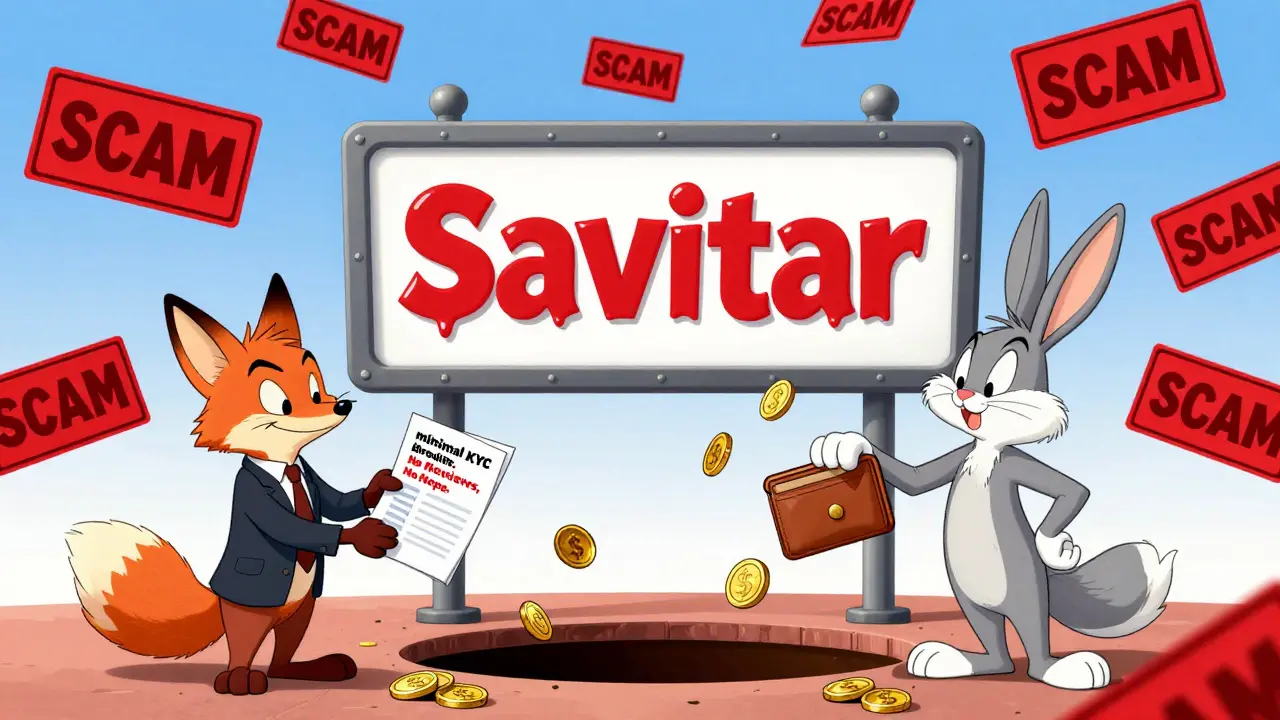
There’s no such thing as a legitimate crypto exchange called Savitar. Not anymore. Not ever. At least, not one you can trust.
If you’ve seen ads, forum posts, or YouTube videos pushing ‘Savitar’ as a new crypto trading platform with ‘minimal KYC’ and ‘top-class security,’ you’re being targeted. This isn’t a glitch in the search results. It’s a classic scam tactic-changing one letter to trick you. The real name floating around in shady corners is Savita Exchange, and even that name has no verifiable footprint in the crypto world.
Let’s cut through the noise. No major exchange directory lists Savitar or Savita. Not CoinGecko. Not CoinMarketCap. Not CryptoCompare. Not even the obscure ones. These platforms track over 700 exchanges. If Savitar existed, it would be there. It’s not. That alone should be your first red flag.
Why ‘Minimal KYC’ Is a Warning Siren
One of the biggest claims made by Savita Exchange is that it requires ‘minimal KYC verification.’ That sounds appealing if you’re tired of uploading your ID and waiting days for approval. But here’s the truth: in 2026, minimal KYC doesn’t mean ‘user-friendly.’ It means ‘illegal.’
The Financial Action Task Force (FATF) updated its rules in 2024. Every exchange that wants to operate legally must follow the Travel Rule for transactions over $1,000. That means collecting and sharing sender and receiver identities across borders. Over 92% of legitimate exchanges now do this. Savita’s claim of ‘minimal KYC’ directly violates this global standard.
And it’s not just about rules. It’s about safety. Exchanges that skip proper identity checks are magnets for criminals. According to Chainalysis’ 2025 Crypto Crime Report, 100% of the $1.34 billion stolen from exchanges in 2024 came from platforms with weak or no KYC. North Korean hacking groups don’t target Binance or Coinbase. They go after the ones that don’t ask for your name.
No Security Details? That’s Not ‘Top-Class’-That’s Suspicious
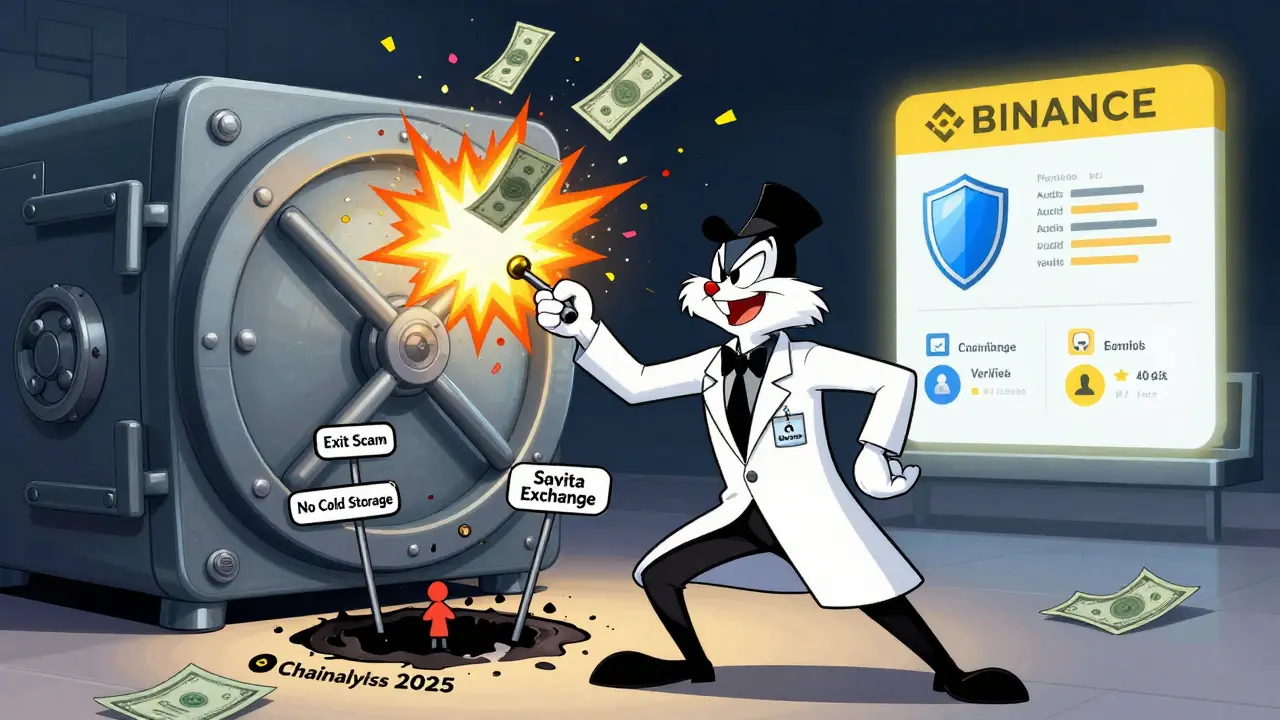
The same site that calls Savita ‘top-class security’ gives you zero details. No mention of cold storage. No info on multi-signature wallets. No proof of insurance. No audits. Nothing.
Compare that to real exchanges. Binance stores 98% of user funds in offline cold wallets. Coinbase insures 95% of its hot wallet assets. Kraken uses hardware security modules (HSMs) to protect private keys. Every one of these platforms publishes quarterly security reports. They list their protocols. They show their certifications.
Savita? Silence. That’s not a privacy feature. It’s a cover-up. According to Arkose Labs’ 2025 security guide, 82% of hacked exchanges in 2024 had no public security documentation. If you can’t see how they protect your money, you’re not using a platform-you’re gambling with your wallet.
No Users. No Reviews. No History.
Where are the users? Where are the reviews?
Check Trustpilot. Check Reddit’s r/CryptoCurrency. Check Bitcointalk. Search for ‘Savitar’ or ‘Savita’-you’ll find maybe one or two vague forum posts from people asking if it’s real. That’s it. No detailed experiences. No complaints about withdrawals. No praise for customer support.
That’s not normal. Even FTX, before it collapsed, had tens of thousands of reviews. Coinbase has over 200,000. Even lesser-known exchanges like KuCoin or Bybit have hundreds of verified user testimonials. Savita has none. And that’s not an accident. Scam platforms don’t want users talking. They want you to deposit, then disappear.
Reddit’s r/CryptoScams thread #14,452 from October 2025 flagged exactly this pattern: platforms with names close to real ones, zero reviews, and claims of ‘easy onboarding.’ 79% of those were confirmed scams within six months.
Why This Scam Works-and How to Avoid It
This isn’t a new trick. It’s an old one, updated for crypto. Scammers pick names that sound real. They use professional-looking websites. They copy phrases from real exchanges: ‘global reach,’ ‘secure trading,’ ‘24/7 support.’
But here’s what they can’t fake: public records. Regulatory filings. Security audits. User reviews. Trading volume. API documentation.
Real exchanges publish their API endpoints. Binance has 127. Coinbase has 98. Savita? No API docs. No developer portal. No GitHub repo. No open-source tools built around it. Developers-the people who build bots, analytics, and trading tools-don’t touch it. That’s because they know it’s not real.
And the numbers? They don’t lie. Binance trades $42 billion a day. Coinbase handles $18 billion. Savita? Zero verified volume. Zero user count. Zero public data. If it were real, you’d see it in the charts. You’d see it in the news. You’d see it in the wallets of real traders.
What You Should Do Right Now
If you’ve already signed up for Savita: stop. Don’t deposit another cent. Try to withdraw what you can. If you can’t, you’ve likely been scammed. Report it to your local financial authority and file a report with Chainalysis’ scam tracker.
If you’re thinking about joining: walk away. There are hundreds of legitimate exchanges with transparent security, real user bases, and regulatory compliance. You don’t need to risk your crypto on a ghost platform.
Stick to the names everyone knows: Binance, Coinbase, Kraken, Bitstamp, KuCoin. They’ve been tested. They’ve been audited. They’ve survived crashes, hacks, and regulatory crackdowns. They’re not perfect-but they’re real.
And if you see ‘Savitar’ or ‘Savita’ pop up again? Share this review. Warn someone. This scam will keep trying. But if more people know the truth, fewer will fall for it.

What Real Crypto Exchanges Look Like
Here’s what separates the real from the fake:
- Full KYC/AML compliance-no exceptions for ‘small deposits’
- 95%+ cold storage-your coins aren’t sitting online
- Multi-signature wallets-multiple keys needed to move funds
- Insurance coverage-if hacked, you get reimbursed
- Quarterly security audits-published reports, not just claims
- Public trading volume-verified by CoinGecko or CoinMarketCap
- Verified user reviews-thousands across multiple platforms
If a platform doesn’t check at least five of these boxes, it’s not worth your time.
Final Word: Don’t Be the Next Victim
The crypto space is full of opportunity. But it’s also full of predators. Savitar isn’t a startup. It’s not a new player. It’s a trap.
There’s no shortcut to safety. No ‘easy’ exchange that skips the rules. The platforms that promise speed and secrecy are the ones that vanish overnight-taking your money with them.
Stick to the names that have lasted. Verify before you invest. And never, ever trust an exchange that won’t tell you how it protects your funds.
Is Savitar a real crypto exchange?
No, Savitar is not a real or legitimate crypto exchange. No verified records, user reviews, trading volume, or regulatory filings exist for it. The name appears to be a misspelling or deliberate imitation of the non-existent ‘Savita Exchange,’ both of which are likely scams.
Why do people say Savita has minimal KYC?
Scammers use ‘minimal KYC’ as bait to attract users who want to avoid identity checks. But in 2026, this is a red flag. Global regulations require most exchanges to verify users for transactions over $1,000. Platforms ignoring this are either illegal or exit scams.
Can I trust Savita’s ‘top-class security’ claim?
No. Legitimate exchanges publish detailed security measures: cold storage ratios, insurance coverage, hardware security modules, and audit reports. Savita provides none of this. Silence on security is a sign of weakness-or fraud.
What should I do if I already deposited money into Savita?
Stop using the platform immediately. Try to withdraw your funds, but don’t expect success-most scams block withdrawals after deposits. Report the platform to your country’s financial regulator and file a report with Chainalysis’ scam database. Recovering funds is unlikely, but reporting helps others avoid the same trap.
Are there any safe exchanges with low KYC?
No legitimate exchange offers truly low KYC. Some may allow small trades without full ID verification, but anything above $1,000 requires compliance with global standards. Avoid any platform that markets itself as ‘KYC-free’-it’s not a feature, it’s a warning.
How do I spot a fake crypto exchange?
Check if it’s listed on CoinGecko or CoinMarketCap. Look for verified user reviews on Trustpilot or Reddit. Search for security reports, API documentation, and regulatory licenses. If any of these are missing, walk away. Legit exchanges don’t hide.
Athena Mantle
January 25, 2026 AT 14:10Andy Simms
January 26, 2026 AT 10:56Andy Marsland
January 26, 2026 AT 19:17MICHELLE REICHARD
January 28, 2026 AT 11:06Nadia Silva
January 28, 2026 AT 21:47tim ang
January 29, 2026 AT 02:00katie gibson
January 30, 2026 AT 08:18Sara Delgado Rivero
January 30, 2026 AT 10:14Kevin Pivko
January 31, 2026 AT 00:23Tselane Sebatane
February 1, 2026 AT 02:50Roshmi Chatterjee
February 2, 2026 AT 01:47Ashok Sharma
February 2, 2026 AT 07:00Jonny Lindva
February 2, 2026 AT 22:37Margaret Roberts
February 3, 2026 AT 11:56Jeffrey Dufoe
February 4, 2026 AT 16:01