
QuickSwap v2 on Base isn’t just another decentralized exchange. It’s a high-speed, ultra-cheap trading platform built for traders who hate paying $10 in gas fees just to swap ETH for USDC. Launched on August 12, 2025, this version of QuickSwap is optimized for Coinbase’s Base chain - a Layer 2 network that’s growing fast because it’s fast, cheap, and backed by one of the biggest names in crypto. If you’re tired of waiting minutes for transactions and paying more in fees than the value of your trade, QuickSwap v2 on Base might be the solution you’ve been looking for.
How QuickSwap v2 on Base Works
QuickSwap runs on an automated market-making (AMM) model, just like Uniswap. But instead of running on Ethereum’s congested mainnet, it’s built on Base, which uses Ethereum’s security but cuts costs and speeds up transactions. Swaps happen in seconds - usually under 2 seconds - and cost less than a penny. You don’t need to sign up or verify your identity. All you need is a Web3 wallet like MetaMask or Coinbase Wallet. Connect it, and you’re trading.
The platform supports over 80,000 trading pairs across 10 blockchains, but on Base alone, you’ll find the most popular tokens: ETH, USDC, WBTC, DAI, and hundreds of meme coins and new DeFi projects. Unlike centralized exchanges, your funds never leave your wallet. QuickSwap doesn’t hold your crypto - you do. That’s the whole point of decentralized exchanges.
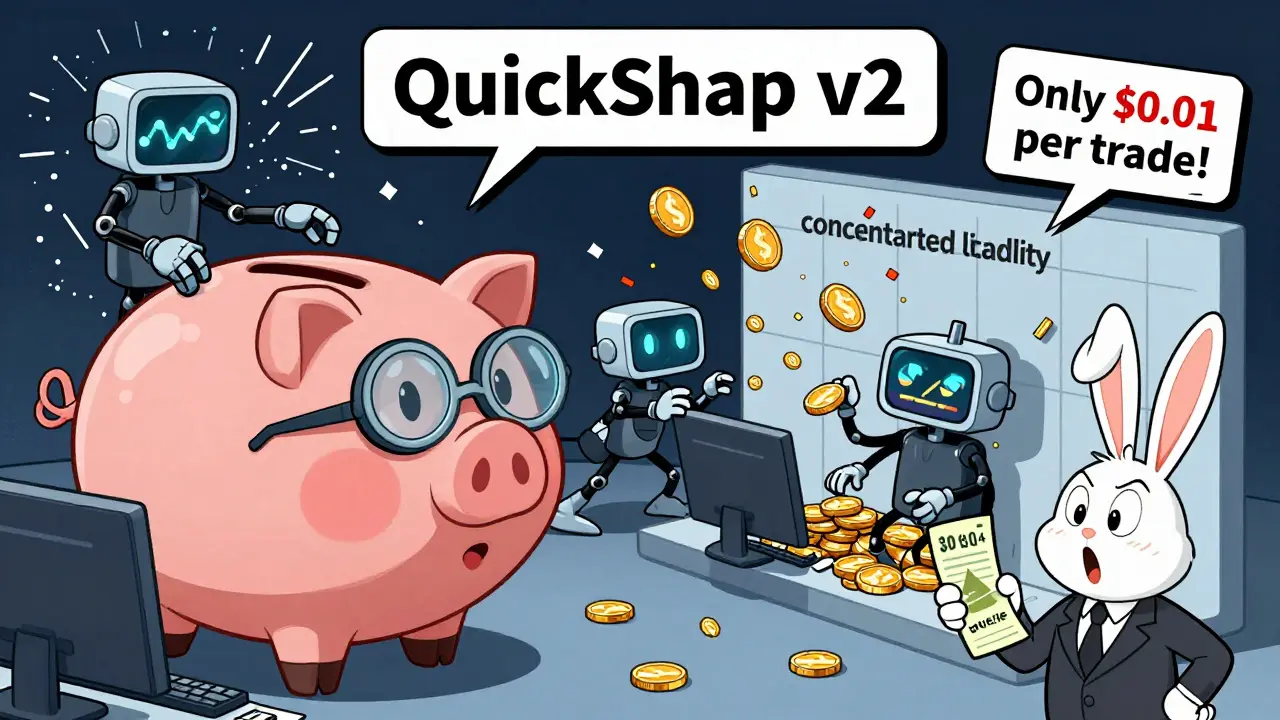
One big upgrade in v2 is concentrated liquidity. This means liquidity providers (LPs) can put their money in specific price ranges instead of across the whole curve. If you think ETH will stay between $3,000 and $3,500, you can lock your liquidity there. That makes your capital work harder. You earn more fees per dollar invested compared to older AMMs. It’s like having a better engine in your car - same fuel, more power.
Trading Fees and Speed
On Ethereum-based DEXs like Uniswap v3, a simple swap can cost anywhere from $1.50 to $15, depending on network congestion. On QuickSwap v2 on Base? You’re looking at $0.005 to $0.01 per trade. That’s not a typo. For high-frequency traders or those doing dozens of swaps a day, that’s hundreds of dollars saved monthly.
Transaction speed is equally impressive. While Ethereum can take 15-30 seconds to confirm during busy times, Base confirms in under 2 seconds. That’s critical if you’re trading volatile tokens or trying to catch a quick arbitrage opportunity. There’s no waiting. No delays. Just connect and swap.
QuickSwap also offers perpetual trading with up to 100x leverage - and zero gas fees on trades. That’s rare in DeFi. Most platforms charge gas even for futures. On QuickSwap, you only pay when you open or close a position, and even then, it’s pennies. This makes it a favorite among crypto day traders who need speed and low overhead.
Liquidity and Volume
As of October 2025, QuickSwap v2 on Base had $385 million in total value locked (TVL), making it the second-largest DEX on Base behind Aerodrome Finance ($1.2 billion). That’s a lot of money, and it means decent liquidity for most major tokens. You won’t get slippage on ETH/USDC or WBTC/USDC trades. But for obscure tokens with low trading volume, you might still see price jumps - especially if you’re trading over $10,000 at once.
24-hour trading volume on Base hit $28.6 million in late October 2025. That’s not Binance-level volume, but for a DEX on a relatively new chain, it’s strong. The platform processes about 18% month-over-month growth in new users on Base since its launch. That growth isn’t accidental. It’s because people are tired of high fees and slow speeds elsewhere.
QuickSwap vs. Alternatives on Base
On Base, your main alternatives are Aerodrome Finance and Camelot DEX. Here’s how QuickSwap stacks up:
| Feature | QuickSwap v2 | Aerodrome Finance | Camelot DEX |
|---|---|---|---|
| TVL (Oct 2025) | $385M | $1.2B | $210M |
| Gas Fee per Swap | $0.005-$0.01 | $0.007-$0.012 | $0.008-$0.015 |
| Concentrated Liquidity | Yes | Yes | No |
| Perpetual Trading | Yes (up to 100x) | No | No |
| Staking Rewards | Yes (QUICK token + 50% of fees) | Yes (AERO token) | Yes (GAL token) |
| API for Bots | Yes (120ms avg response) | Yes | No |
QuickSwap wins on features. It’s the only one offering perpetuals and a robust API for trading bots. Aerodrome has more TVL and deeper liquidity, but QuickSwap gives you more tools. Camelot is simpler but lacks advanced options. If you’re a trader who wants flexibility, QuickSwap is the clear pick.
Staking and Rewards
QuickSwap doesn’t just let you trade - it lets you earn. Through its Dragon’s Lair staking program, you can lock up your QUICK tokens and earn 50% of all protocol fees generated across the platform. That’s huge. On a good day, that can mean hundreds of dollars in passive income, depending on how much you stake and how much volume flows through the system.
Plus, liquidity providers earn 0.25% of every trade in their pool, plus additional QUICK tokens as rewards. This dual reward system keeps LPs engaged. But here’s the catch: staking and farming require you to understand impermanent loss and how price volatility affects your position. If you’re new, you could lose money if you don’t know what you’re doing.
Who Is QuickSwap v2 On Base For?
QuickSwap v2 on Base is perfect for:
- Traders who do multiple swaps daily and want to save on gas
- DeFi users who want to trade perpetuals without centralized exchange risks
- Bot operators who need fast, reliable API access
- LPs who want to maximize capital efficiency with concentrated liquidity
It’s not for:
- Complete beginners who don’t know what a wallet or slippage is
- People who want to buy crypto with a credit card - QuickSwap only accepts crypto
- Institutional traders moving $500,000+ - liquidity isn’t deep enough yet
Downsides and Risks
No platform is perfect. QuickSwap has real drawbacks.
First, the interface is clunky for newcomers. Concentrated liquidity positions, fee tiers, and token approvals aren’t intuitive. Reddit users report spending 20 minutes just to figure out how to add liquidity. There’s no guided walkthrough. You’re expected to know DeFi basics.
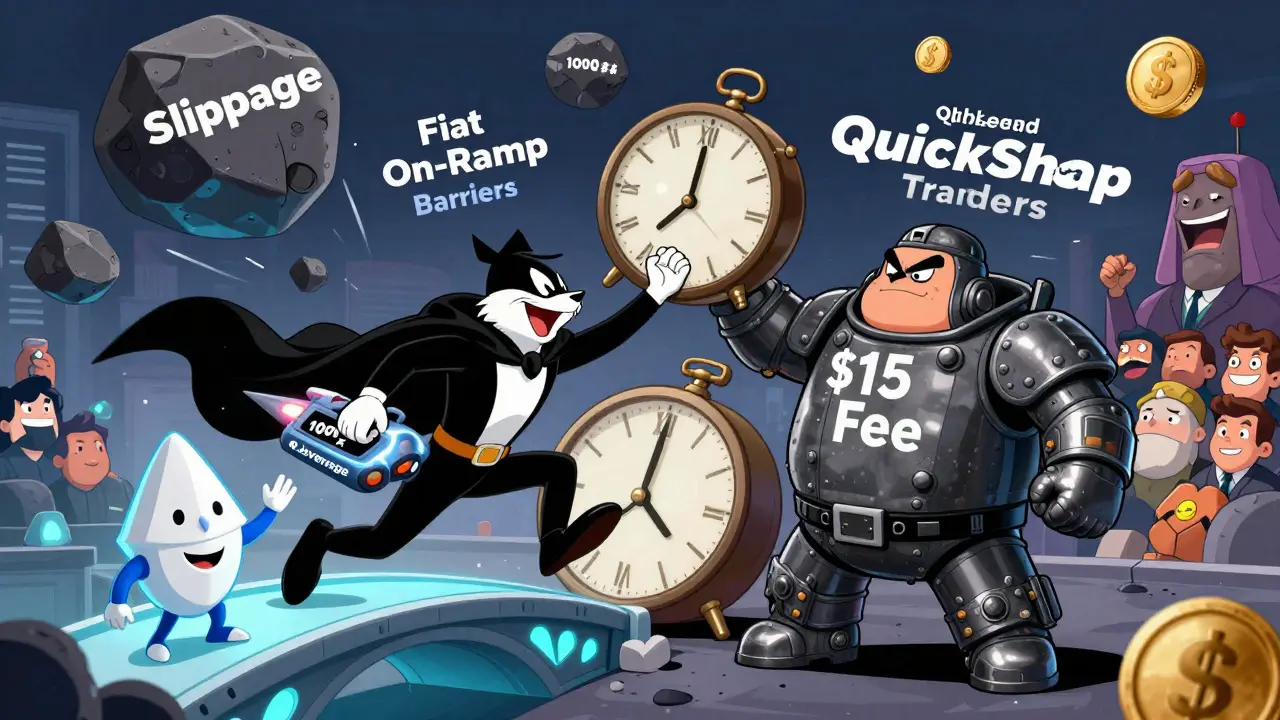
Second, fiat on-ramps are limited. You can only buy crypto with a credit card via Moonpay - and only if it’s supported in your country. That’s a big step back from Binance, which supports 30+ payment methods. You need to already have crypto to use QuickSwap.
Third, slippage protection isn’t as smart as Balancer’s weighted pools. During sharp market moves, you might get worse prices than expected. QuickSwap’s team is working on this, but it’s still a gap.
Finally, there’s regulatory risk. The SEC is watching QUICK token. Is it a security? QuickSwap says no - it’s for governance and fee sharing. But regulators don’t always agree. If the SEC declares QUICK a security, staking rewards could be restricted or shut down.
Getting Started
Here’s how to start using QuickSwap v2 on Base:
- Get a Web3 wallet (MetaMask or Coinbase Wallet recommended)
- Bridge ETH or USDC from Ethereum to Base using Coinbase’s official bridge (takes 2-15 minutes)
- Go to quickswap.exchange and connect your wallet
- Click ‘Swap’ and choose your tokens
- Set slippage tolerance to 0.5%-1% for stablecoins, 3%-5% for volatile tokens
- Confirm the transaction in your wallet
Common mistakes? Setting slippage too low (your trade fails) or approving tokens you don’t need (gives apps access to your funds). Always check token addresses - fake tokens are common. Double-check the contract address before approving.
Support and Learning Resources
QuickSwap has a knowledge base with 147 articles, but they’re written for intermediate users. If you’re new, you’ll need to do extra research. The community is active: 42,000+ on Telegram, 28,000+ on Discord, and 185,000 followers on Twitter. Response time to support questions is about 22 minutes during business hours.
GitHub hosts the open-source code. Over 1,200 commits since the Base v2 launch show active development. The team is responsive, but they’re focused on tech, not education. You’ll need to learn on your own or find tutorials on YouTube.
What’s Next for QuickSwap v2 on Base?
The roadmap is ambitious:
- Q1 2026: AI-powered routing to find the best prices across 1,000+ tokens
- Q2 2026: Institutional-grade API with FIX protocol support
- Q4 2026: Cross-chain perpetual futures
If they deliver, QuickSwap could become the go-to DEX for algorithmic traders on Layer 2. The integration with Coinbase’s ecosystem gives it a massive advantage. Base has 12.4 million monthly active wallets. That’s a huge pool of potential users.
But the real test is whether users stick around after the hype. Will they keep using QuickSwap if the crypto market turns bearish? The platform’s reliance on QUICK token rewards to attract liquidity could be a weakness if prices drop.
Still, with low fees, high speed, and advanced tools, QuickSwap v2 on Base is one of the most compelling DEXs on any Layer 2 chain right now. It’s not perfect, but for traders who want to move fast and pay less, it’s hard to beat.
Is QuickSwap v2 on Base safe to use?
Yes, but with caveats. QuickSwap is non-custodial, so your funds stay in your wallet. The code has been audited and is open-source. However, smart contract risks still exist - especially with multi-chain features. Always use trusted wallets, double-check token addresses, and never approve tokens you don’t understand. Avoid large deposits until you’re confident in the platform.
Can I buy crypto with a credit card on QuickSwap?
No, QuickSwap only accepts cryptocurrency. You need to buy crypto on a centralized exchange like Coinbase or Binance first, then bridge it to Base. Moonpay is integrated for fiat on-ramps, but only for users in supported countries. If you’re new to crypto, you’ll need to use an exchange that supports credit cards before connecting to QuickSwap.
How do I earn rewards on QuickSwap?
You can earn in two ways: by providing liquidity to trading pools or by staking QUICK tokens. LPs earn 0.25% of every trade in their pool plus extra QUICK tokens. Stakers earn 50% of all protocol fees generated across QuickSwap’s networks. Both require you to lock up assets. Rewards are paid out automatically, but you need to claim them manually. Check the platform’s staking page for current APYs.
What’s the difference between QuickSwap v2 and v3?
QuickSwap v2 is the version launched on Base in August 2025. It supports concentrated liquidity and perpetual trading. There is no official v3 on Base yet. The original QuickSwap v2 on Polygon is older and lacks some of the Base-specific upgrades. When people refer to QuickSwap v2 on Base, they mean the August 2025 release - it’s the latest and most advanced version.
Why is QuickSwap on Base better than Uniswap on Ethereum?
Speed and cost. On Ethereum, swaps cost $1-$15 and take 15-60 seconds. On Base, they cost under $0.01 and finish in under 2 seconds. QuickSwap also offers perpetual trading and a better API for bots - features Uniswap doesn’t provide on Ethereum. While Uniswap has more liquidity overall, QuickSwap on Base is far more practical for daily trading and high-frequency strategies.
Does QuickSwap have a mobile app?
No, QuickSwap doesn’t have a dedicated mobile app. But you can access it through any Web3 wallet app like MetaMask or Coinbase Wallet on your phone. The website is mobile-friendly and works smoothly on iOS and Android browsers. For advanced features like staking or perpetual trading, it’s best to use a desktop browser for better visibility and control.
Rod Petrik
January 15, 2026 AT 04:07Sarah Baker
January 16, 2026 AT 21:42Pramod Sharma
January 18, 2026 AT 16:36Liza Tait-Bailey
January 19, 2026 AT 13:35nathan yeung
January 21, 2026 AT 07:39Bharat Kunduri
January 22, 2026 AT 04:07Chris O'Carroll
January 24, 2026 AT 00:52Tony Loneman
January 24, 2026 AT 22:07Ashlea Zirk
January 26, 2026 AT 00:20Shaun Beckford
January 27, 2026 AT 22:44Chris Evans
January 29, 2026 AT 17:45Pat G
January 30, 2026 AT 13:13Alexandra Heller
January 30, 2026 AT 15:15Bryan Muñoz
February 1, 2026 AT 08:27