
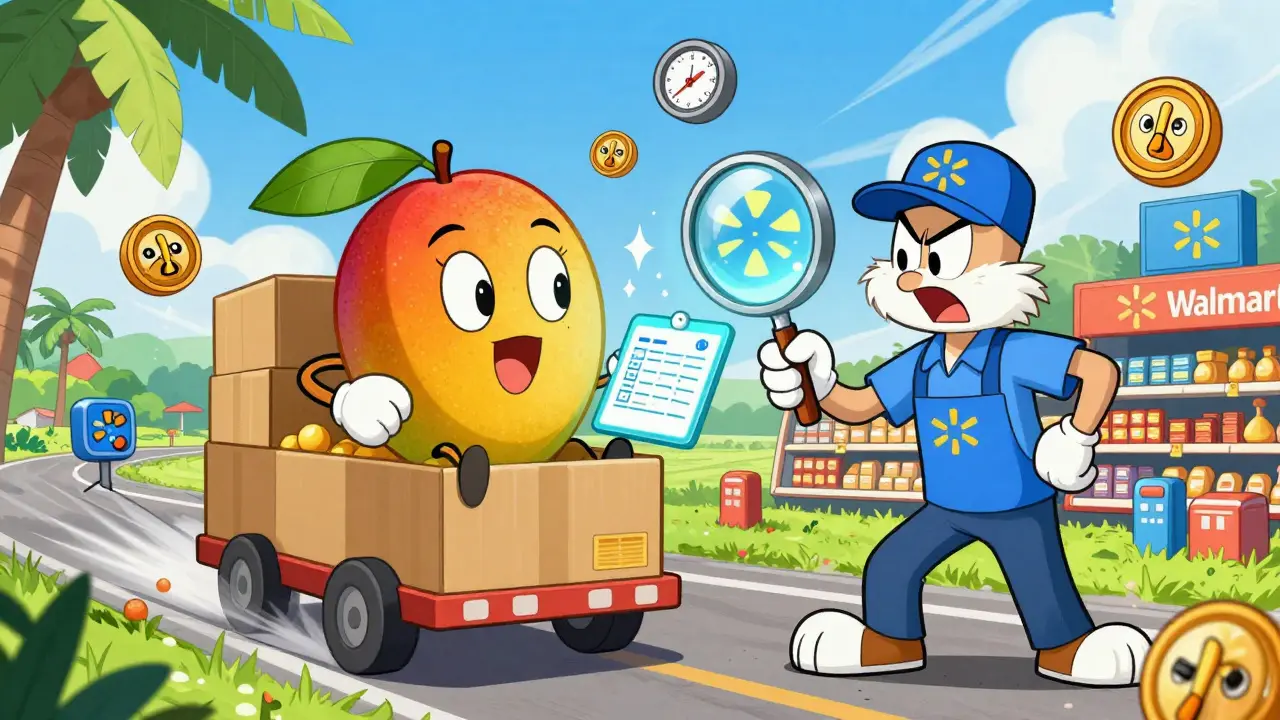
Most people think of blockchain as something behind Bitcoin or Ethereum-open, public, and wild. But in the real world of business, the most valuable blockchains aren’t public at all. They’re private blockchain networks-controlled, permissioned, and built for companies that need security, speed, and compliance. These aren’t experiments. They’re live systems running right now in Walmart’s food supply chain, Santander’s bond trades, and Estonia’s government services.
Supply Chain Transparency Without Exposing Secrets
Imagine a shipment of mangoes leaves a farm in Mexico and ends up on a shelf in Tokyo. Who handled it? Was it stored at the right temperature? Was it ever tampered with? Public blockchains can’t answer that without exposing supplier names, pricing, and logistics routes. Private blockchains can. Walmart uses a private blockchain with IBM to track food from farm to store. If there’s a contamination alert, instead of checking hundreds of paper logs, they find the exact batch in seconds. De Beers tracks diamonds from mine to jeweler, proving they’re conflict-free without revealing client names. Maersk’s TradeLens system-though now retired-showed how shipping lines, ports, and customs agencies could share data on a single ledger without giving each other full access. This isn’t just about tracking. It’s about trust. When a grocery chain like Ekotek lets customers scan a QR code and see the full journey of their olive oil-where it was pressed, who tested it, when it shipped-they don’t just buy a product. They buy confidence. And that loyalty is worth more than any ad campaign.Banking That Moves Faster Than Wire Transfers
Cross-border payments used to take days. Banks sent messages through intermediaries, each adding fees and delays. Now, Santander issues bonds on a private blockchain and settles them in minutes. No clearinghouses. No manual reconciliation. Just code that executes when conditions are met. This isn’t rare anymore. Major banks use private blockchains for KYC-know-your-customer-processes. Instead of every bank asking the same customer for the same documents, one verified copy lives on a shared ledger. When a customer opens an account at Bank A, Bank B can request access with permission. It cuts paperwork by 60% and reduces fraud. Cloud providers like AWS, Microsoft Azure, and Google Cloud now offer Blockchain-as-a-Service (BaaS). That means a mid-sized bank in Chicago doesn’t need to hire blockchain engineers. They can spin up a secure, private network in hours. That’s why adoption has exploded since 2020. The technology isn’t the barrier anymore. The barrier is getting banks to agree on rules.Healthcare: Patient Data That Can’t Be Lost or Leaked
Healthcare moves slowly-not because it doesn’t want change, but because it can’t afford mistakes. HIPAA, GDPR, FDA rules-they all demand control. Public blockchains? Too open. Private blockchains? Perfect. Hospitals in the U.S. and Europe are testing private blockchains to share patient records. A doctor in New York can view a patient’s history from a clinic in Chicago, but only if the patient gives consent. No central database to hack. No copies floating around in unsecured emails. Each access is logged, permanent, and traceable. Clinical trials are another big win. A drug company running a trial can record every test result, every change in dosage, every adverse reaction on a blockchain. Regulators can audit it anytime. Researchers can’t alter past entries. That’s huge for FDA approval. One study found trial data integrity improved by 78% when using private blockchain verification. Privacy tech like zero-knowledge proofs helps too. A hospital can prove a patient meets criteria for a trial without showing their full medical history. It’s like proving you’re over 21 without showing your ID.
Real Estate: Closing in Days, Not Weeks
Buying a house used to mean stacks of paper: deeds, titles, appraisals, loan documents, tax forms. Each step required a different party-agent, lender, title company, government office. Mistakes happened. Fraud happened. Delays were normal. Now, platforms like Propy use private blockchains to tie all those steps together. Buyer, seller, bank, lawyer, county recorder-all on the same network. When the buyer’s funds clear, the smart contract automatically transfers the deed. The title is updated. The tax office is notified. All in one transaction. Settlement time drops from 30-45 days to under 7. Fraud drops because every change is recorded and can’t be erased. Property history becomes permanent: who owned it, when it was renovated, what permits were issued. That’s not just convenience. It’s market value.Insurance: Smarter Claims, Less Fraud
Insurance is built on trust-and fraud. The average insurance claim takes 21 days to settle. Why? Because companies don’t trust each other. A claim filed with one insurer might be a duplicate from another. Or the damage might have been pre-existing. The B3i consortium, made up of 15 major insurers including Allianz and Zurich, uses a private blockchain to share claims data. When a claim comes in, the system checks if it’s been filed before. It checks if the policyholder’s history matches. It flags inconsistencies. Then, if everything checks out, a smart contract pays out automatically. Reinsurance-where insurers protect themselves from huge losses-also gets faster. Instead of emailing spreadsheets back and forth, contracts are coded on-chain. Payments trigger when conditions like earthquake magnitude or wind speed are met. No waiting for adjusters. No disputes over wording. Fraud detection improved by 40% in early trials. Claims processing time dropped from weeks to days. That’s not theory. That’s real money saved.Manufacturing: Proving Parts Are Real
A Boeing 787 has over 2.5 million parts. How do you know a bolt isn’t counterfeit? A sensor isn’t fake? A turbine blade isn’t recycled from a scrapped jet? Private blockchains help. Each part gets a digital twin-a record on the chain with its serial number, manufacturer, test results, and maintenance history. When a mechanic scans the part, they see its full life. No guesswork. IBM teamed up with shipping companies to track containers using IoT sensors. Temperature, humidity, location-all recorded on a private blockchain. If a shipment of medicine spoils, they know exactly when and where it went wrong. AI then predicts future delays before they happen. This isn’t just about quality. It’s about liability. If a car’s airbag fails, the manufacturer needs to know which batch of sensors were used. With blockchain, they find it in seconds. Without it, they shut down entire production lines.
Government: Digital IDs That Put Citizens in Control
Estonia didn’t wait for permission. In 2002, they started building a national digital ID system on blockchain. Today, every citizen has a secure digital identity. They use it to vote, file taxes, access medical records, sign contracts, and open bank accounts-all online. The government doesn’t store your data. You do. You control who sees what. A doctor can’t pull your records without your approval. A police officer can’t access your tax history unless you grant it. Other countries are catching up. Singapore uses private blockchains for land titles. Dubai for business licenses. Sweden for land registration. The goal is the same: reduce bureaucracy, cut corruption, and give people control.Why Not Just Use a Database?
Good question. Why not use a secure database if you’re already controlling access? Because databases can be edited. Deleted. Hacked. Reversed. Blockchains can’t. Once data is on a private blockchain, it’s immutable. That’s the difference between a locked safe and a locked safe with a timestamped, distributed audit trail. Also, databases need a single authority. A private blockchain can have multiple trusted parties-say, a bank, a logistics firm, and a regulator-all updating the same ledger without needing to trust each other. That’s the magic.Challenges? Yes. But They’re Manageable
Private blockchains aren’t magic. They cost more to set up than a cloud database. You need IT staff who understand distributed systems. You need agreement among partners on rules-what data to share, who can write, how to upgrade the system. But the cost of *not* using it is higher. Counterfeit drugs. Lost cargo. Fraudulent claims. Delayed payments. These cost businesses billions every year. The tech is here. The use cases are proven. The ROI is clear. The only question left is: which part of your business is bleeding from lack of transparency?Can private blockchains be hacked?
They’re not immune, but they’re far harder to compromise than public blockchains or traditional databases. Since only approved participants can join, there’s no open attack surface. The data is cryptographically linked and stored across multiple trusted nodes. To alter a record, an attacker would need to control the majority of those trusted nodes-which is nearly impossible in a well-designed consortium. Real-world systems like IBM’s Food Trust and Santander’s blockchain bonds have operated for years without a single successful breach.
Do I need blockchain if I already use ERP or SAP?
ERP systems are great for internal operations. But they’re siloed. If you’re sharing data with suppliers, banks, or regulators, you’re still emailing spreadsheets or using APIs that can be altered or intercepted. A private blockchain creates a single source of truth that everyone agrees on. It doesn’t replace your ERP-it connects it securely to external partners. For example, a manufacturer can keep using SAP for inventory, but feed shipment data to a blockchain that suppliers and auditors can verify in real time.
What’s the difference between private and consortium blockchains?
Private blockchains are controlled by a single organization. Consortium blockchains are governed by a group of organizations-like a group of banks or shipping companies-that jointly manage access and rules. Most business use cases use consortium blockchains because they require collaboration between multiple entities. TradeLens, B3i, and IBM Food Trust are all consortium networks. Private blockchains are more common for internal use, like HR records or compliance logs.
Are private blockchains expensive to maintain?
Initial setup costs are higher than traditional software-usually between $100,000 and $500,000 depending on complexity. But ongoing costs are lower. You don’t pay for transaction fees like on Ethereum. You don’t need constant manual reconciliation. Once the network is running, maintenance is similar to managing a secure cloud server. Many companies see ROI within 12-18 months through reduced fraud, faster settlements, and lower administrative overhead.
Can private blockchains connect to public ones?
Yes, through interoperability tools like Chainlink CCIP, Hyperledger Cactus, or Polkadot. For example, a private blockchain might track a product’s journey from factory to warehouse, then use a public blockchain to issue a tamper-proof certificate to the end consumer. The sensitive business data stays private. The proof of authenticity goes public. This hybrid model is becoming standard for consumer-facing applications like luxury goods or organic food.
Which industries are slowest to adopt private blockchain?
Small businesses and industries with low regulatory pressure. A local bakery doesn’t need blockchain to prove where its flour came from. But in highly regulated sectors-healthcare, finance, pharmaceuticals, aerospace-adoption is rapid. The barrier isn’t technology. It’s leadership. Companies that wait for perfect conditions often miss the window. The leaders are the ones who start small: one process, one partner, one pilot. Then they scale.
Daniel Verreault
December 28, 2025 AT 11:32Alison Hall
December 29, 2025 AT 15:46Amy Garrett
December 30, 2025 AT 02:47Haritha Kusal
December 31, 2025 AT 19:52Mike Reynolds
January 1, 2026 AT 07:40Alex Strachan
January 2, 2026 AT 08:43Jacky Baltes
January 3, 2026 AT 18:42Andy Reynolds
January 4, 2026 AT 16:15Rick Hengehold
January 5, 2026 AT 09:46dayna prest
January 5, 2026 AT 10:02Brandon Woodard
January 6, 2026 AT 00:25Michelle Slayden
January 7, 2026 AT 19:33Ryan Husain
January 9, 2026 AT 15:31Antonio Snoddy
January 10, 2026 AT 12:53Vernon Hughes
January 11, 2026 AT 19:11Rajappa Manohar
January 12, 2026 AT 16:22christopher charles
January 13, 2026 AT 07:07