
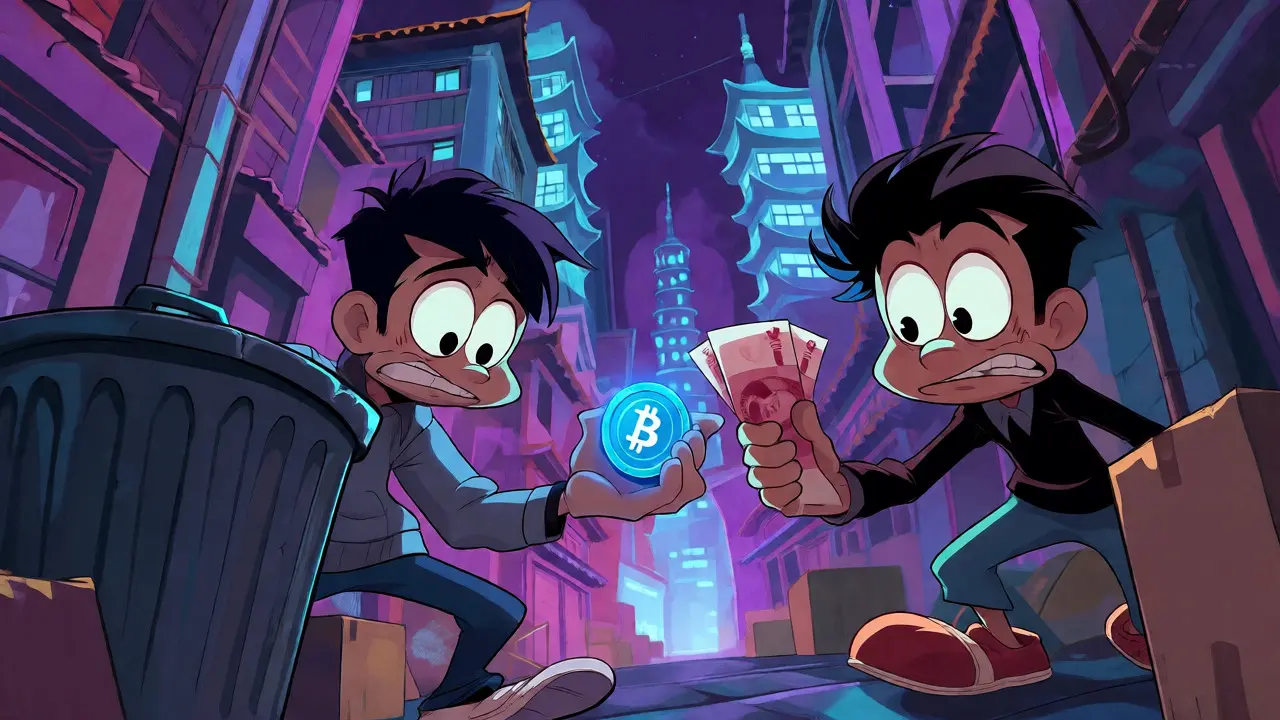
Imagine trying to buy a coffee with cash in a city where the government has declared that paper money is illegal for commercial use, yet everyone still trades it in back alleys. That’s roughly what peer-to-peer (P2P) crypto trading looks like in China today. In September 2021, the People's Bank of China (PBOC) dropped the hammer, banning all cryptocurrency transactions and mining. On paper, the market died. In reality, it just went underground.
If you’re wondering how millions of Chinese citizens still hold Bitcoin or trade stablecoins despite a total ban, you’re asking the right question. The answer isn’t simple compliance; it’s a complex dance of legal gray areas, technical workarounds, and sheer stubbornness. This article breaks down exactly how P2P trading survived the crackdown, the risks involved, and why this "natural experiment" matters for the rest of us watching global finance.
The Legal Loophole: Ownership vs. Transaction
Here’s the core confusion many people have about China’s stance. Did they ban owning crypto? No. They banned trading it through formal institutions. Before the 2021 crackdown, court rulings in Shenzhen, Hangzhou, and Shanghai established that cryptocurrencies are legal virtual property. You can own them. You can inherit them. But you cannot easily move them into or out of the traditional banking system without raising red flags.
This distinction created a massive gray zone. While centralized exchanges like Huobi and OKX pulled out or delisted CNY pairs, individuals retained their digital assets. To convert those assets back into Yuan (RMB) or vice versa, traders turned to P2P methods. Unlike a bank transfer, which leaves a clear audit trail linked to a financial institution, P2P transactions often involve direct bank transfers between two private individuals, masked by vague descriptions like "shopping" or "service fees."
| Activity | Status | Risk Level |
|---|---|---|
| Owning Crypto | Legal (Virtual Property) | Low |
| Mining | Banned | High (Equipment Seizure) |
| Exchange Trading (CNY) | Banned | High (Account Freeze) |
| P2P Transfer | Gray Area / Unregulated | Medium-High (Bank Scrutiny) |
How the Underground Market Works
So, how do you actually trade if you can’t go to an exchange? The primary method involves decentralized platforms accessed via Virtual Private Networks (VPNs). Because the Great Firewall blocks most international crypto sites, traders rely on apps like Telegram or specialized P2P interfaces that aren’t explicitly blocked. LocalBitcoins, Paxful, and decentralized options like Bisq became lifelines.
The process usually looks like this:
- Step 1: A buyer finds a seller on a P2P platform using a VPN.
- Step 2: They agree on a price, often slightly higher than the global market rate to account for risk and fees.
- Step 3: The buyer sends RMB directly to the seller’s bank account, Alipay, or WeChat Pay.
- Step 4: Once the seller confirms receipt, they release the crypto from escrow to the buyer’s wallet.
A critical adaptation here is the dominance of USDT (Tether). Since Bitcoin’s volatility makes small-scale daily trading risky, and because stablecoins offer a dollar-equivalent store of value, USDT became the de facto currency for these underground deals. It allows traders to bypass capital controls more effectively than volatile assets, moving value across borders without triggering immediate currency conversion alerts.

The Rise of Operational Security
You can’t just trade casually anymore. The Chinese government, specifically the State Administration of Foreign Exchange (SAFE), has sophisticated monitoring tools. If your bank account suddenly receives large sums from unknown individuals with no business context, it gets flagged. In 2022 alone, SAFE investigated over 1,200 crypto-related cases, resulting in nearly 900 convictions and hundreds of millions in fines.
To survive, traders developed strict operational security (OpSec) protocols:
- Small Transactions: Keeping transfers under 50,000 RMB ($7,000 USD) to avoid automatic high-value reporting triggers.
- Vague Descriptions: Never writing "Bitcoin" or "Crypto" in bank memos. Instead, users write "goods," "rent," or leave it blank.
- Counterparty Verification: Using encrypted messaging apps to verify identity before transferring funds, reducing the risk of scams.
- Transaction Splitting: Breaking large purchases into multiple smaller payments spread over days or weeks.
One Reddit user, 'ShanghaiTrader88,' reported completing 147 transactions totaling $170,000 since the ban. Their secret? Small chunks and using Alipay’s "friend transfer" feature, which historically triggered fewer automated alerts than standard bank wires. But it’s not foolproof. Another user lost $25,000 to a fake bank screenshot scam, highlighting the extreme counterparty risk when there’s no central authority to dispute a claim.
Economic Impact and Capital Flight
Why does this matter beyond individual traders? Economists argue that the ban was less about technology and more about controlling capital flow. Between 2019 and 2020, Chainalysis data showed over $50 billion in crypto value leaving East Asian accounts. By banning exchanges, Beijing aimed to plug this leak. However, the persistence of P2P trading suggests the demand for offshore asset exposure remains strong.
Despite the ban, China didn’t vanish from the crypto map. In 2022, Chainalysis estimated China still accounted for 4-7% of global P2P volume. This resilience proves that while you can shut down buildings and servers, you can’t easily stop people who want to protect their wealth from inflation or currency devaluation. The "premium" paid on P2P markets-often 3-5% above global rates-is essentially the cost of regulatory arbitrage. It’s the price of doing business in a restricted environment.
Expert Perspectives: Resilience vs. Danger
Experts are split on whether this underground market is a victory for decentralization or a ticking time bomb. Dr. Camilla Russo, a blockchain specialist, argues that China’s ban proved decentralized networks are resilient against nation-state intervention. She calls it the world’s largest natural experiment in crypto survival.
On the other hand, Dr. Henry Sanderson from the Sino Institute warns that pushing trading underground creates more dangerous, unmonitored financial activity. Without regulated exchanges, consumers lose protections. Fraud thrives. When a scam happens, there’s no customer service number to call. You’re dealing with strangers on Telegram, often with little recourse if things go wrong.
Furthermore, the Cambridge Centre for Alternative Finance noted that while China’s hash rate (mining power) dropped to zero briefly in 2021, it rebounded significantly as miners relocated or hid operations. Similarly, P2P volume surged after the initial shock, proving that regulation shifts behavior but doesn’t necessarily eliminate demand.
Practical Tips for Navigating the Gray Zone
If you’re looking at this from an investor’s perspective or just curious about how it works, here are key takeaways from those navigating the space:
- Fees are Higher: Expect to pay 3-5% premiums on P2P platforms compared to open markets. This covers the risk premium for the seller and the hassle of manual verification.
- Platform Choice Matters: International platforms accessible via VPN are preferred, but local WeChat groups also facilitate trades. The latter offers speed but zero dispute resolution.
- Bank Freezes are Real: About 38% of users report experiencing temporary bank account freezes due to suspicious transaction patterns. Always keep proof of the underlying transaction logic.
- Education is Key: Newcomers need 3-4 weeks to learn the nuances of avoiding detection. It’s not just about clicking buttons; it’s about understanding Chinese banking regulations.
The future likely holds more surveillance, not less. Recent guidelines from the PBOC in 2023 expanded monitoring to include any form of decentralized transaction. Traders are already adapting, using NFTs or physical goods barter systems to obscure the flow of digital assets. The cat is out of the bag, but the mouse is getting faster.
Is it illegal to own Bitcoin in China?
No, owning Bitcoin as virtual property is generally considered legal. The ban primarily targets trading activities conducted through financial institutions and exchanges, as well as mining operations.
Why did P2P trading survive the ban?
P2P trading survives because it operates outside formal financial infrastructure. Direct transfers between individuals are harder to monitor than institutional trades, and there is persistent demand for capital preservation and cross-border value transfer.
What are the main risks of P2P trading in China?
The main risks include bank account freezes due to suspicious activity, high counterparty fraud (fake payment screenshots), lack of legal recourse in disputes, and potential penalties for violating capital control regulations.
Which cryptocurrencies are most traded via P2P in China?
USDT (Tether) is the dominant asset for P2P trading due to its stability and utility in bypassing capital controls. Bitcoin remains popular for long-term holding, but stablecoins drive daily transaction volume.
Can I use Alipay or WeChat Pay for crypto?
Yes, these are common methods for settling fiat portions of P2P trades. However, frequent large transfers labeled vaguely can trigger algorithmic reviews by the banks behind these apps, leading to temporary account restrictions.