
You see a notification: "Claim your ORI Orica tokens." It sounds official, right? Maybe you’ve been farming airdrops on Solana and this looks like the next big payout. But before you connect your wallet or share your seed phrase, stop. There is a massive red flag here that most people miss until it’s too late.
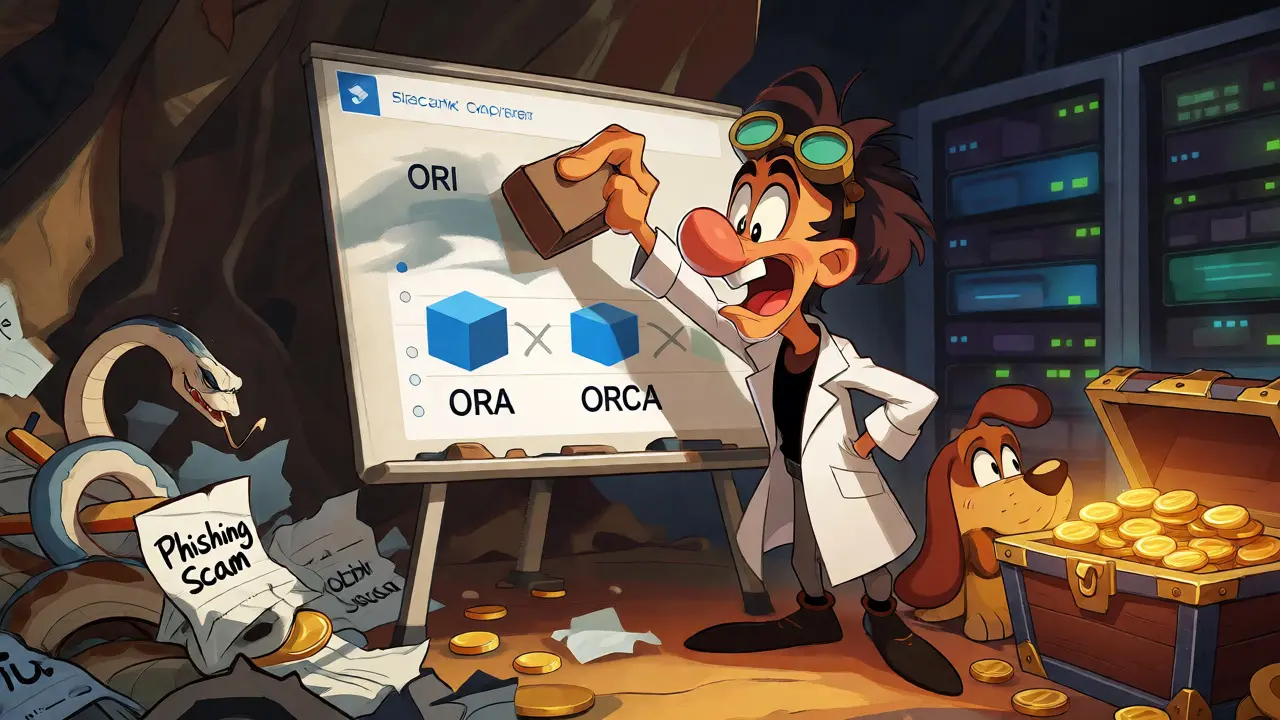
Here is the hard truth as of September 2026: there is no verified, major cryptocurrency project called "ORI" distributed by a company named "Orica" in the mainstream crypto space. If you are seeing this name attached to an airdrop, you are likely looking at one of three things: a brand-new micro-cap token with zero liquidity, a typo for the well-known Orca decentralized exchange on Solana, or worse-a phishing scam designed to drain your funds.
The Identity Crisis: Orica vs. Orca vs. ORCAI
Crypto naming conventions are messy. Developers love Greek mythology, marine life, and abstract concepts. This creates confusion. Let’s clear up who is who.
First, there is Orca DEX. This is a legitimate, high-volume decentralized exchange built on the Solana blockchain. It launched its native ORCA token back in August 2021. If you provided liquidity to Orca early on, you got an airdrop. That ship has sailed, but the platform remains active. It is known for its user-friendly interface and concentrated liquidity features.
Then, there is Orca DeFi AI. In mid-2025, a project by this name ran a small campaign distributing ORCAI tokens. This was an AI assistant tool, not a major financial institution. They targeted top holders of a specific utility token (URS) on Twitter. The total value was modest-around $1,000 USD split among 1,000 users. It wasn’t a game-changer, but it was real.
So where does "ORI" come from? And why "Orica"?
Orica Limited is actually a massive Australian mining services company listed on the ASX. They do explosives and blasting for mines. They have experimented with blockchain for supply chain tracking, but they haven’t launched a public consumer crypto token called "ORI" for retail airdrops. If someone tells you Orica Mining is giving away free coins, check their official investor relations page. You won’t find it.
This leaves us with the "ORI" token itself. In the wild west of crypto, anyone can mint a token named anything. A developer could create a token called ORI today, call it "Orica," and run a fake airdrop bot on Telegram. Without verifiable smart contract data and a transparent team, "ORI" is just a string of characters.
Why This Looks Like a Trap
Scammers rely on cognitive shortcuts. They know you’re hunting for alpha. They know you recognize the name "Orca" because it’s a top-tier DEX. By adding an "i" to make it "Orica" or shortening it to "ORI," they exploit your familiarity.
Think about the mechanics of a legit airdrop. Major protocols like Jupiter, Jito, or Pyth Network announce distributions months in advance. They publish snapshots. They verify transactions on-chain. They don’t usually DM you first asking you to "claim" via a random link. If an "ORI Orica" airdrop is hitting your inbox or Discord now, ask yourself: Did I interact with this protocol six months ago? Do I have a transaction history on their smart contract? If the answer is no, you’re being baited.
There’s also the issue of domain squatting. Legitimate projects own their .com or .io domains. Scams often use weird extensions or subdomains that look close enough to pass a quick glance. Check the URL. Does it say `orca.so`? Or does it say something like `orica-airdrop.net`? The latter is a dead giveaway.
How to Verify Any Airdrop Claim
Don’t trust; verify. Here is a quick checklist to save your portfolio. Use these steps before you click "Approve" on any transaction.
- Check the Contract Address: Go to a block explorer like Solscan (for Solana) or Etherscan (for Ethereum). Paste the token contract address. Look at the creation date. If the token was created yesterday, it’s risky. Look at the holder count. If only 50 people hold it, it’s illiquid.
- Verify the Team: Are the founders doxxed? Can you find them on LinkedIn or Twitter with a history in tech? Anonymous teams are fine for meme coins, but bad for "financial service" claims.
- Official Channels Only: Never click links in DMs. Go to the official X (Twitter) account of the project. Is the handle verified? When did they last post? If the account is new or silent, be skeptical.
- Beware of Seed Phrase Requests: No legitimate airdrop ever asks for your 12-word seed phrase. Ever. If a site asks for it, close the tab immediately.
For Solana specifically, tools like Birdeye or DexScreener can show you if the token has real trading volume. A token with $0 volume is worthless, even if the website looks pretty.
The Real Opportunities in the Orca Ecosystem
If you were hoping for an Orca-related payout, you might still have options, but they aren’t "ORI." The Orca DEX ecosystem continues to evolve. As of late 2026, providing liquidity to stablecoin pairs or emerging Solana memecoins on Orca can earn you trading fees and potential future incentives.
Keep an eye on the broader Solana landscape. Projects like Phantom Wallet, Kamino Finance, and Jupiter continue to reward active users. These platforms have proven track records. They release detailed documentation. They undergo audits. Compare "ORI" to these standards. Does it have an audit report? Is the code open-source on GitHub? If not, it’s not comparable.
| Feature | Orca DEX (Legit) | Orca DeFi AI (Small/Niche) | "ORI Orica" (Unverified) |
|---|---|---|---|
| Token Symbol | ORCA | ORCAI | ORI (Variable) |
| Blockchain | Solana | Solana | Unknown/Various |
| Audited Code | Yes (Multiple firms) | Limited/None Public | Rarely Verified |
| Trading Volume | High ($10M+ daily) | Low | Negligible to Zero |
| Team Transparency | Doxxed, VC-backed | Partially Known | Anonymous |
What To Do If You Already Interacted
Mistakes happen. Maybe you clicked a link. Maybe you signed a transaction. Don’t panic, but act fast.
If you connected your wallet to a suspicious "ORI" site, revoke permissions immediately. Tools like Revoke.cash allow you to disconnect contracts from your wallet. This prevents the malicious contract from moving your assets later. For Solana, you can manage approvals through wallets like Phantom or Backpack directly in the settings.
If you sent SOL or USDC to claim the airdrop, those funds are likely gone. Treat it as tuition. The cost of learning is cheaper than losing your entire portfolio. Document the transaction hash. Share it on community forums like Reddit’s r/CryptoCurrency or r/Solana. Often, others will confirm if it’s a known scam pattern.
Finally, diversify your risk. Don’t put all your capital into speculative airdrop farming. Keep a core holding in established assets like Bitcoin, Ethereum, or SOL. Use smaller amounts for experimental plays. If "ORI" turns out to be a fluke success, great. But statistically, unverified tokens with confusing names tend to fade into obscurity within weeks.
The crypto market rewards clarity. If a project needs a press release to explain why it exists, it probably doesn’t. Stick to platforms with visible traction, active communities, and transparent roadmaps. Your future self will thank you for ignoring the noise.
Is ORI Orica Token a scam?
It is highly likely to be a scam or a misidentified low-value token. There is no major verified project named "ORI" associated with the mining company Orica or the DEX Orca. Always verify the smart contract address on a block explorer before interacting.
Did Orca DEX have an airdrop?
Yes, Orca DEX launched its ORCA token in August 2021 and distributed tokens to early users and liquidity providers. However, that specific airdrop event concluded years ago. Current campaigns may exist but should be verified on the official Orca website.
Can I lose money claiming an airdrop?
Yes. Malicious airdrop sites can drain your wallet if you approve unlimited token spending or sign a malicious transaction. Some scams also require you to send a small fee upfront, which they keep without delivering the token.
Where can I check if a token is real?
Use block explorers like Solscan or Etherscan to check the contract creation date and holder distribution. Cross-reference the token name with aggregators like CoinGecko or CoinMarketCap. If it’s not listed there, it’s likely very new or insignificant.
Should I sell my ORI tokens if I have them?
If you hold ORI tokens acquired through a questionable source, try to sell them while there is still liquidity. Low-cap tokens can drop to zero quickly. If there is no buy order available, the token may be effectively worthless.