

It’s a strange situation in Myanmar right now. On paper, the government says cryptocurrency is strictly illegal. You see public notices warning that buying or selling digital assets is a crime punishable by prison time. Yet, walk down the street in Yangon, open Telegram, or check local marketplaces, and you’ll find people actively trading stablecoins every day. The reason behind this disconnect starts with Central Bank Directive 9/2020, a strict regulatory order issued by the Central Bank of Myanmar (CBM). While the official stance is a total prohibition, the reality on the ground has evolved into a complex grey area driven by economic instability and political division.
If you are trying to understand the risks of holding crypto in Myanmar, or simply want to know why your bank account might get frozen, this is the essential breakdown. The directive isn’t just a suggestion; it carries teeth. It draws power directly from older banking laws that give the CBM exclusive control over currency. However, since the military coup in 2021, things have shifted dramatically. We have two governments effectively operating-military-backed authorities enforcing the ban, and opposition groups actually pushing for their own digital currency. Understanding this split is the key to understanding the risk.
The Legal Basis of the Ban
To grasp why the CBM issued this directive in the first place, we need to look at the specific laws they cited. When the CBM released Directive 9/2020 on May 15, 2020, they weren't acting on a whim. They invoked the Central Bank of Myanmar Law. Specifically, they pointed to Section 40(e) and Section 62. These sections designate the CBM as the sole legal entity authorized to issue and administer local currency. In their view, any other asset claiming to be money-or facilitating exchange-threatens the monopoly they hold over the Kyat.
Before this directive, the environment was somewhat loose. People were told to trade at their own risk, similar to a warning sticker on a product. But the 2020 notification marked a hard pivot toward active enforcement. The CBM explicitly stated that digital currencies are not legal tender. They listed specific assets to target, including Bitcoin (BTC), Litecoin (LTC), and Ethereum (ETH). Crucially, they also targeted non-blockchain payment systems like Perfect Money.
This wasn't just about stopping people from hoarding cash. The directive aimed to plug holes in the financial system where capital was flowing out of the country unchecked. By banning the sale, purchase, exchange, and transfer of unregulated digital currencies, the CBM intended to preserve the stability of the national currency. However, the timing was poor. Just a year after this directive, the February 2021 military coup shattered trust in the state-run economy, ironically fueling demand for the very assets the ban tried to suppress.
Scope and Technical Prohibitions
| Activity Type | Allowed Status | Enforcement Action |
|---|---|---|
| Buying/Selling Crypto | Prohibited | Bank account closure / Legal action |
| Exchanging Digital Currencies | Prohibited | Fines or Imprisonment |
| Holding Wallets | Tolerated if inactive | Risk increases upon transaction |
| Using P2P Platforms | Prohibited | Monitoring via IP/Bank flows |
| Mining Operations | Grey Area / Unregulated | Utility cutoff possible |
Looking at the scope, you realize how broad the net is cast. It is not just about running a mining farm; it is about personal transactions too. The CBM noticed that many citizens were using personal Facebook pages to buy and sell coins. Consequently, they issued warnings specifically targeting those web-based transactions. Financial institutions within Myanmar-this means local banks-are prohibited from facilitating these transactions. If a bank detects a suspicious transfer to a known crypto-related entity, they have been instructed to report it.
In terms of technical scope, the ban covers all forms of unregulated virtual currencies. Before 2020, the narrative was softer. The CBM had previously announced that individuals engaging in digital currency transactions did so at their own risk, but no concrete enforcement measures were implemented until later. The 2020 notification marked a significant shift toward active enforcement, with the CBM pursuing legal action against persons involved in illegal currency conversion and unauthorized hundi money transfers. This brings us to the critical element of enforcement penalties.

Punishment and Enforcement Mechanisms
You cannot talk about this ban without discussing the real-world consequences. Is it actually enforced? Yes. The CBM demonstrated its commitment through concrete actions well into the 2020s. On May 24, 2024, four years after the original directive, the CBM issued another public notice reiterating its warnings. This recent announcement confirmed they were ready to enforce regulations by closing bank accounts and pursuing legal action against violators.
The penalty structure is serious. Violations are pursued under the Anti-Money Laundering Law, the Financial Institutions Law, and the original Central Bank Law. The punishments range from heavy fines to imprisonment. The primary method of enforcement is shutting down bank accounts. If the CBM flags an individual's banking activity as related to crypto, they instruct the commercial bank to freeze those assets. Once the link to illegal currency conversion is established, criminal proceedings begin.
One specific vector they target is the "hundi" system. Hundi is a traditional informal value transfer system used widely in the region. The CBM has actively pursued legal action against individuals found engaging in illegal virtual currency conversion using Tether (USDT) through these networks. By linking digital asset movements to illicit fund transfers, the authorities treat the crypto activity as part of a broader money laundering operation.
However, enforcement has shown signs of selectivity. Legal experts from firms like Tilleke & Gibbins have noted that while overseas operators haven't faced direct action, persons engaged in domestic transactions face increasing scrutiny. The CBM's focus has been on domestic currency converters and hundi operators rather than the average citizen occasionally holding a wallet, though the lines blur when bank accounts are involved. The fear among the public is real: losing access to your primary financial lifeline is a terrifying prospect in a country with limited alternatives.
The Political Schism: SAC vs. NUG
To truly understand the landscape today, you must acknowledge that Myanmar is currently divided politically. There is the military-backed State Administration Council (SAC) which enforces the ban, and the opposition National Unity Government (NUG) which does not. This creates a bizarre dual-reality for citizens depending on who controls the territory you are in.
While the military government clamps down, the opposition NUG has taken the exact opposite approach. In December 2021, the NUG declared Tether (USDT) as legal tender in regions under its control. This creates a direct conflict between the military government's prohibition and the opposition's embrace of cryptocurrency. The military responded to this by drafting cybersecurity laws in January 2022 to criminalize cryptocurrency use further, specifically aiming to counter the NUG's adoption of USDT.
The opposition hasn't stopped there. The NUG has announced plans to establish a cryptocurrency called DMMK (Digital Myanmar Kyats) and has developed a user-friendly mobile wallet. This directly challenges the military government's prohibition. It signals that the future of crypto in Myanmar isn't just one path-it depends entirely on the outcome of the civil war and which faction ultimately takes full control of the state apparatus.
This fragmentation explains why policy implementation is chaotic. If you live in an area controlled by pro-military forces, the ban is absolute. If you are in an NUG-held zone, you might even find officials encouraging the use of stablecoins to support the resistance economy. This makes navigating the legal landscape incredibly dangerous for anyone moving between regions.
The Underground Market Reality
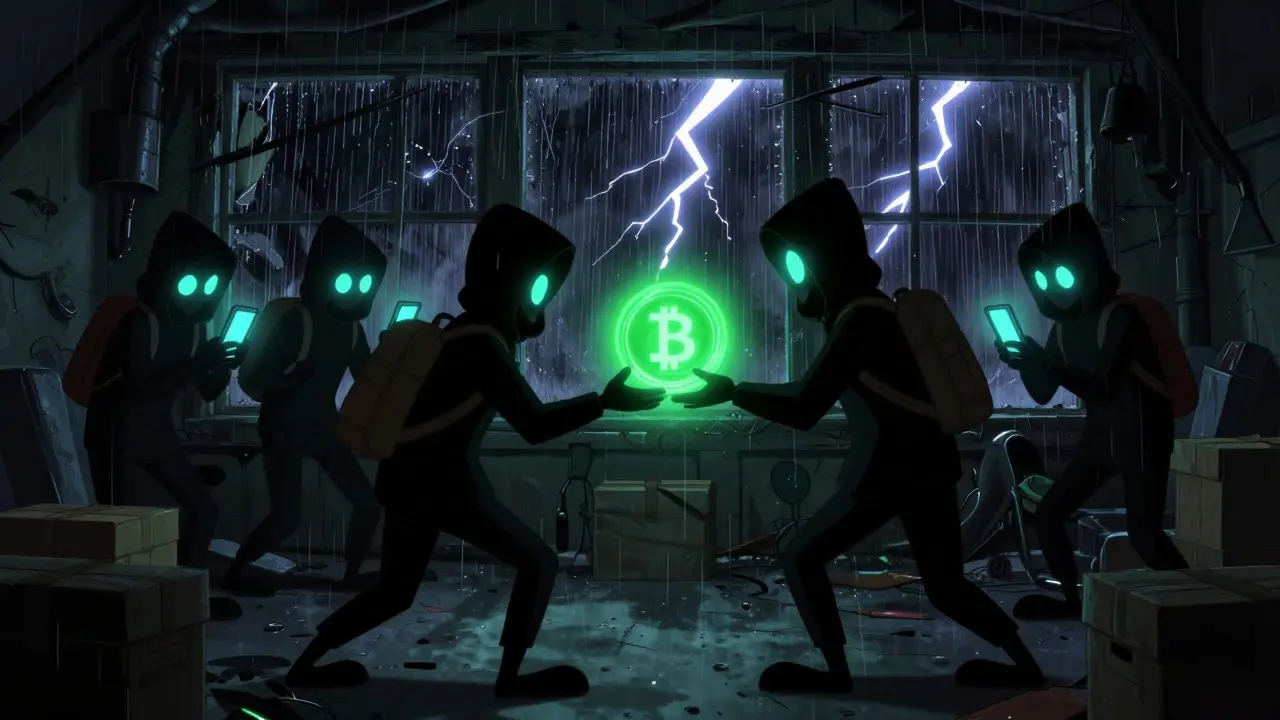
Despite the official ban and the threats of prison, the data suggests a thriving underground economy. Coinfomania's analysis indicates that the period from late 2024 through early 2026 saw tremendous growth in peer-to-peer transactions conducted through Telegram and offshore exchanges. Citizens are not waiting for permission to protect their savings.
Why is this happening? The collapse of the kyat following the 2021 coup intensified demand for alternative stores of value. The national currency has become unstable, making it a terrible way to save money. Stablecoins, especially USDT on the Tron network, dominate informal international payments. People are using digital assets for remittance, saving value, and even financing resistance activities.
The infrastructure for this underground market relies heavily on peer-to-peer platforms because traditional centralized exchanges often require KYC (Know Your Customer) documents that identify users. Local traders prefer methods that don't leave a paper trail in the banking system. The CBM's ability to monitor offshore exchanges is limited. Their surveillance tools are focused on social media platforms like Facebook and traditional banking channels. They struggle to see activity encrypted inside apps like Telegram.
Academic research from Chiang Mai University's School of Public Policy highlights a major hurdle for both users and enforcers: internet connectivity. Cryptocurrency adoption requires reliable internet access. However, the military government has imposed consecutive internet shutdowns to disrupt communication. This creates a stop-start dynamic where crypto markets thrive when the net is up and vanish during blackout periods.
Is Compliance Even Possible?
For the average person in Myanmar, compliance feels impossible because the demand for the product is higher than the fear of the law. Many view digital assets as the only tool left for remittance and finance. The practical implementation of the ban faces significant challenges due to the decentralized nature of these assets.
There is no central switch to flip to stop everyone. Unlike seizing physical gold bullion in a vault, you cannot physically seize a private key held in someone's phone memory. The CBM focuses on the on-ramp and off-ramp points-where the digital meets the fiat currency. If they can catch someone at the bank exchange point, they make an example. But once funds are moved across borders digitally, they lose track.
Furthermore, the geopolitical context matters. Countries like Thailand and Singapore have developed regulatory frameworks that allow trading. Myanmar remains an outlier with a complete prohibition. Analysts note that this contrasts sharply with nations like El Salvador, which embraced Bitcoin as legal tender. This isolation leaves Myanmar disconnected from regional financial integration trends, potentially driving more black-market behavior.
As we move into 2026, the trajectory seems uncertain. The CBM maintains its hard-line stance, reinforced by the May 2024 public notice. However, the parallel economy keeps expanding. It is likely that unless there is a massive political shift resolving the conflict, the official ban will remain on paper while the real economy continues to run on digital rails underneath it.
Shubham Maurya
March 31, 2026 AT 02:49The whole situation smells like corruption mixed with panic 😬 People just want to save their money from inflation but the generals don't understand how digital currency works at all. It is crazy how they try to control something that exists on global servers instead of local vaults. The risk of losing your life savings is real when banks decide to freeze accounts overnight. We are seeing this pattern repeat everywhere else in the world too. The opposition using USDT is a direct challenge to the state monopoly on finance. It shows that power isn't just held by those with guns anymore. I think the crackdown is going to backfire harder than intended. 😠 They should focus on stability instead of criminalizing basic economic survival.
Justin Garcia
April 1, 2026 AT 07:03This will never work and the military knows it too.
Alex Lo
April 2, 2026 AT 17:06so i mean like looking at this whole situation its pretty messed up honestly. You gotta realize that people just want to keep their money safe you know. The banks are freezing accounts left and right which is super stressful for normal folks. I think about how hard it would be to live without access to your funds anytime you need them. Plus the government fighting each other makes everything so much more confusing for everyone involved. Sometimes i wonder why they cant just let us use whatever works best for our savings. Its obvious that the tech doesnt care about borders or laws written on paper anyway. Seeing people trade on telegram shows that the demand is really high despite the threats. If you lose your account you are basically stuck with nothing and thats scary. The opposition group doing their own currency is pretty wild actually. It feels like living in a movie where the rules change depending on who wins the war outside. Most of us just want stability but we get told its illegal to protect ourselves. The underground market keeps growing even when the internet gets shut down for weeks. I really hope they figure this out soon because nobody wins with bans like this. Technology always finds a way through cracks in the wall eventually you see. Honestly its just sad watching a country try so hard to fail at modern economics.
Matt Bridger
April 4, 2026 AT 08:41The regulatory framework presented herein is fundamentally flawed. The Central Bank has demonstrated a lack of foresight regarding economic shifts. Citizens often find themselves trapped in precarious financial positions due to these mandates. It is evident that the prohibition creates a black market which cannot be effectively policed. One must consider the geopolitical ramifications of such isolationist policies. The stability of the Kyat relies heavily on trust which is currently eroding rapidly. When trust vanishes digital assets naturally become the preferred medium of exchange for survival. This situation highlights the futility of legislative attempts to stop technological adoption. Enforcement mechanisms remain largely ineffective against decentralized networks operating overseas. The penalties described serve only to intimidate rather than deter determined actors. We see similar patterns in other jurisdictions attempting currency controls historically. Yet the outcome remains consistently negative for the general populace. The opposition groups utilizing stablecoins further complicate the narrative significantly. Ultimately policy without public support fails regardless of legal teeth. This observation stands true across nearly every authoritarian regime.
Katrina Tate
April 5, 2026 AT 02:42Ignoring the economic reality is what leads to hyperinflation and total collapse. The CBM thinks they can shut off the tap but water always finds a path around the dam. People are trading under the table anyway so the law is just paper tigers roaring at shadows. It's pathetic to watch them chase software code instead of fixing actual banking infrastructure.
Elizabeth Akers
April 6, 2026 AT 07:46i feel bad for everyone caught in the middle of this mess honestly. The fear of jail time makes people nervous but starving is worse so they take the risk. It seems like there is no good choice left for anyone trying to survive economically. We just hope things stabilize before it gets even more dangerous for daily transactions.
Alex Kuzmenko
April 7, 2026 AT 20:18the goverment is making things harder by banning tools people need. Its clear they dont understand the tech landscape at all. Just trying to trade online now feels like a crime punishable by prison which is insane.
Liam Robertson
April 8, 2026 AT 00:52I believe that eventually the authorities will have to relax these restrictions because the demand is simply too strong. History shows that banning technology rarely stops people from using it effectively. Many families depend on remittances and blocking that hurts innocent victims most of all. Hopefully the next phase brings more realistic solutions instead of just threats.
Addy Stearns
April 8, 2026 AT 02:43We must examine the deeper philosophical implications of enforcing monetary sovereignty in a digitized age. The concept of national borders dissolves when information flows freely across encrypted channels globally. Power structures attempt to maintain control through legislation yet ignore the fundamental nature of value storage. A society cannot force its citizens to accept devalued fiat currency indefinitely without resistance. The duality of the government here represents a fractured social contract entirely. When one authority declares an asset legal tender and another calls it contraband the citizen becomes the battlefield. This fragmentation suggests a deeper crisis of legitimacy within the state apparatus itself. Trust in institutions is replaced by trust in mathematics and cryptography ultimately. The transition period will inevitably be violent and chaotic as old systems break down.
Tiffany Selchow
April 8, 2026 AT 05:20Typical failure of a weak state trying to act tough like a big power. They cannot manage their own currency so they blame bitcoin for their incompetence. Anyone with half a brain sees this is just about controlling population movement of funds. Keep talking about freedom while you lock people out of their own bank accounts.
Ronald Siggy
April 9, 2026 AT 03:55You have to stay focused on protecting your family's assets regardless of the political noise surrounding you. Ignoring the risks is dangerous but panic selling is even worse for your long-term security. Build a solid strategy based on facts and not headlines screaming about arrests. Remember that community support networks often fill the gaps left by failing banks.
Jamie Riddell
April 11, 2026 AT 03:25It is heartbreaking to see people punished for just trying to secure their livelihoods. Everyone deserves a safe place to store wealth without fear of arbitrary confiscation. We should listen to those on the ground facing these risks daily.
Beverly Menezes
April 11, 2026 AT 10:32I think it's important to understand that not everyone wants to break the law. Some people just want to send money to relatives abroad safely. The current system makes that impossible without risking everything.
Shaira Vargas
April 13, 2026 AT 02:14The anxiety levels must be incredibly high living under constant threat of account closure. It feels like a nightmare scenario coming true for the average person there. No amount of safety is worth losing your entire identity if the bank decides to cut ties.
Jay Starr
April 13, 2026 AT 03:16Silence is golden when discussing sensitive topics with the wrong crowd nearby. I have seen friends disappear after posting too much about their trading habits online.
Joy Crawford
April 14, 2026 AT 19:10ugh the drama is exhausting but necessary to discuss 💔 they say we are criminals for saving money. i think its really sad how scared everyone feels rn. 😢
Leah Lara
April 16, 2026 AT 14:47Not sure if any of this changes much for regular people honestly. Probably just another thing added to the chaos pile.
Raymond K
April 17, 2026 AT 15:16Honestly the creativy required to move funds around is impressive. It is like solving a puzzle every week to keep cash flowing. Hoping the future brings less stress and more open markets for everyone. Maybe we can learn from other nations handling similar transitions better.