
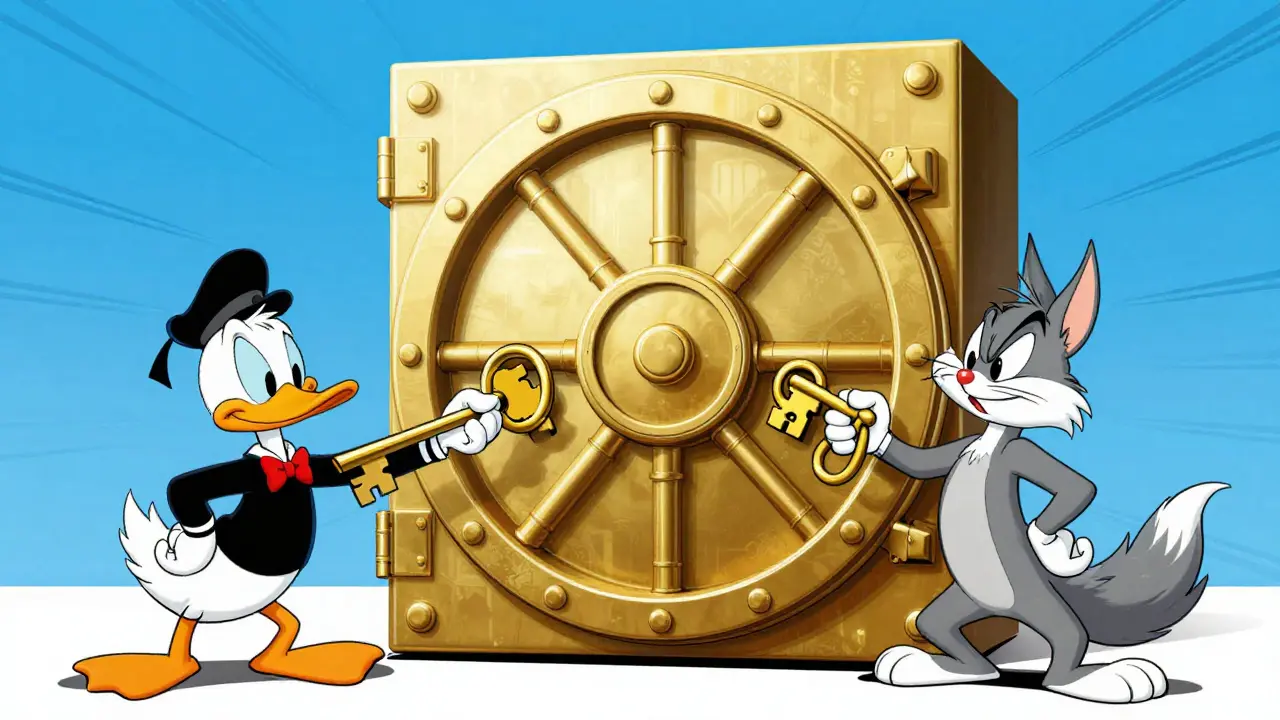
Imagine locking your life savings in a bank vault. But instead of one key held by you, there are three keys, each held by a different person. To open the vault, at least two people must be present and agree to turn their keys simultaneously. This is the core concept behind Multisig (multi-signature) wallets. In the world of cryptocurrency, where transactions are irreversible and hacks are frequent, this simple shift from "one key" to "multiple keys" changes everything. It moves asset protection from relying on a single point of failure to a system of distributed trust.
If you are holding significant amounts of Bitcoin or Ethereum, sticking with a standard single-signature wallet is like leaving your front door unlocked because it’s convenient. Multisig isn’t just for massive institutions anymore; it is becoming the standard for anyone serious about keeping their digital assets safe. But setting up a multisig wallet correctly is tricky. One wrong move in configuration or key storage can render your funds inaccessible forever. Let’s break down exactly how to secure these wallets without getting lost in technical jargon.
Understanding the M-of-N Configuration
The heart of any multisig setup is the M-of-N scheme. This defines the rules for authorization. 'N' is the total number of people (or devices) who hold a key, and 'M' is the minimum number of signatures required to execute a transaction. For example, in a 2-of-3 setup, you have three signers, but only two need to approve a transfer for it to go through. If one signer loses their key or passes away, the other two can still access the funds. If two keys are stolen, the thief still cannot move the money without the third signature.
| Configuration | Total Keys (N) | Required Signatures (M) | Best For |
|---|---|---|---|
| 2-of-2 | 2 | 2 | Couples or business partners requiring mutual consent |
| 2-of-3 | 3 | 2 | Individuals seeking redundancy (home, office, safety deposit box) |
| 3-of-5 | 5 | 3 | Large organizations or DAOs needing robust governance |
Choosing the right ratio depends entirely on your threat model. For most individuals, a 2-of-3 setup offers the best balance between security and usability. It protects against theft (if one key is compromised) and loss (if one key is destroyed). Larger teams often opt for 3-of-5 to prevent collusion among members while ensuring operations continue even if some members leave. The goal is never to make it impossible to access your funds, but to make it significantly harder for an attacker-or a disaster-to take them.
Hardware Wallet Integration: Non-Negotiable Security
You might think that generating a private key on your laptop is enough. It isn’t. The biggest vulnerability in any multisig setup is the device used to generate and store those keys. Best practices dictate that every signer should use a dedicated hardware wallet, such as a Ledger, Trezor, or BitBox. These devices keep private keys offline, isolated from internet-connected malware that could steal them.
However, simply using hardware wallets isn’t enough. You must avoid common mode failures. If all three signers in your 2-of-3 setup use the same brand of hardware wallet, a firmware bug or manufacturing flaw in that specific device could compromise all three keys simultaneously. The golden rule here is diversity. Mix and match manufacturers. Use a Ledger for one key, a Trezor for another, and perhaps a specialized air-gapped device like an Electron Cash AirGap for the third. This ensures that a single vendor’s failure doesn’t spell doom for your entire portfolio.
Furthermore, never use a private key for multisig signing that has ever been exposed to a hot wallet or an online environment. As Polygon’s technical analysis points out, hardware wallets provide limited value if the private keys were previously generated on an internet-connected computer. Always generate new keys specifically for your multisig setup within the secure environment of the hardware device itself.
Geographic and Physical Separation
Digital security is useless if physical security fails. A fire, flood, or burglary can destroy multiple devices sitting in the same room. Therefore, geographic separation of signer keys is critical. Store one backup at home, another in a safety deposit box at a bank, and a third with a trusted family member in a different city. This strategy protects against natural disasters and localized theft.
Consider the Quadriga exchange collapse in 2019. Over $115 million was lost because the founder, Gerald Cotton, was the sole holder of the private keys. When he died, no one else could access the funds. Had they used a multisig wallet with geographically separated keys held by other executives, the company would have survived. This tragic event underscores why physical distribution of keys is not just a recommendation-it is a necessity for any substantial holding.
Operational Security and Verification Protocols
Setting up the wallet is only half the battle. How you use it daily determines its real-world security. Malware can alter transaction details on your screen, showing you that you are sending funds to Alice when you are actually sending them to Bob. This is why independent verification is mandatory.
Before signing any transaction, every signer must verify the raw data on their own hardware device. Do not trust the preview on your phone or computer screen. Check the destination address, the amount, and any function calls directly on the hardware wallet’s display. Tools like Gnosis Safe allow you to review transaction hashes and parameters before approval. If anything looks off-even a slight discrepancy in decimals-abort the transaction immediately.
For administrative actions, such as adding or removing signers, implement out-of-band verification. Never approve a change based solely on an email or a text message. Hackers can spoof these channels. Instead, require a video call or a signed message from the existing signers confirming the request. This extra step prevents social engineering attacks where an attacker impersonates a team member to gain control of the wallet.
Backup Strategies Beyond Seed Phrases
In single-signature wallets, you back up a seed phrase. In multisig, it’s more complex. You need to back up not just the individual private keys (via seed phrases) but also the Output Descriptor file. This file contains the public keys and the M-of-N structure. Without it, you cannot reconstruct the wallet interface to access your funds, even if you have all the private keys.
Create multiple encrypted backups of this descriptor file. Store them separately from your private keys. If you lose the descriptor, you can technically still access funds using advanced software tools, but it requires significant technical expertise. Keeping the descriptor safe simplifies recovery immensely. Additionally, consider time-lock features. Some advanced setups allow a 2-of-3 wallet to automatically convert to 1-of-3 after a set period, such as five years. This acts as a fail-safe if signers become unavailable due to death or incapacitation, ensuring heirs can eventually access the assets.

Monitoring and Maintenance
A multisig wallet is not a "set it and forget it" solution. Active monitoring is essential. Use services like Safe Watcher to get real-time notifications of any on-chain activity related to your wallet. This includes proposed transactions, new signatures, and owner changes. If you see a transaction you didn’t initiate, act immediately. Revoke the compromised signer’s key by having the remaining valid signers approve a removal transaction.
Regularly review your security posture. Are all signers still trustworthy? Have any hardware devices shown signs of tampering? Update your documentation to reflect current procedures. Keep emergency recovery plans clear and accessible to authorized personnel only. Remember, strong passwords protect each private key, and two-factor authentication (2FA) should be enabled on all associated accounts. These layers add friction for attackers while maintaining ease of use for legitimate owners.
Conclusion: Security Through Complexity
Multisig wallets introduce operational complexity. They require coordination, careful planning, and disciplined habits. However, the trade-off is worth it. By eliminating single points of failure and distributing trust, you create a fortress around your digital assets. Whether you are an individual protecting retirement savings or an organization managing treasury funds, adopting multisig best practices is the most effective way to ensure long-term security in the volatile world of blockchain.
Is multisig safer than a hardware wallet?
Yes, generally. A standard hardware wallet uses a single private key. If that key is stolen or the device is coerced into signing a malicious transaction, funds are lost. Multisig requires compromising multiple independent keys across different devices, making unauthorized access exponentially harder. It adds a layer of redundancy that single-key systems lack.
What happens if I lose one key in a 2-of-3 multisig?
You can still access your funds. Since only two signatures are required, the remaining two valid keys can approve transactions. You should then replace the lost key by creating a new one and updating the wallet configuration through a majority vote of the existing signers.
Can multisig wallets be hacked?
While the underlying cryptography is secure, human error and social engineering remain risks. If attackers compromise enough signers (e.g., via phishing) or trick users into approving malicious transactions, funds can be drained. Proper operational security, including independent verification and out-of-band communication, mitigates these risks significantly.
Do I need coding skills to use a multisig wallet?
Not necessarily. User-friendly interfaces like Gnosis Safe for Ethereum or Electrum for Bitcoin abstract much of the complexity. However, understanding the basics of how keys and signatures work is crucial for troubleshooting and ensuring security. Advanced customizations may require technical knowledge.
Why is geographic separation important for keys?
It protects against physical disasters. If all your keys are stored in one house and it burns down, you lose access to your funds. Distributing keys across different locations ensures that a single local event cannot destroy your ability to recover your assets.