
Imagine trying to sell a stock in a market where only three other people are looking at the order book. That is essentially what trading on MonoSwap v3 feels like right now. It’s a decentralized exchange built specifically for the Blast blockchain, and while the promise of zero trading fees sounds attractive, the reality of its current state raises serious red flags for anyone thinking about moving real money here.
You might be wondering if this new platform is the next big thing in DeFi or just another ghost town waiting to fade away. The answer isn't black and white, but the data leans heavily toward caution. As of late 2026, MonoSwap v3 operates with extremely low volume, limited asset support, and trust scores that would make most conservative investors nervous. If you’re already deep into the Blast ecosystem and looking for experimental yield opportunities, you might tolerate the quirks. But if you need reliable liquidity and proven security, there are safer bets out there.
The Core Proposition: Zero Fees and Blast Integration
Let’s start with why anyone would look at this exchange in the first place. MonoSwap v3 is an ecosystem-centric, yield-driven DEX and Launchpad seamlessly integrated with the Blast blockchain network. Launched in 2024, it positions itself as a non-centralized trading platform designed to capture users who want to stay within the Blast Layer 2 environment without bridging assets back to Ethereum mainnet constantly.
The biggest hook here is the fee structure. Unlike centralized exchanges that charge 0.1% to 0.5% per trade, or even major DEXs like Uniswap which typically take a 0.3% cut, MonoSwap v3 advertises a 0% maker fee and 0% taker fee. For high-frequency traders or those executing large swaps, saving on these percentages can theoretically add up. However, you still pay gas fees on the Blast network, so "free" doesn’t mean cost-free.
The platform also functions as a Launchpad, aiming to help new projects on Blast get their tokens listed and traded early. This dual role-exchange plus launchpad-is common in newer DEX ecosystems, hoping to create a flywheel effect where new token launches drive trading volume, which in turn attracts more users.
Liquidity and Trading Volume: The Elephant in the Room
If you ignore the marketing fluff and look at the hard numbers, things get concerning quickly. A decentralized exchange lives and dies by its liquidity. Without enough buyers and sellers, your trades suffer from massive slippage, meaning you get far less value than the market price suggests.
Current data shows MonoSwap v3 supports only 3 to 4 cryptocurrencies. Sources vary slightly, with CoinGecko listing 3 coins and 3 pairs, while holder.io reports 4 assets. The most active pair appears to be USDB/WETH. With such a tiny selection, you’re not going to find exotic altcoins or stablecoin diversification here. You’re mostly swapping between the native Blast stablecoin and Wrapped Ether.
The trading volume tells an even starker story. Depending on the source, 24-hour volume hovers between $6,000 and $10,700. To put that in perspective, top-tier DEXs process hundreds of millions daily. At this level, MonoSwap v3 sits in the bottom percentile for normalized volume. In fact, its combined orderbook percentile registers at the 0th percentile. That means compared to thousands of other exchanges, almost no one is actively trading here.
| Metric | MonoSwap v3 (Blast) | Typical Established DEX |
|---|---|---|
| Trading Fees | 0% | 0.1% - 0.3% |
| Supported Assets | 3-4 Coins | 100+ Tokens |
| 24h Volume | ~$6k - $10k | $1M - $100M+ |
| Trust Score | 0 - 2 (Very Low) | High / Verified |
| Avg Bid-Ask Spread | 0.609% | <0.1% |
Notice the bid-ask spread. While the trading fee is zero, the average spread is over 0.6%. In a liquid market, spreads are usually under 0.1%. This hidden cost effectively negates the benefit of zero fees for many traders. You save on the explicit fee but lose on the implicit cost of poor execution.
Trust, Security, and Regulatory Status
Security is paramount in crypto, especially when dealing with smart contracts. CoinGecko assigns MonoSwap v3 a trust score of 0. Another reputable source, BeInCrypto, gives it a score of 2, ranking it 803rd in trustworthiness. These aren't great signs. A low trust score often indicates a lack of audit history, anonymous teams, or simply insufficient time in the market to build reputation.
Furthermore, regulatory oversight is virtually non-existent. Reports indicate the company does not appear to be regulated by any government authority. For a centralized exchange, this is a major risk factor. For a DEX, it’s standard practice, but it places the entire burden of due diligence on you. There is no customer support hotline to call if a smart contract bug drains your funds.
The social media presence offers a mixed signal. The project has accumulated over 100,000 Twitter followers, suggesting initial hype and community interest. However, follower count does not equal user activity. Web traffic analysis ranks MonoSwap v3 at 550th out of 619 exchanges in organic traffic. Bounce rates and visit duration metrics are anomalous, often showing near-zero engagement times, which hints at either technical tracking issues or users leaving immediately upon seeing the low liquidity.

User Experience and Practical Usage
So, what is it actually like to use? If you are familiar with Web3 wallets like MetaMask or Rabby, the interface will feel standard. You connect your wallet, select the Blast network, and swap tokens. The learning curve is minimal for experienced DeFi users.
However, practical usage reveals significant hurdles. Because liquidity is so thin, executing a trade larger than a few hundred dollars can cause severe slippage. You might intend to buy 1 ETH but end up paying significantly more due to the empty order books. Additionally, the platform lacks margin trading capabilities, limiting its utility for sophisticated strategies.
User reviews are scarce. Most forums and review sites show little to no discussion about MonoSwap v3. When users do report experiences, they often cite the lack of depth in available markets. One user noted that after checking the charts, they found only two active pools, making it impossible to exit positions during volatile periods without accepting unfavorable prices.
The Blast Ecosystem Context
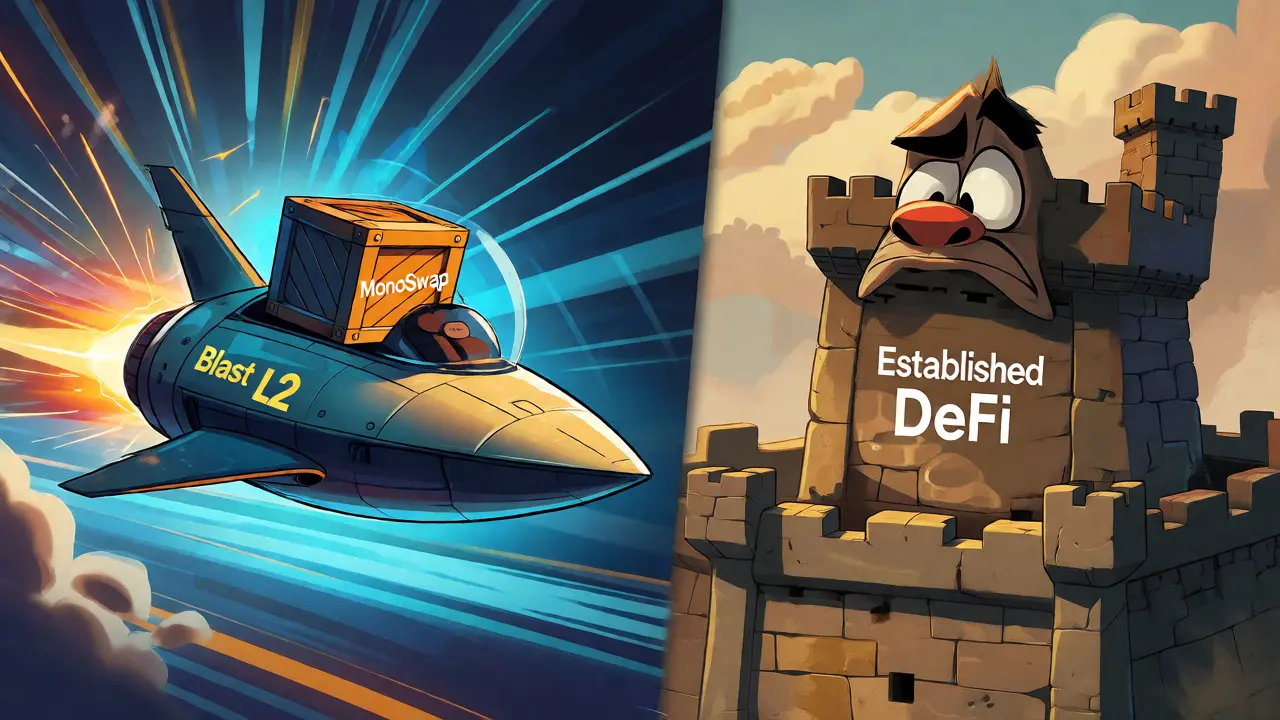
To understand MonoSwap v3, you must understand its host chain. Blast is a Layer 2 scaling solution for Ethereum that launched recently, competing with giants like Arbitrum, Optimism, and Polygon. Blast differentiates itself by offering native yield-bearing ETH and USDC. Users earn interest just by holding assets on the network.
MonoSwap v3 benefits from this narrative. Traders looking to maximize yield might prefer keeping assets on Blast rather than bridging to Arbitrum. However, this creates a dependency risk. If Blast fails to gain long-term traction against established L2s, MonoSwap v3 could become obsolete. Conversely, if Blast explodes in popularity, MonoSwap could ride that wave, provided it improves its liquidity infrastructure.
Currently, Blast is still proving itself. It faces stiff competition, and its total value locked (TVL) fluctuates based on broader market sentiment. MonoSwap v3 is essentially a bet on Blast’s success. If you believe Blast will dominate the yield-focused L2 niche, then exploring MonoSwap makes sense. If you prefer safety in numbers, sticking to multi-chain DEXs like Uniswap or Curve is wiser.
Who Should Use MonoSwap v3?
Given the pros and cons, let’s break down who fits this profile.
- The Blast Die-Hards: If you have all your capital on Blast and refuse to bridge assets elsewhere, MonoSwap is one of the few options for swapping. You accept the lower liquidity as the cost of staying on-chain.
- Small-Cap Speculators: If you are trading very small amounts (under $100), slippage matters less. The zero fees might save you a few cents, though gas fees will likely outweigh this savings.
- Yield Farmers: Some users might interact with MonoSwap primarily to access specific yield farms or launchpad tokens unique to the Blast ecosystem, using the DEX functionality only incidentally.
Conversely, avoid MonoSwap v3 if:
- You are trading larger sums (over $1,000).
- You require a wide variety of tokens beyond ETH and USDB.
- You prioritize security audits and regulatory compliance above all else.
- You need fast, reliable execution for day-trading strategies.
Final Verdict: High Risk, Niche Reward
MonoSwap v3 is a classic example of a platform that looks good on paper (zero fees, new tech) but struggles in practice (low liquidity, low trust). It serves a specific purpose for the Blast ecosystem but fails to compete broadly in the decentralized finance landscape.
For most crypto enthusiasts, the risks outweigh the rewards. The combination of a 0 trust score, negligible volume, and limited asset support makes it a dangerous place to park significant capital. Until MonoSwap v3 demonstrates improved liquidity through better incentives or partnerships, treat it as an experimental playground rather than a primary trading venue. Keep your core holdings on established platforms and only allocate speculative, disposable income to MonoSwap if you are committed to the Blast narrative.
Is MonoSwap v3 safe to use?
Safety is relative in DeFi. MonoSwap v3 has a low trust score (0-2) and lacks comprehensive public audits reported by major aggregators. While smart contract exploits haven't been widely publicized yet, the low adoption rate means fewer eyes are scrutinizing the code. Treat it as high-risk.
Why are the fees 0% if it's a DEX?
MonoSwap v3 subsidizes trading fees to attract users to the Blast ecosystem. They likely rely on other revenue streams, such as protocol-owned liquidity incentives or future tokenomics, rather than immediate transaction fees. Note that you still pay network gas fees on Blast.
What tokens can I trade on MonoSwap v3?
The selection is very limited, currently supporting only 3-4 cryptocurrencies. The primary pairs involve USDB (Blast's stablecoin) and WETH (Wrapped Ether). Do not expect to find popular altcoins like SOL, ADA, or DOGE here.
How does MonoSwap compare to Uniswap?
Uniswap is a global leader with billions in volume and thousands of tokens. MonoSwap v3 is a micro-cap DEX with under $15k daily volume. Uniswap offers superior liquidity, security, and asset variety. MonoSwap offers zero fees and Blast-native integration. For most users, Uniswap is the safer, more versatile choice.
Can I withdraw my funds easily?
Yes, because it is a decentralized exchange, you retain custody of your keys. Withdrawals depend on the Blast network's congestion levels. Since Blast is a Layer 2, withdrawals to Ethereum mainnet may incur bridge fees and time delays, unlike instant internal transfers.