

Imagine signing up for a bank, a crypto exchange, or even a simple investment app-and having to upload your ID, proof of address, and a selfie every single time. You do it once. Then again. Then again. Each company asks for the same documents. Each one stores them separately. Each one is a target for hackers. And you? You’re stuck in a loop of repetition, with no control over who sees your data.
This is the broken system most people still live with. But it doesn’t have to be this way. KYC verification with blockchain is changing all of it. No more duplicate forms. No more centralized databases full of sensitive data. No more waiting weeks for approval. Instead, you own your identity. You control who sees it. And once verified, you can use it anywhere-without re-uploading anything.
How Traditional KYC Fails You
Traditional Know Your Customer (KYC) processes are slow, expensive, and risky. Banks, fintechs, and exchanges each build their own verification systems. They ask for the same documents: passport, utility bill, selfie. They store them in their own servers. If one gets hacked, your data is exposed. And if you want to open an account with another company? You start over.
According to a 2023 Statista survey, 88% of U.S. adults are worried about how companies use their personal data. That fear isn’t irrational. In 2024 alone, over 300 million identity records were leaked in financial sector breaches globally. Centralized databases are just too attractive to attackers. And the cost? Financial institutions spend an average of $150 per customer on onboarding. Multiply that by millions of users. That’s billions wasted on redundant checks.
And the customer experience? Painful. You’re treated like a suspect, not a client. You’re forced to prove you’re who you say you are-over and over-while the companies you trust hoard your data with little accountability.
How Blockchain KYC Works
Blockchain KYC flips the script. Instead of each company holding your data, you hold it. Or rather, you give permission for others to access a verified, encrypted version of it.
Here’s how it works in practice:
- You sign up once with a blockchain-based KYC platform. You upload your ID, proof of address, and complete a live verification check (like a facial scan).
- Your data is encrypted and stored off-chain-often on secure systems like IPFS. Only a cryptographic hash (a unique digital fingerprint) of your data is stored on the blockchain.
- When you want to open an account with a bank or exchange, you grant them temporary access to your verified profile. They don’t see your raw documents. They see a verified hash that matches the one on the blockchain.
- If your data was altered after verification, the hash wouldn’t match. The system instantly flags it as tampered.
- Smart contracts automatically approve or deny access based on pre-set rules-like age, location, or compliance status.
You’re in control. You can revoke access anytime. You can see who accessed your data and when. No more shadowy data brokers. No more silent breaches.
Why Blockchain Makes KYC More Secure
Security isn’t just about encryption-it’s about structure. Centralized systems are single points of failure. One breach, and millions of records are exposed. Blockchain KYC is distributed. Even if one node is compromised, the system stays intact.
The blockchain records every access attempt. Every permission granted. Every verification. It’s immutable. That means:
- Regulators can audit compliance without demanding raw data.
- Companies can prove they followed rules without storing your personal info.
- You can prove you’ve been verified by a trusted source-without revealing your ID.
Platforms like Hyperledger Fabric are leading this shift. They’re permissioned blockchains-meaning only approved entities (banks, regulators, verified users) can join. This keeps the network secure and compliant with financial regulations.
And here’s the clever part: companies like those using Hanbar’s AES Key-Sharing protocol can share KYC data between banks without ever seeing each other’s raw data. One bank verifies you. Another bank gets a cryptographically secure signal that you’re cleared-without touching your passport photo.

Real Benefits: Speed, Cost, and Control
Let’s talk numbers. A 2023 study by financial technology researchers showed blockchain-based KYC reduced onboarding time from 7-10 days to under 2 hours. For customers, that’s a game-changer. For banks, it cuts costs by up to 60%.
Why? Because you’re no longer paying to verify the same person 5 times. One verification, reused across dozens of services. That’s efficiency.
And the customer experience? It’s like switching from filling out paper forms to using Apple’s Face ID. You don’t re-enter your password every time you log in to a new app. Why should you re-upload your ID every time you open a new account?
Users who’ve tried blockchain KYC report feeling more in control. One early adopter in New Zealand told a fintech researcher: “I finally feel like my data belongs to me-not the bank.” That’s not just convenience. That’s dignity.
Challenges and Real-World Hurdles
It’s not perfect yet. Blockchain KYC still faces real obstacles.
Regulation is fragmented. A verification that works in the EU might not meet requirements in Singapore or Brazil. Cross-border compliance is still a patchwork.
Scalability is tricky. While Hyperledger Fabric handles thousands of transactions per second, public blockchains like Ethereum still struggle with speed and cost. Most enterprise systems use private chains for this reason.
Adoption is slow. Banks are cautious. They rely on legacy systems. Changing infrastructure takes time, money, and regulatory approval. Smaller fintechs are leading the way, but big institutions are still watching.
And then there’s the learning curve. Not everyone understands how to use a digital wallet to manage their identity. UX design matters. If it’s too complicated, people won’t use it-even if it’s safer.
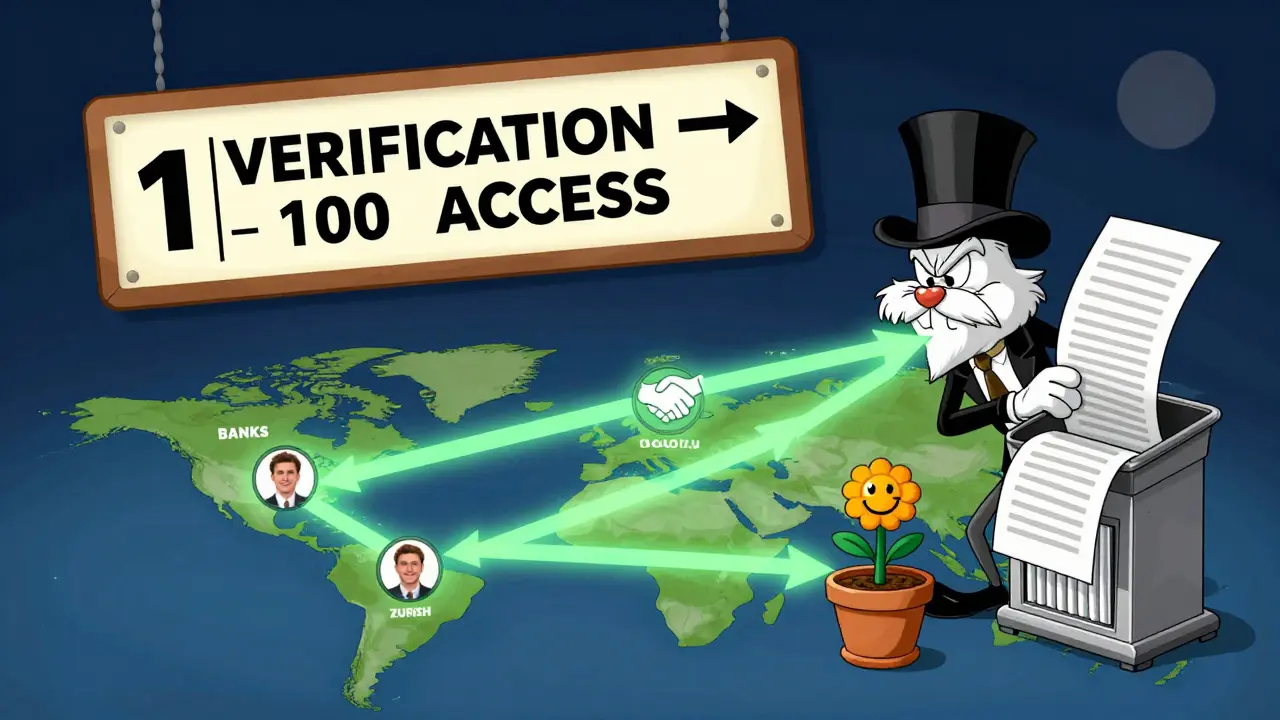
Who’s Doing It Right?
Some companies are already ahead.
Swiss bank UBS has piloted a blockchain KYC system with multiple partners. Customers verified once can onboard with other participating institutions without re-submitting documents. The system uses Hyperledger Fabric and integrates with existing CRM tools.
In Singapore, the Monetary Authority of Singapore (MAS) launched Project Guardian, which includes blockchain-based identity sharing between banks and insurers. The goal? To reduce fraud and duplication across the financial ecosystem.
And startups like Civic and Shyft Network are building consumer-facing apps that let users own their verified identity. You download the app, get verified, and then use it across dozens of services-crypto, banking, even rental platforms.
These aren’t theoretical. They’re live. And they’re working.
The Future Is Consent-Based Identity
Blockchain KYC isn’t just about efficiency. It’s about power. It shifts control from corporations back to individuals. In a world where data is the new oil, you’re no longer the product-you’re the owner.
As privacy laws like GDPR and New Zealand’s Privacy Act 2020 tighten, companies will be forced to adapt. Blockchain KYC gives them a compliant, scalable, and customer-friendly path forward.
Expect to see this tech expand beyond finance. Healthcare providers are testing it for patient records. Government agencies are exploring it for digital IDs. Even landlords are using it to verify tenant backgrounds securely.
The goal isn’t to replace all KYC. It’s to make it smarter. Faster. Fairer.
And it’s already happening. Not in some distant future. Right now.
What You Can Do Today
You don’t need to be a developer to benefit. If you’re using a crypto exchange, fintech app, or investment platform, ask: “Do you use blockchain-based KYC?” If they say no, ask why. Push for better options.
Support platforms that let you own your identity. Use apps that give you control over your data. Vote with your wallet.
The old system is expensive, slow, and unsafe. The new one is here. It’s just waiting for enough people to ask for it.
Jackson Storm
December 31, 2025 AT 17:13bro i just spent 45 minutes uploading my license to some crypto site only to get rejected because my selfie had a shadow. again???
Alison Hall
January 1, 2026 AT 05:17finally. i’m so tired of feeling like a criminal just because i want to invest. this is the future, and it’s already here.
Haritha Kusal
January 1, 2026 AT 10:35this is so good i cant even… i live in india and every time i try to open a binance acc i get stuck for weeks. this would save my life lol
Rajappa Manohar
January 2, 2026 AT 18:08yea but what if ur phone dies? then ur identity is gone? seems risky
prashant choudhari
January 4, 2026 AT 08:22blockchain kycc is the only ethical way forward. centralized data stores are just time bombs waiting to explode. the math is clear.
Mike Pontillo
January 4, 2026 AT 15:46oh wow so now we’re trusting tech bros with our id? next they’ll be asking us to vote with our crypto wallets. brilliant.
Jack and Christine Smith
January 6, 2026 AT 00:06my aunt in texas just got hacked last month. her whole life was dumped online. this could’ve stopped it. why isn’t everyone screaming about this??
Elisabeth Rigo Andrews
January 6, 2026 AT 14:11the architecture is sound, but the compliance layer remains fragmented. without iso 20022 interoperability and ai-driven regulatory mapping, this is just vaporware dressed in smart contracts.
surendra meena
January 8, 2026 AT 08:28YOU THINK THIS IS SAFE?? WHAT IF THE BLOCKCHAIN GETS HACKED?? WHAT IF THE HASH IS CORRUPTED?? YOU’RE JUST GIVING AWAY YOUR SOUL TO A DIGITAL GHOST!!
Joydeep Malati Das
January 10, 2026 AT 06:43an elegant solution to a systemic problem. the shift from ownership to access control represents a profound redefinition of digital personhood.
Raja Oleholeh
January 11, 2026 AT 00:09india needs this. our govt is slow but we’re ready. why wait for permission when the tech works?
Prateek Chitransh
January 12, 2026 AT 02:07you say it’s faster but have you tried explaining this to someone over 60? it’s not just about tech-it’s about trust. and trust takes time.
Mike Reynolds
January 12, 2026 AT 20:32my cousin works at a regional bank. they’re testing this internally. said it cut their onboarding costs by half. people are actually excited now.
Antonio Snoddy
January 14, 2026 AT 14:14think about it. every time you sign up for something, you’re handing over your soul to a corporation that doesn’t care. blockchain kycc isn’t just a tool-it’s a revolution. it’s the first time in human history that identity isn’t a commodity. we’re not just changing systems-we’re changing what it means to be human in the digital age. and if you’re not crying right now, you’re not paying attention.
Steve Williams
January 16, 2026 AT 13:18in nigeria, we’ve seen too many people lose everything to identity theft. this system could save lives. we need global standards, not just pilot programs.
rachael deal
January 16, 2026 AT 20:17yes!! i’ve been waiting for this for years. finally, someone’s listening to the people who actually use these services.
Adam Hull
January 18, 2026 AT 19:10congrats. you’ve built a glorified password manager with blockchain buzzwords. the real problem? people still don’t understand encryption. and banks? they’ll just make you pay extra for "premium identity verification."
Michelle Slayden
January 19, 2026 AT 15:16The ontological implications of decentralized identity are profound. By decoupling authentication from institutional authority, we reconstitute the subject as sovereign agent-reversing the epistemic asymmetry inherent in centralized data regimes. This is not merely technical innovation; it is epistemological liberation.
Vernon Hughes
January 20, 2026 AT 17:52UBS is using this. So is MAS. If you’re still skeptical, you’re not keeping up