

By 2026, running a crypto business without proper KYC and AML systems isn’t just risky-it’s impossible. What used to be a gray area, where exchanges could operate with minimal oversight, is now a tightly regulated global landscape. If you’re trading, holding, or moving crypto, you’re subject to the same rules as banks. The days of anonymous wallets and unverified accounts are over. Regulators aren’t asking nicely anymore-they’re enforcing, fining, and shutting down non-compliant players.
Why KYC and AML Matter Now More Than Ever
The Financial Action Task Force (FATF) didn’t just update its guidelines in 2019-it rewrote the rules for crypto. Recommendation 15 made it clear: virtual asset service providers (VASPs) must treat crypto transactions like traditional bank transfers. That means knowing who your customers are, tracking where their money comes from, and reporting anything suspicious. This isn’t a suggestion. It’s a legal requirement in over 120 countries. The big shift came with the FATF Travel Rule. Now, when you send more than $1,000 in crypto, the sender’s name, account number, and address must be shared with the receiver’s platform. Same goes for the receiver’s details. This applies to exchanges, custodians, DeFi gateways, and even some wallet providers. No exceptions. No loopholes. Blockchain analytics firms now help regulators trace these flows in real time.How the U.S. Is Enforcing Compliance
The U.S. moved fast in 2025. The GENIUS Act and STABLE Act together forced stablecoin issuers into the Bank Secrecy Act’s grip. That means companies like Circle or Tether now need to verify every user, monitor every transaction, and file reports just like a bank. Failure? Fines in the hundreds of millions. JPMorgan and Wells Fargo stopped partnering with crypto firms that couldn’t prove their KYC was ironclad. The SEC and FinCEN are working together like never before. Exchanges like Binance and Kraken have already paid billions in penalties for past gaps. Today, new platforms can’t even get a bank account unless they show audited KYC logs, transaction monitoring systems, and sanctions screening tools. The bar isn’t high-it’s impossibly high.The EU’s MiCAR Framework: A New Standard
The European Union’s Markets in Crypto-Assets Regulation (MiCAR) became fully active in December 2024. It’s the most detailed crypto rulebook in the world. Any firm issuing asset-referenced tokens (like stablecoins), electronic money tokens, or utility tokens must now register with national regulators and follow strict AML/KYC rules. MiCAR requires:- Identity verification for all users, even those with small balances
- Real-time transaction monitoring with AI-driven anomaly detection
- Disclosure of tokenomics, reserve holdings, and governance structure
- Appointment of a compliance officer based in the EU
The UK: A Regulatory Powerhouse
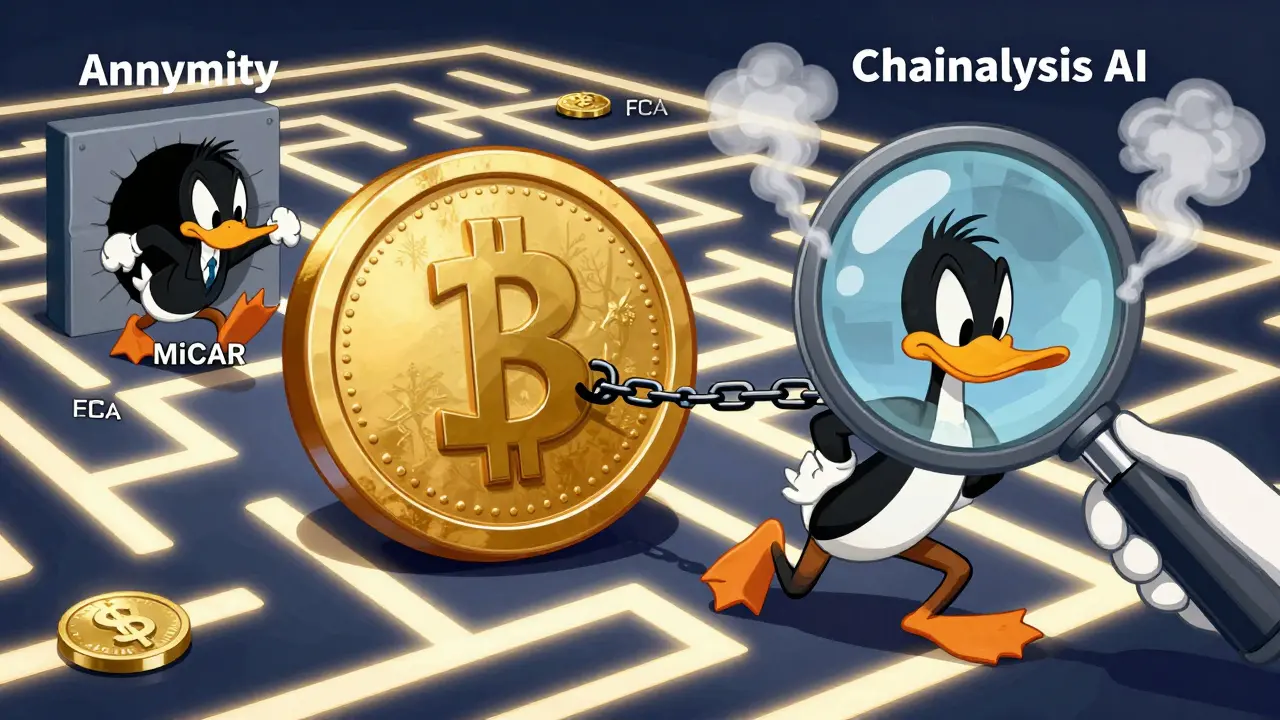
The UK’s Financial Conduct Authority (FCA) has become one of the toughest regulators in the world. Since 2024, any firm handling crypto for customers must register under the UK’s AML regime. That includes even small wallet apps and peer-to-peer platforms that facilitate trades. The FCA demands:- Customer Due Diligence (CDD) for every user
- Continuous transaction monitoring with alerts for unusual patterns
- Record keeping for at least five years
- Immediate Suspicious Activity Reports (SARs) to the National Crime Agency
What’s Required in Your KYC System
A basic ID check isn’t enough anymore. Modern crypto KYC needs:- Government-issued ID verification (passport, driver’s license)
- Live facial recognition to match the person to the ID
- Address verification via utility bill or bank statement
- Sanctions and PEP (Politically Exposed Person) screening
- Risk scoring based on location, transaction history, and behavior
Transaction Monitoring: The Hidden Backbone
KYC is just the front door. Transaction monitoring (KYT) is the security camera system. It watches every transaction after the user signs up. A user who deposits $5,000 in Bitcoin, then sends $4,800 to a mixer? That’s a red flag. A user who receives funds from a Russian wallet linked to a sanctioned entity? Blocked. AI-powered systems now detect patterns humans miss:- Structuring: breaking large transfers into smaller ones to avoid thresholds
- Layering: moving funds through multiple wallets to obscure origin
- Geographic anomalies: sudden transfers from high-risk jurisdictions
The Global Patchwork: Where Rules Differ
Not every country is the same. In Japan, the Financial Services Agency requires full KYC but allows some DeFi access if users are accredited. In Singapore, MAS allows crypto firms to operate under strict licensing, with mandatory AML audits every six months. In Canada, FINTRAC enforces KYC with penalties up to $500,000 per violation. But in places like Nigeria, Nigeria’s SEC has taken a hardline stance-requiring all exchanges to integrate with national ID systems. In Brazil, the Central Bank now requires all crypto transactions over R$10,000 to be reported. Even countries with lax rules are tightening up. The global trend is clear: no safe havens left.
LeeAnn Herker
January 7, 2026 AT 04:04So let me get this straight-we’re trading freedom for compliance? Next they’ll be scanning our retinas before we can buy a pizza with Bitcoin. 😒
They say it’s to stop crime, but half the people enforcing this are the same ones who got rich off the chaos. Hypocrisy has a new logo: KYC.
And don’t get me started on how ‘sanctions screening’ just means your cousin in Ukraine can’t send you $50 for birthday cake anymore. Welcome to the surveillance economy, folks.
They call it transparency. I call it digital handcuffs.
At this point, if you’re not being monitored, you’re probably already on a watchlist.
Blockchain was supposed to be the escape hatch. Now it’s just another bank with worse customer service.
Sherry Giles
January 7, 2026 AT 20:30Canada’s already got this locked down. We don’t play games with crypto. If you’re not KYC’d, you’re not welcome here.
And don’t even think about trying to sneak through a DeFi loophole-our regulators have AI bots crawling every mempool like it’s a crime scene.
US thinks it’s tough? Try dealing with FINTRAC on a Monday morning. They don’t ask. They demand.
And if you think MiCAR is bad, wait till the EU starts auditing your wallet app’s source code.
This isn’t regulation-it’s a full-scale takeover of digital finance. And we’re all just passengers now.
Sabbra Ziro
January 8, 2026 AT 18:52I get why this is happening-money laundering, ransomware, darknet markets… it’s real.
But I also worry that we’re building a system where the only people who can afford to participate are those who already have access to banks, lawyers, and tech teams.
What about the single mom in rural Texas who just wants to save in crypto? Does she need a compliance officer just to buy $100 worth of ETH?
And what happens when the system fails? When your ID verification gets rejected because your photo was too blurry?
We’re not just regulating criminals-we’re regulating the vulnerable.
Can we build this better? With more compassion?
Maybe the real question isn’t ‘how do we enforce?’ but ‘who are we excluding in the process?’
Let’s not make transparency a luxury.
Let’s make it fair.
Jennah Grant
January 9, 2026 AT 17:33Let’s be clear: KYC/AML is table stakes now. No one’s debating that.
But the real issue is scalability. Most compliance stacks are built for institutional players, not retail users.
Biometric verification, real-time Chainalysis integration, PEP screening-all these require API-heavy, cloud-native infrastructure.
Small exchanges? They’re either bankrupt or getting acquired by a bigger player.
And DeFi? Good luck getting a wallet provider to integrate with a regulated on-ramp without killing UX.
The irony? The more compliant you are, the less decentralized you become.
So we’re trading censorship resistance for regulatory survival.
Is that the future we want?
Or are we just building a new version of SWIFT-with more crypto jargon?
Dave Lite
January 10, 2026 AT 19:20Yo, if you’re still running a crypto business without KYC in 2026, you’re not a rebel-you’re a liability 😅
Just got off a call with my compliance team-we just integrated Sumsub + Elliptic + a custom AI anomaly engine.
Now our system flags anything weird: like someone sending 0.001 BTC to 12 different wallets every 17 minutes. Classic structuring.
And yes, we even screen for wallet addresses linked to North Korean mining pools. 🤯
It’s expensive? Absolutely.
But imagine getting fined $200M like Binance did? Nah.
Bottom line: if you’re not automating this, you’re already behind.
And if you think MetaMask is ‘private’? Honey, your wallet address is public. Your IP? Probably logged. You’re not anonymous-you’re just unverified.
Tracey Grammer-Porter
January 11, 2026 AT 09:38I used to think crypto was about freedom
Now I think it’s about responsibility
It’s weird how the same people who hated banks now want them to run their crypto
But maybe that’s the point
Not everyone can handle power
Maybe the system is just trying to keep people from hurting themselves
Or worse
Hurting others
It’s not about control
It’s about care
Even if it feels like a cage
Maybe the cage was always there
We just didn’t see the bars
jim carry
January 11, 2026 AT 11:41Let me tell you something-this whole KYC thing is a scam orchestrated by the Fed, the IMF, and a bunch of Wall Street lawyers who got bored after the 2008 bailouts.
You think they care about crime? No.
They care about control.
They want to know every transaction you make-because if they know where your money is, they can take it.
And don’t even get me started on the ‘travel rule’-that’s just the first step to a global digital ID system.
Next thing you know, you’ll need government approval to buy a bag of chips with Bitcoin.
They’re not stopping crime.
They’re stopping dissent.
And you’re helping them.
By signing your name.
By giving them your face.
By letting them track your every move.
Wake up.
They’re not protecting you.
They’re owning you.
Don Grissett
January 11, 2026 AT 18:33lol so u think u can just ‘opt out’ of govt rules? bro u live in 2026 not 2014
every bank in america now requires u to prove u r not a terrorist to open a crypto account
and if u r using metamask without KYC? u r basically begging to get flagged
the feds have AI that can trace a tx from a mixer to ur phone in 3 seconds
and u think ur ‘private’? please
even ur grandma’s crypto wallet is being monitored now
compliance isn’t optional
it’s survival
and if u r mad about it? go live in a cave
and bring ur own bitcoin mining rig
and hope no one finds u
lol
Katrina Recto
January 12, 2026 AT 15:46It’s not about trust. It’s about consequences.
If you let a drug cartel move millions through your platform, you’re complicit.
That’s not opinion.
That’s law.
And if you’re too lazy to implement basic checks?
You’re not a pioneer.
You’re a liability.
Simple as that.
Mollie Williams
January 13, 2026 AT 12:26There’s a quiet tragedy here.
We built something that was meant to liberate-unmediated, permissionless, borderless.
And now we’re forcing it into the same cages that crushed trust in traditional finance.
Is this progress?
Or just another iteration of power pretending to be protection?
Perhaps the real crime isn’t money laundering.
It’s the surrender of our ideals in exchange for safety.
We traded the wild west for a gated community.
And we called it civilization.
But who gets to decide what civilization looks like?
And who gets left outside the gate?
Dennis Mbuthia
January 15, 2026 AT 03:53Let’s be real-this isn’t about ‘compliance’-it’s about the death of financial autonomy.
They want to know where your money came from, where it’s going, who you’re sending it to, what time you sent it, and what your IP address was when you clicked ‘confirm’.
And they want it all logged, audited, and signed off by some bureaucrat in Brussels or DC who’s never held a private key.
Meanwhile, the real criminals? They’re still running hedge funds in the Caymans.
But hey-let’s lock down the 19-year-old in Ohio who bought $500 of DOGE to pay his rent.
That’s justice.
That’s progress.
That’s the future.
And guess what?
It’s already here.
And you’re not even mad.
You’re just scrolling past it like it’s a TikTok ad.
Surendra Chopde
January 16, 2026 AT 06:25India is moving fast too. RBI is now requiring all exchanges to link with Aadhaar.
Even small P2P traders must verify with government ID.
It’s not perfect, but it’s working.
Before, crypto was used for tax evasion.
Now, it’s just another financial channel.
Yes, it’s invasive.
But corruption is worse.
And if KYC stops one child from being sold because someone laundered money through crypto?
Worth it.
Not freedom?
Maybe.
But safety matters too.
Tre Smith
January 16, 2026 AT 07:38Let’s analyze this with empirical rigor.
According to Chainalysis’ 2025 report, 0.32% of all crypto transactions are illicit.
That’s $24 billion out of $7.5 trillion.
So we’re subjecting 100% of users to invasive surveillance to catch 0.32%.
That’s a 312,500:1 false positive ratio.
And yet, regulators demand full KYC for every wallet.
Why?
Because it’s politically expedient.
Because it’s easier to regulate a user than a bank.
Because the public fears what they don’t understand.
And because compliance vendors are making billions.
So we sacrifice liberty for optics.
And call it ‘security’.
That’s not innovation.
That’s institutional capture.
Allen Dometita
January 17, 2026 AT 22:52Look, I get it-KYC feels like a bummer.
But imagine if your crypto exchange got hacked and someone stole $10M from your account.
And you had no ID proof? No transaction logs?
Who’s gonna help you?
Not the cops.
Not the Feds.
Not even your favorite influencer.
So yeah, it’s annoying.
But it’s also your safety net.
And if you’re mad about it?
Just remember-no one’s forcing you to use crypto.
But if you do?
Play by the rules.
It’s not the end of the world.
It’s just the next level.
And hey-free coffee at the compliance office. 😎
Brittany Slick
January 18, 2026 AT 11:29There’s something beautiful about how far we’ve come.
From anonymous wallets to real-time AI monitoring.
From sketchy exchanges to audited, regulated platforms.
It’s not perfect.
But it’s growing.
And maybe-just maybe-we’re learning how to build something that doesn’t just move money.
But protects people.
Even if it feels heavy.
Even if it feels slow.
Even if it feels like losing something.
Maybe we’re gaining something too.
Trust.
Not in tech.
But in each other.
Andy Schichter
January 19, 2026 AT 20:20Oh wow, look who’s suddenly a financial policy expert.
‘The future is transparent!’
Yeah, like how your Netflix profile is ‘transparent’-everyone knows you binge-watch true crime at 2am.
Great. So now the government knows you bought 0.01 ETH to pay your Uber driver.
What a victory for human dignity.
Next they’ll make you sign a waiver before you can send a meme coin to your dog.
And you’ll thank them for it.
Because you’ve been conditioned.
And that’s the real horror story.
Caitlin Colwell
January 20, 2026 AT 16:02It’s not about trust.
It’s about time.
And we’re running out of both.
Charlotte Parker
January 20, 2026 AT 20:21Let’s be honest-this isn’t about crime.
It’s about control.
And the people who wrote these rules? They never held a private key.
They’ve never lost crypto.
They’ve never sent money to someone in a war zone.
They just want to see your face before you can buy a token.
So congrats.
You’ve won.
You’ve turned the most revolutionary financial experiment in history into a bank with extra steps.
And you called it progress.
How poetic.
Calen Adams
January 22, 2026 AT 13:15Look, I’m not here to argue about freedom vs. regulation.
But if you’re running a crypto business and you haven’t integrated a proper KYC stack by now?
You’re not a visionary.
You’re a liability.
And if you think the SEC doesn’t have your IP logs?
Good luck explaining that to your lawyer after your bank account gets frozen.
Compliance isn’t sexy.
But neither is bankruptcy.
So automate it.
Integrate it.
And stop pretending you’re some underground rebel.
You’re not.
You’re just behind.
And you’re gonna lose.
Sarbjit Nahl
January 24, 2026 AT 00:00Who decided that anonymity is the enemy?
Was it the people who lost money?
Or the people who profit from monitoring them?
Every time we demand identity for access,
We trade a piece of our autonomy for a promise of safety.
But who keeps that promise?
And who answers when it breaks?
Perhaps the real question isn’t whether KYC works.
But whether we still want to be free.
Or just comfortable.
LeeAnn Herker
January 25, 2026 AT 06:32And here’s the kicker-by 2027, they’ll be requiring KYC to use a crypto wallet on your smart fridge.
‘Verify your identity to unlock your ice maker.’
Thanks, regulators.
Now I can’t even make a smoothie without a government form.