

You deposited your ETH and USDT into a pool, expecting to earn trading fees. Six months later, you withdraw your funds only to find that you have less money than if you had just held those assets in your wallet. This is Impermanent Loss, the difference between the value of an asset when held versus its value after providing liquidity in an Automated Market Maker (AMM). It sounds scary, but it is not always a disaster. The real question isn't whether impermanent loss exists-it does-but whether the trading fees you earn can outpace the price divergence of your paired assets.
| Factor | Impact on Profitability | Strategy Tip |
|---|---|---|
| Volatility | High volatility increases IL risk significantly. | Avoid highly volatile altcoin pairs unless fees are massive. |
| Fee Volume | High trading volume offsets IL through fee income. | Choose pools with consistent daily trading volume. |
| Asset Correlation | Correlated assets minimize IL. | Pair ETH with L2 tokens or stablecoins for lower risk. |
| Time Horizon | Longer holding periods allow fees to accumulate. | Short-term LPing often results in net losses due to timing. |
The Math Behind the Magic (and the Pain)
To understand if liquidity provision is worth it, you need to grasp how Automated Market Makers use mathematical formulas to determine asset prices based on supply ratios rather than order books work. In traditional exchanges, buyers and sellers meet at specific prices. In DeFi, you deposit two assets, usually in a 50/50 value ratio. When traders swap one token for another, they change the ratio. Arbitrage bots then step in to rebalance the pool to match external market prices. This rebalancing is where impermanent loss creeps in.
Imagine you deposit 1 ETH and $2,000 USDC into a pool when ETH costs $2,000. Your total position is $4,000. If ETH rises to $3,000, arbitrageurs buy cheap ETH from your pool until the internal price matches the external market. You might end up with 0.8 ETH and $2,400 USDC. That’s still $4,800 total, which looks like a profit. But wait-if you had just held your original 1 ETH and $2,000 USDC, you would have $5,000 ($3,000 + $2,000). You “lost” $200 compared to holding. That gap is the impermanent loss. It becomes permanent only when you withdraw while the price remains diverged.
Fees vs. Losses: The Tipping Point
So, why do people still do this? Because of Trading Fees a percentage of each transaction routed through the pool, paid to liquidity providers as compensation for capital risk. On platforms like Uniswap, the leading decentralized exchange protocol enabling permissionless token swaps via smart contracts, fees typically range from 0.01% to 1% per swap. If a pool has high trading volume, these fees add up quickly.
The break-even point depends entirely on volume relative to volatility. For stablecoin pairs like USDC/USDT, price movement is minimal, so impermanent loss is negligible. Here, you are essentially farming yield with very low risk. However, for volatile pairs like ETH/SOL, a 50% price swing can cause significant IL. You need enough trading fees to cover that gap before withdrawal. Data suggests that during stable markets, many major pools generate annualized yields of 5-20%, which often beats simple holding. But during crash periods or euphoric rallies, IL frequently exceeds fee earnings, leading to negative returns.

Strategies to Minimize the Damage
If you want to stay in the game without getting wrecked by volatility, you need to pick your battles wisely. Not all pools are created equal. Here is how experienced providers approach the decision:
- Stick to Correlated Assets: Pairing assets that move together reduces price divergence. For example, pairing ETH with an Ethereum Layer-2 token often results in lower IL than pairing ETH with a completely uncorrelated altcoin.
- Use Stablecoin Pairs: As mentioned, stable-to-stable pairs offer near-zero IL. This is ideal for conservative investors looking for yield without directional exposure.
- Leverage Concentrated Liquidity: Protocols like Uniswap V3 a version of the DEX allowing users to provide liquidity within specific price ranges for higher capital efficiency let you choose exactly where your money works. You can concentrate liquidity around the current price to earn more fees. The catch? If the price moves outside your range, you stop earning fees and your IL risk spikes because you are effectively holding only one asset.
- Monitor Real-Time Metrics: Don’t set it and forget it. Use tools to track your current IL versus accrued fees. If IL starts eating into your principal faster than fees are accumulating, consider exiting or rebalancing.
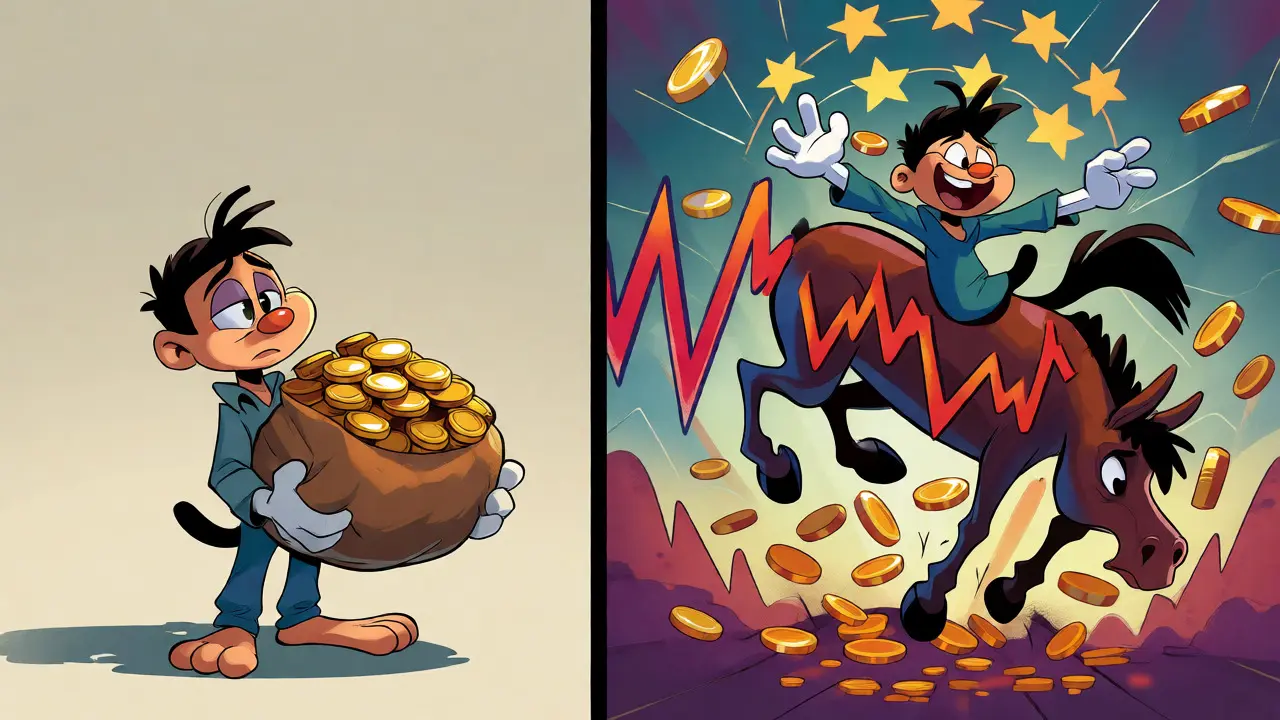
When Is It Actually Worth It?
Context matters more than any single formula. During bull markets, high trading volumes often mean fees skyrocket, easily offsetting moderate IL. In bear markets, volume dries up, and fees drop, making even small price movements painful. Industry analysis indicates that roughly 50-60% of liquidity providers see net positive returns over 6-12 month periods. Short-term providers, however, often lose money due to timing errors and gas fees.
Consider the opportunity cost. If you believe an asset will appreciate significantly, holding might be better. If you think the market will chop sideways with high activity, providing liquidity wins. Advanced users also look at Yield Farming strategies that combine trading fees with additional token incentives to boost overall returns. Some protocols offer extra rewards in their native governance tokens, which can subsidize the IL. Just remember: those reward tokens are also subject to price volatility.
Risks Beyond Impermanent Loss
IL isn’t the only headache. You face Smart Contract Risk the possibility that bugs or exploits in the underlying code could lead to loss of funds. Even audited protocols like Uniswap have faced issues in the past. Then there are gas fees. On Ethereum mainnet, entering and exiting positions can cost tens or hundreds of dollars, eating into profits for smaller portfolios. Layer-2 networks like Arbitrum or Optimism reduce this burden, making liquidity provision more accessible for retail users.
Tax implications also loom large. In many jurisdictions, swapping assets inside a pool or withdrawing them can trigger taxable events. Tracking cost basis across multiple pools and timeframes requires meticulous record-keeping. Failing to account for taxes can turn a nominal profit into a net loss.
Can impermanent loss ever exceed my initial investment?
Yes, in extreme scenarios. If one asset goes to zero while the other holds value, you could lose nearly 100% of the depreciating asset's value compared to holding both. However, you still retain the value of the appreciating asset. It rarely wipes out the entire portfolio unless both assets crash simultaneously.
How do I calculate if I am currently profitable?
Compare your current position value against the value of the assets if you had simply held them since entry. Add any accrued trading fees and incentive rewards to this number. If (Current Value + Fees) > (Hold Value), you are profitable. Many DeFi dashboards automate this calculation.
Does providing liquidity count as passive income?
It is semi-passive. While you don't trade actively, you must monitor market conditions, manage gas fees, and potentially rebalance positions, especially in concentrated liquidity models like Uniswap V3. True passivity is rare in DeFi due to the dynamic nature of crypto markets.
Are there ways to protect against impermanent loss?
Some newer protocols offer "impermanent loss protection" or insurance mechanisms, though they often come with lower base fees or lock-up requirements. Alternatively, using correlated asset pairs or stablecoin pools naturally minimizes the risk of significant price divergence.
What happens if I withdraw during high volatility?
Withdrawing locks in the impermanent loss. If you withdraw while prices are diverged, you realize the loss immediately. Waiting for prices to revert to their original ratio can eliminate the loss, but this requires patience and carries the risk that prices may never return to that level.
Marc Kennedy
September 20, 2026 AT 02:22Yo this is solid! 🚀 I've been LPing on Arbitrum for a while and honestly the fees usually cover the IL if you pick stable pairs. Just gotta be patient fam!