

TVL Calculator
Calculate Your Protocol's TVL
Total Value Locked (TVL) is the sum of all assets locked in a DeFi protocol, calculated by multiplying each asset amount by its current price in USD.
Results will appear here after calculation
When you look at a DeFi protocol like Aave, Uniswap, or Compound, how do you know if it’s actually working? You could check how many people are using it, or how much money it’s making in fees. But the one number everyone looks at first? TVL - Total Value Locked. It’s not perfect, but it’s the closest thing DeFi has to a heartbeat monitor.
What TVL Really Means
TVL is the total amount of money locked in a DeFi protocol’s smart contracts. That means all the crypto people have deposited to lend, borrow, stake, or provide liquidity. If you put 5 ETH into a liquidity pool on Uniswap to earn trading fees, that 5 ETH counts toward Uniswap’s TVL. Same if you stake your USDC on Aave to earn interest. It doesn’t matter if you’re trying to make money or just testing the system - if your crypto is in the contract, it’s part of the total.The math is simple: multiply how much of each asset is locked by its current price in USD, then add it all up. For example, if a protocol holds 40,000 ETH at $2,600 each and 200 million USDC at $1 each, that’s $104 million + $200 million = $304 million in TVL. Easy to calculate, but the meaning behind it? That’s where things get interesting.
Why TVL Matters More Than Market Cap
A lot of people confuse TVL with market capitalization. Market cap tells you how much the protocol’s token is worth based on price and supply - it’s mostly speculation. TVL tells you how much real value people are actively using the protocol for. Two big differences:- Market cap can spike because of hype or a big investor buying tokens - even if no one’s using the product.
- TVL only goes up when real users lock up their assets - which means they believe in the protocol enough to risk their money.
Think of it like a bank. Market cap is how much investors think the bank is worth on paper. TVL is how much cash is actually sitting in the vault. One is guesswork. The other is fact.
In 2020, when DeFi exploded, TVL became the go-to signal. When Aave’s TVL jumped from $100 million to $1 billion in six months, it wasn’t because the AAVE token price surged - it was because thousands of users started locking up their ETH and stablecoins. That’s real adoption. That’s trust.
TVL as a Trust Signal
You’re not just locking up money - you’re trusting a piece of code. No CEO, no customer service line, no insurance. If the smart contract has a bug, your funds could vanish. That’s why TVL is also a measure of security and governance confidence.Protocols with high, stable TVL aren’t just popular - they’ve survived scrutiny. They’ve weathered market crashes, hacks, and volatility. Users keep their money there because they believe it’s safe. That’s why Ethereum still holds over $96 billion in TVL as of late 2025. It’s not just the biggest network - it’s the most trusted.
But here’s the catch: TVL doesn’t tell you if users are happy. Someone might lock up $10,000 in a protocol because the APY is 40% - but if that yield crashes next week, they’ll pull out. High TVL doesn’t mean loyal users. It can just mean high rewards.

What TVL Doesn’t Tell You
TVL is useful, but it’s not a full picture. Here’s what it misses:- Fee revenue: A protocol can have huge TVL but make almost nothing in fees. That means it’s not actually generating income - just attracting deposits.
- User activity: Are 10,000 people actively trading or borrowing? Or is 80% of the TVL from just 5 wallets?
- APY stability: A protocol with a 50% APY might look great, but if that rate is unsustainable, it’s a Ponzi waiting to collapse.
- Impermanent loss: Liquidity providers might see high TVL, but if prices swing too much, they lose money even if the TVL stays flat.
Some protocols game TVL by offering fake incentives - like airdrops or bonus tokens - to lure deposits. That’s called “TVL farming.” It inflates the number, but doesn’t build real value. Smart investors watch for sudden spikes in TVL that don’t match user growth or fee increases. Those are red flags.
How to Use TVL the Right Way
Don’t look at TVL alone. Combine it with three other metrics:- Protocol revenue: How much are users paying in fees? If TVL is high and revenue is rising, the protocol is healthy.
- Active users: Are thousands of unique addresses interacting daily? Or just a few whales moving the numbers?
- APY trends: Is the yield going down over time? That often means the incentive program is fading - and users will leave.
For example, look at two lending protocols:
- Protocol A: $2 billion TVL, $5 million in monthly fees, 10,000 daily active users, APY dropping from 8% to 5% over 6 months.
- Protocol B: $500 million TVL, $3 million in monthly fees, 5,000 daily active users, APY steady at 6%.
Protocol A has more TVL - but Protocol B is more sustainable. It’s making more revenue per dollar locked and keeping users engaged without chasing unrealistic yields.
TVL Across Chains
In 2020, almost all TVL was on Ethereum. Now? It’s spread out. Solana, Polygon, Arbitrum, and even Bitcoin-based DeFi (via Layer 2s like Stacks or Rootstock) are gaining share. That’s good for the ecosystem - but it makes comparisons harder.Don’t compare a TVL of $1 billion on Ethereum to $1 billion on Solana. They’re not the same. Ethereum has deeper liquidity, more institutional backing, and better security. Solana might have faster transactions, but fewer users with long-term capital. Always compare TVL within the same chain or similar protocol types.
Also watch for cross-chain bridges. Some TVL is inflated because assets are locked on one chain but represent funds that originated elsewhere. Tools like DeFiLlama now track “native TVL” - meaning assets actually created on that chain - to give a clearer picture.
The Future of TVL
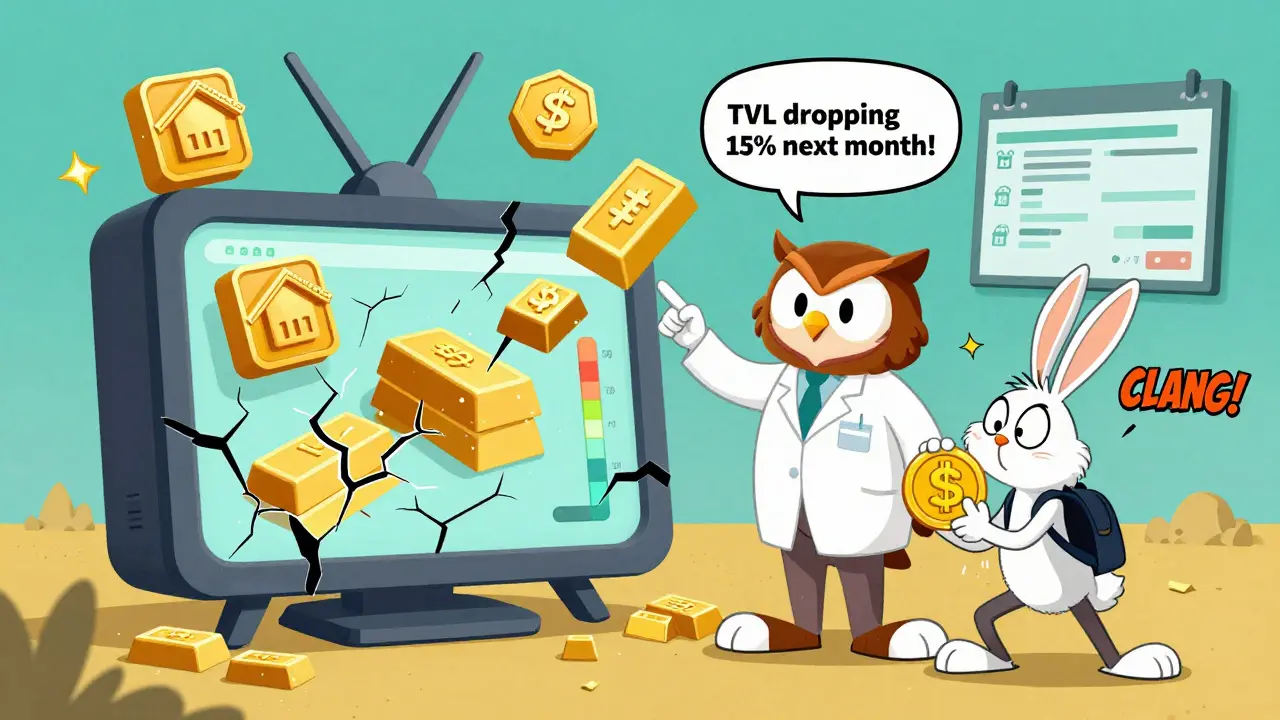
TVL isn’t going away. But it’s evolving. New asset types are entering the mix - tokenized real estate, gold-backed tokens, even tokenized bonds. These aren’t just crypto anymore. They’re real-world value on-chain. That means TVL calculations will need to account for different risk profiles, regulatory status, and price stability.Analytics platforms are also adding AI to predict TVL trends. Instead of just showing today’s number, they’ll say: “This protocol’s TVL is likely to drop 15% in the next 30 days because APY is falling and user retention is low.” That’s the next level.
For now, TVL remains the most accessible, transparent, and widely trusted metric in DeFi. It’s not the whole story - but it’s the first page you open before reading the rest.
Bottom Line
TVL tells you how much money is in the room. It doesn’t tell you who’s in it, what they’re doing, or if they’ll stay. But if no one’s putting money in, you know the party’s over. If billions are locked up, it’s worth asking why - and what’s holding it there.Is TVL the best way to measure DeFi success?
TVL is the most widely used metric, but not the best alone. It shows how much capital is active, but doesn’t reveal revenue, user retention, or sustainability. Combine it with fee data, active users, and APY trends for a complete picture.
Can TVL be manipulated?
Yes. Some protocols offer high yield bonuses or airdrops to attract short-term deposits - a practice called “TVL farming.” These spikes look impressive but vanish once the incentives end. Watch for sudden TVL jumps without matching increases in user activity or fees.
Why does Ethereum have the highest TVL?
Ethereum has the oldest, most secure, and most widely used DeFi protocols. It hosts the largest liquidity pools, most trusted lending platforms, and deepest institutional adoption. Even with higher fees and slower speeds, users trust it more than newer chains - so they keep their capital there.
Does high TVL mean high returns?
Not necessarily. High TVL means lots of money is locked in, but returns depend on fee structures and incentive models. Some high-TVl protocols have low yields because they’re stable and don’t need to pay extra. Others with low TVL offer sky-high APYs to attract users - which is often unsustainable.
What’s the difference between TVL and liquidity?
TVL is the total value of all assets locked in a protocol - including staked tokens, lent assets, and liquidity pools. Liquidity refers specifically to funds in trading pools (like on Uniswap) that enable swaps. So all liquidity is part of TVL, but not all TVL is liquidity.
Mani Kumar
December 5, 2025 AT 01:00TVL is a superficial metric at best. It conflates capital concentration with utility. Real adoption is measured in active, non-arbitrage-driven transactions - not the volume of idle assets trapped in smart contracts.
Most protocols gaming TVL are engineering illusions, not ecosystems.
Britney Power
December 7, 2025 AT 00:47One must interrogate the structural integrity behind TVL - not merely its magnitude. The metric is fundamentally flawed as a proxy for success because it ignores velocity, capital efficiency, and the opportunity cost of capital deployment.
When 80% of TVL resides in five wallets - often cross-chain bridges or yield aggregators masquerading as protocols - one is not observing a decentralized economy, but a centralized concentration of speculative capital, dressed in blockchain aesthetics.
Furthermore, the reliance on TVL as a benchmark perpetuates a misallocation of resources: VCs fund protocols based on inflated TVL, not on fee generation or user retention - which are the true indicators of sustainable value creation.
And let us not forget: TVL is a lagging indicator. It reflects past capital inflows, not future viability. A protocol can have $10B in TVL and still be on the brink of collapse if its revenue model is unsustainable - as we saw with the Terra implosion, where TVL was euphoric until the algorithmic peg snapped.
True success lies in autonomous revenue streams, not in yield farming incentives that evaporate with the next bull run.
TVL is the heartbeat - but without oxygen, the heart beats only to die. We must measure respiration, not pulse.
Akash Kumar Yadav
December 7, 2025 AT 12:56USA and UK analysts keep overcomplicating this. TVL is simple - if money is in it, people trust it. No country has that kind of trust except India and China - and even then, they don't need fancy metrics.
Stop pretending TVL is flawed. It's just that Western finance can't handle raw truth.
India's DeFi growth? Silent. But real. And TVL proves it - even if your Bloomberg terminal doesn't count it.
samuel goodge
December 8, 2025 AT 23:10TVL, as a metric, is both profoundly intuitive and dangerously reductive - a double-edged sword forged in the crucible of speculative markets.
It is, in essence, a collective act of trust - a decentralized ledger of confidence - but it is not, by any stretch, a measure of utility, resilience, or ethical governance.
Consider this: a protocol may attract $5 billion in TVL through a 200% APY incentive - but if 95% of that capital is withdrawn within 30 days, what has been achieved? Merely a temporary illusion of popularity - a mirage sustained by algorithmic arbitrage bots, not human conviction.
And yet - and here is the paradox - TVL remains indispensable, because it is the only metric that is simultaneously transparent, auditable, and universally comparable across chains.
It is the closest thing we have to a public square where capital votes with its feet.
But to treat it as a singular truth is to commit the same error as medieval astronomers who believed the sun revolved around the earth - because it appeared to.
Thus, we must use TVL not as an end, but as a starting point - a compass, not a map.
Its value lies not in its number, but in the questions it compels us to ask: Who is locking? Why? For how long? And at what cost?
Without those follow-ups, TVL is merely noise dressed in blockchain garb.
Jay Weldy
December 10, 2025 AT 09:43I really appreciate how this breaks down TVL without throwing shade at new projects. Too many people act like high TVL = scam, but sometimes it’s just early adoption.
What matters is whether people are sticking around after the hype fades. That’s the real test.
Melinda Kiss
December 12, 2025 AT 02:48So true!! 😊 TVL is like the first date - it shows interest, but doesn’t tell you if they’ll call again.
Always check fee revenue + active users. That’s the real relationship status. 💬
Christy Whitaker
December 12, 2025 AT 20:49You’re all missing the point. TVL is a surveillance tool. Every dollar locked is a data point tracked by the same institutions that control traditional finance.
They don’t care if you ‘trust’ the protocol - they care that you’re exposing your entire portfolio to a single chain, a single smart contract, a single point of failure.
TVL isn’t trust. It’s compliance.
And if you think Ethereum is ‘secure’ - you haven’t watched the flash loan attacks on Aave in 2023. Or the 100M+ drain on Layer 2s last quarter.
They let you lock your money… so they know exactly where to strike next.
Nancy Sunshine
December 13, 2025 AT 16:13While TVL is an indispensable metric, it must be contextualized within the broader macroeconomic landscape of DeFi.
For instance, the concentration of TVL on Ethereum - despite its high gas fees - reflects not merely technological superiority, but institutional inertia and regulatory familiarity.
Moreover, the emergence of ‘native TVL’ as a metric, as referenced in the article, represents a necessary evolution toward precision - one that accounts for asset provenance and mitigates the distortions introduced by cross-chain bridging.
Furthermore, the integration of AI-driven predictive analytics for TVL trends signals the maturation of DeFi analytics from descriptive to prescriptive modeling - a critical step toward risk-adjusted capital allocation.
That said, one must remain vigilant against the normalization of TVL as a KPI for protocol legitimacy, as this encourages a race to the bottom in incentive design - a phenomenon observed in the proliferation of ‘liquidity mining’ schemes that prioritize short-term capital inflows over long-term protocol health.
Thus, while TVL remains the most accessible proxy for market confidence, it is neither sufficient nor, in isolation, reliable as a definitive indicator of sustainable success.
Ann Ellsworth
December 14, 2025 AT 00:23TVL is literally the only thing that matters. If you're not measuring TVL, you're not measuring anything. Everyone else is just confused because they don't understand DeFi.
Also, why are you even reading this if you don't know what a liquidity pool is? 🤦♀️
Also also - did you know that 87% of TVL on Solana is actually from Ethereum via bridges? No? Then you're not qualified to comment. #DeFiLiteracy
Catherine Williams
December 15, 2025 AT 06:57Love how this post doesn’t just say ‘TVL good’ or ‘TVL bad’ - it shows the nuance.
For new folks jumping into DeFi: don’t chase TVL. Chase projects that have steady revenue, real users, and don’t need to pay you 50% APY to stay alive.
And if you’re a dev? Build for retention, not hype. The money will follow.
Mohamed Haybe
December 17, 2025 AT 01:37TVL? More like Tired Value Lied
Western media loves this number because it makes crypto look like a bank. But in India, we know better. Real money moves quietly. No TVL. No fanfare. Just wallets growing.
Meanwhile, you all scream about $2B on Arbitrum while real adoption is happening in WhatsApp groups with USDT.
TVL is a trophy for losers who need validation.
Real wealth doesn’t post on DeFiLlama.
Marsha Enright
December 17, 2025 AT 18:00Great breakdown! I always tell my friends: TVL is the ‘number of people in the room’ - but you still need to check if they’re dancing, or just standing there waiting for free snacks.
Fee revenue + active users = the real party vibe. 💃🕺
Andrew Brady
December 18, 2025 AT 17:41TVL is a government-backed deception. Every dollar locked is a digital fingerprint for the Fed’s blockchain surveillance program.
Why do you think the SEC pushes TVL as the ‘standard’? Because it makes it easier to track, freeze, and tax your assets.
Ethereum’s $96B TVL? That’s not trust - that’s a honeypot.
Next they’ll mandate KYC on wallets. You think this is freedom? You’re being recorded.
Don’t lock your money. Lock your beliefs - and stay off-chain.
Sharmishtha Sohoni
December 20, 2025 AT 10:25Does TVL include staked ETH on L2s or just mainnet? And how do you account for rehypothecation?
Also - is TVL measured before or after impermanent loss adjustments?
Durgesh Mehta
December 21, 2025 AT 20:22TVL is useful but not everything. I like how the post lists what it misses. Most people don't even think about fee revenue. Good stuff.
Sarah Roberge
December 21, 2025 AT 21:29What if… TVL is just a distraction? What if the real revolution isn’t in locking money… but in unlocking *identity*?
What if the future isn’t about how much you lock… but how much you *reveal*?
And what if the protocols that win… aren’t the ones with the highest TVL… but the ones that let you own your data?
…I think I’m onto something.
Can someone please write a whitepaper on this? I’ll name it ‘The TVL Illusion’.
Steve Savage
December 23, 2025 AT 04:09TVL is like the size of a campfire - tells you people gathered, but not if they’re telling stories or just warming their hands.
What matters is who’s staying past midnight.
And honestly? I’m more impressed by a $500M protocol with 10k daily users than a $5B one with 50 whales.
Layla Hu
December 24, 2025 AT 11:31Interesting. I never thought about TVL as a trust signal. Makes sense though.
Nora Colombie
December 25, 2025 AT 17:52TVL is a joke. Real DeFi is on Bitcoin. All these EVM chains are just centralized clones with faster transactions and worse security. You think Ethereum is ‘trusted’? It’s just the biggest Ponzi with the best PR.
And don’t even get me started on ‘native TVL’ - that’s just another Wall Street term to make you feel like you’re doing something smart while they quietly drain the liquidity.
Bitcoin DeFi is the only real thing. Everyone else is just playing dress-up.