

Staking crypto isn’t magic. It’s not gambling. And it doesn’t require you to be a tech genius. At its core, staking is simply locking up your cryptocurrency to help secure a blockchain network-and getting paid for it. Think of it like putting money in a savings account, except instead of a bank, you’re helping run a decentralized computer network. And instead of 3% interest, you might earn 5%, 10%, or even more-depending on the coin and platform.
What Is Crypto Staking?
Crypto staking works on blockchains that use proof-of-stake (PoS) instead of proof-of-work. Bitcoin uses proof-of-work, which needs massive amounts of electricity to solve complex math problems. PoS blockchains like Ethereum, Cardano, and Polkadot skip the mining rigs. Instead, they pick validators based on how much crypto you’re willing to lock up. The more you stake, the higher your chance of being chosen to verify transactions. When you do, you earn rewards.
Ethereum’s switch to proof-of-stake in 2022 was the big moment that made staking mainstream. Before that, staking was mostly for crypto insiders. Afterward, millions of regular people started staking their ETH, ADA, SOL, and other tokens. Today, over $40 billion worth of crypto is actively staked across major networks. That’s not a small number-it’s real money working for you while you sleep.
How Staking Rewards Work
Your rewards come from two places: new tokens created by the network and transaction fees. The network pays you in the same coin you’re staking. So if you stake SOL, you earn more SOL. If you stake ADA, you earn more ADA. The reward rate is usually shown as an annual percentage yield (APY). Right now, you can find APYs ranging from 3% to 15% on popular coins.
But here’s the catch: rewards aren’t guaranteed. Networks can slow down. Validators can make mistakes. And if you’re running your own node, a single glitch could cost you part of your stake through something called slashing. Slashing means the network penalizes you by burning a portion of your staked tokens if you go offline too long or sign conflicting blocks. It’s rare on big platforms, but it’s real.
Most people don’t run their own nodes. They use platforms that handle the technical stuff for them. That’s where things get easier-and riskier.
Four Ways to Stake Crypto (And Which One’s Right for You)
There are four main ways to stake. Each has trade-offs between control, ease, and risk.
1. Centralized Exchange Staking (Easiest)
Platforms like Coinbase, Kraken, and Bitpanda let you stake with one click. You buy your crypto on the exchange, click “Stake,” and that’s it. Rewards show up weekly or monthly. Bitpanda even offers up to 25% APY on some coins with no lock-up periods. Kraken lets you stake immediately after buying ETH.
This is perfect if you’re new. No setup. No wallet management. Just log in and earn.
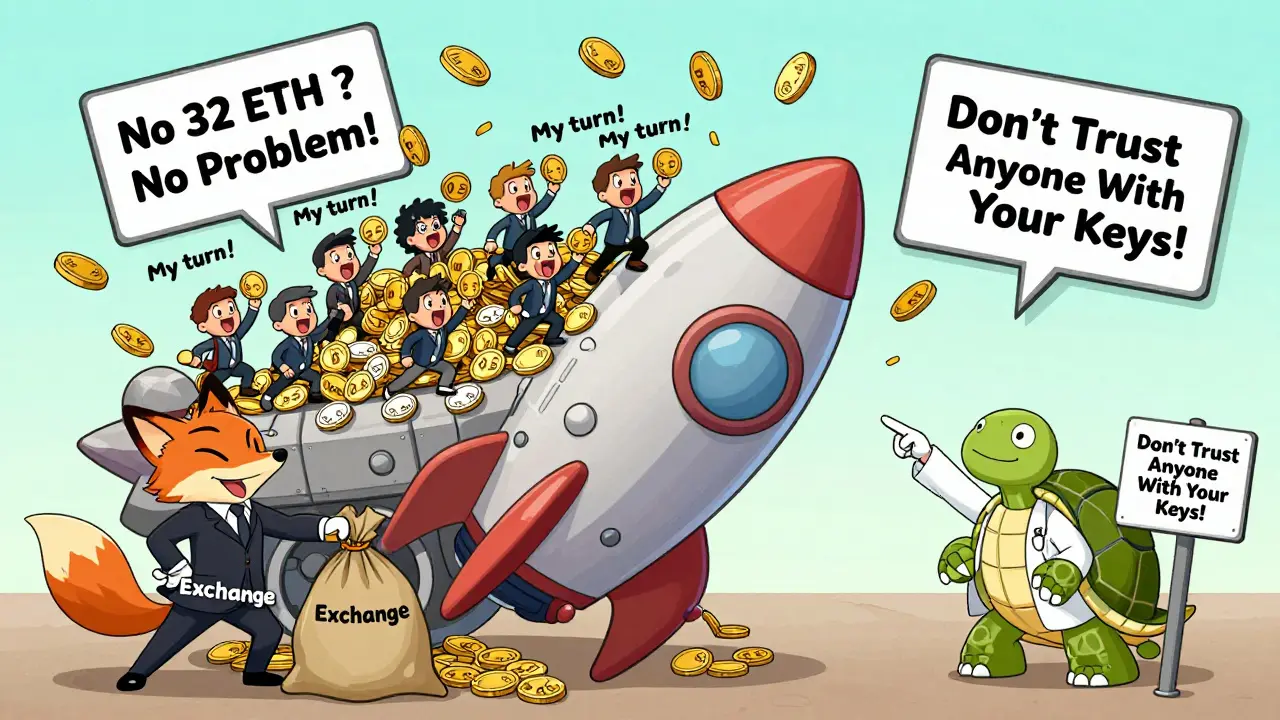
But here’s the downside: you don’t own your keys. The exchange does. That means if Kraken gets hacked, frozen, or shut down, your staked crypto could vanish. In 2023, FTX collapsed and users lost over $8 billion-including staked assets. That’s not hypothetical. It happened.
2. Staking Pools (Middle Ground)
Staking pools let you team up with others to meet minimum requirements. Ethereum, for example, needs 32 ETH to run a validator. Most people don’t have that much. So you join a pool-say, with 10,000 other people-and combine your 0.5 ETH with everyone else’s. The pool runs the validator, and you get a share of the rewards proportional to your contribution.
Popular pool providers include Lido, Rocket Pool, and Stakehound. They’re decentralized, meaning they’re not owned by one company. But you still give up some control. Your tokens are locked in a smart contract. You can’t move them instantly. And if the pool gets hacked, you lose your stake.
Still, this is a solid option if you want better security than an exchange but don’t want to manage a server.
3. Decentralized Wallet Staking (More Control)
With wallets like Phantom (for SOL), Keplr (for COSMOS), or MetaMask (for ETH), you can stake directly from your own wallet. You keep your private keys. You choose which validator to delegate to. You get full transparency.
This method is safer than exchanges because your funds aren’t sitting on a company’s server. But it’s not simple. You need to understand gas fees, delegation, unbonding periods, and how to read validator performance stats. One wrong click and you could lock your coins for 21 days. Or pick a validator that gets slashed.
If you’re comfortable with wallets and have a few hundred dollars to stake, this is the sweet spot between safety and control.
4. Run Your Own Validator (For Experts Only)
Running your own validator means buying a server, installing software, keeping it online 24/7, and updating it regularly. You need 32 ETH for Ethereum. You need 200 SOL for Solana. You need technical skills and patience.
The upside? You earn the full reward-no pool fees, no platform cut. You also get more influence over the network.
The downside? One power outage. One software bug. One missed update. And you could lose part of your stake. Most people who try this end up hiring someone to manage it. Which defeats the purpose.
Unless you’re a sysadmin or love tinkering with Linux servers, skip this. It’s not worth the stress.
How to Start Staking in 5 Steps
Here’s how to get started-no matter which method you choose.
- Choose a coin that supports staking. Not all crypto can be staked. Stick with PoS coins: Ethereum (ETH), Cardano (ADA), Polkadot (DOT), Solana (SOL), Polygon (MATIC), or Cosmos (ATOM). Avoid Bitcoin, Dogecoin, or Litecoin-they don’t stake.
- Buy the coin. Use a trusted exchange like Coinbase, Kraken, or Binance. Transfer it to your wallet if you’re using a decentralized method.
- Select your staking method. Beginners: use Coinbase or Kraken. Intermediate: use a wallet like Phantom or MetaMask. Advanced: consider a staking pool like Lido.
- Lock your tokens. Click “Stake,” confirm the transaction, and wait. Some platforms require a waiting period of hours or days before rewards start.
- Track your rewards. Check your wallet or platform dashboard weekly. Most show your APY, estimated earnings, and unbonding status.
Start small. Stake $50. See how it works. Then scale up.
What You Need to Watch Out For
Staking looks easy. But there are hidden traps.
- Lock-up periods. Some coins lock your tokens for weeks or months. If the price crashes, you can’t sell. Always check the unbonding time before you stake.
- Slashing risk. If you’re using a validator, pick one with a strong track record. Look for uptime above 99%. Avoid new or unknown validators.
- Taxes. In most countries, staking rewards are taxable income. In the U.S., the IRS treats them as ordinary income when you receive them. In Australia and New Zealand, they’re treated as assessable income. Keep records. Don’t assume your exchange will send you a tax form.
- APY isn’t fixed. That 12% APY you saw? It might drop to 6% next month. Network demand changes. Reward rates adjust. Don’t assume it’ll stay the same.
- Platform risk. If you stake on an exchange, you’re trusting their security. If you stake via a smart contract, you’re trusting the code. Both can fail.

Best Platforms for Staking in 2025
Here’s a quick breakdown of top platforms based on ease, safety, and reward potential.
| Platform | Best For | Minimum Stake | APY Range | Lock-Up | Key Risk |
|---|---|---|---|---|---|
| Coinbase | Beginners | $1 | 3%-5% | 1-2 days | Exchange control |
| Kraken | ETH stakers | 0.001 ETH | 4%-5% | 1-2 days | Exchange control |
| Bitpanda | Flexible staking | $1 | 5%-25% | None | Exchange control |
| Lido | ETH staking pools | 0.001 ETH | 3%-4% | 18-24 hours | Smart contract risk |
| Phantom Wallet | SOL staking | 0.01 SOL | 7%-8% | 2-3 days | User error |
For most people, Kraken or Bitpanda are the best starting points. They’re simple, reliable, and let you stake small amounts. If you’re serious about security and understand wallets, go with Phantom or MetaMask.
Is Staking Worth It?
Yes-if you’re realistic.
Staking won’t make you rich overnight. But it turns idle crypto into passive income. If you hold 10 ETH worth $30,000, earning 5% APY gives you $1,500 a year. That’s more than most savings accounts. And you’re helping keep the network secure.
The key is to start small, understand the risks, and never stake more than you can afford to lose. Don’t chase 25% APYs from unknown platforms. That’s usually a scam or a dying project.
Staking is one of the few ways to earn from crypto without trading. No timing the market. No FOMO. Just hold, stake, and earn.
Can you lose money staking crypto?
Yes. You can lose money if the value of your staked coin drops. That’s market risk, not staking risk. You can also lose part of your stake through slashing if you run a validator and make mistakes. And if you stake on a centralized exchange that gets hacked or shuts down, you could lose everything. Always understand the risks before you stake.
Do you need to pay taxes on staking rewards?
Yes. In most countries, staking rewards are treated as taxable income. In the U.S., Australia, and New Zealand, you pay income tax on the value of the rewards when you receive them. Keep records of when you earned rewards and their USD value at that time. Most exchanges don’t send tax forms, so you’re responsible for tracking this yourself.
What’s the safest way to stake crypto?
The safest way is using a reputable decentralized wallet like Phantom or MetaMask, and delegating to a well-known validator with high uptime and a strong reputation. Avoid staking on unknown platforms or exchanges with poor security histories. Always keep your private keys secure and never share them.
Can you unstake your crypto anytime?
It depends. On exchanges like Bitpanda, you can unstake anytime. On Ethereum staking pools, it takes 18-24 hours. On Solana, it takes 2-3 days. On some networks, it can take weeks. Always check the unbonding period before you stake. You won’t be able to sell your crypto during that time.
Which coins are best for staking in 2025?
The top coins for staking in 2025 are Ethereum (ETH), Solana (SOL), Cardano (ADA), Polkadot (DOT), and Cosmos (ATOM). These networks are stable, widely used, and offer reliable rewards. Avoid staking on new or low-market-cap coins-they’re riskier and often have inflated APYs to attract users.
Next Steps
If you’re ready to start:
- Open a Coinbase or Kraken account.
- Buy $50 worth of ETH or SOL.
- Click “Stake” and confirm.
- Check your rewards in 7 days.
That’s it. No complex setup. No server. No risk of slashing. Just simple, safe staking.
Once you’re comfortable, explore decentralized wallets. Learn how to read validator stats. Understand unbonding times. Then scale up.
Staking isn’t a get-rich-quick scheme. It’s a slow, steady way to grow your crypto holdings while helping the network. And in a world full of noise, that’s worth something.
Jake Mepham
December 19, 2025 AT 12:24Staking is the closest thing crypto has to a free lunch-just don’t stare too long at the 25% APYs, they’re usually trick candles.
Started with $50 on Kraken last year, now I’m up $8 in rewards and zero panic. No server, no sweat. Perfect for beginners.
SHEFFIN ANTONY
December 21, 2025 AT 02:44You call that a guide? You missed the entire point-staking is just centralized banking with a blockchain tattoo.
Anyone who thinks PoS is ‘decentralized’ is either delusional or paid by Lido. Real decentralization means running your own node-or don’t bother.
Vyas Koduvayur
December 22, 2025 AT 19:11Let me break this down for you because clearly, the article skipped the critical nuance.
First, APY is a marketing lie-it’s a theoretical max based on ideal validator performance, which 70% of nodes don’t hit. Second, slashing isn’t ‘rare’-it’s systemic in pools that over-delegate. Third, tax treatment varies by state in the US, not just federally. Fourth, the table lists Bitpanda’s 25% APY like it’s real-did you even check their whitepaper? That’s a promotional stunt for a shell company with zero audit history. Fifth, you didn’t mention MEV extraction risks on Ethereum staking pools. Sixth, Solana’s 7-8% APY? That’s down from 12% last year because their inflation schedule changed. Seventh, you didn’t warn about validator commissions-some take 30% of your rewards. Eighth, MetaMask doesn’t support direct staking on Solana-Phantom does, but you need to use the Solana CLI for full control. Ninth, the unbonding period on Cosmos is 21 days, not ‘weeks.’ Tenth, the IRS doesn’t treat staking rewards as capital gains-they’re ordinary income, period. Eleventh, you didn’t mention that staking on exchanges violates the terms of service for some coins like DOT. Twelfth, Lido’s stETH is not ETH-it’s a derivative with liquidity risk. Thirteenth, the article says ‘avoid Dogecoin’ like it’s obvious-what about TRX or AVAX? Fourteenth, no mention of MEV bots front-running your validator proposals. Fifteenth, you didn’t explain why 32 ETH is the minimum-it’s because of the 1/32 validator slot allocation algorithm. Sixteenth, the table says Kraken allows 0.001 ETH-but that’s only for liquid staking, not direct staking. Seventeenth, you missed that Cardano’s rewards are paid every 5 days, not monthly. Eighteenth, ‘simple’ staking on Coinbase? Try withdrawing your ETH after staking-it takes 14 days. Nineteenth, you didn’t warn that staking rewards compound daily, not annually. Twentieth, and finally, you didn’t mention that staking on centralized platforms makes you ineligible for future airdrops on the native chain. So yeah, this guide is a glorified ad.
Lloyd Yang
December 24, 2025 AT 01:03Man, I remember when staking was just a whisper in crypto forums. Now it’s on CNBC and my grandma’s Reddit feed.
But honestly? This guide nails it. I started with $20 on Coinbase just to see what it felt like-didn’t even know what a validator was. Now I’ve got a little dashboard showing my ETH rewards ticking up every few hours. It’s like magic, but real. No gambling, no hype. Just sitting there, watching my crypto work while I binge-watch Netflix. And yeah, I know the risks-exchange hacks, price drops, slashing-but I only staked what I could afford to lose. That’s the secret. Not chasing 20% APYs on some random token. Just picking the big, stable ones and letting time do the heavy lifting. If you’re reading this and you’re nervous? Start with $10. Just $10. See how it feels. If you like it, add $20 next month. That’s how you build wealth in crypto-slow, steady, and smart. You don’t need to be a genius. You just need to show up.
Cathy Bounchareune
December 25, 2025 AT 23:58Wait, so I can just… click a button and get paid in crypto?
My brain can’t process this. I thought crypto was all about volatility and gambling. Now it’s like a savings account that doesn’t suck? I’m confused. And also… kinda excited? Is this real? Can I do this with my leftover LTC? Or is that a trap?
Jordan Renaud
December 26, 2025 AT 20:12There’s something deeply peaceful about staking.
You’re not fighting the market. You’re not chasing pumps. You’re not trying to outsmart anyone. You’re just… participating. Like planting a tree and trusting it’ll grow. The rewards are nice, sure-but the real win is knowing you’re helping keep a decentralized network alive. That’s not just financial. It’s philosophical. And in a world full of noise, that quiet contribution? That’s worth more than any APY.
vaibhav pushilkar
December 27, 2025 AT 20:48Start small. Kraken. ETH. Done.
Luke Steven
December 28, 2025 AT 04:59Staking is the crypto equivalent of buying a house instead of renting.
You’re not just holding-you’re building. Even if the market dips, you’re still earning. Kinda makes you wonder why everyone’s still trading like maniacs. 🤔
Ellen Sales
December 29, 2025 AT 14:38So staking is just… bank but with more tech buzzwords and less FDIC?
Also why is everyone acting like 5% APY is a miracle? My credit union gives me 4.5% on CDs and I don’t need to trust a smart contract to get it. 🙄
Charles Freitas
December 30, 2025 AT 23:29Anyone who thinks staking is safe hasn’t watched FTX collapse
or read the fine print on Lido’s smart contract. You’re not earning rewards-you’re lending your assets to a black box that could vanish tomorrow. And you call that finance? This isn’t investing. It’s gambling with a blockchain sticker on it.
Ashley Lewis
December 31, 2025 AT 22:17This article is a non-technical overview masquerading as authoritative guidance. It lacks rigor, omits critical regulatory disclosures, and trivializes systemic risks inherent in proof-of-stake mechanisms. The tone is patronizing, the data is superficial, and the conclusion is dangerously reductive. One cannot responsibly advise on asset allocation without addressing counterparty risk, liquidity risk, and tax liability in detail. This piece fails on all counts.
Craig Fraser
January 2, 2026 AT 16:12Why are we even talking about this? Staking is just crypto’s version of a Ponzi scheme with better UI.
Someone’s gotta pay the rewards, right? And it ain’t the blockchain-it’s new investors. Wake up.
Jacob Lawrenson
January 3, 2026 AT 00:48Just staked my first 0.1 SOL on Phantom!! 🚀
Got my first reward in 3 days-felt like Christmas. You guys are overthinking this. Just pick a coin you believe in, stake it, and chill. No need to be a sysadmin. 🙌
Zavier McGuire
January 3, 2026 AT 13:03Why are people so scared of running their own node
it’s just linux and a few commands
you don’t need to be a genius
just don’t turn off your router
Sybille Wernheim
January 5, 2026 AT 12:45I staked $100 on ADA because I liked the project’s vibe
and now I get little notifications every few days like ‘+0.12 ADA’
it’s the most chill way to hold crypto
no stress
no FOMO
just quiet growth
thank you for this guide