

Western sanctions were supposed to choke off Russia’s access to global finance. Instead, they pushed Moscow into the shadows of the blockchain. By May 2026, Russia has built a sophisticated digital financial infrastructure that turns cryptocurrency from a speculative asset into a strategic tool for war funding and economic survival. This isn’t just about buying Bitcoin; it is a state-sponsored engineering project designed to bypass SWIFT, freeze-proof assets, and move billions without leaving a paper trail.
The shift has been rapid and deliberate. What started as individual traders moving funds evolved into a coordinated system involving custom tokens, sanctioned exchanges, and shell companies across multiple jurisdictions. The UK government’s October 2025 announcement targeting these networks marked a turning point, but the game of cat-and-mouse between regulators and evaders is far from over. Understanding how this works requires looking past the hype of crypto prices and into the mechanics of financial warfare.
The Core Mechanism: Custom Tokens and Kyrgyzstan
At the heart of Russia’s sanctions evasion strategy is a simple problem: how do you spend rubles when no one will touch them? The answer lies in A7A5, a ruble-backed cryptocurrency token specifically designed to bridge sanctioned Russian currency with international markets. Created by a Kyrgyzstani firm, A7A5 operates on both the TRON and Ethereum blockchains. It acts as a digital proxy for the ruble, allowing users to convert their local currency into a token that can be traded globally without triggering traditional banking alerts.
The scale of this operation is staggering. In just four months after its launch, the dedicated exchange processing A7A5 transactions handled $9.3 billion. This volume suggests deep integration into Russia’s commercial and military supply chains. Kyrgyzstan serves as the critical geographic loophole. Its financial sector, particularly institutions like Capital Bank under director Kantemir Chalbayev, provides the necessary fiat gateway. These banks connect the opaque world of crypto to the real economy, converting digital assets into cash for purchasing military goods and other restricted items.
This setup creates a multi-layered shield. Traditional sanctions target banks and individuals. By routing transactions through a token issued in Central Asia and processed on decentralized ledgers, Russia fragments the audit trail. You cannot sanction a line of code, and you struggle to freeze assets that change hands instantly across borders. The A7A5 token is not an investment vehicle; it is a utility tool for circumvention.
The Exchange Evolution: From Garantex to Grinex
If A7A5 is the engine, the exchanges are the transmission. For years, Garantex was the primary darknet market and cryptocurrency exchange facilitating illicit transactions for Russian actors. The U.S. Treasury sanctioned Garantex repeatedly, but each time, the platform simply adapted. When law enforcement actions led by the U.S. Secret Service effectively dismantled Garantex’s public-facing operations on March 6, 2025, the underlying infrastructure did not disappear. It migrated.
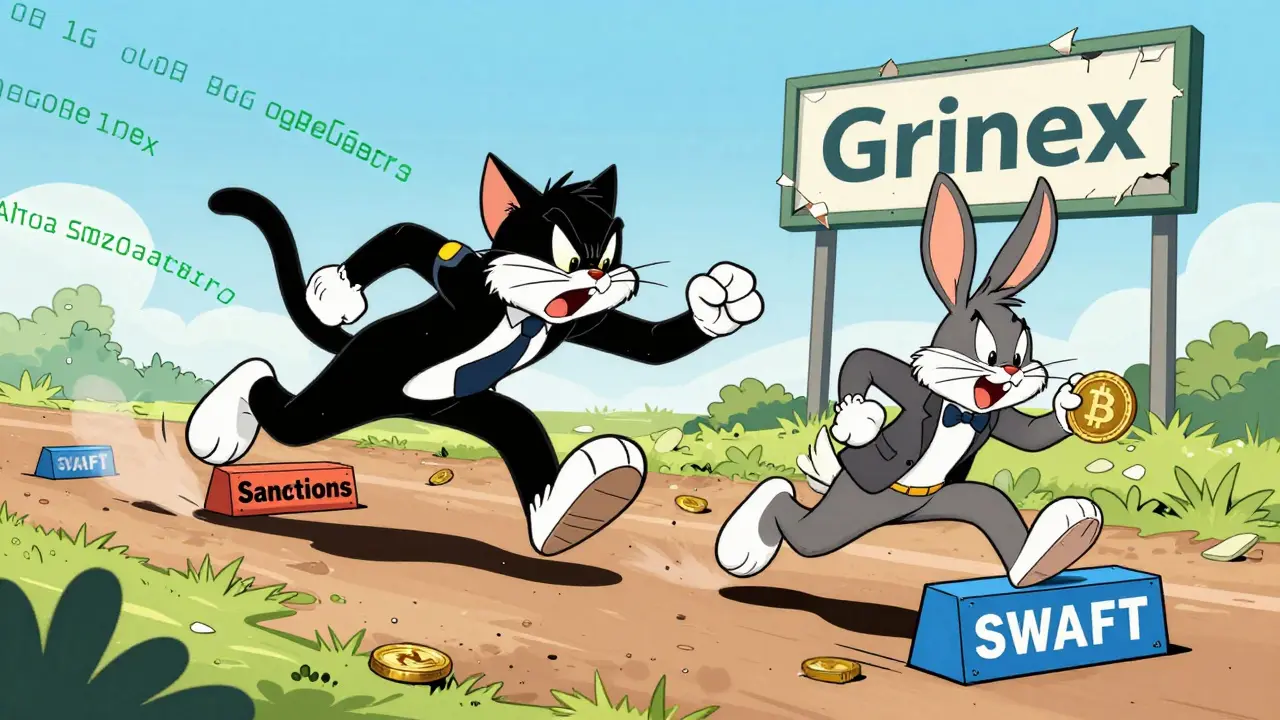
Enter Grinex, a cryptocurrency exchange launched immediately after Garantex's shutdown, explicitly formed to continue services for former Garantex customers. Grinex’s promotional materials openly admitted it was created in response to sanctions and asset freezes. Within weeks, it began transferring customer deposits from the old platform to the new one. By mid-2025, Grinex was facilitating billions in transactions before the U.S. Treasury’s Office of Foreign Assets Control (OFAC) designated it for sanctions due to its ownership ties to Garantex.
This pattern reveals a key insight: shutting down one node in the network rarely stops the flow. The operators have deep technical expertise and redundant systems. They treat regulatory action as a temporary inconvenience rather than a permanent barrier. The transition from Garantex to Grinex, and earlier iterations like Exved, demonstrates a resilient, adaptive structure. Each new platform inherits the user base, liquidity, and operational know-how of its predecessor, ensuring continuity for those needing to move money outside the Western financial system.
The Ilan Shor Connection and Political Financing
Sanctions evasion is not just about buying tanks; it is also about influencing politics abroad. Data leaked on September 3, 2025, regarding Ilan Shor, a Moldovan politician and fugitive convicted of bank fraud who aids Russia's efforts to undermine democratic processes in Moldova, exposed a darker side of these crypto networks. Shor, already sanctioned by the U.S. in 2022, used wallets controlled by A7 and associated businesses to receive $8 billion in stablecoin transactions over 18 months.
Analysis by blockchain intelligence firm Elliptic showed these funds were not idle. They were deployed to purchase infrastructure for apps managing networks of political activists in Moldova. This illustrates how cryptocurrency enables precise, untraceable political warfare. Traditional banking leaves records; crypto allows for granular funding of disinformation campaigns and activist groups without exposing the source. The use of stablecoins ensures value stability, while the blockchain provides the anonymity needed to hide the connection to Russian state interests.
This case highlights the broader risk of "dirty crypto" schemes. It is not merely about economic survival for Russia; it is about exporting instability. The same tools used to buy steel for missiles can fund bots that sway elections in neighboring countries. The intersection of financial sanctions evasion and hybrid warfare makes this issue critical for national security agencies worldwide.
International Regulatory Responses in 2025-2026
The international community has responded with increasing aggression. The European Union’s 19th package of sanctions, adopted in late 2025, marked a historic shift. For the first time, the EU directly targeted dirty Russian crypto schemes by banning transactions on specific platforms used to bypass restrictions. This moved beyond general warnings to concrete prohibitions, forcing compliant exchanges to cut ties with entities linked to these networks.
In the UK, the October 2025 actions targeted Grinex, Meer, and the A7A5 infrastructure. These moves were part of a coordinated effort with the U.S. and EU to squeeze the remaining avenues for Russian revenue. Officials described these steps as vital to reinforcing diplomatic pressure and disrupting the war machine. However, enforcement remains challenging. Blockchain technology is borderless, while laws are territorial. A ban in London does not stop a transaction in Bishkek or Tashkent.
The Financial Action Task Force (FATF) has also raised the alarm. In August 2025, FATF President Elisa de Anda Madrazo reported to the UN Security Council that terrorist organizations like ISIL-K were increasingly using virtual assets for transfers and donations. While focused on terrorism, this report underscores a universal trend: malicious actors of all types are migrating to crypto because it offers speed, anonymity, and resistance to seizure. Russia’s sophisticated evasion techniques set a precedent that others may follow.
The Compliance Arms Race
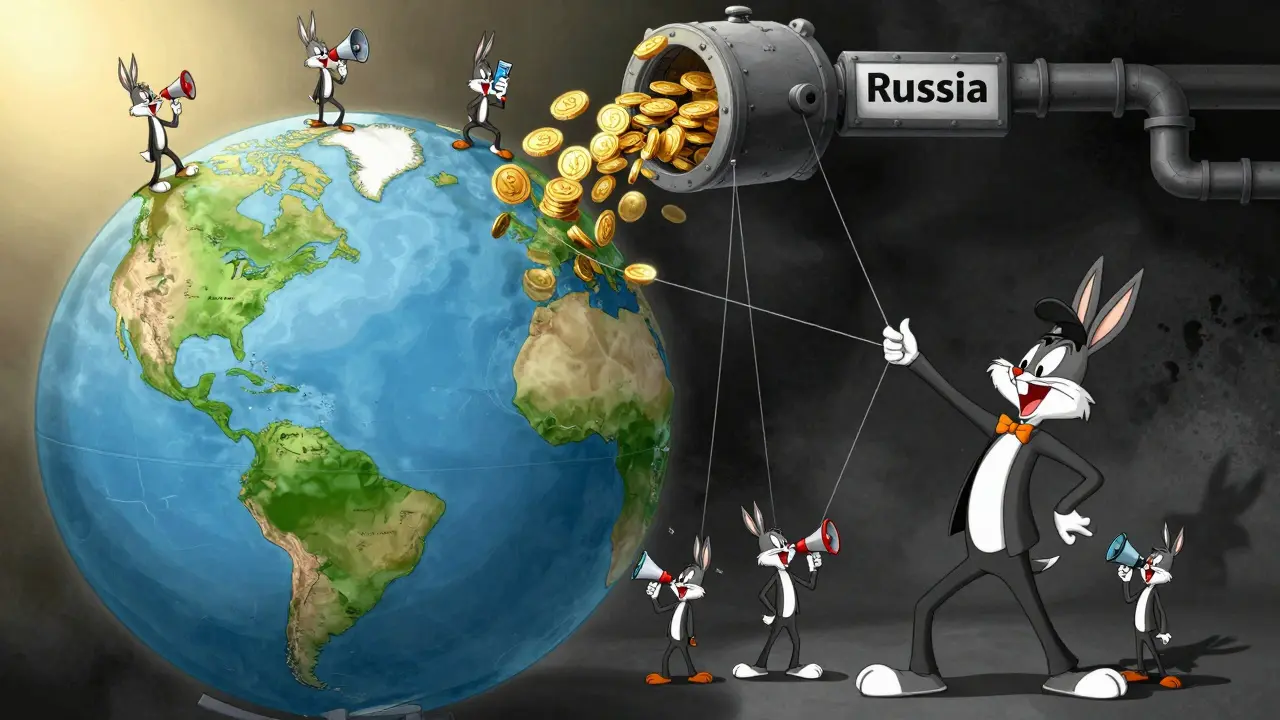
As evasion tactics grow more complex, so does the defense. The cryptocurrency industry is undergoing a massive compliance overhaul. Firms like Elliptic have added support for A7A5 screening on TRON and Ethereum, allowing compliance teams to flag suspicious transactions in real-time. This is not just about catching bad guys; it is about protecting legitimate businesses from being swept up in secondary sanctions.
Exchanges now face a dilemma: serve high-volume, high-risk clients or maintain access to the global financial system. Most choose the latter. The cost of losing banking relationships is too high. This has created a fragmented market where compliant platforms thrive, and illicit activity migrates to smaller, less regulated venues or decentralized protocols. But even here, the net is tightening. On-chain analysis tools are becoming more powerful, capable of tracing funds through multiple hops and identifying patterns indicative of sanctions evasion.
Oxford Analytica’s September 2025 assessment noted that while Russia’s crypto expansion offers short-term benefits, long-term sustainability is questionable. Regulatory pressure is intensifying, and tracking capabilities are improving. The cat-and-mouse game drives innovation on both sides, but the balance is slowly shifting toward regulators who control the fiat on-ramps and off-ramps. Without access to dollars, euros, or pounds, crypto alone cannot sustain an economy at war.
| Entity | Type | Role in Evasion | Status (May 2026) |
|---|---|---|---|
| A7A5 | Cryptocurrency Token | Ruble-backed bridge for cross-border transactions | Active, monitored by compliance firms |
| Grinex | Cryptocurrency Exchange | Successor to Garantex, facilitates large-scale transfers | Sanctioned by OFAC and UK |
| Capital Bank | Traditional Bank | Fiat gateway in Kyrgyzstan for military procurement | Under scrutiny, key enabler |
| Ilan Shor | Individual | Political financing via stablecoins for Moldovan activism | Sanctioned, fugitive status |
Future Outlook: Will Crypto Save Russia?
Russia’s pivot to cryptocurrency is a testament to its resilience and adaptability. It has bought time, preserved some economic functionality, and funded its military objectives despite unprecedented isolation. However, it is not a silver bullet. The reliance on third-party jurisdictions like Kyrgyzstan introduces geopolitical risks. If these countries face pressure to comply with international norms, the entire structure could collapse.
Moreover, the sheer volume of transactions attracts attention. Billions in flows cannot remain hidden forever. As AI-driven analytics improve, the ability to anonymize large-scale movements diminishes. The future likely holds a hybrid model: Russia will continue using crypto for specific, high-value transactions while relying on barter and trade with non-aligned nations for bulk goods. Crypto is a tool, not a replacement for the global financial system.
For the rest of the world, the lesson is clear. Sanctions must evolve alongside technology. Regulators need better tools, international cooperation, and a willingness to target the infrastructure, not just the end-users. The battle for financial sovereignty is now fought on the blockchain, and the stakes have never been higher.
What is the A7A5 token?
A7A5 is a ruble-backed cryptocurrency token created by a Kyrgyzstani firm to help Russians bypass Western sanctions. It operates on the TRON and Ethereum blockchains, allowing users to convert sanctioned rubles into a digital asset that can be traded internationally. Since its creation, it has processed over $9.3 billion in transactions.
Why did Garantex become Grinex?
Garantex was heavily sanctioned by the U.S. and disrupted by law enforcement in March 2025. To continue operations, its creators launched Grinex, which inherited Garantex’s customer base and infrastructure. Grinex explicitly stated it was formed in response to sanctions, though it too was later sanctioned by OFAC.
How does Kyrgyzstan facilitate sanctions evasion?
Kyrgyzstan serves as a financial hub for these operations due to its less stringent regulations and proximity to Russia. Banks like Capital Bank act as gateways, converting cryptocurrency into fiat currency for purchasing military goods and other restricted items. This connects the digital crypto world with the physical supply chain.
What role does Ilan Shor play in this network?
Ilan Shor, a Moldovan politician and fugitive, uses crypto wallets linked to the A7 network to receive billions in stablecoins. These funds are used to finance political activism and disinformation campaigns in Moldova, demonstrating how crypto supports hybrid warfare beyond direct military spending.
Are international sanctions effective against crypto evasion?
Sanctions are partially effective. They force illicit activity into more obscure channels and increase costs for evaders. However, they have not stopped the flow entirely. The EU and UK have begun targeting specific crypto platforms and tokens, but enforcement remains challenging due to the borderless nature of blockchain technology.
Can regular users be affected by these sanctions?
Yes, indirectly. Legitimate exchanges may restrict services or close accounts if they suspect links to sanctioned entities. Compliance tools are becoming stricter, meaning users might face more rigorous KYC checks or delays in transactions involving certain tokens or regions.