

Imagine trying to send a simple message on your phone, but the network is so clogged that it costs you $50 just to get through. That was daily life for many Ethereum a decentralized public blockchain platform that supports smart contracts and decentralized applications (dApps) users during peak congestion periods. With the main network processing only about 15 to 20 transactions per second (TPS), the system couldn't keep up with global demand. Enter Rollups Layer 2 scaling solutions that bundle multiple transactions into single batches to process them off-chain while maintaining Ethereum's security guarantees. These aren't just a minor upgrade; they are the engine room of Ethereum’s future. They allow the network to handle thousands of transactions per second without sacrificing the security or decentralization that makes crypto valuable in the first place.
If you have ever wondered why your transaction fees spiked or why transfers took forever, the answer lies in how the base layer works. But if you want to know how we get from slow and expensive to fast and cheap, you need to understand rollups. This guide breaks down exactly how they work, the two main types you need to know, and why they are critical for the next phase of web3 adoption.
The Core Problem: Why Ethereum Needs Scaling
To understand the solution, we first have to look at the problem. Ethereum is designed to be secure and decentralized. Every node on the network validates every transaction. This is great for security because it means no single entity can control the ledger. However, it creates a bottleneck. When millions of people try to use the network at once-like during an NFT mint or a DeFi crash-the network gets congested.
This congestion leads to high gas fees. Gas is the fee paid to execute transactions on Ethereum. When demand outstrips supply, users bid against each other to get their transactions processed. In 2021 and 2022, these bids regularly exceeded $100 for simple token swaps. For a micro-transaction or a small game interaction, this is prohibitive. The network simply cannot scale horizontally by adding more powerful servers because its security model relies on widespread participation, not centralized supercomputers.
Rollups solve this by moving the heavy lifting off the main chain. They don't change Ethereum's core rules; they just optimize how data is submitted to it. Think of it like this: instead of sending every individual receipt to the bank manager (the mainnet), you send one summary sheet saying, "Here are 1,000 transactions, all valid." The bank manager checks the summary, not the individual receipts. This drastically reduces the load on the main system.
How Rollups Actually Work
At a technical level, Layer 2 secondary protocols built on top of an existing blockchain to improve scalability and reduce transaction costs rollups operate by executing transactions on a separate chain parallel to the main Ethereum blockchain. Here is the step-by-step flow:
- Bundling: Users interact with the rollup network. Instead of submitting each transaction individually to Ethereum, the rollup sequencer bundles hundreds or thousands of transactions into a single batch.
- Off-Chain Execution: The rollup processes these transactions off-chain. This means the computational work happens outside the main Ethereum network, which is much faster and cheaper.
- Data Submission: The rollup submits compressed data about these transactions back to the Ethereum mainnet. This data serves as a record that can be verified later if needed.
- Settlement: Smart contracts on Ethereum verify the validity of the batch. If everything checks out, the state of the rollup is updated, and the transactions are considered final.
This process maintains Ethereum's security because the final settlement still happens on the mainnet. If a rollup tries to cheat, the mainnet can reject the invalid data. You get the speed of a sidechain with the security of the main chain.

Optimistic vs. ZK Rollups: The Two Main Types
Not all rollups are created equal. There are two dominant architectures, each with different trade-offs regarding speed, cost, and complexity. Understanding the difference between Optimistic Rollups Layer 2 solutions that assume transactions are valid by default and use a challenge period to detect fraud and ZK Rollups Layer 2 solutions that use zero-knowledge proofs to cryptographically verify transaction validity instantly is crucial for developers and users alike.
| Feature | Optimistic Rollups | ZK Rollups |
|---|---|---|
| Verification Method | Fraud Proofs (Challenge Period) | Zero-Knowledge Proofs (Cryptographic) |
| Withdrawal Time | 7 days (standard challenge window) | Near instant (minutes/hours) |
| Computational Load | Low (on L1), High (for challengers) | High (proof generation requires powerful hardware) |
| EVM Compatibility | High (easy to port existing apps) | Varying (some require custom bytecode) |
| Examples | Arbitrum, Optimism | zkSync, StarkNet |
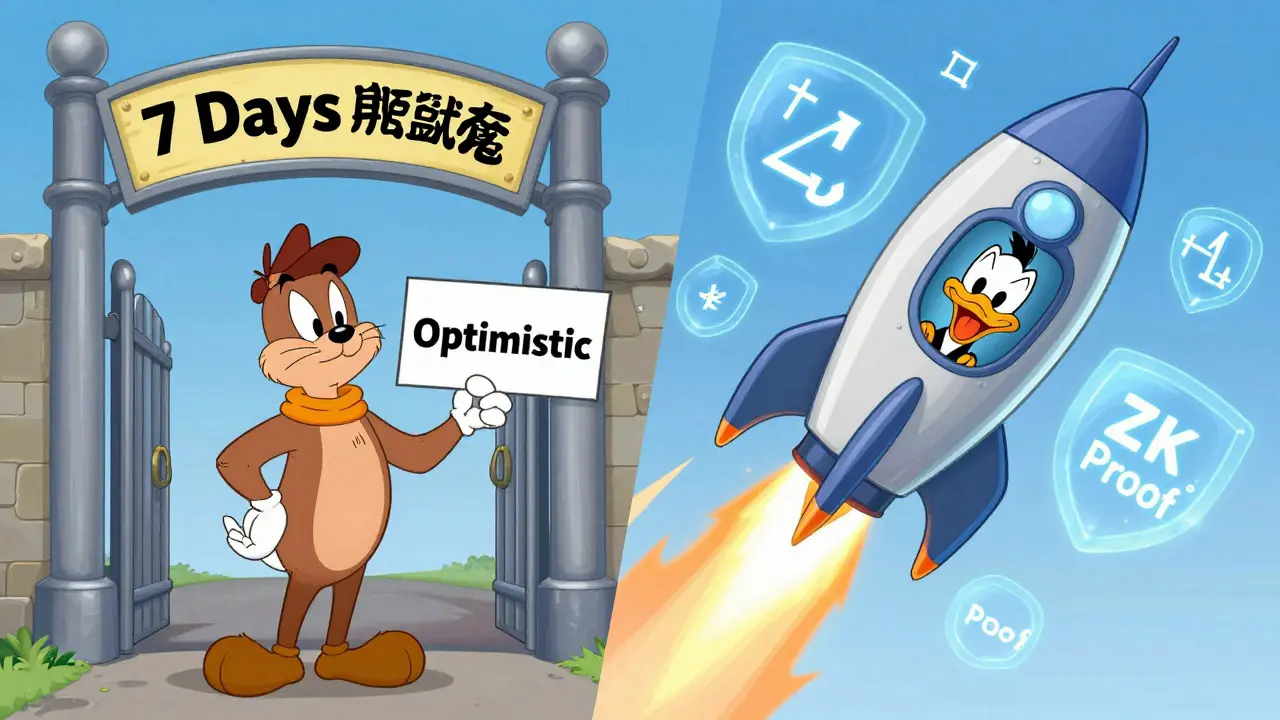
Optimistic Rollups assume that all transactions are valid unless proven otherwise. This is the "optimistic" part. To ensure security, there is a seven-day challenge period after a batch is submitted. During this time, anyone can submit a "fraud proof" if they detect an error. If no one challenges the batch within seven days, it becomes final. This approach is easier to implement and highly compatible with existing Ethereum code, which is why projects like Arbitrum and Optimism gained early traction.
ZK Rollups, on the other hand, use complex mathematics called zero-knowledge proofs to verify transactions. A proof is generated that mathematically guarantees the transactions are valid without revealing the underlying data. Because the proof is cryptographic, there is no need for a waiting period. Finality is near-instant. However, generating these proofs is computationally intensive. It requires specialized hardware and significant energy, making it harder for average users to run nodes compared to optimistic rollups. Despite this, ZK rollups are often seen as the long-term winner due to their superior privacy and instant finality.
Why Rollups Beat Other Scaling Solutions
You might wonder why we don't just use sidechains or state channels. Each alternative has significant flaws when compared to rollups.
Sidechains (like Polygon PoS) operate independently with their own consensus mechanisms. While they are fast, they do not inherit Ethereum's security. If the sidechain's validators collude or are hacked, your funds are at risk. Rollups derive their security directly from Ethereum, meaning you would need to compromise the entire Ethereum network to steal funds from a rollup. That is a massive difference in trust assumptions.
State Channels (like Lightning Network for Bitcoin) are excellent for specific use cases, such as micropayments between two parties. However, they are not general-purpose. You cannot easily build a complex decentralized exchange (DEX) or a social media app on a state channel. Rollups are fully programmable and support any smart contract logic that runs on Ethereum.
Rollups strike the optimal balance. They offer the general-purpose capability of sidechains but with the security guarantees of the mainnet. This is why experts from firms like Rather Labs and QuickNode identify rollups as the primary path forward for Ethereum's scalability.
The Role of Sharding and Future Throughput
Rollups are powerful on their own, but their potential multiplies when combined with Ethereum's upcoming upgrades. Currently, rollups are limited by the amount of data they can fit into an Ethereum block. As more rollups launch, they compete for this space, driving up data costs.
This is where Sharding a technology that splits the blockchain database into smaller pieces (shards) to increase throughput and data availability comes in. Ethereum's roadmap includes implementing data sharding, which will create multiple shards capable of storing large amounts of data simultaneously. This effectively increases the bandwidth available for rollups to post their transaction batches.
With sharding, Ethereum could theoretically support 100,000 transactions per second across all rollups combined. This isn't magic; it's infrastructure expansion. The Merge, completed in September 2022, transitioned Ethereum to Proof of Stake, reducing energy consumption and setting the stage for these scalability improvements. Now, with rollups handling execution and sharding handling data availability, the network is poised for exponential growth.
Practical Implications for Users and Developers
For everyday users, the shift to rollups means lower fees and faster confirmations. You can swap tokens, mint NFTs, or play blockchain games without worrying about paying $50 in gas. Most major wallets now support multiple Layer 2 networks seamlessly. You bridge your assets from Ethereum mainnet to a rollup, use them, and bridge back when needed.
For developers, the landscape is evolving. Building on an optimistic rollup is straightforward because you can often deploy existing Solidity contracts with minimal changes. Building on a ZK rollup may require learning new tools or using virtual machines that emulate EVM behavior. However, the trend is toward greater compatibility. As ZK technology matures, the barrier to entry will drop, allowing developers to choose the best tool for their specific application needs.
The key takeaway is that rollups are not a temporary fix. They are the fundamental architecture of Ethereum's scalable future. By processing transactions off-chain and settling on-chain, they preserve the decentralization and security that define the ecosystem while unlocking the throughput required for global adoption.
Are rollups safe?
Yes, rollups are generally considered very safe because they derive their security from the Ethereum mainnet. Unlike sidechains, which have their own independent security models, rollups post their data to Ethereum. If a rollup attempts to validate an incorrect state, users can dispute it on the mainnet. For optimistic rollups, this involves a fraud proof during the challenge period. For ZK rollups, the cryptographic proof ensures validity before submission. The risk is primarily related to bridge hacks or smart contract bugs in the rollup's implementation, not the underlying consensus mechanism.
What is the difference between Layer 1 and Layer 2?
Layer 1 refers to the base blockchain protocol itself, such as Ethereum, Bitcoin, or Solana. It handles consensus, security, and final settlement. Layer 2 refers to secondary frameworks or protocols built on top of Layer 1 to enhance scalability and functionality. Layer 2 solutions, like rollups, process transactions off the main chain and then settle them on Layer 1. This division of labor allows Layer 1 to remain secure and decentralized while Layer 2 provides high throughput and low costs.
Which rollup should I use?
The choice depends on your needs. If you prioritize ease of use and compatibility with existing Ethereum apps, optimistic rollups like Arbitrum or Optimism are excellent choices. They have large ecosystems and are easy to integrate. If you need instant finality for withdrawals or enhanced privacy features, ZK rollups like zkSync or StarkNet are better suited. For most general users, sticking to the largest rollups with the most liquidity and developer support is the safest bet.
Do rollups replace Ethereum?
No, rollups do not replace Ethereum; they complement it. Ethereum remains the settlement layer and the source of truth for security. Rollups act as execution layers that handle the bulk of transaction processing. This relationship is symbiotic. Rollups rely on Ethereum for security and censorship resistance, while Ethereum relies on rollups to scale its capacity and reduce fees for end-users. Together, they form a cohesive ecosystem.
How much do rollups save in fees?
Fee savings vary based on network congestion and the specific rollup used. Generally, transactions on rollups cost a fraction of what they do on Ethereum mainnet. While a mainnet transfer might cost $10-$50 during peak times, the same transaction on a rollup typically costs less than $0.10. Complex interactions like swapping tokens on a DEX might cost $0.50-$2.00 on a rollup, compared to $20+ on mainnet. This drastic reduction makes micro-transactions and frequent interactions economically viable.