

When someone loses money to a crypto scam, it’s easy to assume the funds are gone forever. But that’s not always true. Thanks to coordinated efforts between countries, law enforcement is now recovering millions in stolen cryptocurrency - not just in one country, but across continents. In 2025, a single operation called HAECHI VI recovered $439 million from scams targeting people in 40 different nations. That’s not luck. It’s the result of a new global system built to chase criminals who thought the borderless nature of crypto would protect them.
Why Countries Had to Work Together
Cryptocurrency doesn’t care about borders. A scammer in Nigeria can target victims in Canada, send stolen funds through a crypto mixer in Switzerland, and cash out in Japan - all in minutes. Before 2014, each country handled these cases alone. If a criminal crossed a border, the investigation stopped. That changed when INTERPOL launched its Global Financial Crime Programme. Suddenly, police in Angola could share data with officers in Germany, and a scam operating out of Zambia could be taken down with arrests in South Korea and Brazil - all on the same day. The key insight? Criminals operate globally. So must enforcement.How INTERPOL Makes It Work
INTERPOL isn’t just a meeting place. It’s the central nervous system for crypto crime enforcement. Through its Global Rapid Intervention of Payments (I-GRIP), law enforcement can freeze transactions in real time. If a victim in Seoul sends KRW 6.6 billion ($3.91 million) to a fake bank account in Dubai, the Korean police can alert INTERPOL. Within hours, Emirati authorities freeze the account. No more waiting months for paperwork. This system works because it connects 195 countries. Each country has a National Central Bureau - a dedicated team trained to handle crypto investigations. In 2022, only 62% of INTERPOL members had such units. By 2025, that number jumped to 87%. Officers now spend 120 hours training on blockchain tracing tools before they even open a case.Real Cases That Changed the Game
Operation Serengeti 2025 didn’t just make headlines - it saved lives. In August 2025, authorities in Angola shut down 25 illegal crypto mining centers. In Zambia, they dismantled a $300 million investment scam that fooled over 65,000 people. The same operation led to arrests in Germany, Côte d’Ivoire, and Indonesia. Why? Because the scam’s infrastructure was spread across borders. One team couldn’t have stopped it. Then there was HAECHI VI. This wasn’t one scam. It was seven different types of fraud: romance scams, voice phishing, fake investment apps. The result? 3,000 arrests. $439 million recovered. And for the first time, victims in low-income countries saw real money returned - not just promises.
Who’s Helping Behind the Scenes
Governments can’t do this alone. Blockchain analytics firms like Chainalysis, Elliptic, and TRM Labs are now essential partners. They provide the tools that trace transactions across dozens of blockchains. Chainalysis found that in 2025, illicit entities still held nearly $15 billion in crypto - mostly Bitcoin. But the real breakthrough was seeing how criminals were moving money. In 2021, 40% of stolen funds went straight to exchanges. By 2025, that dropped to 15%. Why? Criminals started using decentralized exchanges, cross-chain bridges, and no-KYC swap services. They thought they were untouchable. Elliptic’s research showed over $21.8 billion in illicit funds had been laundered using cross-chain methods. But now, tools exist to trace those paths automatically. What used to take hours of manual work can be done in minutes. That’s the game-changer.Regional Differences in Enforcement
Not every country approaches crypto crime the same way. The U.S. focuses on prosecution - like the October 2024 case where 17 people were charged for using bots to manipulate meme coin prices. The SEC goes after companies with civil lawsuits. Meanwhile, Europol in Europe treats crypto-enabled crime as part of broader organized crime - especially how it’s used to recruit minors online. But only INTERPOL’s model works at scale. A standalone U.S. operation might recover $10 million. A coordinated INTERPOL effort like HAECHI VI recovered $439 million. The difference? Simultaneous action. No country has to wait for another to act. Data flows in real time. Arrests happen together.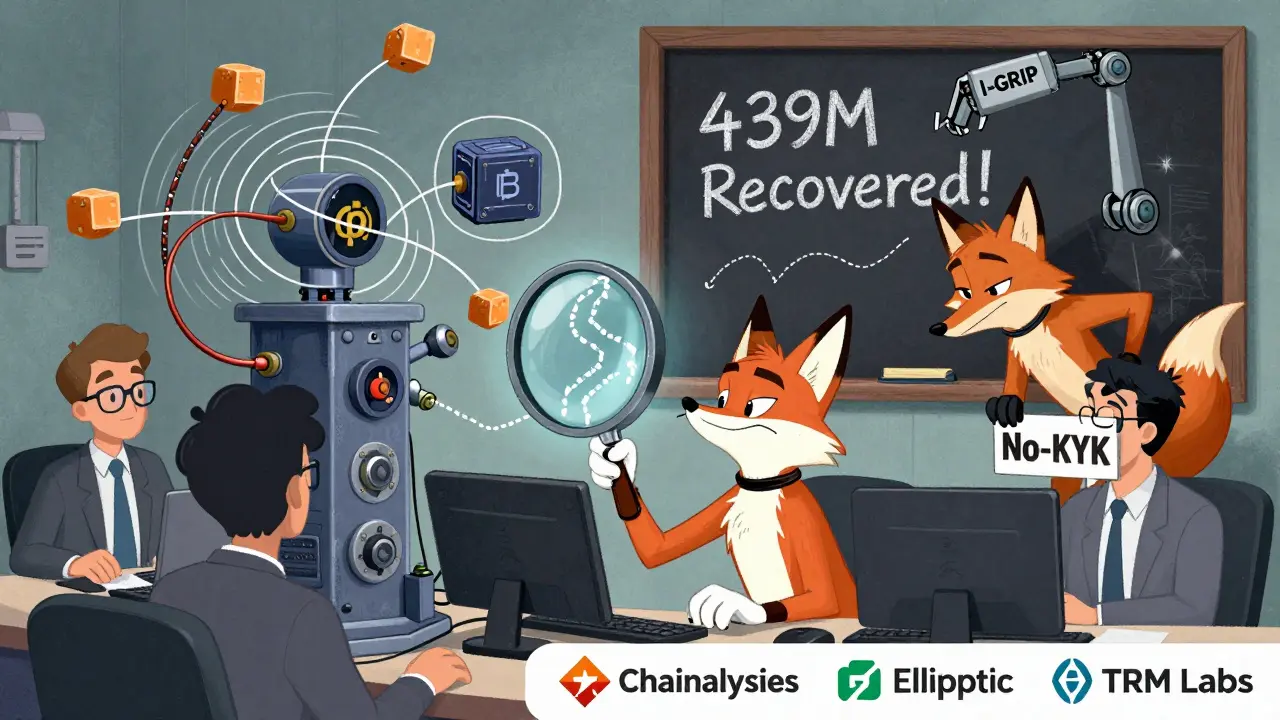
Where the System Still Falls Short
Despite progress, criminals keep adapting. The biggest weakness? Speed. Even with I-GRIP, it can take days to freeze a wallet if the funds are moved through multiple chains. Elliptic’s data shows that launderers now use “hot wallets” - wallets that exist for just hours before the money is split and moved again. This makes tracing harder. Jurisdictional conflicts still exist. A police officer in Brazil can’t legally access data stored on a server in Singapore without formal treaties. That’s why INTERPOL’s role as a neutral hub matters so much. It bypasses politics. Another issue: smaller scams. While big operations get attention, thousands of small frauds - like fake NFT marketplaces or fake mining rigs - fly under the radar. They’re harder to track, and often involve victims who don’t report the crime.What’s Next
The future of crypto crime enforcement isn’t about more laws. It’s about better tools and tighter collaboration. TRM Labs predicts that terrorist groups and state-backed hackers will increasingly use crypto to move funds. That means enforcement must evolve faster. The Cybercrime Atlas, hosted by the World Economic Forum, is becoming a real-time intelligence hub. It pulls together data from police, private firms, and NGOs. In 2026, it will include AI-powered anomaly detection - flagging suspicious wallet behavior before a crime even completes. The message is clear: crypto crime isn’t going away. But neither is the global response. Every recovered dollar, every arrest, every frozen wallet proves one thing - when countries work together, criminals can’t hide.Can stolen cryptocurrency really be recovered?
Yes - and it’s happening more often than people think. In 2025, INTERPOL’s Operation HAECHI VI recovered $439 million from crypto scams across 40 countries. Tools like I-GRIP allow real-time freezing of transactions, and blockchain analytics firms help trace funds even after they’ve been moved through multiple wallets. While not every dollar is recovered, victims are now seeing real returns - something that was nearly impossible just five years ago.
How do international agencies track crypto transactions?
They use blockchain analytics platforms like Chainalysis, Elliptic, and TRM Labs. These tools map transaction flows across Bitcoin, Ethereum, and other blockchains. Investigators follow the trail from the original stolen wallet through mixers, bridges, and decentralized exchanges. INTERPOL’s I-GRIP system then allows law enforcement in one country to request immediate action from another - like freezing a wallet in Dubai based on evidence from Seoul.
Why can’t one country handle crypto crime alone?
Because crypto criminals don’t stay in one place. A scammer might live in Nigeria, target victims in the U.S., use a mixer in Switzerland, and cash out in Japan. National police forces can’t cross borders to investigate or freeze assets. Only international cooperation - like INTERPOL’s network - can connect these dots and act across jurisdictions in real time.
What role do private companies play in crypto crime enforcement?
They provide the technology police can’t build themselves. Companies like Chainalysis and Elliptic have spent years developing tools to trace crypto transactions across hundreds of blockchains. INTERPOL now relies on these firms to analyze data, identify patterns, and flag suspicious activity. In fact, INTERPOL’s director says private sector partnerships have dramatically improved the accuracy and speed of investigations.
Is there a limit to how much crypto crime can be stopped?
There’s no perfect solution - criminals are constantly adapting. As law enforcement gets better at tracing transactions, criminals use cross-chain bridges, privacy coins, and decentralized exchanges to hide their trail. The challenge now isn’t just catching them - it’s staying ahead. That’s why ongoing collaboration, training, and investment in new tools are critical. The goal isn’t to eliminate all crime, but to make it too risky and too hard to be worth it.
How can individuals help in fighting crypto crime?
By reporting scams. If you or someone you know lost money to a crypto fraud, report it to local authorities - and to INTERPOL’s Financial Crime unit. The more data shared, the better law enforcement can connect cases across borders. Also, use reputable platforms with KYC and anti-fraud measures. Avoid unknown wallets, unverified projects, and promises of guaranteed returns - those are red flags.
Carl Gaard
March 4, 2026 AT 01:38bella gonzales
March 5, 2026 AT 05:28Paul Reinhart
March 6, 2026 AT 14:20Samantha Stultz
March 7, 2026 AT 21:13Robert Conmy
March 8, 2026 AT 09:35Lilly Markou
March 10, 2026 AT 01:41McKenna Becker
March 10, 2026 AT 21:15precious Ncube
March 12, 2026 AT 04:46Amita Pandey
March 13, 2026 AT 09:32Jan Czuchaj
March 14, 2026 AT 02:15Tracy Peterson
March 14, 2026 AT 15:13George Suggs
March 16, 2026 AT 12:00Dianna Bethea
March 17, 2026 AT 12:34KingDesigners &Co
March 17, 2026 AT 20:38Felicia Eriksson
March 19, 2026 AT 14:30aaron marp
March 19, 2026 AT 22:50Patrick Streeb
March 21, 2026 AT 08:38Phillip Marson
March 22, 2026 AT 09:08Tracy Whetsel
March 23, 2026 AT 01:37Alyssa Herndon
March 24, 2026 AT 02:40Ifeanyi Uche
March 24, 2026 AT 07:02Paul Reinhart
March 25, 2026 AT 10:22