

Imagine depositing Bitcoin into an exchange, then instantly withdrawing it to another wallet-only to find out the exchange still shows your original deposit. That’s the nightmare of double-spending. It’s not science fiction. It’s a real threat that every major cryptocurrency exchange fights every second of every day. And if you’re trading crypto, you need to know how they stop it.
What Double-Spending Actually Means
Double-spending happens when someone tries to use the same digital coins in two different transactions. With cash, you can’t hand the same $20 bill to two people. But digital money? It’s just data. Without safeguards, you could copy it, send it twice, and walk away with twice the value. This isn’t just a theoretical flaw. In 2018, Bitcoin Gold suffered a 51% attack where attackers reversed transactions and stole over $18 million. Exchanges that accepted just one confirmation lost funds. Since then, the rules have changed. Today, exchanges don’t just trust the blockchain-they verify it, delay it, and watch it like hawks.How Blockchain Consensus Stops Double-Spending
The core defense against double-spending isn’t a firewall or a password. It’s the blockchain’s consensus mechanism-the system that decides which transactions are real. Proof of Work (PoW), used by Bitcoin, makes double-spending expensive. Miners compete to solve math puzzles to add new blocks. Each block confirms previous transactions. To reverse a transaction, an attacker would need to control more than half the network’s mining power. That’s not just hard-it’s astronomically costly. In 2025, mining Bitcoin’s network requires over 150 terawatt-hours of electricity annually. Replicating that power just to flip a few transactions? Economically impossible for all but nation-states. Proof of Stake (PoS), used by Ethereum, Solana, and Cardano, works differently. Instead of mining, validators are chosen based on how much crypto they’ve locked up (staked). If a validator tries to approve a fraudulent transaction, they lose part or all of their stake. It’s like putting your house on the line to vouch for a transaction. The penalty is worse than the payout. Delegated Proof of Stake (DPoS), used by EOS and TRON, adds voting. Token holders elect a small group of validators. If one acts dishonestly, voters can kick them out and replace them within hours. This dynamic accountability makes long-term attacks nearly impossible.How Exchanges Verify Transactions
Exchanges don’t just rely on the blockchain. They add their own layers. Every time you deposit crypto, the exchange waits. Not for seconds. For blocks. - Bitcoin: 6 confirmations (about 60 minutes) before the deposit is final. - Ethereum: 12-30 confirmations (3-10 minutes), depending on network congestion. - Solana: Often just 1-2 confirmations (under a second), but only because its consensus is designed for speed and finality. Each confirmation means another block has been added on top of your transaction. The deeper it goes, the harder it is to rewrite history. After six blocks, the chance of a successful double-spend drops below 0.000001%. For large withdrawals-say, over $100,000-many exchanges add extra delays. Even if a transaction has six confirmations, they might hold the funds for 24 hours. They’ll check for unusual patterns: Was the deposit followed by a withdrawal to a new wallet? Did the wallet have zero history before? These red flags trigger manual reviews.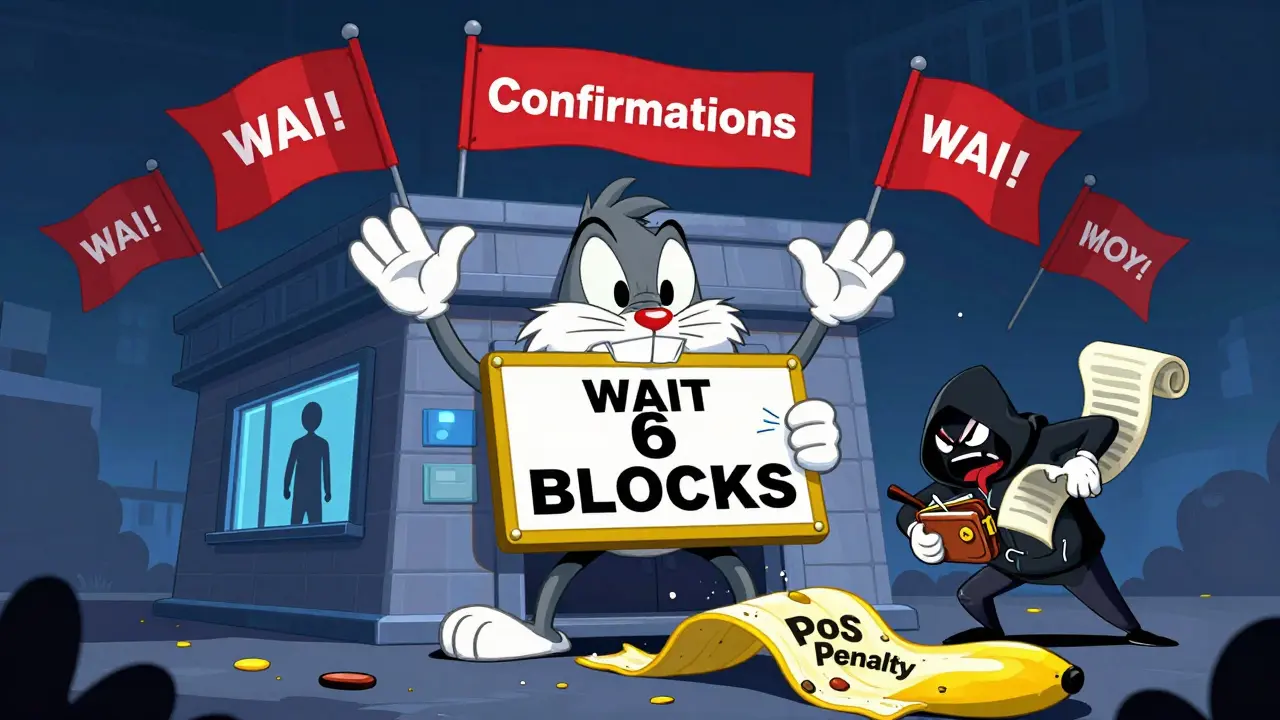
Real-Time Monitoring and AI Detection
Modern exchanges don’t wait for attacks to happen. They predict them. Machine learning models scan millions of transactions daily. They look for: - Rapid deposit-and-withdrawal cycles - Transactions from newly created wallets - Multiple small deposits from the same IP or device - Withdrawals to addresses linked to past fraud One exchange in Singapore flagged a double-spend attempt in 2024 by noticing a wallet that deposited 0.3 BTC, withdrew 0.25 BTC to a new address, then tried to deposit the same 0.3 BTC again using a different transaction ID. The system blocked it before the second deposit was confirmed. No user lost money. These systems learn from every attempted attack. The more fraud they stop, the smarter they get.Why Decentralization Is Your Best Defense
The beauty of blockchain security isn’t in one strong point-it’s in thousands of them. Every node on the Bitcoin or Ethereum network holds a full copy of the blockchain. If one node sees a double-spend attempt, it broadcasts it to the rest. The network ignores the fraudulent version. The honest version wins. No single company controls this. No central server can be hacked to erase records. Even if an exchange gets compromised, the blockchain itself remains intact. That’s why exchanges that rely on blockchain finality, not just their own databases, survive attacks.
What Happens When Security Fails
No system is perfect. In 2022, a smaller exchange in South Korea lost $12 million after accepting only two confirmations on a PoW chain with low hash power. The attacker mined a private chain, reversed the deposit, and then published it after the exchange had already credited the user. That’s why exchanges now follow strict rules:- Never trust a transaction until it’s deeply buried in the chain
- Never rely on a single node or data source
- Always cross-check with multiple public block explorers
- Delay withdrawals for high-risk accounts
What’s Next for Exchange Security
The future isn’t about choosing one consensus mechanism. It’s about combining them. New hybrid systems are emerging: - PoW + PoS layers for high-security deposits - Zero-knowledge proofs to verify transactions without exposing details - On-chain governance that lets users vote on security upgrades Some exchanges are testing “finality gadgets”-special protocols that guarantee a transaction is irreversible after just one block, even on slower chains. These could cut waiting times from hours to minutes without sacrificing safety. The goal? To make double-spending not just hard, but pointless. To turn every transaction into a permanent, unchangeable record. That’s the promise of blockchain-and why exchanges still matter.At the end of the day, you don’t need to understand how the engine works. You just need to know it won’t let you get cheated. And right now, the systems protecting your crypto are better than ever.
Elvis Lam
December 18, 2025 AT 13:31Exchanges don't just wait for confirmations-they pray for them. Six blocks on Bitcoin isn't a standard, it's a ritual. I've seen wallets get flagged for 12 confirmations on low-hash altcoins because one dumb exchange got reorged and lost $2M in 48 hours. Bottom line: if an exchange lets you withdraw before the blockchain says 'final,' they're gambling with your money, not protecting it.
And yeah, PoS is slick, but don't let the marketing fool you. Validators still get hacked, bribed, or coerced. The real win isn't the consensus-it's the multiple independent verification layers. If your exchange only checks one block explorer? Run.
Sammy Tam
December 19, 2025 AT 07:26Man, I remember when I first deposited ETH and it took like 10 minutes to show up. Thought the site was broken. Turned out it was just doing its damn job. Now I appreciate the wait. It's like waiting for your coffee to brew-fast is fine, but if it's gonna be good, you gotta let it steep.
Also, AI detecting sketchy wallets? That's next-level. My buddy got flagged because he used the same IP after moving across states. Took three days to prove he wasn't a bot. Worth it though. Better safe than sorry, right?
Jonny Cena
December 20, 2025 AT 00:45For anyone new to crypto, don't panic when deposits take time. That delay? That's your money breathing. Every confirmation is another lock on the vault. Exchanges aren't being slow-they're being smart.
And if you're wondering why your $50 withdrawal took 24 hours? It's not because they're holding you hostage. It's because they're protecting you from someone who's trying to steal it. Trust the process, even when it feels annoying.
Florence Maail
December 20, 2025 AT 14:41lol so you're telling me the government doesn't control all the nodes and just lets you think it's 'decentralized'? 😏
Also, '6 confirmations' = 6 minutes? Nah. That's the lie they feed you so you don't ask why your funds are frozen for 3 days. The real blockchain is a puppet show. I've seen the code. They're just replaying transactions from a private server. #DeepStateCrypto
George Cheetham
December 22, 2025 AT 03:37There's a beautiful irony here: the very technology designed to remove intermediaries now relies on centralized exchanges to enforce its integrity. The blockchain is immutable, yes-but the trust model has shifted from miners to compliance officers, AI algorithms, and risk management teams.
We've outsourced our sovereignty to corporations that, while well-intentioned, still operate under legal and financial pressures. The dream of true peer-to-peer value transfer? Still waiting on a software update.
Emma Sherwood
December 23, 2025 AT 23:56As someone who grew up in a country where banking was a luxury, seeing crypto exchanges use AI to prevent fraud feels like progress. Not perfect, but progress. They're not just protecting money-they're protecting dignity. People who’ve been excluded from traditional finance now have a fighting chance.
And yes, the wait times are frustrating. But imagine if you lost your life savings because someone rushed a withdrawal. That’s the real horror story.
Jesse Messiah
December 25, 2025 AT 18:58so i just wanna say... i read this whole thing and honestly? it made me feel smarter. like, i used to think exchanges were just like banks but with more emojis. now i get it. they're like digital bouncers with PhDs in math and machine learning.
also, 6 confirmations? yeah, that's a lot. but imagine if your house had 6 locks. you'd feel safe, right? same thing. thanks for explaining it like i'm not a robot 😊
Craig Nikonov
December 27, 2025 AT 11:33Proof of Stake? More like Proof of Rich People. If you can't afford to stake 32 ETH, you're not a validator-you're a spectator. And those 'delegated' validators? They're just oligarchs with better PR.
Also, AI detecting fraud? Cute. The same AI that flags your wallet for 'using a new device' also flags your cousin's account because you both use the same Wi-Fi. Welcome to the surveillance economy, folks.
Shruti Sinha
December 28, 2025 AT 20:04Very well-structured explanation. The part about multiple block explorers being cross-checked is critical-many retail users don’t realize exchanges can be fed false data from a single compromised node. The layered verification approach is what separates professional platforms from amateur ones.
Also, Solana’s 1-2 confirmations work because of its unique consensus architecture, not because it’s ‘faster’ in a general sense. Architecture matters more than speed.
Sean Kerr
December 29, 2025 AT 08:03brooo i just wanna say... i used to think crypto was just digital money... but now i realize it's like... a whole freaking security opera 🎭
6 confirmations? yeah it takes forever... but imagine if you got scammed because you clicked 'withdraw' too fast? 😳
also... AI catching the same BTC twice?? that's like a digital Sherlock Holmes 👮♂️🔍
thank you for not talking like a textbook. i actually learned something today 💪
Chevy Guy
December 31, 2025 AT 07:38They say '6 confirmations' but never mention that exchanges can pause withdrawals for 72 hours if you're 'high risk'... which means if you ever bought crypto during a dip... you're flagged as a 'speculator' and treated like a criminal
Also... who decided 6 is magic? Why not 5? Or 7? They just picked a number that sounds official. It's all theater.
And AI? Yeah right. My account got locked because I used a VPN. Guess I'm a money launderer now 🤷♂️
Abby Daguindal
January 1, 2026 AT 20:15Most of you are missing the point. This isn't about security-it's about control. Exchanges are gatekeepers. They decide what’s 'real' and what’s 'fraud.' They freeze accounts without warning. They report you to the IRS. They profit from your fear.
True decentralization doesn't need 6 confirmations. It needs no middlemen at all. You're being sold a lie wrapped in technical jargon.
Rebecca Kotnik
January 2, 2026 AT 22:06It is both intellectually and ethically imperative to recognize that the architecture of modern cryptocurrency exchanges represents not merely a technological innovation, but a profound reconfiguration of trust paradigms in economic systems. The transition from centralized financial intermediaries to algorithmically governed, multi-layered verification protocols signifies a paradigm shift in the ontological nature of value itself.
One must consider that the psychological burden of waiting for confirmations-often perceived as inconvenience-is, in fact, a necessary epistemic pause, a temporal buffer that allows for the emergent consensus of the network to manifest without the volatility of human impatience. The 6-confirmation standard is not arbitrary; it is the mathematical embodiment of probabilistic finality, wherein the cumulative entropy of successive blocks renders historical revision statistically negligible.
Furthermore, the deployment of machine learning models to detect anomalous transactional behavior reflects an evolution in institutional epistemology: from reactive auditing to predictive integrity management. These systems do not merely respond to fraud-they anticipate its morphology, learning from adversarial patterns with a sophistication that surpasses human intuition.
It is therefore not hyperbole to assert that the current infrastructure, while imperfect, represents one of the most robust and resilient financial frameworks ever conceived by human civilization. To dismiss it as 'centralized' is to misunderstand the distributed nature of its governance. The nodes are decentralized. The rules are transparent. The incentives are aligned. What remains is not a question of technology, but of cultural literacy.
And yet, we persist in reducing these systems to memes, to complaints about 'waiting too long,' to conspiracy-laden rants about 'hidden servers.' We have been given a tool of unprecedented power, and we treat it like a toy. That is not the fault of the system. That is the failure of the user.
Sally Valdez
January 4, 2026 AT 21:46USA thinks it invented security. LOL. China’s blockchain monitoring is 10x more advanced. They track your wallet to your apartment. Your 'decentralized' crypto? More like 'decentralized but watched by the NSA and PLA.'
And don't even get me started on 'AI detection.' That's just another way to ban people who don't buy into the system. If you're poor, you're a 'risk.' If you're rich, you're 'high net worth.'
They call it security. I call it control. And I'm not playing.
Samantha West
January 5, 2026 AT 14:10Interesting how everyone talks about confirmations like they're sacred... but nobody ever asks who owns the block explorers
what if all three 'independent' explorers are owned by the same company? what if the AI model was trained on data from a single exchange? what if the 'decentralized' network is just a bunch of nodes running on AWS?
we're not securing the blockchain... we're just decorating the illusion of it
and yet... we still trust it
how naive
how very very naive
Greg Knapp
January 5, 2026 AT 21:38bro why do you care so much about confirmations??
just send it and move on
i lost $3k once because i waited too long to withdraw and the exchange went down
so now i just do it fast and pray
crypto is gambling anyway
why are you reading a 1000 word essay on security when you could be buying the next memecoin??
you're overthinking it
just chill
its just digital money
lol
Kayla Murphy
January 6, 2026 AT 19:54I used to think crypto was just for tech bros... but after I helped my mom set up her first wallet and saw how she finally felt in control of her savings? I get it now.
Yes, the wait is long. Yes, the rules are confusing. But for people who’ve been locked out of banks for decades? This is freedom.
Don’t mock the process. Celebrate that it exists at all.
Amy Copeland
January 8, 2026 AT 02:45Wow. So you’re telling me that after all this, the only reason we haven’t been robbed is because exchanges are... *cautious*? How touching. How utterly, depressingly, bourgeois.
Let me guess-your favorite exchange has a ‘Trust & Safety’ team with a LinkedIn profile? How very 2024. You’re not protecting your assets-you’re outsourcing your paranoia to a corporation that charges you 1.5% to move money.
And you call this innovation?
It’s just capitalism with a blockchain logo.
Mark Cook
January 9, 2026 AT 14:366 confirmations? Pfft. I did a double-spend once on Dogecoin. Just sent it to two wallets at the same time. One went through. The other? Got rejected. I laughed for an hour.
Turns out exchanges are way too slow. If you know what you're doing, you can exploit the lag.
They think they're smart? They're just slow.
And now they're charging me 'security fees' for my own cleverness 😂