

Before Bitcoin, peer-to-peer (P2P) meant sharing music files. Napster made it famous in 1999, but it was never truly decentralized. Its servers still held the index. One shutdown, and the whole system collapsed. That’s the problem with early P2P: it looked distributed, but it relied on hidden middlemen. Blockchain changed that. It didn’t just improve file sharing-it rebuilt trust from the ground up, without banks, without brokers, without anyone you have to believe in.
The First Spark: Before Bitcoin
The real story of blockchain P2P starts long before Satoshi Nakamoto. In 1982, cryptographer David Chaum wrote a paper about systems where strangers could transact without trusting each other-or any central authority. He called it ‘computer systems established, maintained, and trusted by mutually suspicious groups.’ That’s the core idea behind every blockchain today. No one needed to be honest. The math made honesty the only smart choice. Then came Stuart Haber and W. Scott Stornetta in 1991. They didn’t care about music or money. They wanted to make sure digital documents couldn’t be backdated. Their solution? Chain blocks of data together using cryptography. Each block held a hash of the one before it. Change one, and the whole chain breaks. It was elegant. It was simple. And it had one big flaw: it wasn’t scalable. Adding each document took time. So in 1992, they added Merkle trees. Instead of hashing one document at a time, they bundled dozens into a single root hash. That’s still how Bitcoin verifies thousands of transactions in seconds. Napster didn’t invent P2P, but it showed the world what was possible. Millions of computers sharing files directly. No central warehouse. No single point of failure-except the server that listed what files were available. Take that server down, and the network went blind. Bitcoin fixed that. It made the list itself decentralized.Bitcoin: The First Truly Decentralized P2P Network
On January 3, 2009, the first Bitcoin block was mined. It wasn’t just a new currency. It was a new kind of network. No company owned it. No government controlled it. No server held the records. Instead, thousands of computers around the world-full nodes-kept identical copies of the entire transaction history. Every time someone sent Bitcoin, that transaction was broadcast to every node. They checked it. They validated it. And then they added it to their copy of the ledger. The magic? Proof-of-work. Before a new block could be added, a miner had to solve a math puzzle. It wasn’t hard for one computer. But doing it fast enough to stay ahead of everyone else? That required serious computing power. And once solved, everyone else could verify the answer in seconds. It was asymmetric: hard to create, easy to check. That’s how Bitcoin stopped bad actors. To cheat, you’d need more than half the network’s power. That’s expensive. And it’s obvious if you try. The first real Bitcoin transaction? 10 BTC from Satoshi Nakamoto to Hal Finney, a computer scientist and early crypto advocate. No bank. No receipt. No middleman. Just two strangers, trusting math over institutions. By 2014, the Bitcoin blockchain was 20GB. By 2020, it was over 200GB. Running a full node wasn’t just for techies anymore-it became a commitment. You needed storage, bandwidth, and patience. But in return, you got something priceless: direct control over your money.Scaling the Network: The Limits and the Fixes
Bitcoin’s network can handle about seven transactions per second. Visa handles 24,000. That’s not a bug-it’s a design choice. Bitcoin prioritizes security and decentralization over speed. But that’s not practical for buying coffee or paying rent. So the community built workarounds. The Lightning Network, launched in 2018, lets users open payment channels off-chain. You can send dozens of microtransactions between two parties without touching the main blockchain. Only the final balance gets recorded. It’s like a tab at a bar-you settle up at the end. Lightning now handles millions of transactions monthly, with fees under a penny. Ethereum took a different path. It didn’t just move money-it ran programs. Smart contracts. That opened the door to DeFi, NFTs, and decentralized apps. But Ethereum’s original proof-of-work model was energy-hungry. In 2022, it switched to proof-of-stake. Instead of miners solving puzzles, validators lock up ETH as collateral. The more you stake, the higher your chance to propose the next block. The energy drop? 99.95%. No more mining rigs in basements. Just regular people running nodes on laptops. Sharding is next. Ethereum plans to split its blockchain into 64 smaller chains, each handling its own transactions. Think of it like adding more checkout lanes at a grocery store. More lanes, less waiting. It’s not live yet, but the testnets are running smoothly.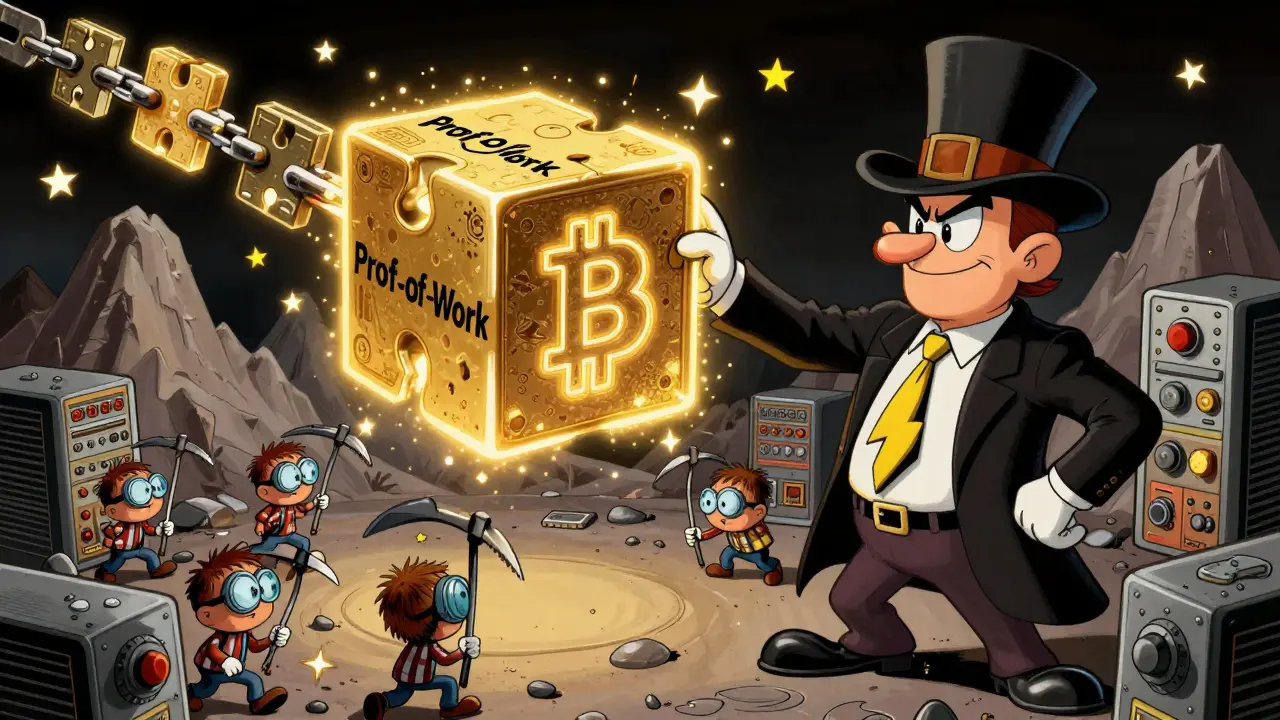
How Blockchain P2P Is Different From Old P2P
BitTorrent was better than Napster. No central server. Files downloaded directly from peers. But there was no accountability. You could download a corrupted file. No one could prove who uploaded it. No way to verify authenticity. Blockchain P2P fixes that. Every transaction is cryptographically signed. Every change is recorded permanently. You can trace every Bitcoin from its creation to its last spend. That’s not possible with file-sharing networks. And it’s not just about money. Supply chains now use blockchain to track coffee beans from farm to cup. Pharmaceuticals verify drug origins. Even voting systems are being tested. The key difference? Trust. Old P2P trusted the network. Blockchain P2P trusts the code. And the code doesn’t lie.Who Uses It-and Why
In 2023, over 87% of Fortune 500 companies were experimenting with blockchain P2P. Not for speculation. For real problems. Cross-border payments used to take days and cost $35. Now, a worker in the U.S. can send $500 to Nigeria in 15 minutes for $2.50. That’s not a gimmick. That’s life-changing. Reddit users report bypassing PayPal’s $3,000 limit when selling cars. Small businesses in Venezuela use Bitcoin to pay suppliers without currency controls. Refugees in Ukraine received aid via crypto wallets when banks shut down. But it’s not perfect. A user on Reddit paid $50 in fees to send $20 during a network spike. Another lost access to their wallet after forgetting a password. Chainalysis says 20% of all lost cryptocurrency is due to poor key management. That’s not the blockchain’s fault. It’s human error. And then there’s the hack. In 2021, $600 million vanished from Poly Network-not because the blockchain broke, but because a smart contract had a flaw. The attacker returned the money after public pressure. That’s the paradox: the network is secure, but the apps built on top aren’t always.
Jack Petty
February 2, 2026 AT 15:57Brianne Hurley
February 4, 2026 AT 01:28christal Rodriguez
February 5, 2026 AT 10:06Tressie Trezza
February 7, 2026 AT 07:27Mark Ganim
February 7, 2026 AT 09:52mary irons
February 7, 2026 AT 21:37Wayne mutunga
February 8, 2026 AT 13:06Gavin Francis
February 9, 2026 AT 13:07Dylan Morrison
February 10, 2026 AT 18:02josh gander
February 11, 2026 AT 20:17Andrea Demontis
February 12, 2026 AT 17:04Joseph Pietrasik
February 14, 2026 AT 02:18Raju Bhagat
February 14, 2026 AT 15:02laurence watson
February 15, 2026 AT 04:17Pamela Mainama
February 15, 2026 AT 16:41Parth Makwana
February 17, 2026 AT 06:42Elle M
February 17, 2026 AT 09:57Crystal Underwood
February 18, 2026 AT 00:54Raymond Pute
February 19, 2026 AT 14:56