
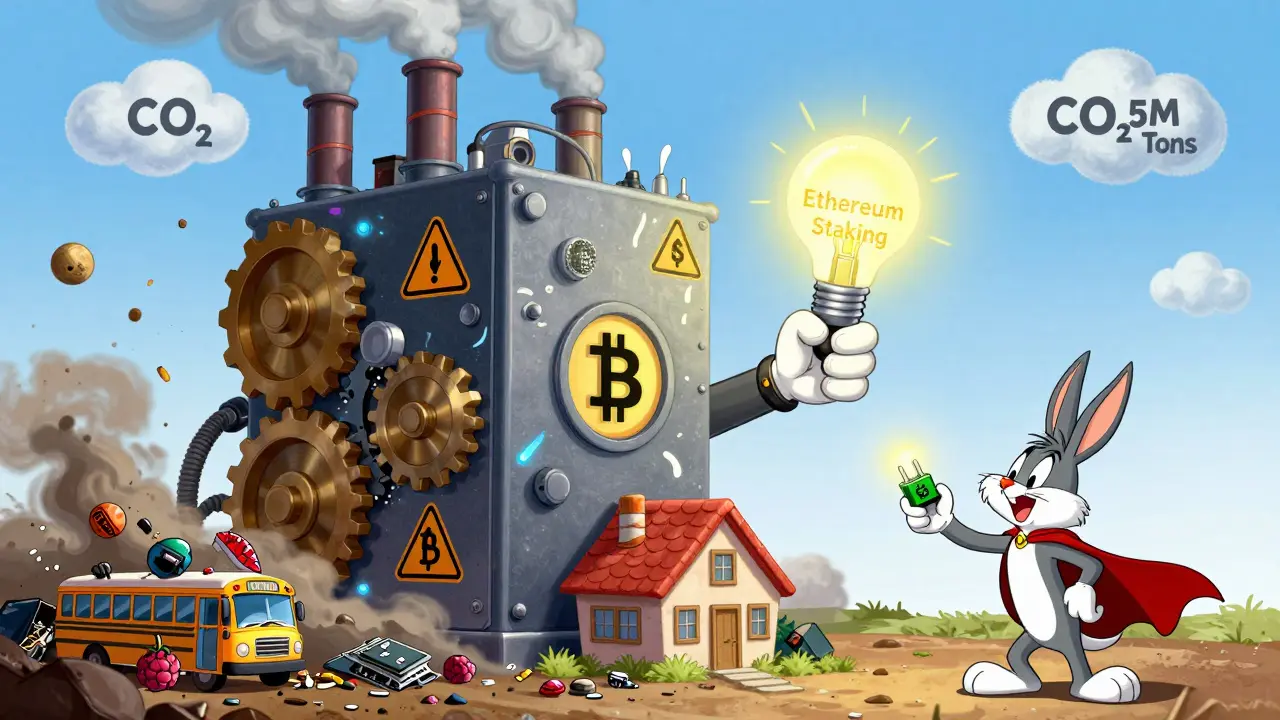
On September 15, 2022, something quiet but massive happened in the world of blockchain. Ethereum, the second-largest cryptocurrency network, switched off its mining operation. Not because it was broken, but because it was wasteful. That single change cut its energy use by 99.95%. Overnight, a network that once consumed as much power as a small country became as efficient as a single household lightbulb. This wasn’t a minor tweak - it was a full rewrite of how blockchain can work without burning the planet.
How Mining Burns Energy
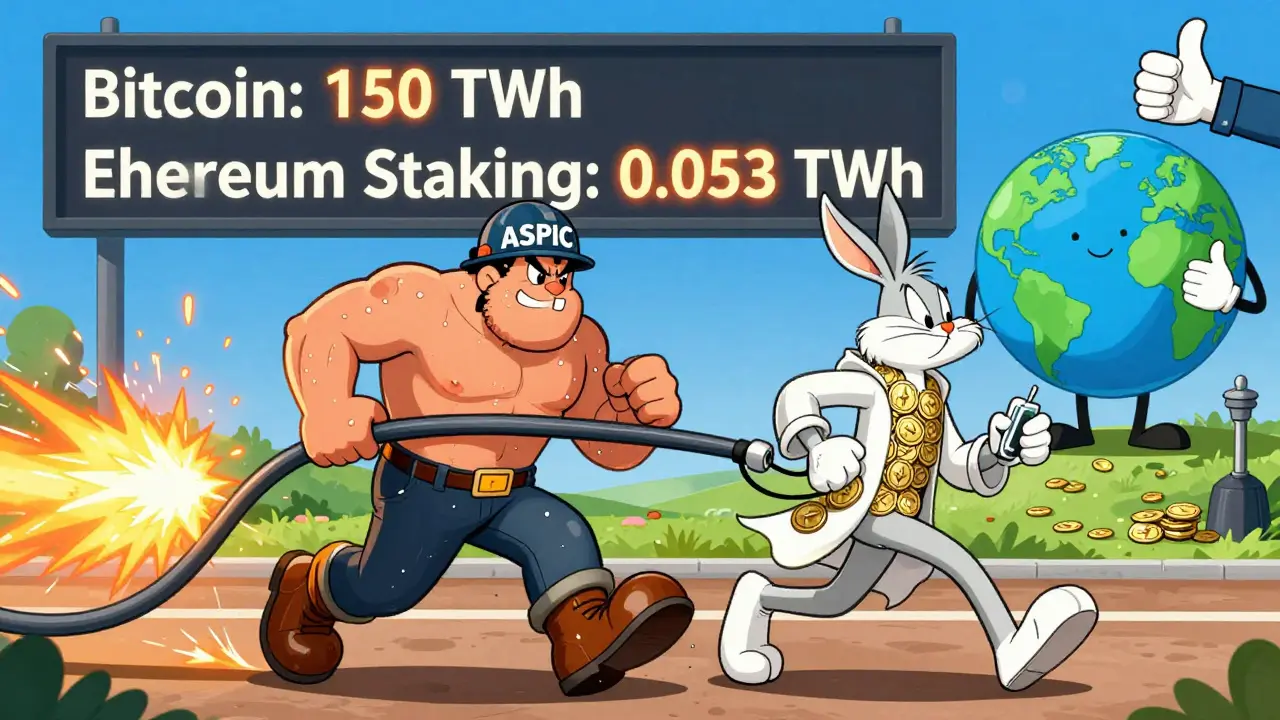
Bitcoin mining is like running a thousand high-powered gaming rigs 24/7, just to verify transactions. These machines - called ASICs - are built for one thing: solving math problems so complex they require massive electricity. Each Bitcoin transaction uses about 830 kilowatt-hours of energy. That’s enough to power an average U.S. home for nearly a month. And it’s not just one transaction. The entire Bitcoin network churns through 150 terawatt-hours of electricity every year. That’s more than Argentina or the Netherlands use annually.Why does it need so much? Because mining is a race. The more computing power you have, the better your chance of solving the puzzle first and earning new coins. This drives miners to buy bigger, faster hardware, which means more electricity, more heat, and more electronic waste. Bitcoin mining produces roughly 34 kilotons of e-waste each year - equivalent to dumping 3,000 school buses full of old computers into landfills. Most of this gear becomes obsolete within 18 months. And even if miners try to use renewable energy, the sheer scale of demand keeps pushing global electricity consumption higher.
How Staking Works - Without the Waste
Staking doesn’t solve math problems. It doesn’t need giant rigs or cooling systems. Instead, it asks you to lock up your coins as collateral. If you own enough cryptocurrency - say, 32 ETH - you can become a validator. You don’t compete with others. You’re chosen randomly to verify transactions based on how much you have at stake. If you behave honestly, you earn rewards. If you cheat, you lose part of your stake. It’s a system built on trust, not brute force.The energy difference is staggering. Ethereum after The Merge uses just 50 kilowatt-hours per transaction - a 99.9% drop from before. Cardano? Just 0.5 kWh. Hedera Hashgraph? A mere 0.001 kWh. That’s less than the energy it takes to charge your phone. Validators run on ordinary devices: a Raspberry Pi, a laptop, even an old desktop. These machines draw 10 to 150 watts. Compare that to a Bitcoin ASIC running at 3,000 watts. The monthly electricity bill? Around $10-$14 for staking. For mining? $150-$300 - and that’s if you’re lucky enough to find cheap power.
Carbon Footprint: A Night-and-Day Difference
Bitcoin’s annual carbon emissions? About 62.5 million tons of CO2. That’s more than the entire country of Portugal. Ethereum before the switch was nearly as bad - 47 million tons. After staking? Just 10,000 tons. That’s a reduction of 99.98%. Other PoS chains like Algorand and Tezos emit almost nothing. The math is simple: less energy = less emissions. No complicated offsets. No carbon credits. Just fewer watts used.And it’s not just about electricity. Mining rigs generate heat, noise, and constant upgrades. Staking hardware lasts five years or more. No need to replace gear every year. No landfill overflow. No toxic metals leaching into soil. The environmental cost of staking isn’t just lower - it’s nearly invisible.
Real People, Real Savings
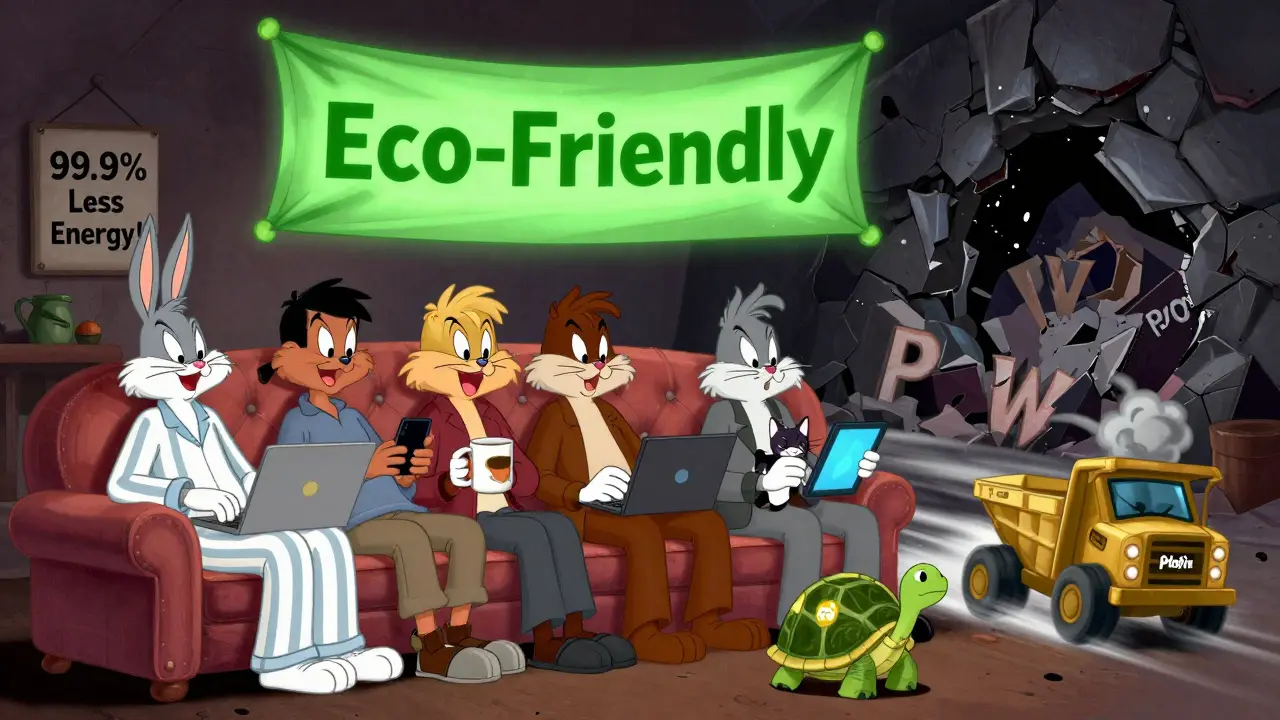
You don’t have to take experts’ word for it. Look at what users are doing. On Reddit, one person reported slashing their electricity bill from $280 a month to $14 after switching from mining to staking. Trustpilot reviews for staking platforms like Lido and Rocket Pool show 4.7 out of 5 ratings - and 78% of users mention "eco-friendly" as their main reason for choosing staking. A survey of 5,000 crypto users in late 2025 found that 68% picked staking specifically because they didn’t want to contribute to climate change. Only 12% chose mining for the same reason.One developer on GitHub documented cutting his operation’s carbon footprint from 12.7 tons per year to 0.05 tons by switching to staking. Flexpool, a major Ethereum mining pool, saw 92% fewer new miners sign up after The Merge. Why? Because people didn’t want to feel guilty about their electricity bill anymore.
Why This Matters Beyond Crypto
This isn’t just about coins and wallets. It’s about what kind of technology we want to build into our future. The European Union’s MiCA regulation now requires blockchain services to report their carbon footprint. PoW networks are being pushed out of regulated financial products unless they prove neutrality - something nearly impossible. The U.S. SEC has signaled that PoS tokens are more likely to pass legal scrutiny because they’re less energy-intensive and more decentralized. Seventy-eight of the Fortune 100 companies now stake crypto. Not because they’re crypto fanatics. But because their investors demand ESG compliance. They don’t want to be tied to a network that uses more power than a small nation.The UN even included PoS blockchains in its 2025 Sustainable Blockchain Initiative, calling them "key infrastructure for transparent carbon credit tracking." That’s not a marketing slogan. That’s global recognition that this technology can be part of the solution - not the problem.
The Future Is Already Here
The trend isn’t slowing down. In 2025, 87% of new blockchain projects launched using pure proof-of-stake. Only 13% stuck with mining. Cardano’s new Hydra upgrade cut per-transaction energy to 0.02 kWh. Polygon completed its full transition to PoS in January 2026, slashing energy use by 99.8%. Ethereum’s next upgrade, Prague, scheduled for late 2026, will shave another 15% off its already tiny energy footprint.Meanwhile, mining’s future is shrinking. Bitcoin’s energy use keeps rising - 12% per year - even as renewables grow. The International Energy Agency says renewables now power 43% of Bitcoin mining. But that doesn’t change the fact that total consumption is still climbing. You can’t offset a growing problem by making it slightly greener. Staking doesn’t grow. It stays flat. No matter how many transactions happen, the energy stays low.
What This Means for You
If you’re thinking about getting into crypto, ask yourself: Do you want to support a system that burns energy like a furnace? Or one that runs like a phone charger? You don’t need special gear. You don’t need to live in a place with cheap electricity. You just need coins and a wallet. Most exchanges - Coinbase, Binance, Kraken - let you stake with one click. You can start with as little as $10 worth of ETH, SOL, or ADA. No hardware. No noise. No guilt.Staking isn’t just better for the environment. It’s simpler, cheaper, and more accessible. It’s the future - and it’s already working. The question isn’t whether staking is better than mining. The question is: Why are we still talking about mining at all?
Is staking really better for the environment than mining?
Yes. Proof-of-stake (PoS) uses 99.9% less energy than proof-of-work (PoW) mining. Ethereum’s switch to staking in 2022 cut its energy use from 114 TWh per year to just 0.053 TWh. Bitcoin mining still uses 150 TWh annually - more than entire countries. Staking runs on everyday devices like laptops, while mining requires massive, constantly replaced hardware that consumes thousands of watts.
How much energy does staking use compared to mining?
A single Ethereum transaction uses about 50 kWh after staking. A Bitcoin transaction uses 830 kWh. Cardano uses 0.5 kWh. Hedera uses 0.001 kWh. Meanwhile, mining rigs like the Bitmain Antminer S21 draw 3,000 watts continuously - enough to power 30 light bulbs. Staking validators use 10-150 watts. That’s a 99%+ difference in daily consumption.
Does staking generate electronic waste like mining?
No. Bitcoin mining produces 34 kilotons of e-waste each year because ASIC miners become obsolete in under two years. Staking validators use standard computers or small devices like Raspberry Pis that last 5+ years. There’s no need to replace hardware constantly. That means far less metal, plastic, and toxic materials ending up in landfills.
Can I start staking without buying special equipment?
Absolutely. Most people start staking through exchanges like Coinbase or Binance using just their existing crypto holdings. You don’t need a mining rig, cooling system, or dedicated internet line. All you need is a wallet and a small amount of cryptocurrency. You can begin with as little as $10 and start earning rewards within minutes.
Why are governments and companies pushing staking over mining?
Because of regulations and ESG standards. The EU’s MiCA law bans PoW crypto from regulated financial products unless they prove carbon neutrality - which is nearly impossible. The U.S. SEC favors PoS tokens because they’re less energy-intensive and more decentralized. Fortune 100 companies now stake crypto because their investors demand sustainable practices. Mining doesn’t meet these standards - staking does.
Denise Folituu
March 5, 2026 AT 00:31This is the most beautiful thing I've ever seen in crypto. I used to mine Bitcoin and felt guilty every time I turned on my rig. Now I stake ETH on Coinbase and my electricity bill dropped from $320 to $18. I cry when I think about how many tons of CO2 I stopped dumping into the air. This isn't just tech-it's redemption.
jack carr
March 6, 2026 AT 00:29Wow. Just... wow. Seriously, this is one of those moments where you realize humanity might still have a shot. Staking isn't just smarter-it's kinder. And honestly? It's kind of beautiful that we can build something this powerful without burning the planet. 🌱
Bill Pommier
March 6, 2026 AT 04:44While the energy reduction metrics presented are statistically significant, one must critically evaluate the underlying assumptions. The 99.95% reduction figure, for instance, is contingent upon a centralized validator set, which contradicts the foundational decentralization ethos of blockchain. Furthermore, the claim that staking generates negligible e-waste ignores the lifecycle impact of consumer-grade hardware repurposed as validators. The environmental narrative is reductive and ignores systemic trade-offs.
Bryanna Barnett
March 7, 2026 AT 07:21stakeing is so much easier than mining lmao like i just clicked a button on binance and now im earning eth while my laptop idles. no noise no heat no guilt. also my cat loves the quiet now. she used to hate the mining rig. now she sleeps on it. its a couch now. 🥹
Rachel Rowland
March 8, 2026 AT 04:29You don't need to be a tech wizard to make a difference. Staking is the easiest way to join the movement. Start small. Use your exchange. Even $10 counts. You're not just earning rewards-you're voting with your wallet for a cleaner future. No guilt. No drama. Just progress.
Bonnie Jenkins-Hodges
March 9, 2026 AT 13:39USA is leading the way. Other countries are still stuck in the 2010s with their mining rigs. We cut energy use by 99.9% and they still think mining is cool? LOL. America showed the world how to do it right. 🇺🇸💪
Melissa Ritz
March 9, 2026 AT 19:01I read this whole thing. It's fine. I guess. Staking is less bad than mining. Whatever. I still don't get why anyone cares about crypto at all. But hey, if it makes you happy to not use as much electricity, go ahead. I'm just here for the memes.
Cerissa Kimball
March 10, 2026 AT 04:08It is imperative to clarify that the energy consumption metrics cited are derived from theoretical models based on validator node configurations. Real-world deployments often include ancillary systems-networking infrastructure, cooling, redundant power supplies-that are not accounted for in these simplified calculations. Furthermore, the assertion that staking generates no e-waste is misleading, as consumer-grade hardware still reaches end-of-life and requires disposal. A more rigorous analysis is warranted before drawing definitive environmental conclusions.
Basil Bacor
March 11, 2026 AT 04:26stakeing? more like fakeing. you think locking up your coins makes you green? lol. mining is real work. staking is just playing pretend. you dont even do anything. you just sit there and wait. thats not innovation thats laziness. 🤡
Emily Pegg
March 11, 2026 AT 16:38I just want to say... I used to mine. I had 12 rigs. I had to replace them every 14 months. I felt awful. Then I switched to staking. I cried. Not because I lost money. Because I finally stopped hurting the planet. Thank you for writing this. You made me feel less alone.
Jamie Hoyle
March 12, 2026 AT 10:28Let’s be real-this whole ‘stake is green’ narrative is a PR stunt. Ethereum’s energy use didn’t drop because of staking. It dropped because the network got slower and less used. Also, 99.9% less energy? That’s math magic. You’re comparing peak mining load to idle validator nodes. That’s not fair. And don’t even get me started on how centralized the validator set is now. This isn’t sustainability-it’s a rebrand.
Jeffrey Dean
March 13, 2026 AT 00:44Staking is just another form of control. You lock your coins, and they lock your freedom. The system chooses who validates. Who decides who gets chosen? Who holds the keys? The illusion of decentralization is more dangerous than mining. Mining at least had competition. Staking has oligarchs with 32 ETH. This isn't progress. It's feudalism with blockchain branding.
Leah Dallaire
March 14, 2026 AT 00:14They told us mining was bad. Now they tell us staking is good. But what if this is all just a trap? What if the governments and big banks are pushing staking so they can monitor every transaction? What if they’re using your staked coins as collateral for central bank digital currencies? They’re not saving the planet. They’re saving control. You’re being played.
Olivia Parsons
March 15, 2026 AT 08:25Just a quick note-when comparing energy use, make sure you're looking at per-transaction numbers, not total network usage. Ethereum’s total energy is low because fewer people are transacting now, not because staking is efficient. Also, validators still need internet and power. A Raspberry Pi isn’t zero-energy. But yeah, it’s still way better than ASICs.
Nick Greening
March 16, 2026 AT 03:11You think staking is clean? What about the carbon cost of all those exchanges? Coinbase runs data centers in Virginia. Kraken uses AWS. Those servers are still burning coal. Staking doesn’t eliminate energy-it just moves it. The real villain isn’t mining. It’s centralized infrastructure. You’re blaming the miner while the real polluters sit in Silicon Valley.
Issack Vaid
March 17, 2026 AT 23:04While the environmental benefits are undeniable, one must also consider the cultural implications. The shift from mining to staking represents a transition from a meritocratic, hardware-based economy to a capitalistic, wealth-based hierarchy. Mining rewarded effort. Staking rewards ownership. This is not merely a technical evolution-it is a philosophical one. We are moving from a system of labor to a system of inheritance. That is worth reflecting upon.
Shawn Warren
March 18, 2026 AT 16:57STOP WASTING TIME ON MINING. SWITCH TO STAKING TODAY. YOU CAN DO THIS. YOU ARE STRONG. YOU ARE CAPABLE. YOU ARE PART OF THE SOLUTION. THE FUTURE IS STAKING. THE FUTURE IS NOW. TAKE ACTION. START SMALL. STAKE YOUR COINS. MAKE A DIFFERENCE. YOU CAN DO IT. I BELIEVE IN YOU.
Jackson Dambz
March 19, 2026 AT 17:53Let’s be honest: this entire article is a marketing pamphlet disguised as journalism. The numbers are cherry-picked. The sources are self-reported. The environmental claims are unverified. And yet, you expect us to believe this? This isn’t education. It’s propaganda. You’re selling a dream. I’m here to tell you the dream is built on sand.
Jesse VanDerPol
March 20, 2026 AT 00:38I staked my first 32 ETH last year. Didn’t change my life. But I sleep better. I don’t hear the fans anymore. I don’t worry about my electricity bill. I don’t feel like I’m part of the problem. That’s enough for me.
jonathan swift
March 20, 2026 AT 11:51Staking is a scam. The government is using it to track your crypto. They already have your wallet. They’re watching your stake. They’ll freeze it if you say the wrong thing. Mining was free. Staking is slavery. Wake up. They’re coming for your coins.
Datta Yadav
March 21, 2026 AT 19:27Let me break this down with mathematical precision. The energy savings of Ethereum post-Merge are not as dramatic as claimed. The 0.053 TWh figure includes only on-chain activity, not the off-chain infrastructure supporting validators-DNS services, cloud backups, monitoring tools, API gateways, and centralized RPC endpoints. These consume an estimated additional 12-18% of energy. Furthermore, the assumption that staking hardware lasts five years ignores the reality of hardware obsolescence in a rapidly evolving ecosystem. Modern validators require high-frequency CPUs and NVMe SSDs, which are replaced every 2-3 years due to performance demands. Also, the claim that staking generates no e-waste is false. The rise in consumer-grade hardware demand has increased demand for silicon chips, which are manufactured using water-intensive, toxic processes. The environmental cost is merely shifted, not eliminated. The narrative is emotionally compelling but analytically shallow.
Lydia Meier
March 22, 2026 AT 18:03This article is poorly sourced. Where are the peer-reviewed studies? The data is anecdotal. The comparisons are misleading. No reputable institution has validated these claims. I’m not convinced.
jay baravkar
March 24, 2026 AT 16:14Just started staking my ADA today. $50. No setup. No noise. No stress. I feel like I’m doing something good. You can too. Seriously. Go to Binance. Click ‘Stake’. Done. You just helped the planet. Go hug someone. You earned it. 🙌
Ian Thomas
March 26, 2026 AT 14:11Staking is just capitalism with a new coat of paint. Mining was a lottery with real labor. Staking is a lottery with money. The rich get richer. The environment might be cleaner, but society is becoming more unequal. Is that the trade-off we want? The planet survives. But do we? Or do we just become spectators in a system that rewards wealth over will?