
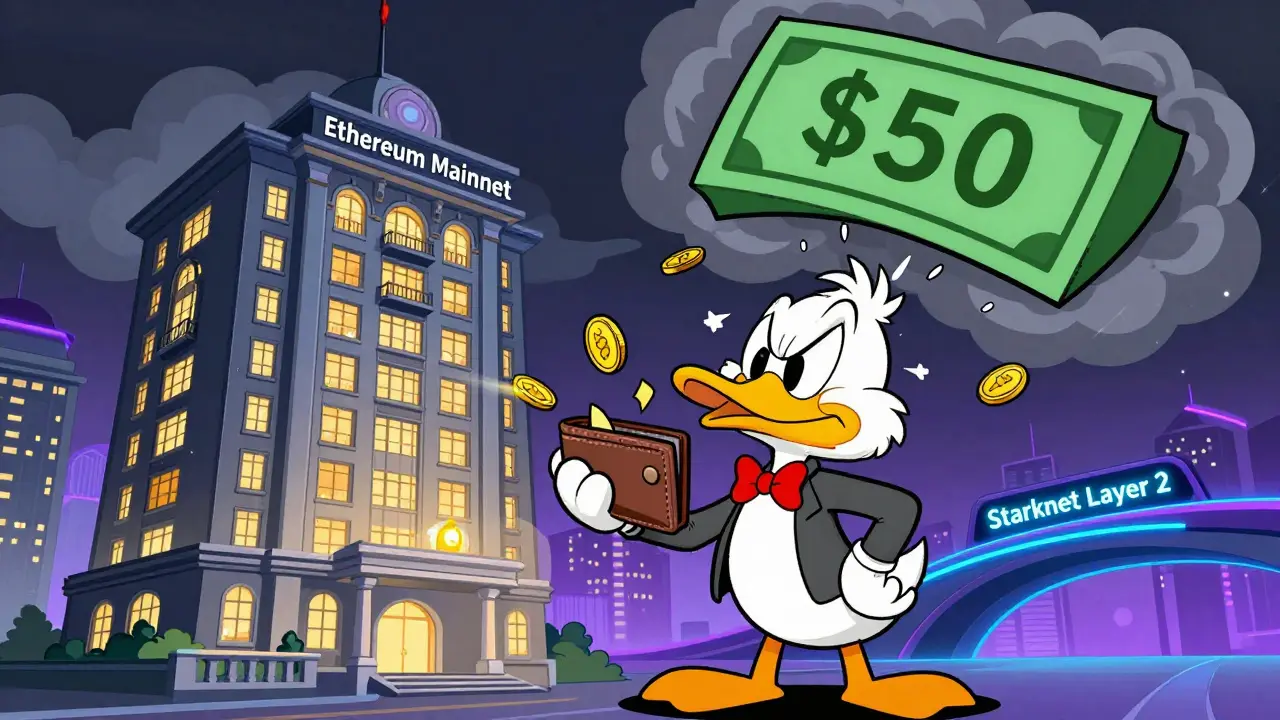
Trading crypto on Ethereum mainnet feels like paying rent for a luxury apartment you barely use. You get burned by gas fees that spike to $50 just to swap tokens, and your capital sits idle most of the time. That is exactly why traders are flocking to Layer 2 solutions, and specifically to Ekubo Protocol, which claims to be the "AMM endgame" on Starknet. But does it actually deliver on the hype, or is it just another complex protocol with a steep learning curve? As we move through early 2026, Ekubo has cemented itself as the dominant decentralized exchange (DEX) on Starknet, but its unique approach requires a different mindset than swapping tokens on Uniswap.
The Core Problem: Why Traditional AMMs Fail Traders
To understand why Ekubo exists, you have to look at what is broken in current decentralized finance. Traditional Automated Market Makers (AMMs) like Uniswap V2 spread liquidity across all possible price ranges. This means if you provide liquidity for ETH/USDC, your funds are working for prices from $1 to $10,000+, even though the price rarely moves outside a tiny band. This creates massive capital inefficiency. You need millions of dollars in TVL just to support reasonable trading volumes without huge slippage.
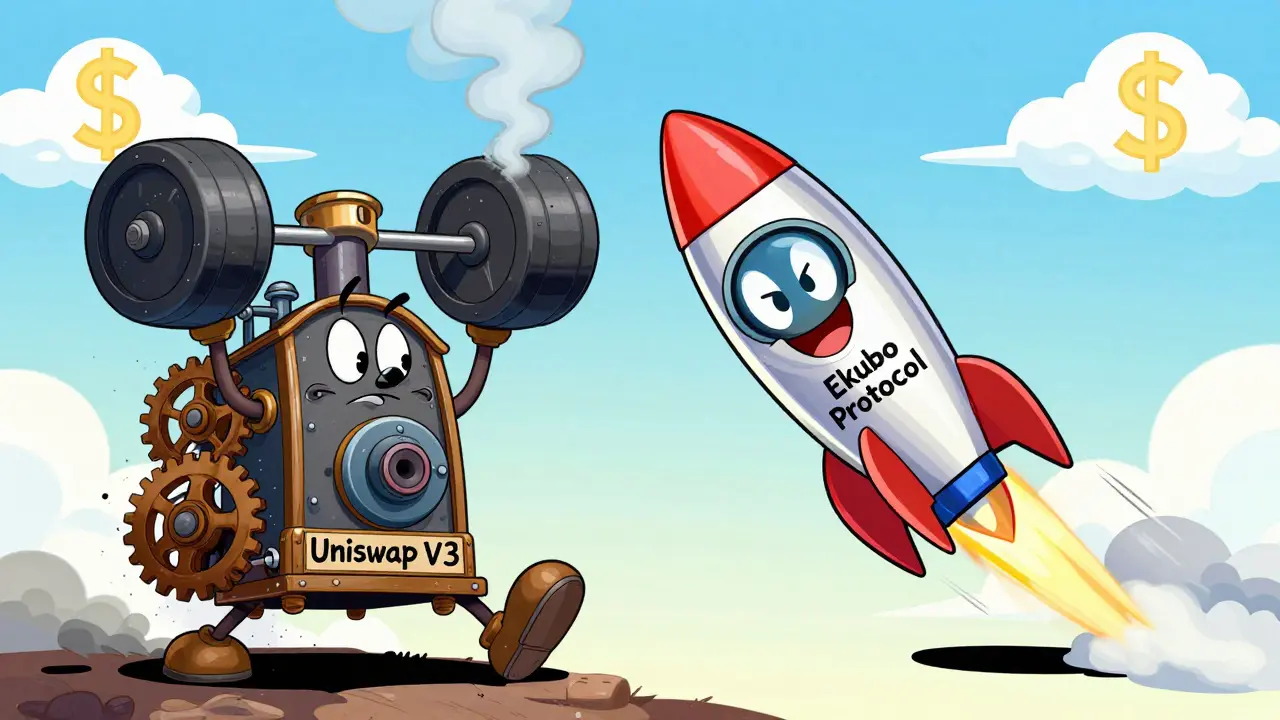
Uniswap V3 tried to fix this with concentrated liquidity, allowing providers to pick specific ranges. It was a step forward, but the minimum tick spacing was still too wide for high-frequency or stablecoin trading. Enter Ekubo. Built natively on Starknet's ZK-Rollup architecture using Cairo smart contracts, Ekubo introduces "super-concentrated liquidity." It allows orders within one hundredth of a single basis point (0.0001%). That is a 10,000x improvement over Uniswap V3's precision. For stablecoins, where price stability is key, this translates to up to 4 million times greater capital efficiency compared to conventional AMMs.
How Ekubo Works: The Super-Concentrated Liquidity Model
You might wonder how such precision works without crashing the system. Ekubo leverages the computational power of StarkWare's technology. Because Starknet processes transactions off-chain and posts validity proofs to Ethereum, the cost of computation is drastically lower. Ekubo’s smart contracts are optimized for this environment.
Here is what that means for you:
- Micro-Tick Precision: You can place liquidity positions as narrow as 0.0001%. This mimics an order book more closely than any previous AMM.
- Lower Gas Costs: Swap execution costs approximately 15,000 gas units on Starknet. In real terms, that is about $0.0012 per swap during normal conditions. Compare that to Uniswap V3 on Ethereum, which averages $0.25 to $0.50.
- Modular Architecture: The protocol separates core AMM functionality from additional features, allowing third-party developers to build custom order types and automated strategies on top of Ekubo.
This design makes Ekubo particularly powerful for stablecoin pairs. If you are trading USDC against USDT, the price hardly moves. On Uniswap, you waste capital covering impossible price scenarios. On Ekubo, you concentrate your capital exactly where the trades happen, earning significantly higher yields on the same amount of deposited assets.
| Feature | Ekubo Protocol (Starknet) | Uniswap V3 (Ethereum) | PancakeSwap V3 (BNB Chain) |
|---|---|---|---|
| Avg. Swap Fee | $0.0012 | $0.25 - $0.50 | $0.018 |
| Capital Efficiency (Stablecoins) | Up to 100x better than V3 | Baseline | Moderate |
| Minimum Tick Spacing | 0.0001% | 0.01% | Variable |
| Market Share (DEX Volume) | 62.3% (on Starknet) | Dominant on Ethereum | Dominant on BNB Chain |
| Security Audits | OpenZeppelin, ConsenSys Diligence | Multiple Top Firms | CertiK, Others |
Performance and Market Position in 2026
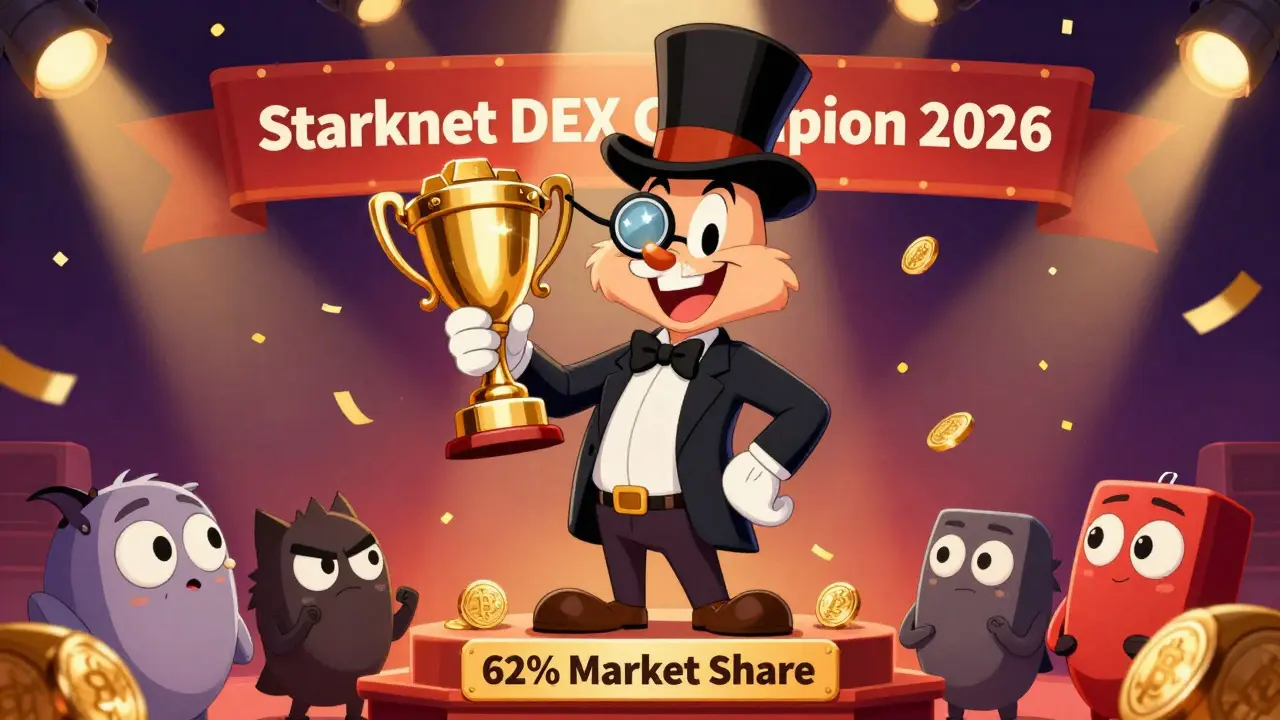
As of late 2025 and moving into 2026, Ekubo is not just a niche player; it is the heavyweight champion of Starknet. It commands a 62.3% market share of total DEX volume on the network, processing around $42.7 million in daily trading volume. By comparison, competitors like JediSwap hold only 10.2%, and ZKSwap holds 8.7%.
This dominance is driven largely by institutional adoption. Major market makers like Wintermute and GSR manage over $1.2 billion in Ekubo pools. They love the capital efficiency. For retail users, this translates to deeper liquidity and less slippage when you trade large amounts. However, this also means Ekubo faces "platform risk." Its success is tightly bound to Starknet's growth. If alternative ZK-Rollups gain significant traction, Ekubo could struggle to maintain its user base outside the Starknet ecosystem.
The governance token, EKUBO, has seen significant appreciation since its launch in March 2024. Trading around $4.54 in late 2025, it represents a way for users to participate in the protocol's future. Recent governance votes have allocated millions in tokens to liquidity mining incentives, which helped boost Total Value Locked (TVL) by 37% in just two weeks. But remember, token utility beyond governance remains a question mark for many holders.
User Experience: The Steep Learning Curve
Let’s be honest: Ekubo is not for absolute beginners. If you are used to clicking "Swap" on a simple interface, Ekubo will frustrate you initially. The complexity comes from managing concentrated liquidity positions. You must select precise price ranges. Get it wrong, and your liquidity goes out of range, earning zero fees while exposing you to impermanent loss.
User feedback reflects this divide. On Trustpilot, Ekubo holds a 3.8/5 rating. Positive reviews praise the "lowest fees in DeFi" and "unmatched stablecoin yields." Negative reviews consistently cite the "steep learning curve" and "limited asset selection" compared to Ethereum giants. Reddit threads show experienced users earning 22%+ APY on stablecoin pairs, but also warn novices about the risks. One user reported losing $320 due to incorrect price range selection during a stablecoin depeg event.
To mitigate this, Ekubo provides extensive resources. Their "Ekubo Academy" offers 28 interactive modules, and their YouTube channel hosts 47 videos totaling over 6 hours of content. The community Discord is active with over 14,000 members. Expect to spend 5-8 hours mastering the platform if you have prior DeFi experience, or 12-15 hours if you are new to concentrated liquidity concepts.
Security and Trust
In DeFi, security is non-negotiable. Ekubo takes this seriously. All smart contracts are written in Cairo and undergo formal verification through StarkWare. Before mainnet launch, audits were completed by industry leaders OpenZeppelin and ConsenSys Diligence. These audits identified and resolved 7 critical and 12 high-severity issues. While no system is immune to bugs, the rigorous pre-launch vetting provides a strong foundation.
However, keep in mind that Ekubo operates on Starknet. You are trusting not just Ekubo's code, but also Starknet's bridge and underlying infrastructure. Always use reputable bridges like the official Starknet Bridge to move assets from Ethereum.
Who Should Use Ekubo?
Ekubo is ideal for:
- Stablecoin Traders: If you trade USDC/USDT or similar pairs, the capital efficiency here is unmatched. Yields of 18.7% APY are common compared to ~3% on Uniswap.
- Cost-Conscious Swappers: If you make frequent small trades, saving $0.25 per transaction adds up quickly.
- Advanced LPs: If you understand concentrated liquidity and want to maximize returns on volatile assets, Ekubo’s precision gives you an edge.
It is NOT ideal for:
- Total Beginners: The interface and concepts require study. Start with simpler DEXes first.
- Cross-Chain Users: Ekubo is currently limited to Starknet assets. Bridging from other chains adds friction and cost.
- Passive Investors: Concentrated liquidity requires active management. You cannot set and forget.
Future Outlook: What Comes Next?
Ekubo’s roadmap for 2026 includes the integration of "EKUBO Chain," a dedicated appchain for concentrated liquidity protocols, scheduled for Q2 2026. Later in the year, cross-rollup liquidity sharing aims to connect Ekubo with other ZK-Rollup ecosystems. These developments could reduce the platform risk tied solely to Starknet.
Industry analysts predict that concentrated liquidity AMMs will capture 78% of stablecoin trading volume across all L2s by 2027. Ekubo is well-positioned to lead this shift, provided Starknet continues its growth trajectory. With regular updates every 2-3 weeks and a dynamic fee adjustment algorithm introduced in version 1.2, the team is actively improving the product.
Is Ekubo safe to use?
Ekubo has undergone rigorous audits by OpenZeppelin and ConsenSys Diligence, resolving all critical issues before launch. However, as with any DeFi protocol, there are inherent smart contract and platform risks. Always start with small amounts and ensure you are using the official Ekubo interface (app.ekubo.org).
How do I get started with Ekubo?
First, set up a Starknet-compatible wallet like Braavos, Argent X, or Voyager. Bridge assets from Ethereum to Starknet using the official bridge. Then, visit app.ekubo.org to connect your wallet. Familiarize yourself with the "Ekubo Academy" tutorials before providing liquidity to avoid costly mistakes.
What is the EKUBO token used for?
The EKUBO token is primarily used for governance, allowing holders to vote on protocol upgrades and parameter changes. It also serves as a reward mechanism for liquidity providers through liquidity mining incentives. Currently, its utility beyond governance is limited.
Can I trade ERC-20 tokens from Ethereum directly on Ekubo?
Not directly. You must first bridge your ERC-20 tokens from Ethereum mainnet to Starknet. Once bridged, they become native Starknet assets and can be traded on Ekubo. Cross-layer messaging capabilities support this process, but direct integration with other Layer 2 solutions is currently limited.
Why are fees so low on Ekubo compared to Uniswap?
Ekubo runs on Starknet, a ZK-Rollup Layer 2 solution. Transactions are processed off-chain, and only validity proofs are posted to Ethereum. This drastically reduces computational costs. Additionally, Ekubo’s Cairo-based smart contracts are optimized for this architecture, resulting in average swap fees of around $0.0012.
Is Ekubo better than Uniswap for volatile assets?
For highly volatile assets, Ekubo requires more active management due to its concentrated liquidity model. During extreme volatility, it may result in 23% higher impermanent loss compared to broader-range AMMs if positions are not rebalanced frequently. It excels in stablecoin pairs but demands vigilance for volatile ones.
What wallets work with Ekubo?
Ekubo supports all major wallets compatible with Starknet, including Braavos, Argent X, and Voyager. Ensure your wallet is updated to the latest version to access all features seamlessly.
Does Ekubo charge any hidden fees?
Ekubo is transparent about its fee structure. There are standard trading fees paid to liquidity providers, and minimal network gas fees due to Starknet’s efficiency. Be aware of potential slippage in thinly traded pairs, but there are no hidden protocol fees.
Aaron Zeiler
May 2, 2026 AT 21:48look i traded on uniswap for years and the gas fees were killing me just to swap eth for usdc ekubo is a game changer because you can actually keep your capital working without burning it up on every single transaction
the micro-tick precision is wild honestly like 0.0001% spacing means you are not wasting liquidity on price ranges that will never happen
i started with stablecoins first since its safer but now im doing some volatile pairs too just gotta watch the impermanent loss closely
Carli Bates
May 3, 2026 AT 01:02oh great another dex promising the moon while hiding the fact that if you set your range wrong you lose everything instantly
super-concentrated liquidity sounds fancy until you realize it just means super-concentrated risk for people who dont know what they are doing
why do we keep pretending these complex protocols are for normal people when they clearly require a degree in financial engineering to operate safely
Barbara Jones
May 4, 2026 AT 03:18i think ppl get scared bcuz it looks complicated at first but u just gotta take ur time
the academy videos r actually pretty good if u watch them slowly
dont rush into putting big amounts in till u feel comfy with the interface tho
Brendan Thraxton
May 6, 2026 AT 02:02you guys are missing the bigger picture here
starknet is scaling fast and ekubo is riding that wave hard
if you want to maximize yields on stablecoins this is literally the best place right now
just make sure you bridge your assets properly from eth mainnet first so you dont get stuck paying high fees there
Tracy McBurney
May 7, 2026 AT 03:34let's dissect the actual mechanics here because most of you are ignoring the platform risk entirely
ekubo is tethered to starknet which means if starknet fails or loses dominance ekubo dies with it
it is not just about low fees it is about ecosystem dependency which is a massive red flag for long term holding
also the token utility is weak governance only does not cut it when you need real demand drivers for price appreciation
Ipsita Seal
May 7, 2026 AT 05:19i tried it once and got confused by all the sliders and numbers so i gave up
why cant they just make a button that says swap and done like everyone else
this whole concentrated liquidity thing is just stress for no reason honestly
Kathleen Warren
May 8, 2026 AT 13:20i hear you ipsita
it is totally okay to start simple
maybe try just swapping small amounts first before trying to provide liquidity
the learning curve is steep but you do not have to master it all day one
Rushell Perry
May 8, 2026 AT 19:56hey everyone
i found the comparison table in the post really helpful
seeing the fee difference between ekubo and uniswap v3 makes it clear why traders are moving over
just remember to check the current tvl before you jump in to make sure there is enough depth for your trade size
Abhishek Verma
May 9, 2026 AT 18:20so let me get this straight you pay $0.0012 to swap tokens but then you have to worry about smart contract risks and bridge hacks
what is next free money from thin air?
these layer 2 solutions are just delaying the inevitable rug pull
Ryan Nakielny
May 10, 2026 AT 12:17abhishek you are being dramatic as usual
yes there are risks but ignoring the tech progress is stupid
starknet has been audited by top firms and the security model is solid compared to older chains
stop fear mongering and look at the data instead
Nitin Gupta
May 11, 2026 AT 20:21i agree with ryan nakielny here
the audits from openzeppelin and consensys diligence are a good sign
they fixed all critical issues before launch which shows responsibility
always use the official bridge though to avoid any third party risks
Sri Astuti
May 13, 2026 AT 17:14:) i think the key is understanding that this is not for passive investors
if you want to earn high apy you must actively manage your positions
the 22% apy on stablecoins is amazing but only if you keep your range tight and rebalance often
it is like gardening you have to water it regularly or it dies :)
Elle Kharitou
May 14, 2026 AT 04:37hello friends 🌟
as someone who loves exploring new technologies i find ekubo fascinating
the way it uses cairo smart contracts to achieve such precision is truly innovative
it reminds me of how blockchain started as a niche concept and now powers global finance 🚀
we should embrace these changes even if they seem complex at first 💫
its me
May 15, 2026 AT 07:05there is a moral failing in designing systems that punish ignorance
when you allow users to lock their funds based on complex parameters you are essentially gambling with their livelihoods
the fact that they offer tutorials does not absolve them of the responsibility to make the default state safe
capital efficiency should not come at the cost of user safety
Janis Naglis
May 16, 2026 AT 13:26i disagree with the negativity here!!!
decentralized finance is supposed to be permissionless and sophisticated!!!
if you cannot handle the complexity maybe defi is not for you yet!!!
but for those who step up the rewards are incredible!!!
let us support innovation instead of complaining about learning curves!!!
Jimmy vasquez
May 18, 2026 AT 11:07hey guys
just wanted to share my experience with the wallet integration
braavos works perfectly with ekubo and the account abstraction features make signing transactions much easier
argent x is also a good option if you prefer social recovery
make sure your wallet is updated to the latest version to avoid any connection errors
Andrew Todd
May 20, 2026 AT 05:36this is typical american greed
trying to squeeze every last cent out of trading fees while ignoring the broader economic impact
we should focus on building stable economies not chasing yield on unstable platforms
keep your money in regulated banks where it belongs
Gabrielle Danis
May 21, 2026 AT 02:24andrew todd your comment is completely irrelevant to the technical discussion at hand.
regarding the protocol itself, the modular architecture allows for third-party developers to build custom strategies.
this is a significant advantage over monolithic designs that cannot adapt quickly to market changes.
please stick to factual observations rather than political rhetoric.