
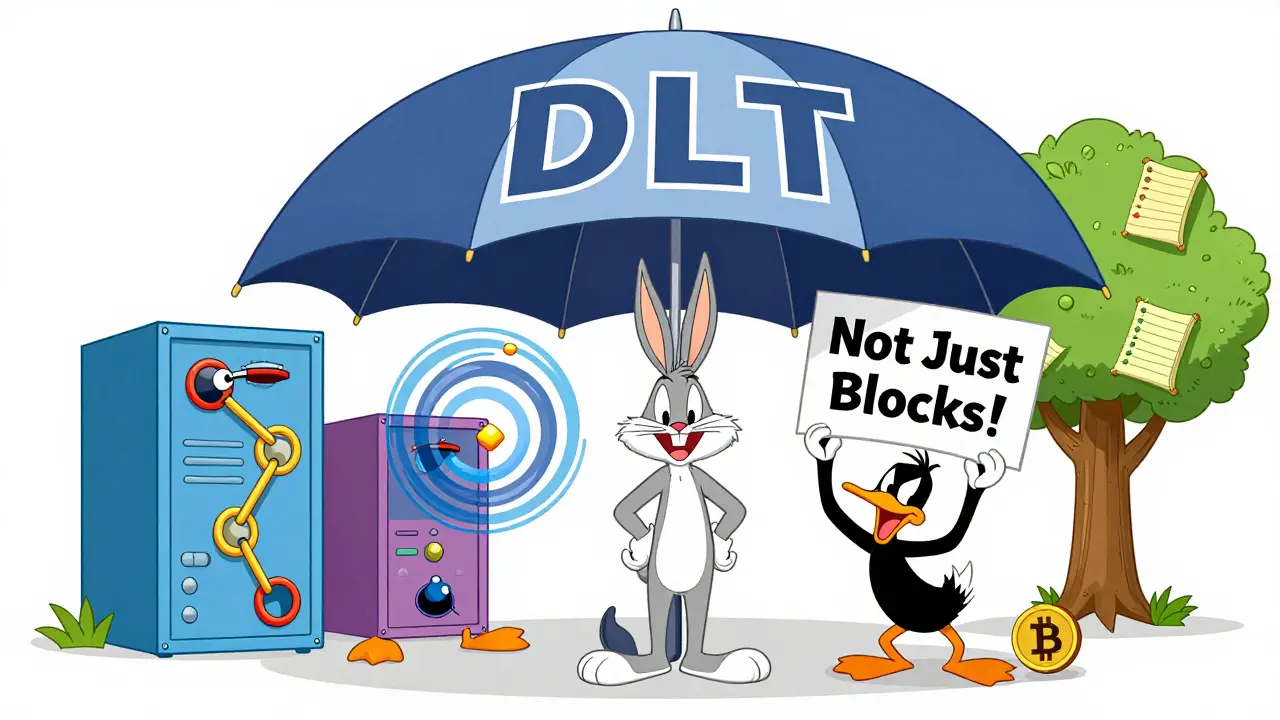
When people talk about blockchain, they often act like it's the only kind of distributed ledger out there. But that’s not true. Blockchain is just one way to build a distributed ledger - not the only way. The real story? Distributed Ledger Technology (DLT) is the big umbrella. Blockchain fits under it, but so do other systems that don’t use blocks or chains at all. If you’ve heard that blockchain and DLT are the same thing, you’ve been misled. Let’s clear this up.
What is Distributed Ledger Technology (DLT)?
Think of DLT as a shared, digital notebook that everyone in a network can see and update - but no one can erase or secretly change. It’s not stored on one server. Instead, copies live on dozens, even hundreds, of computers scattered across the globe. Every time someone adds new information, every copy gets updated at the same time. No middleman needed. That’s the core idea: decentralization.
DLT doesn’t care how the data is organized. It could be in blocks, in a graph, in a tree, or even in a web of connected entries. The only requirement? Everyone agrees on what’s true. That’s done through consensus - a set of rules that decides which updates get accepted. Some DLTs use Proof-of-Stake. Others use Practical Byzantine Fault Tolerance (PBFT). Some don’t even need tokens.
Enterprise DLT systems like R3 Corda and Hyperledger Fabric are built this way. They’re used by banks, shipping companies, and governments because they’re fast, energy-efficient, and let trusted partners collaborate without exposing data to the public. For example, Maersk’s TradeLens system uses Hyperledger Fabric to track shipping containers across 98 companies. No blockchain. Just DLT.
What is Blockchain?
Blockchain is a specific type of DLT that forces data into a chain of blocks. Each block holds a batch of transactions, a timestamp, and a cryptographic hash of the previous block. That hash is the magic glue. Change one transaction? The hash changes. That breaks the chain. Everyone knows something was tampered with.
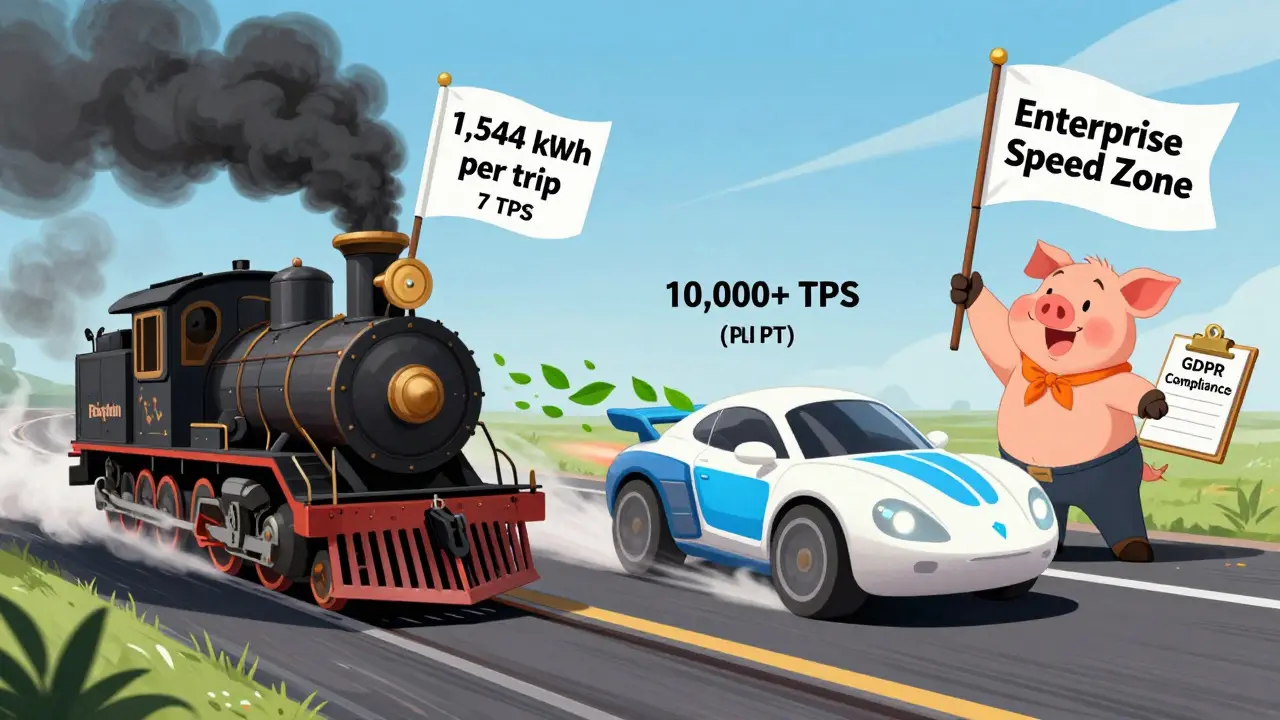
This design makes blockchain perfect for trustless environments - places where participants don’t know or trust each other. Bitcoin, Ethereum, and Litecoin all use blockchain. They rely on Proof-of-Work (PoW) or Proof-of-Stake (PoS) to validate transactions. PoW is famous for being slow and power-hungry. Bitcoin uses around 1,544 kWh per transaction. Ethereum used to be the same - until the Merge in 2022 cut its energy use by 99.95%.
Blockchain’s biggest strength? Immutability. Once something is added, it’s nearly impossible to remove. That’s why it dominates cryptocurrency. But that same strength becomes a weakness in business. If you need to correct a mistake - like a wrong payment or a recalled product - blockchain makes it hard. DLTs like Corda let you edit records with proper authorization. Blockchain? Not so much.
Key Differences Between DLT and Blockchain
Here’s the real breakdown. These aren’t minor tweaks - they’re fundamental design choices.
- Data structure: DLT can use any format - graphs, trees, directed acyclic graphs (DAGs). Blockchain? Always blocks in a linear chain.
- Consensus: DLT can use PBFT, Raft, or even manual approval. Blockchain almost always uses PoW, PoS, or similar mechanisms designed for anonymous networks.
- Speed: Bitcoin handles 7 transactions per second (TPS). Ethereum does 30. But non-blockchain DLTs like Hedera Hashgraph hit 10,000+ TPS. That’s why central banks building digital currencies (CBDCs) are choosing DLT - not blockchain.
- Energy use: PoW blockchains burn electricity. PBFT-based DLTs? They’re as efficient as a regular database. A 2022 IBM study showed PBFT uses 99% less energy than PoW.
- Access: Public blockchains are open to anyone. Enterprise DLTs are permissioned - only approved participants can join. That’s why 68% of banking pilots use non-blockchain DLT, according to Deloitte’s 2023 survey.
- Tokens: Bitcoin and Ethereum need native tokens (BTC, ETH) to pay for transactions. Enterprise DLTs like Corda or Fabric? They don’t need tokens at all. BBVA’s 2021 trade finance pilot ran without any cryptocurrency.
Real-World Use Cases: Where Each One Wins
Choosing between DLT and blockchain isn’t about which is better. It’s about which fits your problem.
Use blockchain if:
- You’re building a cryptocurrency or NFT platform.
- You need to prove ownership in a public, permissionless setting.
- Trust among users is near zero - like peer-to-peer payments.
- You’re okay with slower speeds and higher costs.
Use DLT if:
- You’re a bank, hospital, or logistics firm working with known partners.
- You need to process thousands of transactions per second.
- You need to edit or delete records legally (like GDPR compliance).
- You care about energy efficiency and cost.
Take supply chains. Walmart uses blockchain to trace food - but only because they want public transparency. If they were just sharing data with 10 trusted suppliers? They’d use Hyperledger Fabric. Faster. Cheaper. Cleaner.
Central banks are another example. The European Central Bank, China’s digital yuan, and Sweden’s e-krona all use non-blockchain DLT. Why? Because they need to settle millions of transactions daily. Blockchain can’t keep up.

What’s the Future? Convergence
Here’s the twist: the lines are blurring. Ethereum’s Merge didn’t remove blockchain - it just made it greener. R3’s Corda 5, released in March 2023, now lets users add cryptographic chaining for audit trails. It’s not blockchain. But it borrowed a feature from it.
Most new enterprise projects today are hybrids. They take the speed of DAG-based DLTs and layer on blockchain-style security where needed. According to 451 Research, 63% of new DLT deployments in 2023 mixed elements from both worlds.
Experts aren’t divided anymore. The real debate isn’t “blockchain vs DLT.” It’s “What’s the right tool for the job?” Dr. Leemon Baird of Hedera Hashgraph says non-chain systems will dominate enterprise use. MIT’s Dr. David Suter argues everything will eventually look like blockchain. The truth? Both are right - depending on who you ask.
Getting Started: Which Should You Learn?
If you’re a developer, your path depends on your goals.
- Learn blockchain if you want to build crypto apps, smart contracts, or DeFi platforms. Start with Solidity, Ethereum, and tools like Truffle or Hardhat.
- Learn DLT if you’re targeting enterprise software, finance, or logistics. Hyperledger Fabric and R3 Corda are the leaders. Both have complex setup guides - Fabric’s docs are over 1,200 pages - but offer real-world impact.
Developer surveys show Ethereum has better tools and community support. StackOverflow gives it a 4.7/5 for documentation. Hyperledger Fabric? 4.3/5. But for enterprise use, Fabric gets 4.6/5 stars from 147 companies on G2 Crowd. Why? Because it just works in controlled environments.
One thing’s clear: if you only know blockchain, you’re missing half the picture. The future belongs to people who understand both - and know when to use which.
Is blockchain the same as DLT?
No. Blockchain is a type of DLT, but not all DLTs are blockchains. DLT is the broader category - any decentralized, shared ledger. Blockchain is a specific design that chains data in blocks with cryptographic links. Think of it like this: all squares are rectangles, but not all rectangles are squares.
Why do banks use DLT instead of blockchain?
Banks use DLT because they need speed, privacy, and control. Blockchain is slow (30 TPS on Ethereum), public, and can’t easily fix mistakes. DLT systems like Hyperledger Fabric handle 4,500 TPS, let banks control who joins the network, and allow authorized edits. That’s critical for compliance, auditing, and daily operations.
Can DLT work without tokens?
Yes. Public blockchains like Bitcoin and Ethereum need tokens to pay for transactions (gas fees). But enterprise DLTs like Corda and Fabric don’t need any tokens at all. They rely on permissioned access and internal agreements to validate data. BBVA’s 2021 trade finance project ran successfully without cryptocurrency.
Which is more secure: DLT or blockchain?
Both are secure, but differently. Blockchain’s immutability makes tampering obvious - great for public trust. DLTs like Hyperledger use role-based access and PBFT consensus, which are harder to attack in closed networks. In practice, enterprise DLTs are often more secure for business use because they limit exposure and allow recovery. Blockchain’s strength is in anonymity; DLT’s is in control.
Is blockchain dead because of DLT?
No. Blockchain is alive and well - just in its lane. It dominates cryptocurrency, NFTs, and public trust systems. But for enterprise apps needing speed, privacy, and efficiency, DLT is the go-to. The two aren’t rivals - they’re tools for different jobs. The future isn’t one replacing the other. It’s both coexisting, each doing what it does best.
Bottom line: Stop treating blockchain as the only option. DLT is the bigger, smarter, and more flexible category. If you’re building something for the public, blockchain might be right. If you’re solving real business problems? Look beyond the chain.
Kaz Selbie
February 11, 2026 AT 09:33SAKTHIVEL A
February 12, 2026 AT 02:06Ace Crystal
February 12, 2026 AT 21:05Brittany Meadows
February 14, 2026 AT 14:48Desiree Foo
February 15, 2026 AT 18:19Keturah Hudson
February 16, 2026 AT 20:59Christopher Wardle
February 17, 2026 AT 04:37Grace Mugambi
February 18, 2026 AT 11:50krista muzer
February 19, 2026 AT 12:03Crystal McCoun
February 19, 2026 AT 15:19Elijah Young
February 20, 2026 AT 18:42John Doyle
February 21, 2026 AT 05:29Beth Trittschuh
February 22, 2026 AT 00:58kelvin joseph-kanyin
February 22, 2026 AT 03:17Robbi Hess
February 23, 2026 AT 11:22