

Most crypto investors are still debating whether tokens have any real use outside of speculation. But a specific sector is quietly changing the game by tying digital assets to tangible, physical infrastructure. This is DePIN, or Decentralized Physical Infrastructure Networks. If you've been wondering if this hype translates to actual returns, you're not alone. The sector has exploded from a niche experiment into a multi-billion dollar industry, but separating the gold from the noise requires more than just reading whitepapers.
The core promise of DePIN is simple: use blockchain incentives to build and maintain real-world networks like wireless coverage, data storage, and even street mapping. Instead of relying on massive corporate capital, these projects reward individuals for contributing their hardware-like a Wi-Fi hotspot or a GPU-to a shared network. For investors, this creates a unique opportunity to own a piece of the physical internet's backbone. However, it also introduces risks that pure software protocols don't face, such as hardware maintenance costs and regulatory hurdles. Understanding these dynamics is crucial before you allocate a single dollar.
What Actually Defines a DePIN Project?
Decentralized Physical Infrastructure Networks are blockchain-based systems that incentivize the creation and maintenance of physical infrastructure through token rewards. Unlike traditional tech companies that centralize control over servers or cell towers, DePINs distribute this ownership among thousands of users. The technology relies on three pillars: a secure ledger (usually Ethereum, Solana, or Polygon), smart contracts that automate payment verification, and a tokenomics model that pays providers for their resources.
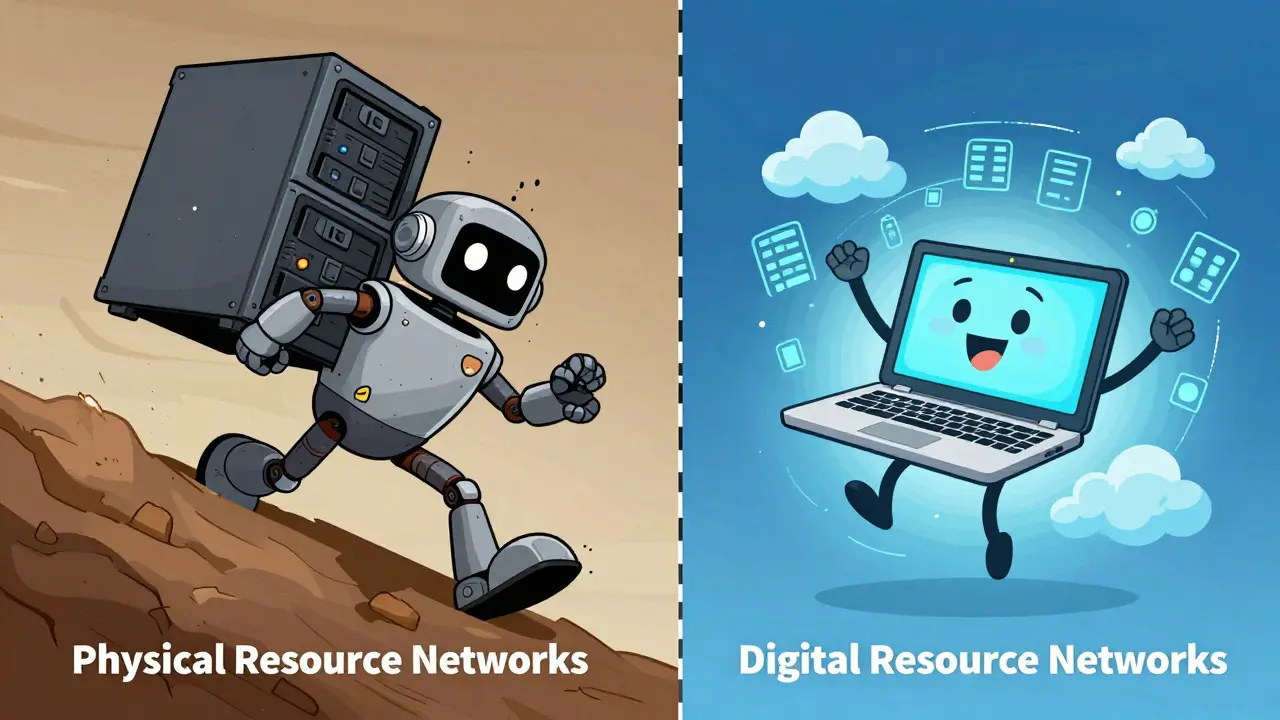
It helps to split these projects into two distinct buckets, as they behave very differently in the market:
- Physical Resource Networks (PRNs): These require you to buy and run actual hardware. Think of Helium for wireless connectivity or Hivemapper for street-level mapping. The barrier to entry is higher because you need to purchase devices ranging from $100 to $1,000, but the network effects tend to be stronger once established.
- Digital Resource Networks (DRNs): These leverage computing power you likely already have. Projects like Filecoin for decentralized storage or Render Network for GPU rendering fall here. Entry costs are lower since you're using existing hardware, making them accessible to a broader range of participants.
The distinction matters because PRNs often face "cold start" problems-they need enough nodes in a geographic area to be useful. DRNs, on the other hand, can scale globally almost instantly as long as there is demand for compute or storage. As an investor, knowing which side of the fence a project sits on will dictate your risk profile and expected timeline for returns.
The Numbers Behind the Hype: Market Growth and Adoption
You might be skeptical about whether these networks are actually being used. The data suggests they are gaining traction faster than most early-stage technologies. Between January 2022 and late 2023, the total market capitalization of DePIN projects grew by approximately 1,500%, reaching over $3.2 billion. To put that in perspective, the broader crypto market only grew by about 180% during the same period. This outperformance signals that investors are valuing the tangible utility of these networks highly.
Adoption metrics back up the price action. Helium, one of the pioneers, reached one million hotspots globally by mid-2023, doubling its footprint in just six months. More impressively, its mobile service expanded to cover over 1,800 U.S. cities, including rural areas that major carriers often ignore. Meanwhile, Hivemapper collected 1.5 billion street images, with its data now powering navigation tools for enterprise clients like Ford and Uber. These aren't just vanity metrics; they represent real revenue streams and user bases that support the underlying tokens.
However, growth isn't uniform. While top-tier projects see double-digit quarterly increases in usage, smaller networks struggle to find critical mass. The sector is currently the 7th largest in crypto by market cap, accounting for roughly 3.2% of the total market. This positions DePIN as a significant but still emerging category, offering high upside potential alongside the volatility typical of new sectors.
Reward Structures: What Can You Actually Earn?
Let's talk money. How do you make profit from a DePIN? There are two main ways: buying the token and hoping for appreciation, or actively participating by running hardware. Active participation offers immediate cash flow, but it comes with operational headaches.
Consider a user on Reddit who reported earning $120 monthly from a $400 Helium hotspot after electricity costs. That’s a 30% annualized return, which beats many traditional savings accounts. But it’s not guaranteed. As networks grow, rewards per node often dilute. Helium’s average daily earnings per hotspot dropped from $1.50 in early 2022 to around $0.35 by late 2023. So, while the initial ROI looks attractive, you need to monitor network density carefully. If too many neighbors add hotspots, your share of the pie shrinks.
For Digital Resource Networks, the math changes. Filecoin miners, for instance, faced stiff competition and high storage costs during the 2020-2021 bear market, leading some to exit. Render Network, however, saw a 47% quarterly jump in processing jobs, suggesting that demand for distributed GPU power is surging due to AI trends. Here, the key metric isn't just how much you earn per day, but whether the underlying demand for the service (rendering, storage, bandwidth) is growing. If the world needs more GPU power, your token position strengthens regardless of short-term reward fluctuations.
| Project | Type | Key Metric (2023) | Primary Risk |
|---|---|---|---|
| Helium | Physical (Wireless) | 1M+ Hotspots | Reward Dilution, Regulatory Spectrum Issues |
| Filecoin | Digital (Storage) | High Storage Capacity | Competition from Cloud Giants |
| Render Network | Digital (GPU Compute) | 1.2M Jobs/Q | Hardware Obsolescence |
| Hivemapper | Physical (Mapping) | 1.5B Images | Data Accuracy Verification |
Comparing DePIN to Traditional Infrastructure and DeFi
Why invest in DePIN when you could just buy shares in a telecom company or stick to standard DeFi protocols? The answer lies in cost efficiency and access. According to a16z Crypto, DePIN networks can deploy infrastructure at 30-50% lower costs than traditional providers. This is because they crowdsource the capital and labor, eliminating the overhead of large corporate structures.
When compared to Decentralized Finance (DeFi), DePIN offers a different kind of security. DeFi’s Total Value Locked (TVL) hit $82 billion in late 2023, but much of that value is circular-tokens locked in protocols to generate yield. DePIN, conversely, generates value from external users paying for services. A farmer using Helium to connect sensors, or a movie studio using Render for VFX, brings in fresh fiat currency or stablecoins. This external demand makes the ecosystem more resilient to internal token manipulation.
That said, centralized competitors aren't sleeping. Deutsche Telekom partnered with Helium in 2023, signaling that traditional giants see value in integrating decentralized elements rather than fighting them. This hybrid approach could accelerate adoption, as big companies bring reliability and brand trust to what was previously a scrappy, community-driven space.
Navigating Risks: Regulation and Tokenomics
No investment discussion is complete without addressing what could go wrong. The biggest headwind for DePIN is regulation. In the U.S., the FCC approved Helium’s spectrum usage in 2022, but imposed new requirements in 2023 that temporarily reduced hotspot earnings by 20%. If regulators decide that decentralized networks threaten national security or grid stability, they could impose heavy compliance costs that kill profitability.
Tokenomics is another minefield. About 60% of early DePIN projects had to modify their reward structures within 18 months of launch. This often means inflation spikes or reward cuts, which can spook investors. When evaluating a project, look for sustainable emission schedules. Ideally, annual inflation should drop below 5% after the initial distribution phase. If a project is printing tokens endlessly to attract users, you’re essentially subsidizing the network with your purchasing power.
There’s also the "verification problem." How does the blockchain know you’re actually providing good service? If a Filecoin miner stores junk data, the network suffers. Innovative oracle solutions are being developed to verify quality, but until this is perfected, there’s always a risk that the "real-world" aspect isn’t as robust as claimed. Always check for third-party audits or verifiable usage metrics, not just token price charts.

Strategies for Getting Started in 2026
If you’re ready to dive in, your strategy depends on your risk tolerance and technical skill. You don’t need to become a full-time node operator to participate. Here are three common entry points:
- Token-Only Positioning: Buy tokens on major exchanges like Binance or Coinbase. This is the lowest friction method. You bet on the network’s growth without dealing with hardware. It’s suitable for passive investors who believe in the long-term thesis.
- Digital Resource Contribution: Use your existing PC or server to contribute to DRNs like Render or Filecoin. This requires technical setup but no extra hardware purchase. It’s a good way to learn how the mechanics work while earning small amounts of tokens.
- Physical Infrastructure Deployment: Buy hardware for PRNs like Helium. This requires upfront capital ($100-$1,000) and ongoing electricity costs. It offers the highest potential for active income but carries the highest operational risk. Ensure you understand local regulations and network density in your area before buying.
Whichever path you choose, diversification is key. Don’t put all your eggs in one basket. Mix PRNs and DRNs to balance the risks of hardware dependency against the risks of compute commoditization. And keep an eye on the roadmap-projects like Helium migrating to Solana to cut transaction costs by 80% can be significant catalysts for token value.
Frequently Asked Questions
Is DePIN a good investment for beginners?
Yes, but start with token-only positions. Buying tokens on an exchange allows you to gain exposure without the complexity of managing hardware. Once you understand the basics, you can explore active participation in Digital Resource Networks, which have lower barriers to entry than Physical Resource Networks.
How do I verify if a DePIN project is legitimate?
Look for verifiable real-world usage metrics, such as API calls, service transactions, or third-party audits. Avoid projects that rely solely on token price action or vague promises. Check if the network has enterprise clients or organic consumer adoption, and review the tokenomics for sustainable inflation rates.
What is the difference between PRN and DRN?
PRNs (Physical Resource Networks) require physical hardware like routers or cameras, making them location-dependent. DRNs (Digital Resource Networks) utilize existing computing power for tasks like storage or rendering, allowing for global scalability without geographic constraints.
Are DePIN tokens taxed differently than regular crypto?
In many jurisdictions, including most U.S. states, infrastructure rewards are treated as taxable income when received, similar to staking rewards. You may also owe capital gains tax when selling the tokens. Always consult a tax professional familiar with crypto assets to stay compliant.
Can traditional companies beat DePIN projects?
Traditional companies have advantages in scale and reliability, but DePINs offer lower deployment costs and community ownership. Many experts predict a hybrid future where traditional firms integrate DePIN elements rather than replacing them entirely, creating a collaborative ecosystem rather than a zero-sum game.