
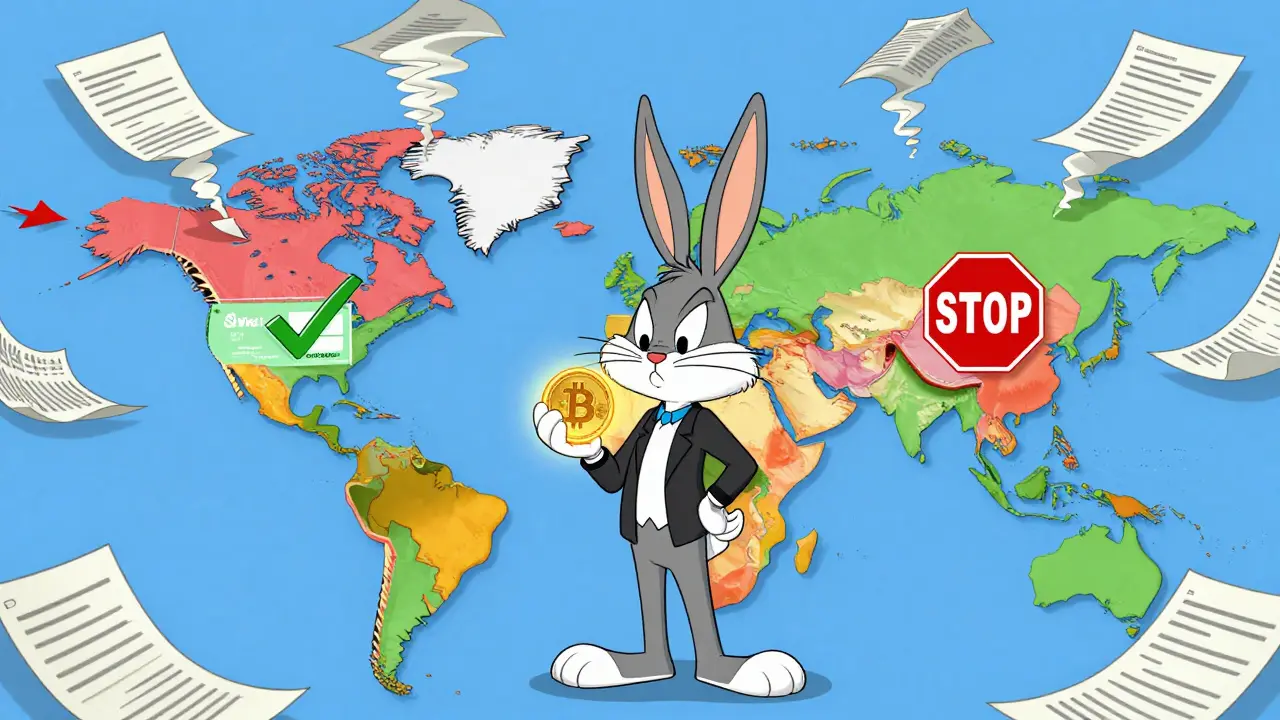
Is your cryptocurrency actually legal where you live? The answer depends entirely on which border you cross. As of mid-2026, there is no single global rulebook for digital assets. Instead, we have a fragmented patchwork of laws that ranges from welcoming open arms to strict criminal bans. This complexity creates real risks for traders, businesses, and everyday users who might accidentally break the law simply by holding Bitcoin.
Understanding this landscape isn't just about compliance; it's about protecting your wealth. A transaction that is perfectly normal in Singapore could be a felony in China or subject to heavy taxes in Brazil. With over 421 million people owning crypto globally, knowing the specific rules of your jurisdiction is the most important step in safe participation.
Quick Summary: Key Takeaways
- Crypto is legal in 45 countries, partially banned in 20, and generally banned in 10, according to the Atlantic Council’s 2024 tracker.
- Only two nations, El Salvador and the Central African Republic, have adopted Bitcoin as official legal tender alongside their local currencies.
- The EU’s MiCA regulation provides a unified framework for all 27 member states, setting strict rules for stablecoins and service providers starting late 2024.
- Taxation varies wildly: Portugal offers 0% tax on individual crypto gains, while Brazil taxes profits over BRL 35,000/month at 15%.
- Bans are often ineffective: High adoption rates persist in restrictive countries like Vietnam and Turkey due to economic pressures and peer-to-peer trading.
The Four Pillars of Crypto Regulation
To navigate this mess, experts categorize countries into four distinct buckets. Knowing which bucket your country falls into tells you everything you need to know about risk and opportunity.
- Legal and Regulated: These 45 countries welcome crypto but enforce strict rules. You can trade, hold, and use crypto, but exchanges must get licenses, and you likely owe taxes on profits. Examples include the United States, Switzerland, and Japan.
- Partially Banned: In these 20 nations, some activities are allowed while others are forbidden. For instance, you might be able to own Bitcoin, but banks cannot process payments for it. Namibia and Zimbabwe fit here.
- Generally Banned: Ten countries prohibit crypto entirely. Trading, mining, and sometimes even possession can lead to fines or jail time. China, Bolivia, and Bangladesh are prominent examples.
- Undecided or Unregulated: These jurisdictions haven’t passed specific laws yet. While not illegal, the lack of clarity means there’s no consumer protection if an exchange collapses. Angola and several African nations fall into this gray area.
This classification matters because "unregulated" doesn't mean "safe." It usually means you’re on your own. If a platform fails, there’s no government body to call for help.
Major Regions: How They Handle Digital Assets
Let’s look closer at how major economic zones approach cryptocurrency. The differences are stark and directly impact how you should operate.
European Union: The MiCA Revolution
Europe has moved from fragmentation to unity with the Markets in Crypto-Assets (MiCA) regulation. Expected to fully enter force in December 2024, MiCA creates a single set of rules for all 27 EU member states. This was a game-changer for businesses.
Before MiCA, a crypto firm had to navigate different laws in France, Germany, and Italy. Now, one license works everywhere. MiCA specifically targets stablecoin issuers, requiring them to back tokens with high-quality assets. It also imposes transparency obligations on all crypto asset service providers. Professor Hilary Allen from American University called this "the world's most comprehensive framework." For users, this means higher security standards but potentially higher fees as exchanges pass compliance costs-estimated at €250,000 initial setup for medium-sized firms-onto customers.
United States: A Regulatory Maze
The US remains a complex web of overlapping agencies. There is no single federal crypto law. Instead, you face three main regulators:
- SEC (Securities and Exchange Commission): Treats many altcoins as securities. If they classify your token as a security, you must register it, which is expensive and difficult.
- CFTC (Commodity Futures Trading Commission): Classifies Bitcoin and Ethereum as commodities. This allows for futures trading but offers less direct oversight of spot markets.
- IRS (Internal Revenue Service): Treats crypto as property. Every trade is a taxable event. You must report capital gains or losses, just like selling stocks or real estate.
In March 2025, the House Financial Services Committee approved the Clarity for Payment Stablecoins Act, aiming to create a federal framework for stablecoins. However, until this becomes law, the regulatory uncertainty persists. Starting an exchange here requires a Money Services Business (MSB) registration with FinCEN ($3,000-$10,000 fee) plus state-by-state money transmitter licenses, costing an average of $5,000 per state.
Asia-Pacific: Innovation vs. Control
Asia shows the widest divergence. On one end, Singapore and Japan are highly regulated hubs. Japan was the first G7 nation to recognize Bitcoin as legal property in 2017 and now requires exchanges to join a compensation fund to protect users against hacks.
On the other end, China maintains a total ban since September 2021. All transactions, trading, and mining are prohibited. Despite this, China remains a significant player in blockchain technology development, focusing on its own Central Bank Digital Currency (CBDC), the digital yuan, rather than decentralized cryptocurrencies.
Vietnam presents a unique case. It ranks #1 in the Chainalysis 2025 Global Crypto Adoption Index. Why? Because despite lacking clear comprehensive regulation, economic factors drive massive peer-to-peer usage. Users bypass formal channels, leading to high volumes but also high risk from scams.

Tax Implications: What You Owe the Government
Legality is only half the battle. Taxation is where many crypto holders make costly mistakes. Rules vary dramatically:
| Country | Tax Status for Individuals | Key Thresholds/Rules |
|---|---|---|
| Portugal | 0% Tax on Occasional Gains | Crypto is considered a "gambling" gain if held for personal investment, not professional trading. No capital gains tax for occasional sales. |
| Brazil | 15% Capital Gains Tax | Applies only if monthly sales exceed BRL 35,000 (~$7,000 USD). Smaller trades are tax-free. |
| Australia | No CGT on Personal Holdings | If held for more than 12 months and used personally (not business), no capital gains tax. Business income is taxed normally. |
| Estonia | Tax Exempt (Since 2024) | Eliminated crypto taxation entirely in 2024 after European Commission pressure regarding state aid rules. A major shift from previous policies. |
| United States | Capital Gains Tax | Taxed as property. Short-term gains (held <1 year) taxed as ordinary income. Long-term gains (held >1 year) taxed at lower capital gains rates. |
Note that Estonia’s exemption is rare. Most developed economies treat crypto similarly to stocks. Always consult a local tax professional, as laws change frequently. For example, Ukraine legalized crypto in March 2022 but imposed a $3,300 limit on foreign currency purchases using crypto, forcing users to rely on peer-to-peer platforms like LocalBitcoins to stay compliant.
Why Bans Rarely Work: The Adoption Paradox
You might think banning crypto would stop its use. Data suggests otherwise. Dr. Sheila Warren, CEO of the Crypto Council for Innovation, testified in February 2025 that "bans are generally ineffective."
The World Bank’s 2024 Financial Inclusion Report found a weak correlation (r=0.28) between regulatory restrictiveness and adoption rates. Look at Venezuela. Despite operating in a regulatory gray area and facing economic sanctions, it ranked 4th globally in crypto adoption in 2025. Why? Hyperinflation. When local currency loses value, people turn to Bitcoin as a store of value regardless of legality.
Similarly, Vietnam and Turkey top adoption charts despite ambiguous or restrictive regulations. People use crypto for remittances, savings, and speculation because traditional banking systems fail them. Bans push activity underground, making it harder for governments to monitor money laundering or collect taxes, ironically increasing systemic risk.

Practical Steps for Users and Businesses
So, what should you do? Here is a checklist based on your situation:
If You Are an Individual Trader
- Verify Local Laws: Check if your country is in the "Banned" list. If yes, avoid holding crypto on centralized exchanges linked to your bank account.
- Track Every Transaction: Use software like Koinly or CoinTracker. Even in places like Australia where personal holdings may be exempt, proving you didn't trade for profit requires records.
- Use Reputable Exchanges: Stick to platforms licensed in your jurisdiction. In the EU, ensure they comply with MiCA. In the US, check for FinCEN registration.
- Secure Your Assets: Don’t leave large amounts on exchanges. Use hardware wallets (Ledger, Trezor) for long-term storage. Regulations don’t protect you from hacks.
If You Are Starting a Crypto Business
- Choose Jurisdiction Wisely: Malta, Switzerland, and Singapore offer high approval ratings (78%, 72%, and 69% respectively among pros) due to clear regulatory paths.
- Budget for Compliance: Expect to spend 14.2 months on average to establish a compliant business in regulated markets. Factor in licensing fees, legal counsel, and AML/KYC systems.
- Monitor CBDC Developments: 92% of central banks are exploring digital currencies. Your business model must adapt to potential interoperability requirements between private crypto and state-issued digital cash.
The Future: Convergence and Clarity
The trend is moving toward greater regulation, not less. The International Organization of Securities Commissions (IOSCO) projects that by 2027, 75% of countries will have dedicated crypto regulations, up from 37% in 2024.
We are seeing a convergence of two worlds: private cryptocurrencies and Central Bank Digital Currencies (CBDCs). The World Economic Forum predicts 90% of central banks will issue some form of digital currency by 2030. This doesn't mean Bitcoin will disappear. Instead, we’ll likely see interoperable frameworks where private assets coexist with state-backed digital money, governed by clearer, albeit stricter, global standards.
For now, ignorance is not bliss. It’s liability. Stay informed, keep records, and respect the borders-both physical and digital.
Is Bitcoin legal in my country?
Check the Atlantic Council’s Cryptocurrency Regulation Tracker. As of 2024, crypto is legal in 45 countries, partially banned in 20, and banned in 10. Major bans include China, Bolivia, and Bangladesh. Most Western nations, including the US, UK, and EU members, allow it under strict regulation.
What is MiCA and how does it affect me?
MiCA (Markets in Crypto-Assets) is the EU’s unified crypto regulation. It ensures that any crypto service provider operating in Europe meets strict safety, transparency, and consumer protection standards. For users, this means safer exchanges but potentially higher fees. It applies to all 27 EU member states.
Do I have to pay taxes on cryptocurrency?
In most developed countries, yes. The US IRS treats crypto as property, taxing capital gains. Brazil taxes gains over BRL 35,000/month at 15%. Portugal currently offers 0% tax on occasional personal gains. Always consult a local tax expert, as rules vary significantly.
Can I mine Bitcoin legally?
Mining legality follows general crypto laws. It is banned in China and several other countries. In the US and EU, it is legal but subject to energy regulations and business licensing. Some countries like Kazakhstan have imposed restrictions due to grid strain.
Which countries are best for crypto businesses?
Malta, Switzerland, Singapore, and Japan are top choices due to clear regulatory frameworks and high industry approval ratings. The UAE and Dubai have also emerged as major hubs with dedicated free zones for blockchain companies.
Is it safe to use crypto in countries where it is banned?
No. Using crypto in banned jurisdictions carries legal risks, including fines or imprisonment. Additionally, without legal protection, you have no recourse if you are scammed or if an exchange freezes your funds. Peer-to-peer methods exist but carry high counterparty risk.
How does the FATF Travel Rule affect crypto transactions?
The FATF Travel Rule, updated in Feb 2025, requires exchanges to share sender and receiver information for transactions over $1,000. This reduces anonymity and increases privacy concerns for users, making it harder to move funds between unlinked accounts without revealing identity.