
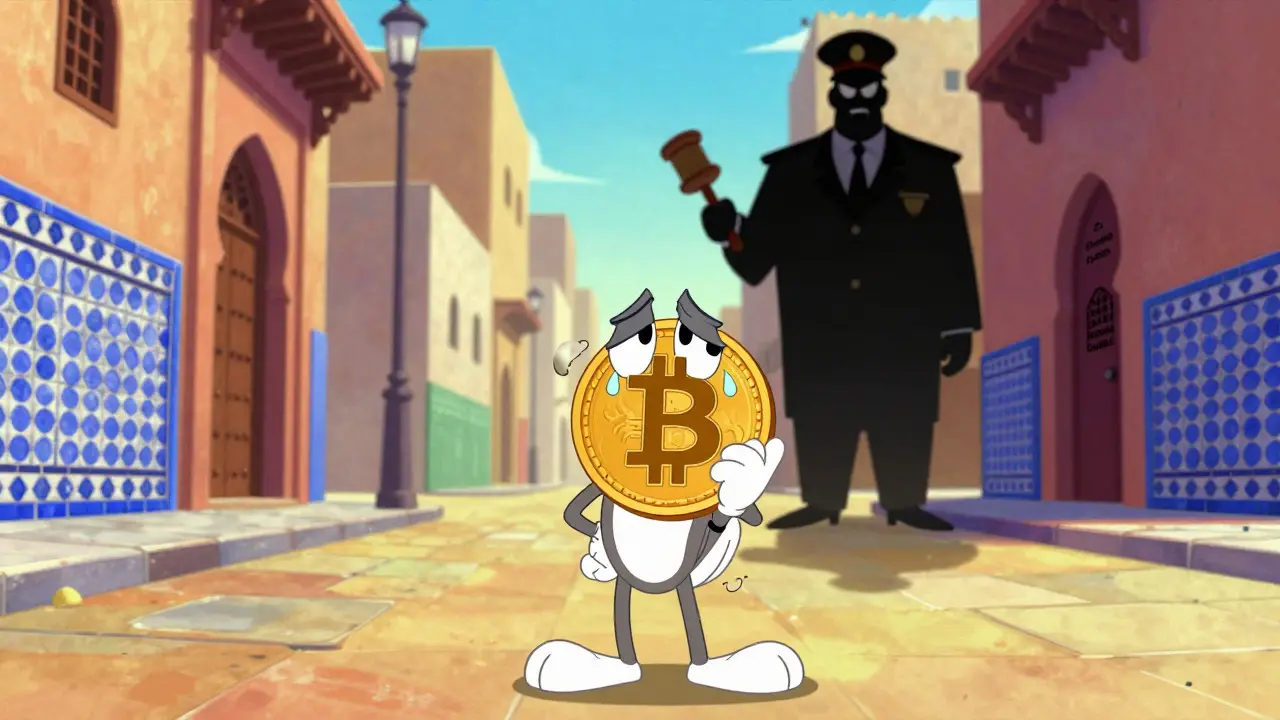
Imagine holding a digital wallet full of Bitcoin while standing on the streets of Casablanca. For years, this simple act was enough to trigger a legal headache under Moroccan law. The country’s approach to cryptocurrency has been anything but straightforward. It shifted from a hardline ban to a tightly controlled regulatory framework that treats unauthorized crypto activity as a violation of foreign exchange rules. If you are navigating this space in 2026, understanding these nuances is not just about avoiding fines; it is about knowing where the lines are drawn between innovation and illegality.
The core issue revolves around foreign exchange violations. Morocco maintains strict capital controls to protect its currency, the Moroccan Dirham (MAD). Historically, any movement of money outside traditional banking channels was viewed with suspicion. When cryptocurrencies entered the picture, authorities saw them as a backdoor for moving capital out of the country without oversight. This perspective shaped every regulation, fine, and policy decision from 2017 through today.
From Total Ban to Regulated Framework
To understand the current rules, you have to look at how we got here. In November 2017, Bank Al-Maghrib (BAM, the central bank of Morocco) issued a circular effectively banning all cryptocurrency transactions. The logic was clear: crypto assets were not recognized as legal tender, and using them violated existing foreign exchange regulations. This ban lasted for seven years. During this time, owning Bitcoin wasn't technically a crime for individuals, but trading it or using it for payments was considered an illegal financial operation.
However, the landscape changed dramatically in 2024 and 2025. Governor Abdellatif Jouahri announced that Morocco had completed a draft law to legalize and regulate cryptocurrency use. By 2025, this legislation was finalized. The new framework did not throw open the floodgates. Instead, it created a supervised market. Trading is now permitted, but only through platforms that hold a mandatory license from Bank Al-Maghrib. This shift marks a move from prohibition to control, ensuring that every transaction can be monitored for anti-money laundering (AML) purposes.
What Constitutes a Foreign Exchange Violation?
So, what exactly gets you in trouble? The definition of a violation hinges on two main factors: licensing and payment usage. Under the current 2025-2026 regulations, the following activities are considered violations:
- Using Unlicensed Platforms: Trading crypto on exchanges that do not have explicit approval from Bank Al-Maghrib is illegal. Even if the platform is reputable globally, if it lacks local authorization, your activity is unauthorized.
- Commercial Payments: You cannot use cryptocurrency to pay for goods or services within Morocco. Businesses must still use traditional banking channels for domestic transactions. Using crypto for cross-border settlements is also restricted unless done through approved institutional channels.
- Cryptocurrency Mining: This remains completely illegal. The government banned mining in 2017 due to concerns over energy consumption and capital flight associated with importing expensive hardware. This ban persists in 2026.
The distinction is crucial. Holding crypto might be tolerated in some contexts, but actively trading it without a licensed intermediary or trying to use it as a medium of exchange triggers foreign exchange enforcement mechanisms.
| Violator Type | Offense Severity | Financial Penalty (MAD) | USD Equivalent (Approx.) |
|---|---|---|---|
| Individual Citizen | Minor/First Offense | MAD 20,000 - MAD 100,000 | $2,000 - $10,000 |
| Corporate Entity | Standard Violation | Up to MAD 500,000 | Up to $50,000 |
| Any Entity | Repeat/Criminal Offense | Criminal Proceedings | N/A (Potential Imprisonment) |
The Role of Bank Al-Maghrib and Compliance
Bank Al-Maghrib acts as the gatekeeper for all legitimate crypto activity. To operate legally, a platform must obtain a license from BAM. This process involves rigorous checks. Platforms must implement robust Know Your Customer (KYC) procedures. They must also comply with Anti-Money Laundering (AML) and Countering the Financing of Terrorism (CFT) regulations.
For businesses, this means no more flying under the radar. Every transaction is monitored. Suspicious activity must be reported to financial authorities. Additionally, profits generated from cryptocurrency transactions are subject to a 15% capital gains tax. This tax must be properly declared to the Moroccan tax authorities. Failure to report these gains adds another layer of potential violation, combining foreign exchange infractions with tax evasion charges.
The Moroccan Capital Market Authority (AMMC) also plays a role, specifically overseeing Initial Coin Offerings (ICOs) and tokenized securities. These activities require separate regulatory approval to ensure they meet securities laws. This dual oversight by BAM and AMMC creates a comprehensive net designed to catch both retail traders and large-scale projects attempting to bypass regulations.

Why Mining Remains Illegal
You might wonder why trading is being regulated while mining stays banned. The answer lies in energy and capital flows. Mining operations require significant electricity and expensive imported hardware. From the government's perspective, this represents a drain on national resources and a channel for capital to leave the country without proper foreign exchange documentation.
In 2026, countries like Kazakhstan and Canada have become hubs for miners because they offer legal clarity and cheap energy. Morocco, conversely, wants to prevent large-scale operations that could strain its energy infrastructure. The ban ensures that no one sets up a massive farm in Rabat or Marrakech, siphoning power and sending profits abroad via untraceable crypto channels. For individual hobbyists, this means mining at home is technically prohibited, though enforcement varies based on scale and visibility.
The Rise of OTC and P2P Markets
Despite the regulations, demand for crypto in Morocco has not disappeared. In fact, projections indicate the market will reach nearly $280 million USD in 2025 and exceed that figure in 2026. How is this possible under such strict rules? The answer is the underground economy. Many Moroccans turn to Over-the-Counter (OTC) trading and Peer-to-Peer (P2P) platforms.
These methods allow users to buy and sell crypto directly with each other, often using cash or mobile transfers to obscure the trail from traditional banking monitors. While this helps enthusiasts participate in the global crypto economy, it carries risks. P2P trades lack the consumer protections of licensed exchanges. Scams are common, and if authorities detect patterns of large-scale P2P trading, participants can still face penalties for circumventing foreign exchange controls. It is a gray area where convenience meets compliance risk.

e-Dirham: The Government’s Alternative
While regulating private crypto, Morocco is building its own digital currency solution. Bank Al-Maghrib has launched the e-Dirham, a Central Bank Digital Currency (CBDC). The first pilot program focused on reducing cash dependence and streamlining domestic transactions. As of 2026, the central bank is conducting a second phase pilot in collaboration with the Central Bank of Egypt and the World Bank.
This second phase focuses specifically on cross-border transfers. This is significant because cross-border payments were a primary reason for the original crypto ban. By creating a state-controlled digital channel for international transfers, Morocco aims to address the efficiency issues of traditional banking while maintaining full oversight of capital flows. The e-Dirham offers a compliant alternative to private cryptocurrencies for businesses needing to send money abroad, potentially reducing the incentive to use unregulated crypto channels.
Practical Steps for Compliance in 2026
If you are an individual or business operating in Morocco, here is how to stay on the right side of the law:
- Use Only Licensed Exchanges: Verify that your trading platform holds a license from Bank Al-Maghrib. Do not assume global popularity equals local legality.
- Avoid Commercial Payments: Keep crypto in your wallet for investment purposes only. Pay for groceries, rent, or B2B services using traditional bank transfers or credit cards.
- Report Gains: Declare any profits from crypto sales to the tax authority. The 15% capital gains tax applies, and non-reporting can lead to audits.
- Steer Clear of Mining: Unless regulations change, avoid setting up mining rigs. The risk of equipment seizure and fines outweighs the potential rewards.
- Monitor Regulatory Updates: The framework is still evolving. Stay informed about announcements from BAM and the AMMC regarding ICOs and new licensing requirements.
Regional Context and Future Outlook
Morocco’s cautious approach contrasts with neighbors and other emerging markets. While some African nations have embraced crypto to boost financial inclusion, Morocco prioritizes monetary sovereignty. This strategy aligns with advice from international partners like the International Monetary Fund (IMF), which emphasizes stability during periods of economic transition.
Looking ahead, the success of the e-Dirham and the licensed exchange model will dictate future policies. If these systems prove effective in controlling capital flight while fostering fintech innovation, Morocco may gradually expand permissible uses. However, expect strict oversight to remain the norm. The goal is not to eliminate crypto, but to domesticate it within the bounds of Moroccan foreign exchange law.
Is owning Bitcoin illegal in Morocco in 2026?
Owning Bitcoin itself is not explicitly criminalized for individuals, but trading it or using it for payments requires going through a licensed platform approved by Bank Al-Maghrib. Engaging in unauthorized trading or using crypto for commercial transactions constitutes a foreign exchange violation.
What is the fine for crypto violations in Morocco?
Individuals face fines ranging from MAD 20,000 to MAD 100,000 (approx. $2,000-$10,000 USD). Corporate entities can be fined up to MAD 500,000 (approx. $50,000 USD). Repeat offenses may lead to criminal proceedings.
Can I mine cryptocurrency in Morocco?
No, cryptocurrency mining remains completely illegal in Morocco as of 2026. The ban is enforced to prevent energy waste and unauthorized capital outflows related to hardware imports and electricity costs.
How much tax do I pay on crypto profits?
Profits from cryptocurrency transactions are subject to a 15% capital gains tax. These gains must be properly reported to Moroccan tax authorities to avoid additional penalties for tax evasion.
What is the e-Dirham?
The e-Dirham is Morocco's Central Bank Digital Currency (CBDC) developed by Bank Al-Maghrib. It is designed to streamline domestic transactions and facilitate cross-border payments in a regulated environment, offering an alternative to private cryptocurrencies.
Are peer-to-peer (P2P) crypto trades legal?
P2P trades exist in a gray area. While widely used, they bypass licensed platforms and can be seen as circumventing foreign exchange controls. Participants risk penalties if authorities determine the activity violates AML or capital control regulations.
Which institutions regulate crypto in Morocco?
Bank Al-Maghrib (BAM) regulates trading platforms and enforces foreign exchange laws. The Moroccan Capital Market Authority (AMMC) oversees Initial Coin Offerings (ICOs) and tokenized securities.
When did Morocco start regulating cryptocurrency?
Morocco implemented a total ban in 2017. The regulatory framework allowing licensed trading was finalized in 2025, marking a shift from prohibition to supervised legalization.