
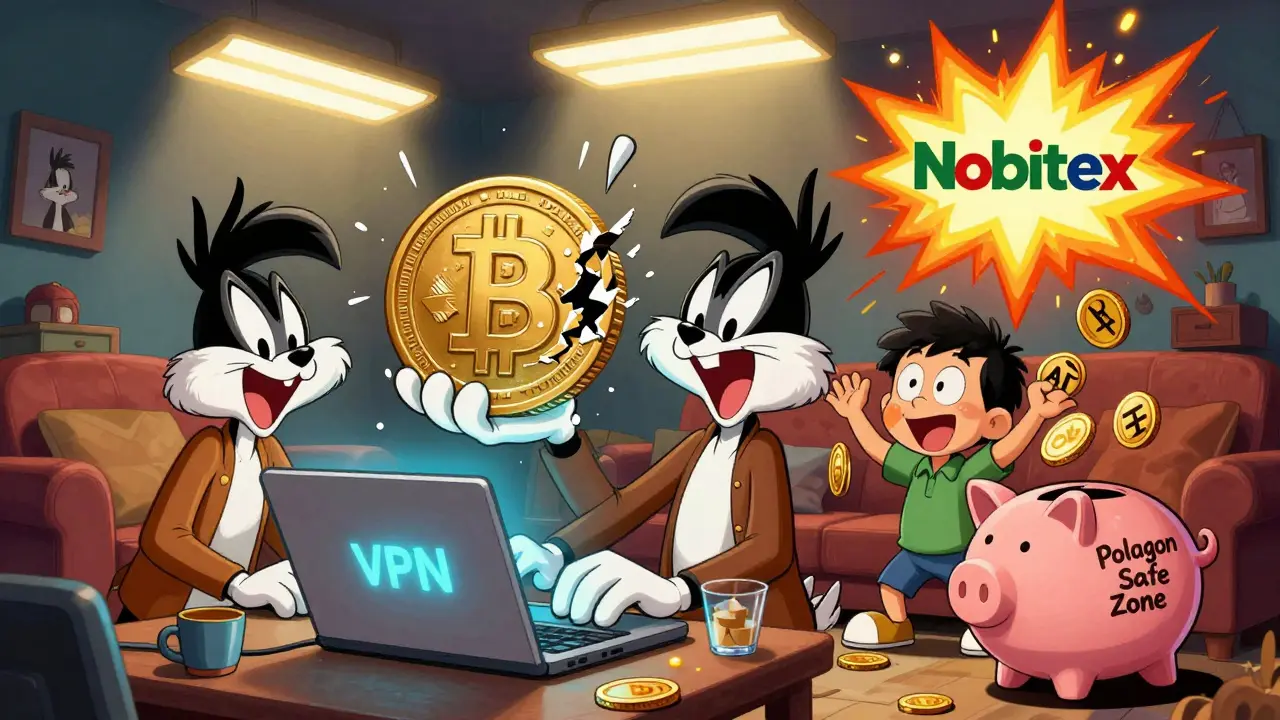
For millions of Iranians, cryptocurrency isn’t just an investment-it’s a lifeline. With banks cut off from global systems and inflation eating away at the rial, digital assets have become the most reliable way to store value, send money abroad, and access goods and services. But finding a crypto exchange that actually works for Iranian users isn’t easy. Many platforms ban them outright. Others freeze accounts without warning. And some, like Iran’s biggest exchange, Nobitex, have been hacked for over $90 million.
Nobitex: The Domestic Giant Under Fire
Nobitex handles more than 87% of all crypto trades inside Iran. With over 11 million users, it’s the go-to platform for buying Bitcoin, Ethereum, and stablecoins like USDT. But its dominance comes with serious risks. In June 2025, hackers stole $90 million from the exchange. That’s one of the largest crypto heists of the year. The breach exposed how fragile Iran’s domestic crypto infrastructure really is.Then in July, Tether froze 42 Iranian-linked wallet addresses tied to Nobitex. Many of those wallets had direct connections to IRGC-affiliated addresses flagged by international counter-terror finance units. Suddenly, users couldn’t access their USDT. Panic spread. People scrambled to swap their USDT for DAI on the Polygon network-faster, cheaper, and harder to freeze. The government even pushed the shift publicly, urging citizens to avoid USDT.
Nobitex isn’t just an exchange anymore. It’s a critical piece of Iran’s financial underground. But after the hack and the freezes, trust has cracked. Many users are now moving away from centralized platforms entirely-toward decentralized exchanges and peer-to-peer trading.
International Exchanges That Still Accept Iranian Users
While domestic options are risky, several international exchanges still let Iranians sign up and trade. They’re not perfect, but they offer better security, more coins, and lower fees. Here are the top five as of late 2025:- MEXC - Rated 9.1/10. Minimum deposit: $30. Supports 196 cryptocurrencies. Spot maker fee: 0.2%. Known for fast withdrawals and solid mobile app. Many Iranian traders use it for altcoins not available locally.
- Bitsgap - Rated 8.4/10. No minimum deposit. Supports 673 coins. It’s not a direct exchange-it’s a trading bot platform that connects to others like Binance and KuCoin. Great for automated strategies, but requires setup.
- XT.com - Rated 8.3/10. Minimum deposit: $10. Supports over 1,000 cryptocurrencies. Fee: 0.2%. Popular for its low fees and wide selection of obscure tokens.
- LATOKEN - Rated 8.0/10. Minimum deposit: $1. 475 coins. Maker fee: 0.49%. Offers staking and savings programs, which Iranian users rely on to earn passive income.
- CoinEx - Rated 7.9/10. Minimum deposit: $1. Also 475 coins. Same fee as LATOKEN. Has a simple interface and decent customer support in Persian.
These exchanges don’t openly advertise they serve Iran, but they don’t block Iranian IPs or IDs either. That’s the gray zone they operate in. Most require basic KYC-passport, selfie, sometimes proof of address. But they don’t ask where you live. Some users report account freezes after large deposits, especially if they’re using USDT. The key is to diversify.

KuCoin and BingX: The User-Friendly Alternatives
Not all rankings agree. CexFinder’s user-based ratings paint a different picture. KuCoin leads with a 4.4/5, praised for its easy fiat on-ramps (via P2P), beginner interface, and staking options. Iranian users love that they can earn interest on their crypto without locking it up for months. BingX scores 4.0/5, with strong futures and copy-trading tools-ideal for more experienced traders looking to follow top performers.XT.com drops to 3.7/5 here. CoinEx at 3.6/5. Tapbit? Just 2.7/5. Why the difference? Because these ratings come from real users who’ve been locked out, had withdrawals delayed, or lost funds to poor support. If you’re new, start with KuCoin. If you’re advanced, test Bitsgap or BingX. Avoid exchanges with ratings under 3.5 unless you’re comfortable with high risk.
What’s Changed in 2025? The Tax Law and the USDT Exodus
In August 2025, Iran passed its first crypto tax law. It’s called the Law on Taxation of Speculation and Profiteering. For the first time, profits from Bitcoin, Ethereum, or even meme coins are taxable-just like real estate or gold. The government isn’t trying to stop crypto. It’s trying to control it. To tax it. To bring it into the system.That’s why the USDT exodus happened. When Tether froze those 42 addresses, it wasn’t just a punishment-it was a signal. The Iranian government told users: Stop relying on USDT. It’s dangerous. It’s being watched. So people moved. Fast. To DAI on Polygon. To TRON-based stablecoins. To P2P trades with local traders. The market adapted overnight.
This is now the new reality: If you’re using crypto in Iran, you need at least two tools. One for trading (like MEXC or KuCoin). One for holding stable value (like DAI on Polygon). And you need to assume your account could be frozen at any moment.
What You Need to Know Before You Start
If you’re an Iranian citizen looking to use crypto exchanges, here’s what actually matters:- Don’t use USDT as your main stablecoin. It’s the most frozen. Use DAI instead.
- Use a VPN. Some exchanges block Iranian IPs. A reliable one (like ExpressVPN or NordVPN) helps you access platforms without triggering flags.
- Never keep large amounts on an exchange. Withdraw to a hardware wallet like Ledger or Trezor. If the exchange gets hacked or frozen, your coins are safe.
- Start small. Test with $20-$50 first. See how fast withdrawals go. See if they ask for extra documents.
- Use P2P for fiat. Local sellers on Paxful or LocalBitcoins still trade rials for crypto. It’s slower, but it works when bank transfers fail.
Also, avoid any exchange that asks for your Iranian ID card number or a selfie with your passport in Persian. That’s a red flag. They’re collecting data for compliance-and that data could get handed over.
The Bigger Picture: Crypto as Survival
Iran isn’t unique. Venezuela, Nigeria, and Russia have similar stories. But Iran’s crypto ecosystem is one of the most advanced in the Global South. It’s not just about avoiding sanctions. It’s about surviving an economy that no longer works.People use crypto to pay for medicine. To send money to family overseas. To buy software, courses, and tools blocked by Western sanctions. The exchanges aren’t heroes. They’re just the only tools left. And as long as the banking system stays locked, crypto will keep growing-even if it’s messy, risky, and constantly under pressure.
The next big shift won’t be a new exchange. It’ll be more Iranians moving to DeFi-using Uniswap, SushiSwap, or Curve directly from their wallets. No KYC. No freeze risk. Just code. That’s the future. And it’s already here.
Can Iranian citizens legally use crypto exchanges?
Yes, but it’s legally gray. Iran doesn’t ban cryptocurrency outright. In fact, it taxes it. The government allows trading and mining, but it doesn’t protect users. Exchanges can freeze accounts, and the state can seize assets. There’s no legal recourse if something goes wrong.
Which exchange has the lowest fees for Iranian users?
MEXC and XT.com both charge 0.2% for spot maker trades-the lowest among major platforms. Bitsgap doesn’t charge direct fees but takes a cut from the exchanges it connects to. Avoid platforms charging over 0.4% unless they offer unique features like staking or copy trading.
Is Nobitex safe to use in 2025?
Not really. After the $90 million hack and government-linked freezes, trust has collapsed. Many users still use it because it’s the only option for rial-to-crypto trades, but it’s no longer secure. Keep small amounts only, and move funds to international exchanges or cold wallets as soon as possible.
Why is USDT being avoided by Iranian users?
Because Tether froze over 42 Iranian-linked addresses in July 2025, many tied to Nobitex. USDT is centralized and controlled by a U.S.-based company. If your wallet is flagged, your funds vanish overnight. DAI, on the other hand, is decentralized and runs on blockchain networks like Polygon, making it harder to freeze.
Do I need a VPN to use crypto exchanges in Iran?
Not always, but it helps. Some exchanges block Iranian IPs. Others allow access but monitor activity more closely. A good VPN masks your location and reduces the chance of your account being flagged or restricted without warning. Choose a provider with strong privacy policies-no logs, no data sharing.
Can I withdraw crypto profits to my bank account in Iran?
No. Iranian banks are still cut off from global systems. You can’t directly convert crypto to rials through a bank. Your only options are P2P trades with local buyers or using exchanges that support rial withdrawals (like Nobitex). Even then, fees are high and delays are common.
What’s the best way to store crypto if I live in Iran?
Use a hardware wallet like Ledger Nano X or Trezor Model T. Store your private keys offline. Never keep large amounts on an exchange-even if it’s reputable. If you need quick access for trading, keep a small balance on MEXC or KuCoin, but move the rest to cold storage immediately.
Naman Modi
December 25, 2025 AT 04:34Dan Dellechiaie
December 25, 2025 AT 21:51Radha Reddy
December 27, 2025 AT 14:37Shubham Singh
December 27, 2025 AT 20:32Vijay n
December 28, 2025 AT 12:45Collin Crawford
December 30, 2025 AT 00:05Tristan Bertles
December 30, 2025 AT 12:10Helen Pieracacos
January 1, 2026 AT 07:06Dustin Bright
January 2, 2026 AT 12:51Melissa Black
January 3, 2026 AT 22:52chris yusunas
January 5, 2026 AT 18:22Mmathapelo Ndlovu
January 6, 2026 AT 14:46Tyler Porter
January 8, 2026 AT 05:55Rishav Ranjan
January 9, 2026 AT 04:29Sophia Wade
January 10, 2026 AT 02:46Brian Martitsch
January 11, 2026 AT 04:34Ashley Lewis
January 12, 2026 AT 10:47