
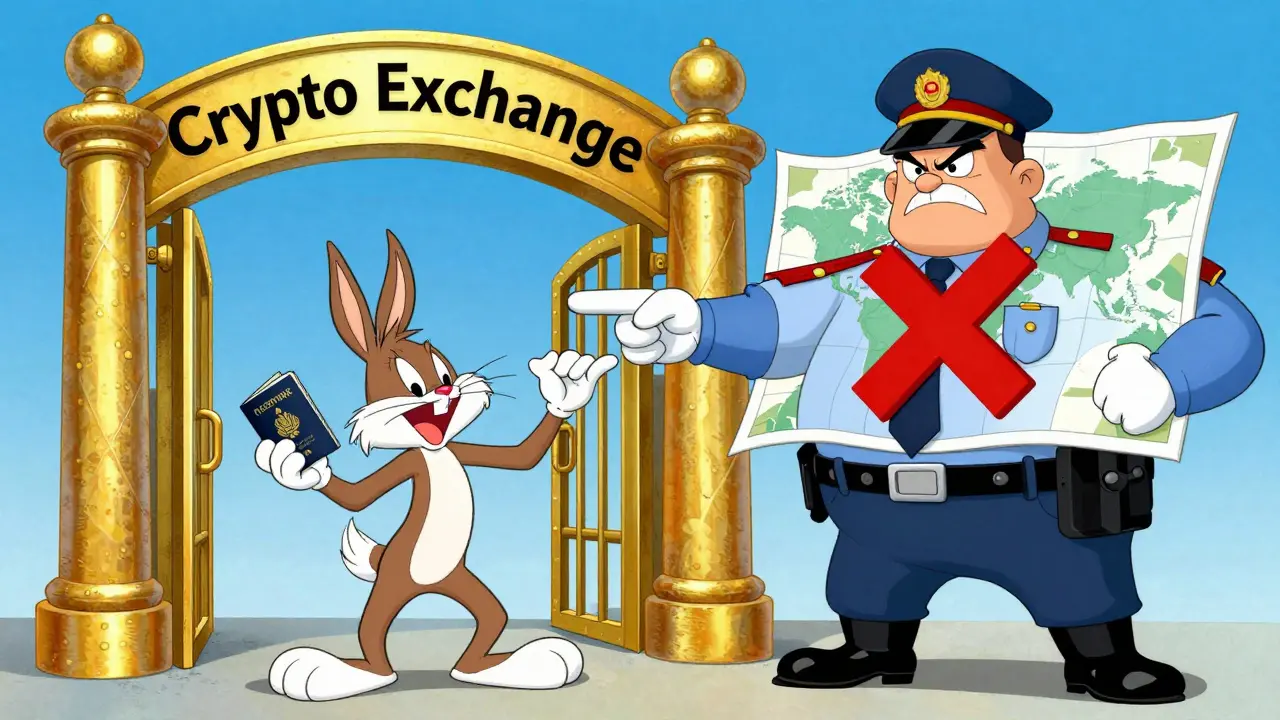
Ever tried to sign up for a trading platform only to be told your country isn't supported? It's a frustrating experience that highlights a massive gap in the "borderless" promise of blockchain. While the market is booming-projected to hit $122.63 billion by 2032-where you can actually trade depends entirely on the laws of the land you're standing in. crypto exchange availability isn't about technical glitches; it's about a complex tug-of-war between global finance and national sovereignty.
The Great Divide: Why Some Regions Are Blocked
If you've noticed that certain apps simply won't load or accounts get flagged during KYC (Know Your Customer) checks, you're seeing regulatory friction in action. Governments aren't usually against the technology itself, but they are terrified of money laundering and tax evasion. This is why a platform might be available in Singapore but completely banned in another jurisdiction.
The most striking example is the United States. The U.S. regulatory environment is a minefield of overlapping agencies. You have the SEC (Securities and Exchange Commission) arguing that many tokens are securities, and the Treasury Department focusing on sanctions. This friction led to a historic turning point in November 2023, when Binance-the world's largest exchange-agreed to a $4 billion settlement to essentially exit the U.S. market to avoid further legal battles.
Regional Strategies: The "Silo" Approach
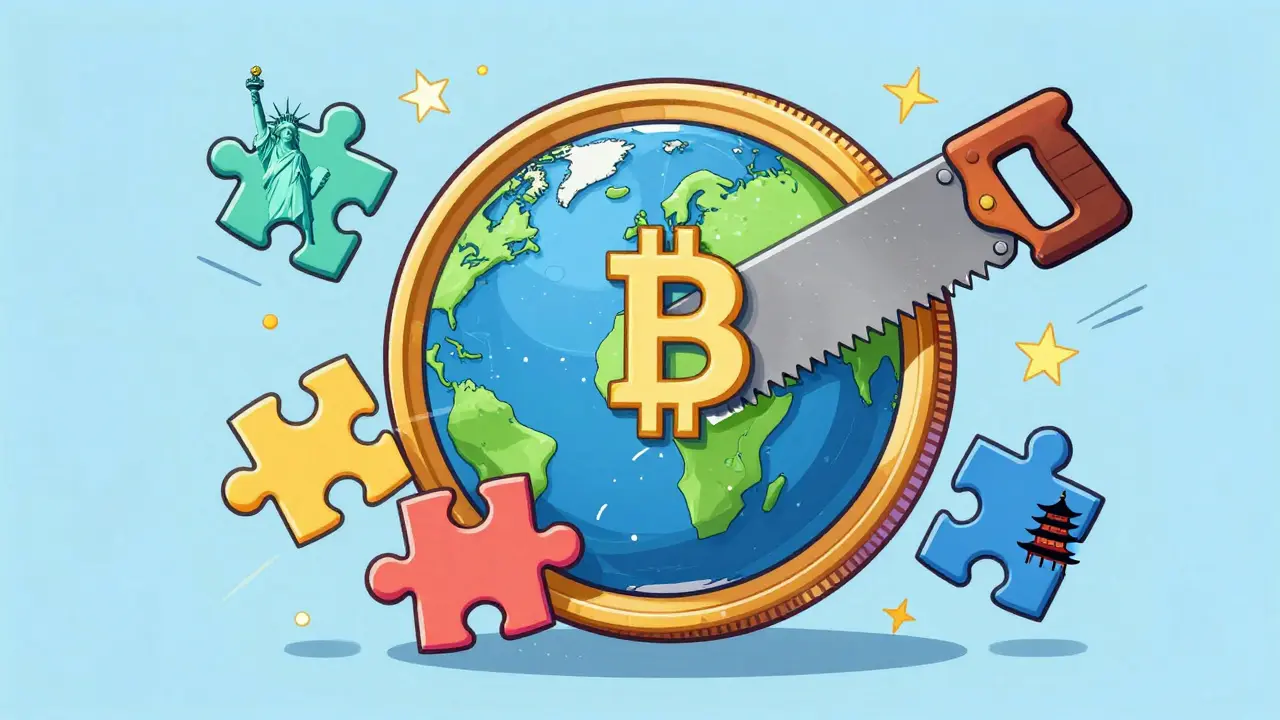
To survive, global giants don't just leave a region; they split themselves into smaller, compliant pieces. This is the "Silo" strategy. Instead of one global app, they create regional variants. This ensures that if one version of the platform gets hit by a local law, the rest of the global business stays safe.
| Global Entity | Regional Variant | Primary Reason for Split | Market Focus |
|---|---|---|---|
| Binance | Binance.US | Compliance with U.S. federal/state laws | American Residents |
| Binance | Binance TR | Turkish financial regulations | Turkey |
| Binance | Binance.KR | South Korean real-name account laws | South Korea |
Hotspots of High Availability and Adoption
While the U.S. and Europe are bogged down in paperwork, other regions are sprinting ahead. According to the 2025 Global Crypto Adoption Index, Eastern Europe is currently the wild west of retail adoption. Ukraine ranks first globally, followed by Moldova and Georgia. In these areas, crypto isn't just a speculative bet; it's often a tool for financial survival or a way to move money during political instability.
Asia remains a powerhouse, with Hong Kong SAR, Vietnam, and Singapore showing massive engagement. What's interesting is that adoption is highest in places where traditional banking is either broken or too restrictive. For instance, Venezuela and Yemen rank highly because people need a way to protect their savings from hyperinflation.
The Shift Toward Spot Trading and DeFi
Most people entering the market today stick to Spot Trading, which is simply buying an asset and owning it immediately. It's intuitive and carries less risk than complex derivatives. In 2025, spot trading accounts for roughly 61.3% of the market share. Because it's simpler, regulators find it easier to approve, meaning spot-only platforms often have wider regional availability than those offering high-leverage futures trading.
However, as regional restrictions tighten, more users are migrating toward DeFi (Decentralized Finance). Since DEXs (Decentralized Exchanges) operate via smart contracts on a blockchain rather than through a company with a physical office, they are incredibly hard to "block" regionally. You can't easily serve a cease-and-desist letter to a piece of code.

How to Navigate Availability Issues
If you find yourself in a region with limited exchange options, you have a few paths. First, check for licensed local exchanges. While they might have fewer coins than a giant like Gate.io or Bitget, they offer the legal safety of being recognized by your government.
Second, look for P2P (Peer-to-Peer) marketplaces. These allow you to buy directly from another person in your city, bypassing the corporate structure of an exchange. Third, explore non-custodial wallets. While these aren't exchanges, they allow you to hold your own assets, meaning no one can freeze your account based on where you live.
The Future of Global Access
We are moving toward a world of "Regulatory Clarity." In the past, exchanges operated in a gray area, hoping they wouldn't get caught. Now, the winners are the ones who embrace transparency. Platforms that implement biometric verification and multi-factor authentication are finding it much easier to enter restrictive markets.
Expect a trend where "Global" exchanges continue to fragment into regional hubs. You might see more specialized platforms focusing solely on the ASEAN region or the EU, each tailored to specific tax laws and consumer protection rules. The goal isn't a single global app, but a network of connected regional portals.
Why is my exchange account restricted by region?
Restrictions usually happen because the exchange doesn't have a legal license to operate in your specific country or state. To avoid fines from regulators like the SEC, platforms use IP tracking and KYC documents to block users from restricted jurisdictions.
Are decentralized exchanges (DEX) available everywhere?
Technically, yes. Since DEXs run on blockchain code without a central headquarters, they are accessible to anyone with an internet connection and a wallet. However, some countries may block the websites (front-ends) used to access these protocols.
What is the difference between Binance and Binance.US?
Binance.US is a separate legal entity created specifically to comply with United States laws. It offers a more limited selection of coins and features compared to the global Binance platform to ensure it doesn't violate U.S. financial regulations.
Which regions have the highest crypto adoption right now?
Currently, Eastern European nations like Ukraine, Moldova, and Georgia lead the way. Asian markets, particularly Vietnam and Hong Kong, also show very high levels of exchange usage and retail adoption.
Can I use a VPN to bypass regional exchange restrictions?
While a VPN hides your location, most reputable exchanges require KYC (identity verification) with a government ID. If your ID is from a restricted region, a VPN will not help you open an account, and attempting to bypass these rules can lead to your funds being frozen.
Samson Selleck
April 12, 2026 AT 07:47The systemic friction here is just a symptom of the legacy financial paradigm attempting to exert hegemony over a distributed ledger architecture. It's essentially a jurisdictional arbitrage game where CEXs are merely playing the role of compliant vassals to the SEC's regulatory theater. If you actually look at the liquidity flows, the 'Silo' approach is nothing more than a desperate attempt to mitigate the risk of total asset seizure while maintaining a facade of global accessibility. The cognitive dissonance of calling this "borderless" while relying on biometric verification is honestly staggering. We are seeing the institutionalization of crypto, which effectively kills the cypherpunk ethos in favor of a sanitized, corporate-approved version of digital assets. The irony is that by seeking 'regulatory clarity,' these platforms are just building bigger walls for the state to manage. It's a complete capitulation of the original vision of Bitcoin.
Tyler Webb
April 13, 2026 AT 01:26It's really a tough spot for a lot of people when they just want to save their money and find the doors locked :)
Omotola Balogun
April 14, 2026 AT 11:31P2P is where the real action is in Nigeria anyway. Most of these big exchanges just make things too complicated with there KYC processes. Just find someone trusty in your circle and swap it's much faster.
Rob Mitchell
April 15, 2026 AT 08:08Non-custodial wallets are definitely the way to go for long-term safety.
James Bone
April 16, 2026 AT 15:19Imagine thinking a 'Silo' strategy is a win for the user. It's just a way for companies to keep their pockets full while pretending to follow the law. This whole 'regulatory clarity' thing is a joke told by suits to keep us in line. The only real way out is the total abandonment of centralized custody. Why would anyone trust a company that changes its Terms of Service based on which country's government is yelling the loudest this week? It's pure theater.
Alan Seiden
April 17, 2026 AT 07:51Typical garbage. Britain should just ignore all this American nonsense and set its own gold standard for the world to follow. Why are we even discussing the SEC's failures as if they matter to us?
Hope Johnson
April 18, 2026 AT 21:25I think it is profoundly interesting to consider how the very nature of our identity is being renegotiated through these digital gateways. When we speak of "regional restrictions," we aren't just talking about software blocks, but the fundamental tension between our physical existence-tied to a piece of land-and our digital existence, which aspires to be universal. It's a poetic struggle, really, as we attempt to bridge the gap between the ancient concept of the nation-state and the modern reality of a global network. By moving toward DeFi, we aren't just escaping a regulator; we are asserting a new form of digital citizenship that doesn't require a passport to exist or a government's permission to participate in the global economy. This evolution reflects a deeper human desire for autonomy and a world where value can flow as freely as information, regardless of the arbitrary lines drawn on a map centuries ago.
william manes
April 20, 2026 AT 10:50USA #1! 🇺🇸 Keep those regulators strong so we can wipe out the scams! 🚀💪
Aaliyah BROTHERS
April 20, 2026 AT 18:29Wake up people!!! The "Silo" strategy is just a fancy word for surveillance hubs!!! They want every single cent tracked and taxed by the deep state... it's all a trap to freeze your assets once the "great reset" hits!!! DON'T TRUST THE KYC!!!
Heather Warren
April 22, 2026 AT 07:43I find that using a hardware wallet combined with a DEX is usually the most straightforward way to handle this.
Kieran Smith
April 23, 2026 AT 22:45man i tried use a vpn once and almost got my acount locked lol. its not worth the risk for sure
ssjuul z
April 24, 2026 AT 04:12Just gotta keep pushing forward and learning how these tools work! (^_^) We'll get there!
Rima Dinar
April 26, 2026 AT 01:31If you are someone who is just starting out and feeling overwhelmed by all these regional blocks, please know that it is completely normal to feel frustrated because the learning curve is steep and the legal jargon is confusing, but if you just take it one step at a time and perhaps start with a very small amount of money in a local exchange that you trust, you will eventually find your way into the broader ecosystem of decentralized finance where these boundaries simply don't exist in the same way.
Artavius Edmond
April 27, 2026 AT 19:41Everything is just a phase, man. Eventually the tech will just win and the laws will have to catch up. Chill out and enjoy the ride.
Jason Davis
April 29, 2026 AT 17:01DEXs are amazing but the slippage on low volume pairs can be a realy pain in the neck.
Agnessa Dale
May 1, 2026 AT 09:39It's great to see more people getting into the space!
Prasanna Shembekar
May 2, 2026 AT 04:22my heart breaks for people in venezuela man that is so sad
Jessie Tayaban
May 4, 2026 AT 02:43omg i can't believe how much of a mess the US gov made with binance!!! its just so wild lol
Amanda Faust
May 5, 2026 AT 11:06kyc is just a way for exchanges to sell your data to third parties
Rebecca Violette
May 7, 2026 AT 00:22i just want my money back from the last crash i cant even deal with this
Emily H
May 8, 2026 AT 06:38The transition toward a network of connected regional portals appears to be a pragmatic evolution for the industry.
Swati Sharma
May 8, 2026 AT 23:38Utilizing liquidity pools on a DEX can definitely mitigate the issues found in CEX regional silos through automated market makers.
Stanly Hayes
May 10, 2026 AT 12:02Stop whining about the rules and just use what's available! Either play the game or get out of the way!
Lane Montgomery
May 11, 2026 AT 20:29Which exchange are you using specifically?
Adam Auksel
May 12, 2026 AT 15:22Let's all try to help each other find the safest routes! 🌟 Every bit of shared knowledge makes the community stronger! 🚀