
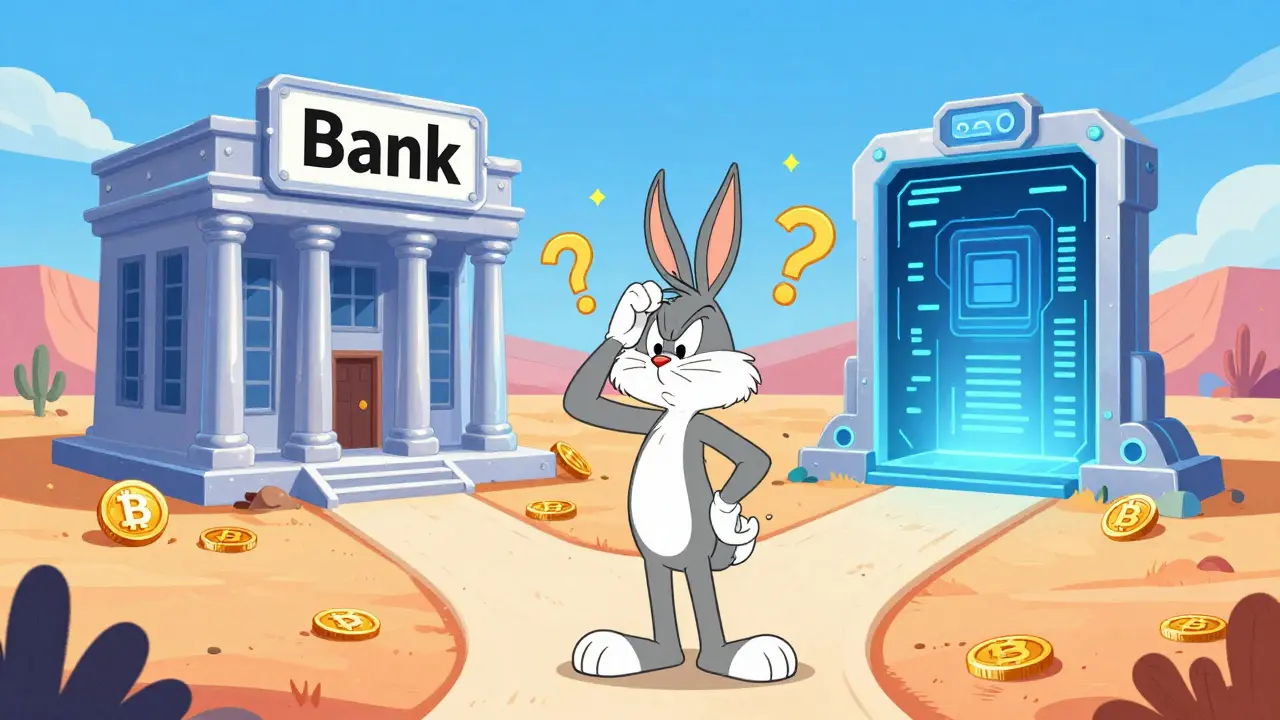
If you've been searching for a Coin Bank Exchange review, you've probably noticed something strange: the search results don't actually lead to a single company with that name. It's a common trap. People often mix up the names of a few different things-usually combining the giant exchange Coinbase is a high-level cryptocurrency exchange and custodian founded in 2012 that serves as a primary gateway for retail and institutional investors to buy and sell digital assets with the various "crypto-friendly" banks that handle the actual cash deposits.
Here is the reality: there is no major, reputable platform called "Coin Bank Exchange." If you see a website using that exact name promising guaranteed returns or asking for an upfront deposit to "unlock" your funds, be extremely careful. It's likely a scam. What most people are actually looking for is a review of Coinbase or a way to link their traditional bank account to a crypto platform. Let's clear up the confusion and look at how the actual industry leader, Coinbase, stacks up in 2026.
Key Takeaways for Your Crypto Journey
- Clarification: "Coin Bank Exchange" isn't a real entity; you're likely thinking of Coinbase.
- Best For: Total beginners who want a safe, SEC-registered environment.
- Biggest Downside: High retail fees compared to professional-grade alternatives.
- Security: Top-tier, with 98% of assets kept in cold storage.
- Verdict: Great for your first $1,000, but move to Advanced Trade as you grow.
Is it Coinbase or a Crypto Bank?
The confusion usually stems from how we move money. To buy Bitcoin, you need a bridge between your traditional bank (fiat) and the digital market. Coinbase isn't a bank, but it partners with institutions like Customers Bank, which provides the infrastructure to move billions of dollars in fiat volume monthly. When you link your account via Plaid, you're using a secure connector that lets the exchange talk to your bank.
If you are looking for a place to "bank" your crypto, you're looking for a Centralized Exchange (CEX). These platforms hold your keys for you, making it easy to log in with a password, but meaning you don't have total control over your coins. For those who want total control, a non-custodial wallet is the way to go, though that's a different conversation entirely.
How Coinbase Actually Performs
Since Coinbase is the most likely target of your search, let's look at the hard numbers. As of late 2025, the platform supports 235 different cryptocurrencies. If you're just starting, the interface is a dream. You can set up an account and pass the AI-powered ID verification in under 24 hours. In fact, most new users master the basics of trading in about three hours.
However, that convenience comes at a price. If you use the "simple buy" feature with a debit card, you might pay up to 3.99% in fees for larger purchases. Contrast that with Kraken, where card fees typically hover between 0.90% and 1.50%. If you're trading $100, a few bucks doesn't matter. If you're trading $10,000, those fees become a massive leak in your portfolio.
| Feature | Coinbase | Kraken | Binance US |
|---|---|---|---|
| Ease of Use | Exceptional | Moderate | Moderate |
| Retail Card Fees | 1.49% - 3.99% | 0.90% - 1.50% | ~0.50% |
| Asset Selection | 235 Tokens | High | Moderate |
| Custody Security | 98% Cold Storage | Very High | High |
The Security Trade-off
One thing Coinbase does better than almost anyone is regulatory compliance. They are an SEC-registered broker-dealer. For a regular person, this means they aren't likely to vanish overnight with your money. They maintain a $255 million crime insurance policy through Lloyd's of London, which provides a safety net that most smaller exchanges simply don't have.
But there's a catch: regulations mean less privacy. In 2024, they implemented strict transaction monitoring to satisfy the SEC. While this makes the platform more attractive to big institutional investors-increasing their business account count to over 14,300-it can feel invasive for the casual user. Also, keep an eye on your 2FA. Some users report getting locked out of their accounts due to two-factor authentication glitches, which can be a nightmare when the market is crashing and you need to sell.
Making Money While You Wait: Staking
If you aren't planning to trade every day, you can use Staking. This is essentially like earning interest on your crypto by helping secure the network. For example, you can earn around 3.8% APY on Ethereum or 6.2% on Solana.
Just be aware that Coinbase takes a cut. Their fee deductions for staking range from 25.25% to 35%. You're paying for the convenience of not having to run your own technical node. If you're okay with a "set it and forget it" approach, it's a great way to grow your holdings without constantly checking the price charts.

Common Pitfalls and How to Avoid Them
The biggest mistake new users make is sticking to the "Simple Trade" interface for too long. Once you move past your first few hundred dollars, switch to Advanced Trade. This platform offers much lower fees (sometimes 0% for high-volume makers) and gives you the tools to actually manage your entries and exits.
Another issue is the "volatility lag." During massive price swings-like the Bitcoin halving event-Coinbase has historically struggled with outages. In April 2024, over a million users were locked out during a 12% price swing. To avoid this, don't keep all your eggs in one basket. A common strategy among experienced traders is to use Coinbase for the easy on-ramp and a secondary exchange like Kraken for more stable altcoin trading.
Is Coin Bank Exchange a legitimate company?
No. There is no widely recognized or regulated cryptocurrency exchange by that exact name. It is likely a confusion between Coinbase and the banks they partner with. If you find a site with this name asking for money, it is likely a scam.
How high are the fees on Coinbase?
Fees vary wildly. ACH transfers are often 0%, but instant card purchases can range from 1.49% up to 3.99% depending on the amount. To get the lowest rates, use the Advanced Trade platform instead of the basic "Buy/Sell" buttons.
Is my money safe on Coinbase?
Compared to most exchanges, yes. They are SEC-registered, keep 98% of assets in cold storage across 17 locations, and carry a significant crime insurance policy. However, the only 100% safe way to store crypto is in a hardware wallet that you control personally.
What is the difference between a crypto exchange and a crypto bank?
An exchange (like Coinbase) is a marketplace where you swap one asset for another. A crypto-friendly bank (like Customers Bank) is a traditional financial institution that allows you to move USD into and out of those exchanges without freezing your account.
How long does it take to verify a Coinbase account?
Most users complete the verification process within 24 hours thanks to their AI-driven ID system. You'll need a valid government ID and a smartphone for the biometric checks.
Next Steps for New Investors
If you're just getting started, start small. Deposit a a few dollars via ACH to avoid the high card fees. Spend a little time in the "Coinbase Earn" section to understand what you're actually buying. Once you feel comfortable and your portfolio grows, look into a hardware wallet (like Ledger or Trezor) to move your long-term holdings off the exchange. Remember: the goal is to use the exchange as a door, not as a permanent home for your coins.
Matthew Wright
April 8, 2026 AT 19:45Actually... the point about the "Simple Trade" fees is spot on!!! I've seen so many people just bleed money because they didn't realize they were paying a massive premium for a button that basically does nothing... a few clicks into the Advanced Trade tab and you're saving a ton of cash!!!
Diana Martín Prieto
April 9, 2026 AT 01:54It's really important to emphasize the hardware wallet part for anyone starting out. While the security at these big exchanges is great for a transition point, getting your own seed phrase is the only way to truly own your assets. If you're feeling overwhelmed, just start with a small amount in ACH as suggested, then take your time reading up on Trezor or Ledger. You've got this!
Deepak Prusty
April 10, 2026 AT 14:30Everyone knows the 2FA issues are a systemic failure of their UX design, not just a glitch.
Arwyn Keast
April 12, 2026 AT 11:22Typical American-centric analysis. The liquidity pools and regulatory arbitrage over here in the UK make these US-based CEXs look like toy stores. If you're actually trying to optimize for slippage and avoid the bloated retail fees of a corporate monolith, you'd be looking at a completely different set of order books. Absolute rubbish to suggest a one-size-fits-all approach for the entire English-speaking market.
Manisha Sharma
April 13, 2026 AT 09:12omg the sheer ignorance of thinking a corporate entity is 'safe' is just... wow. it's all just a simulation of value anyway. the real truth is in the decentralized ether where the elite can't touch us. you guys are just following the breadcrumbs of a failed financial system lol
Earnest Mudzengi
April 14, 2026 AT 06:28WAKE UP!! The SEC registration is just a front for the deep state to track every single Satoshi you move! They want your KYC data so they can freeze your assets the second you stop complying with the narrative. It's all a honey-pot operation to lure in the retail sheep before the Great Reset hits. Don't let the 'insurance policy' fool you, it's just a way to keep you from panicking while they consolidate power!!
Alexandra Lance
April 14, 2026 AT 12:46Imagine actually believing the government can 'regulate' a decentralized asset 😂. The irony is just delicious. They'll 'protect' your money right into a frozen account until you provide your firstborn's social security number 🙄💅✨
Hugo Lopez
April 16, 2026 AT 02:05Let's try to keep things positive everyone! 😊 I think it's just a matter of finding the right balance between convenience and security. Thanks for the clear breakdown of the fees!
sekhar reddy
April 17, 2026 AT 16:22Brooo the outages during halving are actually insane!!! I almost had a heart attack trying to login when the price was dipping 12% in minutes!! Totally unacceptable for a 'leader' in the industry!! 😱
Taylor Meadows
April 18, 2026 AT 09:32You're all just chasing ghosts. Most of you don't even understand the basic psychology of a bear market, let alone how to manage a portfolio. You'll probably lose it all and then come back here crying for a 'safe' bank.
Carol Prates
April 19, 2026 AT 05:05I actually tried to switch to Advanced Trade and it was such a nightmare at first! Like, why make the basic version so easy and the cheaper version look like a cockpit from a 747? It's almost like they want us to keep paying those 3.99% fees! Just a little friendly warning to anyone else: it takes a minute to get used to the interface!
alex rodea
April 19, 2026 AT 11:26Just take it slow and you'll be fine. Use the simple tools until you feel good, then move up. You can do it!
Trish Swanson
April 20, 2026 AT 14:20Fees are way too high... why use them???
Suzanne Robitaille
April 20, 2026 AT 16:01There is such a poetic tragedy in the way we trust these digital vaults with our hopes for the future. We trade our privacy for a promise of stability, yet the very nature of crypto was to break those chains. It's a beautiful, messy contradiction of the modern age!
Siddharth Bhandari
April 21, 2026 AT 22:46For those in India, be mindful that the tax implications on CEX trades are quite heavy now. Even if the platform fees are low, the 30% tax on virtual digital assets can eat your gains. It's often better to move funds to a private wallet and only bring them back when you're ready to exit to fiat.
Patty Levino
April 22, 2026 AT 16:45I've had a similar experience with 2FA lockouts. It's incredibly stressful, but usually, if you just stay calm and open a ticket, they get you back in within a few days. Just make sure you have your backup codes written down on actual paper!
Evan Borisoff
April 23, 2026 AT 14:44The sheer audacity of suggesting that a non-SEC registered entity could possibly provide the same level of institutional-grade fiduciary security is laughable given the current geopolitical landscape where US dollar hegemony is the only thing keeping these markets from a total systemic collapse into primordial chaos. If you aren't leveraging a regulated on-ramp with a proper US-based custodial framework, you're essentially gambling in a casino where the house isn't even in the same time zone as your legal recourse, and frankly, anyone opting for a 'moderate' security exchange over a gold-standard regulated one is simply inviting a catastrophic liquidation event that will leave them bankrupt and bewildered in a world that only respects hard-coded regulatory compliance and verified capital flows.
Brooke Herold
April 25, 2026 AT 06:28It's interesting to see how different cultures approach the risk of these platforms. In some regions, the distrust of banks is so high that the risk of a CEX is actually seen as a safer bet than a traditional savings account.
akash temgire
April 26, 2026 AT 09:33The fee structure is unacceptable. Immediate rectification is required.