

Imagine you’re offered 10,000 tokens in a new blockchain project. Sounds great - until you realize you won’t get a single one until you’ve worked for a full year. And even then, you won’t get the rest until the next three years pass, one chunk at a time. That’s the reality of cliff vesting and linear vesting - two systems that control how and when you actually receive your crypto equity. They’re not just paperwork. They shape whether you stay or leave, whether you feel valued, and whether the project survives its toughest early months.
What Cliff Vesting Really Does
Cliff vesting is a hard stop. No tokens until the cliff. No partial payments. No exceptions. In a standard setup, you get nothing for the first 12 months - not a single token. Then, on day 365, the entire first chunk (often 25% of your total grant) drops into your wallet all at once. After that, the rest unlocks monthly or quarterly over the next three years. This isn’t just a technical rule. It’s a psychological lever. Companies use it to filter out short-term takers. If someone joins a startup, sees the cliff coming, and leaves after 11 months? They walk away with nothing. That’s the point. The cliff acts like a contract: prove you’re in for the long haul before you get paid. Smart contracts on blockchains like Sui or Ethereum enforce this automatically. They check the current timestamp against the cliff date. If it’s not passed? Tokens stay locked in a vesting wallet. No one can touch them. No admin can override it. That’s why crypto projects love cliff vesting - it’s trustless, transparent, and tamper-proof. But here’s the catch: that first year is brutal. Employees report feeling like they’re working for free. No equity. No visible reward. Some leave anyway - not because they’re lazy, but because they can’t afford to wait. Startups in competitive markets like Solana or Arbitrum ecosystems sometimes shorten the cliff to six months to stay attractive. Others, especially those building core infrastructure, use 18-month cliffs for senior roles. It’s not one-size-fits-all.How Linear Vesting Works in Practice
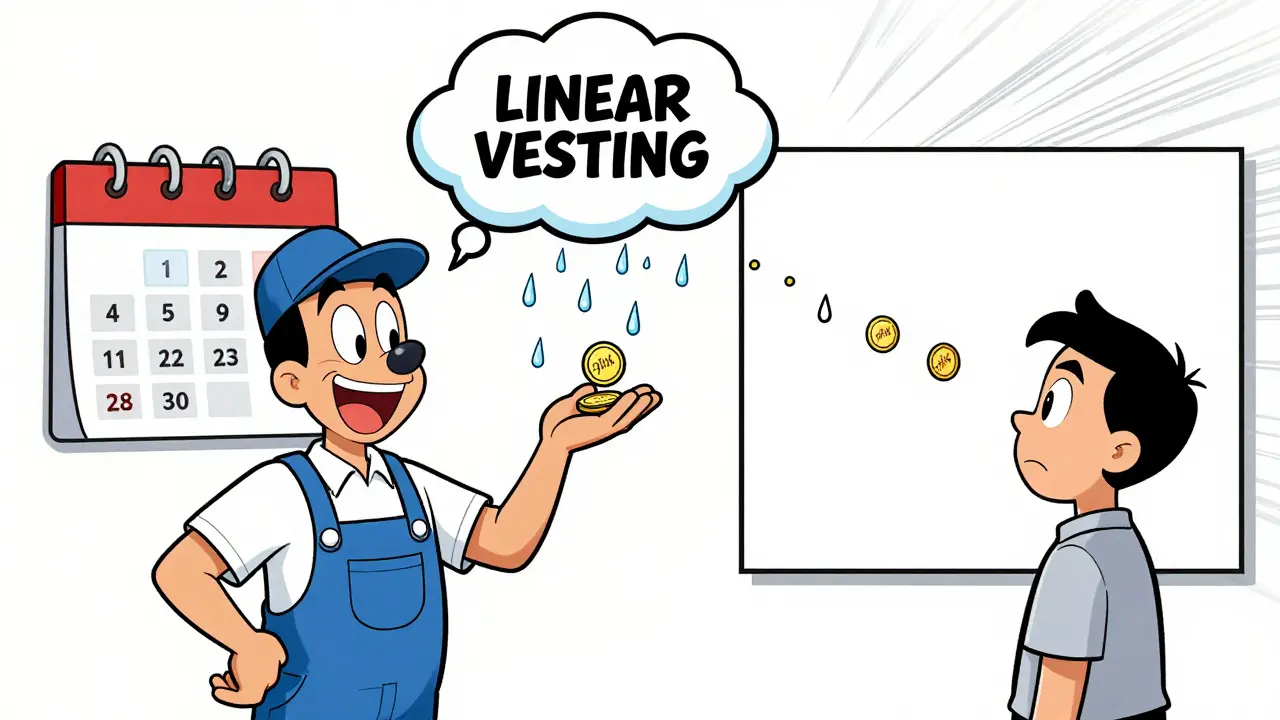
Linear vesting is the opposite of drama. It’s steady. Predictable. Math-based. Take a four-year linear vesting schedule with no cliff. You get 10,000 tokens. Each year, you unlock 2,500. That’s 208.33 tokens per month. Every single month. No surprises. No cliff. No waiting. You can track your progress on a spreadsheet or in your wallet app - and you’ll see your balance grow, slowly but surely. This model is common in more mature blockchain projects, DAOs, or teams that don’t need to force early retention. It’s also popular with advisors who contribute over time but aren’t full-time employees. Instead of tying their payout to tenure, they get a steady drip based on months served. The math is simple: divide total tokens by the number of months in the vesting period. For a 48-month schedule, that’s 10,000 ÷ 48 = 208.33 per month. Done. No triggers. No binary gates. Just continuous accrual. The upside? Employees feel rewarded regularly. They can plan. They know their net worth is growing. That builds loyalty. It also reduces the shock of losing everything if you leave early - because you’ve already earned something. The downside? It doesn’t stop people from jumping ship after six months. If you’re on a linear schedule and leave at month 10, you still get 2,083 tokens. For a company that just spent six months training you, that might feel like a loss. That’s why many projects combine linear vesting with a cliff - to get the best of both worlds.The Hybrid Model: Why 4-Year with 1-Year Cliff Dominates
The most common setup in crypto startups isn’t pure cliff or pure linear. It’s a hybrid: four-year vesting with a one-year cliff. Here’s how it breaks down:- Year 1: 0% until day 365, then 25% unlocks immediately
- Year 2: 2.08% per month (25% total)
- Year 3: 2.08% per month (25% total)
- Year 4: 2.08% per month (25% total)
- It protects the company from early exits - if you leave before year one, you get nothing.
- It keeps people motivated after the cliff - because they’re always earning more, month after month.
When to Use Cliff Vesting vs Linear Vesting
Choosing between them isn’t about what’s better - it’s about what fits your situation. Use cliff vesting when:- You’re a new blockchain startup with high turnover risk
- You’re hiring for critical roles (core devs, protocol designers)
- You want to signal long-term commitment to investors
- You’re using smart contracts and want zero admin overhead
- You’re a DAO with steady, part-time contributors
- You’re compensating advisors who deliver value over time
- You’re in a talent-scarce market and need to be more attractive
- You want employees to feel equity growth every month
Real-World Impact: What Employees Actually Feel
Talk to anyone who’s been through a cliff vesting period, and you’ll hear two stories. The first: “I almost quit at month 10. I was burning out. But then the cliff hit. Suddenly, I had real skin in the game. I stayed.” The second: “I left after 14 months. I had 25% vested, but the next 25% was coming in monthly. I didn’t want to wait three more years for the rest. I took a job with a linear schedule.” That’s the tension. Cliff vesting creates loyalty through pressure. Linear vesting creates loyalty through trust. In crypto, where projects rise and fall fast, the psychological weight of waiting matters. A 2024 survey of 300 blockchain developers found that 68% said they’d leave a project if the cliff was longer than 12 months. Only 12% would leave if they got monthly unlocks from day one. That’s not just about money. It’s about feeling seen. About knowing your effort is recognized - not just rewarded at the end of a long tunnel.
Smart Contracts and Automation: The Crypto Advantage
One reason cliff and linear vesting work so well in blockchain is automation. Unlike traditional equity plans that need HR systems and spreadsheets, crypto vesting runs on code. A smart contract can be programmed to:- Lock tokens in a vesting wallet
- Release 25% on a specific timestamp (cliff)
- Release 1/36 of the remaining balance every month (linear)
- Send notifications to the user when tokens unlock
What’s Next for Vesting in Crypto?
The future isn’t just about time-based vesting anymore. Some projects are testing milestone-based vesting: you get tokens when you ship a feature, hit a user target, or complete a security audit. That’s great for contributors who aren’t full-time employees. Others are experimenting with back-loaded vesting: you get less early, more later. That’s for projects betting on long-term growth - like Layer 2 chains or decentralized identity platforms. And then there’s reverse cliffs: you get 25% upfront, then the rest unlocks over three years. That’s rare, but it’s popping up in high-demand roles where companies need to compete with Web2 salaries. The trend? More customization. Less defaulting. More data-driven decisions. Teams are starting to track: Who stays? Who leaves? When? Why? And they’re adjusting vesting schedules based on real behavior - not just templates.Final Thought: It’s Not About the Tokens. It’s About the Trust.
Cliff vesting says: “Prove you’re serious.” Linear vesting says: “We trust you from day one.” The best blockchain projects don’t just pick one. They choose the structure that matches their culture, stage, and goals. And they communicate it clearly - because when people understand the rules, they play by them. Don’t just copy the 4-year with 1-year cliff because it’s popular. Ask: What kind of team do we want to build? What kind of trust do we want to earn? The answer will tell you which vesting model fits.What happens if I leave before the cliff date?
If you leave before the cliff date - say, after 11 months on a one-year cliff - you forfeit all your tokens. No partial payout. No exceptions. This is intentional: the cliff is designed to prevent short-term hires from walking away with equity. Smart contracts enforce this automatically, so even the project founders can’t override it.
Is linear vesting fairer than cliff vesting?
It depends on your perspective. Linear vesting feels fairer because you earn something every month - no all-or-nothing stakes. But cliff vesting can feel fairer to the company, especially if early employees leave quickly. The fairness question isn’t just about math - it’s about alignment. If the team values long-term commitment, cliff vesting rewards that. If the team values transparency and steady growth, linear vesting wins.
Can I negotiate my vesting schedule?
Yes - especially for senior roles, founders, or advisors. While most junior hires get the standard 4-year with 1-year cliff, top talent often negotiates shorter cliffs (6 months), faster linear schedules, or milestone-based unlocks. The key is to show how your contribution reduces risk or accelerates growth. If you’re bringing critical skills or connections, you have leverage.
Why do crypto projects prefer smart contract vesting?
Because it’s transparent, automated, and trustless. Unlike traditional equity plans that rely on HR departments and legal paperwork, crypto vesting runs on code. Tokens are locked in a wallet until the schedule triggers. Anyone can verify the contract on a blockchain explorer. This reduces fraud, delays, and disputes - all major pain points in Web2 compensation systems.
Are there alternatives to time-based vesting?
Yes. Milestone-based vesting is growing fast, especially for advisors and contractors. Instead of unlocking tokens over time, you earn them when you complete specific goals - like launching a feature, hitting a user target, or passing a security audit. This aligns rewards directly with output, not just hours worked. Some DAOs are even testing performance-based vesting tied to on-chain metrics like protocol usage or revenue generated.