
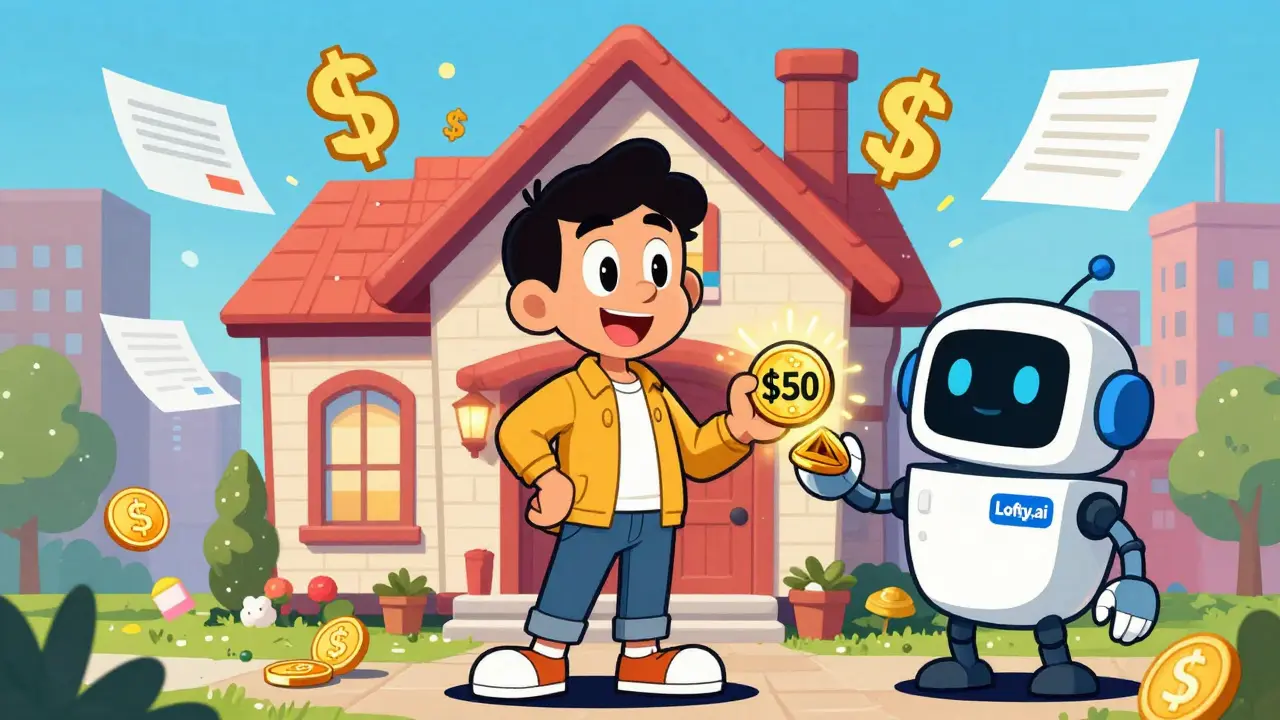
Imagine buying a share of a rental house in Detroit for $50-not the whole house, just a tiny slice of it. You get a portion of the rent every day. No realtor. No months-long closing. Just a few clicks and your ownership is recorded on a blockchain. This isn’t science fiction. It’s happening right now, and platforms like Lofty.ai, RealT, and Propy are making it real.
What Exactly Is a Blockchain Real Estate Platform?
A blockchain real estate platform turns physical property into digital tokens. Each token represents ownership-sometimes as small as 0.01%-of a house, apartment, or commercial building. These tokens live on a blockchain, meaning every transaction is recorded permanently, transparently, and without needing a middleman like a title company or bank. Before blockchain, buying real estate meant paperwork, inspections, lawyers, and waiting weeks just to close. Now, with smart contracts, the whole process can finish in under 15 minutes. The blockchain doesn’t just record who owns what-it automatically handles rent distribution, compliance checks, and even tax reporting. The key shift? Real estate is no longer just for people with $500,000 to spare. With tokenization, you can start with $50. That’s the game-changer.How Tokenization Works: From Brick to Blockchain
Here’s how it actually works in practice:- A property owner or developer partners with a platform like Bricksquare or Libertum to tokenize their asset.
- The property is appraised, legally verified, and converted into a set number of digital tokens-say, 10,000 tokens representing 100% ownership.
- Each token is assigned an ERC-20 or ERC-3643 standard (depending on whether it’s a security or utility token).
- Investors buy tokens using stablecoins like USDC or ETH through a wallet like MetaMask.
- Once purchased, the platform’s smart contract automatically sends rental income to your wallet every day or month.
- Ownership is recorded on the blockchain. You can sell your tokens anytime on the platform’s marketplace.
Top Platforms in 2025: Who’s Leading the Pack?
There are over 15 active platforms now, but only a few stand out for scale, reliability, and user experience.- Lofty.ai: Focuses on daily rental payouts. As of January 2025, it had $127 million in tokenized assets. Minimum investment: $50. Fees: 3%. Popular with millennials who want passive income without waiting for monthly checks.
- RealT: The oldest and most proven. Since 2019, it’s paid out over $29 million in rent to 65,000+ investors. Most properties are in Detroit and Atlanta. Minimum: $100. Uses Ethereum and requires MetaMask. Rated 4.2/5 on Trustpilot.
- Propy: Built for international buyers. Has completed transactions in 27 countries. Uses Ethereum smart contracts and integrates with automated inspection tools. Best for cross-border deals. Fee: 2.5%. Learning curve is steep for non-tech users.
- Brickblock: Offers tokenized real estate bonds-fixed returns between 4.2% and 7.8%. Minimum investment: $1,000. Good for conservative investors who want predictable income, not property appreciation.
- Republic: Targets accredited investors (net worth over $1 million). Has facilitated $890 million in real estate investments since 2020. Not for beginners.
- Deedcoin: Charges just 1% commission-half the industry standard. But it’s still small, with only $38 million in total volume. Could be a disruptor if it scales.
Why This Matters: The Real Benefits
People don’t just jump into blockchain real estate because it’s trendy. They do it because it solves real problems:- Liquidity: Traditional real estate is locked up for years. Tokenized property can be sold in minutes.
- Lower entry cost: You don’t need a down payment on a whole house. $50 gets you in.
- Transparency: Every transaction is public and unchangeable. No hidden fees or forged documents.
- Automation: Rent is sent automatically. Taxes are tracked. Compliance is built into the code.
- Global access: A student in Manila can invest in a property in Chicago. A retiree in Berlin can own a piece of a Miami condo.
The Dark Side: Risks and Scams
It’s not all smooth sailing. The wild west phase is over, but risks remain.- Regulatory gray zones: The SEC has issued 17 cease-and-desist orders in 2025 alone. Platforms that mislabel security tokens as "utility" tokens are getting shut down.
- Scams: In January 2025, a fake Miami property on StackerNews vanished with $2.3 million from 47 investors. No KYC. No audits. Just a website and promises.
- Wallet mistakes: If you send funds to the wrong address? Gone forever. No customer service can undo it.
- Limited properties: Most platforms only offer residential properties in a few U.S. cities. No luxury beachfront. No commercial towers in Tokyo.
- Slow support: Blocksquare users report average support response times of 58 hours. If something goes wrong, you might be waiting days.
Who’s Using This? The Investor Profile
This isn’t just for crypto bros anymore. According to Republic’s 2025 survey:- 63% of investors are millennials (ages 28-43).
- Average investment size: $3,200.
- 78% hold their tokens for 12+ months.
- Most use MetaMask (78% of all wallet integrations).
- Over half have never owned real estate before.
What’s Next? The Future in 2025 and Beyond
The market is maturing fast.- Institutional players are moving in: BlackRock launched its first tokenized real estate fund in April 2025 with $450 million in assets. JPMorgan’s Onyx platform processed $1.2 billion in tokenized real estate deals in Q1 2025.
- New tech is emerging: Libertum’s blockchain handles 1,200 transactions per second. Reddio’s new protocol hits 5,000 TPS. Tectum Labs just launched quantum-resistant keys to guard against future computing threats.
- Regulations are tightening: The SEC now clearly states that any token representing ownership in physical property is a security. MiCA in Europe offers clearer rules. Compliance isn’t optional anymore.
- Consolidation is happening: Propy’s enterprise division was bought by ConsenSys for $120 million. RealT was acquired by Fortress Investment Group for $210 million.
How to Get Started (Safely)
If you’re ready to try it:- Choose a compliant platform: Stick with Lofty, RealT, or Propy. Avoid unknowns.
- Set up a MetaMask wallet. Fund it with USDC (not ETH-it’s too volatile for property deals).
- Complete KYC. Expect 3-5 business days. No shortcuts.
- Start small. Buy $100 worth of tokens. Test the system.
- Read the smart contract terms. Understand how rent is distributed and how you exit.
- Don’t invest more than you can afford to lose. It’s still early, and regulations are shifting.
Frequently Asked Questions
Can I really own a piece of a house with $50?
Yes. Platforms like Lofty.ai allow you to buy fractional shares of rental properties starting at $50. You don’t own the whole house-you own a tiny slice of it. That slice gives you a proportional share of rental income and potential appreciation. Your ownership is recorded on the blockchain and can be sold anytime.
Are blockchain real estate platforms legal?
It depends. In the U.S., the SEC considers any token representing ownership in physical property to be a security. That means platforms must either register with the SEC or qualify for an exemption (like Regulation D). Platforms like RealT and Lofty.ai are compliant. Others that don’t follow these rules are being shut down. Always check if a platform has public SEC compliance documentation.
Do I need to know how to use crypto?
You need basic crypto knowledge. You’ll need a wallet (usually MetaMask), understand stablecoins like USDC, and know how to send and receive tokens. You don’t need to be a developer, but you must be comfortable with digital wallets and private keys. If you’re not, take time to learn-or stick with traditional real estate.
How do I get paid rent?
Rent is automatically sent to your crypto wallet via smart contract. Most platforms pay daily (Lofty) or monthly (RealT). Payments come in USDC, a stablecoin pegged to the U.S. dollar. You can hold it, swap it for cash, or reinvest it. No bank statements. No delays.
What happens if the platform shuts down?
Your tokens are still on the blockchain. They’re yours, even if the platform disappears. You can still transfer them to another wallet or sell them on a decentralized exchange. But if the platform was the only marketplace for those tokens, finding a buyer could be harder. That’s why platform reputation and liquidity matter.
Is this just another crypto bubble?
No. This isn’t about speculative tokens or memes. It’s about digitizing a $300 trillion global asset class. The technology solves real problems: illiquidity, high fees, slow processes. Institutional investors like BlackRock and JPMorgan are pouring billions in. This is infrastructure, not hype.
Naman Modi
December 20, 2025 AT 00:20Mmathapelo Ndlovu
December 20, 2025 AT 02:49Rishav Ranjan
December 20, 2025 AT 17:16Jake Mepham
December 21, 2025 AT 15:41Jacob Lawrenson
December 22, 2025 AT 21:56Zavier McGuire
December 24, 2025 AT 09:56Sybille Wernheim
December 26, 2025 AT 01:31Cathy Bounchareune
December 27, 2025 AT 11:56Sheila Ayu
December 29, 2025 AT 04:41Radha Reddy
December 30, 2025 AT 20:06Shubham Singh
December 30, 2025 AT 23:49Sarah Glaser
January 1, 2026 AT 00:34roxanne nott
January 1, 2026 AT 21:58Tristan Bertles
January 2, 2026 AT 08:19Megan O'Brien
January 2, 2026 AT 12:38Dusty Rogers
January 4, 2026 AT 12:12Helen Pieracacos
January 6, 2026 AT 09:28Dustin Bright
January 8, 2026 AT 05:48Melissa Black
January 8, 2026 AT 15:06