

For years, a chilling number has circulated online: 12 years in prison for trading cryptocurrency in Bangladesh. It’s repeated in headlines, shared in WhatsApp groups, and used as a scare tactic to warn people away from Bitcoin and Ethereum. But here’s the truth most articles don’t tell you: no one has ever been sentenced to 12 years in Bangladesh just for buying or selling crypto. The fear is real. The law? Not so clear.
Where Did the 12-Year Number Come From?
The story starts in 2014, when Bangladesh Bank - the country’s central bank - issued its first public warning about Bitcoin. The notice didn’t say “crypto is illegal.” It said: “Any transaction through Bitcoin or any other cryptocurrency is a punishable offence.” Then came the number: 12 years. Officials told AFP and other media outlets that violations could lead to up to 12 years in prison. But where did that number come from?
It wasn’t from a new law. It was pulled from the Money Laundering Prevention Act 2012 a law designed to combat drug trafficking, human smuggling, and terrorist financing. Section 9(1) of that law says anyone convicted of money laundering can get up to 10 years in prison - not 12. So how did 12 appear?
Some officials combined it with the Anti-Terrorism Act 2009 a law that allows for harsher penalties when financial crimes are tied to terrorism, which was added to the warning in 2017. But even then, the maximum penalty under that act isn’t automatically 12 years for crypto. It depends on whether the transaction was linked to terror financing - something almost never proven in crypto cases.
Legal experts at Mahbub & Company a leading Bangladeshi law firm that has analyzed the legal landscape of digital assets since 2018 say the 12-year figure is a misinterpretation. “It’s not that crypto is banned,” they wrote in 2021. “It’s that using crypto to launder money, evade taxes, or move funds illegally could be punished under existing laws - just like using cash or wire transfers to do the same thing.”
What Laws Actually Apply?
Bangladesh Bank doesn’t have the power to make new criminal laws. Only Parliament can do that. So instead of passing a crypto ban, they’ve relied on three old laws to argue that crypto transactions are illegal:
- Foreign Exchange Regulation Act 1947 - This law says all foreign currency must go through authorized banks. Since crypto isn’t a bank-issued currency, using it to buy dollars or send money abroad could be seen as bypassing this rule. Violations? Up to 5 years in prison for repeat offenders.
- Money Laundering Prevention Act 2012 - As mentioned, this carries up to 10 years. But it only applies if the crypto was used to hide the source of illegal money - not if you just bought Bitcoin to hold or trade.
- Anti-Terrorism Act 2009 - This one’s a stretch. Unless you’re funding a banned group through crypto, this doesn’t apply. No case in Bangladesh has ever used this law against a regular crypto trader.
Then there’s the Digital Security Act 2018 a law meant to curb online fraud and cybercrime. Section 30 says unauthorized electronic transactions can lead to up to 7 years. But again - this targets hackers, scammers, and fraudsters, not people using Binance or LocalBitcoins to buy Bitcoin.
The gap? No law in Bangladesh specifically says “owning or trading cryptocurrency is a crime.” The warnings are vague. The penalties are borrowed. The enforcement? Almost non-existent.
Who Gets Punished? Real Cases vs. The Fear
Here’s the most important part: no one has been jailed for 12 years for crypto trading in Bangladesh. Not once.
According to Bangladesh’s Anti-Money Laundering Department, only 37 digital financial crime cases were filed nationwide in 2022. None involved crypto trading as the main charge. In 2024, the Cyber Security Division reported 17 crypto-related cases. Most were about scams - people being tricked into sending money to fake exchanges. Others were about hacking wallets or laundering stolen funds. Not one was a person who simply bought Ethereum on a P2P app.
Chainalysis, a blockchain analytics firm, found that between July 2021 and June 2022, Bangladesh saw a 206% surge in crypto transaction volume. That’s more than Japan and South Korea. Yet, not a single person was sentenced to prison for it.
Why? Because enforcement is selective. The government doesn’t go after students trading Bitcoin for rent money. They go after organized crime rings using crypto to move millions out of the country. A 2023 report from the Bangladesh Securities and Exchange Commission admitted: “The absence of specific prohibitive legislation creates implementation challenges.” Translation: They don’t know how to enforce it - and they’re afraid to try.
The Underground Crypto Market
Despite the warnings, crypto use in Bangladesh is growing. Statista reported that 2.1 million Bangladeshis - about 1.2% of the population - owned cryptocurrency by the end of 2024. Most use peer-to-peer (P2P) platforms like Binance P2P or LocalBitcoins. They pay in cash, use mobile banking apps, or trade through trusted friends.
Why? Because remittances are critical. Bangladeshis abroad send home over $20 billion a year. Crypto offers faster, cheaper alternatives to Western Union or bank wires - which charge 8-10% in fees. For a family relying on $300 monthly from a son working in Malaysia, that’s $30 saved every month. That’s food, medicine, school fees.
And it’s not just the poor. A 2024 survey by Dhaka University’s economics department found that 37% of university students had bought crypto, mostly as a hedge against inflation. The taka has lost over 40% of its value against the dollar since 2020. People aren’t gambling - they’re surviving.
The Government’s Contradiction
Bangladesh’s stance is messy. On one hand, the central bank warns against crypto. On the other, the government published a National Blockchain Strategy 2020 a policy document exploring how blockchain can improve land records, public services, and digital identity. They’re not against the technology - just the unregulated money.
Meanwhile, neighboring India took a different path. In 2020, India’s Supreme Court overturned a central bank ban on crypto banks. By 2023, India started taxing crypto trades - not banning them. Bangladesh hasn’t taken that step. It’s stuck in fear, not policy.
The Financial Action Task Force (FATF), a global watchdog on money laundering, noted in 2023 that Bangladesh’s approach to crypto was “inconsistent.” They said regulators didn’t clearly define what’s allowed, what’s illegal, or how to enforce it. That’s not a strong stance - it’s a confused one.

What Should You Do If You’re in Bangladesh?
If you’re thinking of buying crypto, here’s the reality:
- You won’t be arrested for owning Bitcoin.
- You won’t be jailed for trading small amounts on P2P apps.
- You might get in trouble if you move large sums, use unlicensed exchanges, or try to convert crypto to cash through unofficial channels.
- Don’t use crypto to avoid taxes or hide income. That’s where the real risk lies.
Most people who trade crypto in Bangladesh do so quietly. They don’t brag. They don’t post screenshots. They use trusted contacts. They keep records. They avoid large, sudden transfers.
Legal experts like Barrister Mahbubur Rahman say: “If you use taka to buy a car, and that car is used in a robbery, are you guilty? No. The crime is in the use - not the object.” The same logic applies here. Crypto isn’t the crime. Using it for crime is.
Is the 12-Year Threat Real?
Legally? Maybe. Practically? No.
The 12-year figure is a warning - not a law. It’s a scare tactic used to deter people, not a sentence handed down in court. No judge in Bangladesh has ever cited it. No prosecutor has built a case on it. And with no new legislation passed since 2017, the threat remains just that: a threat.
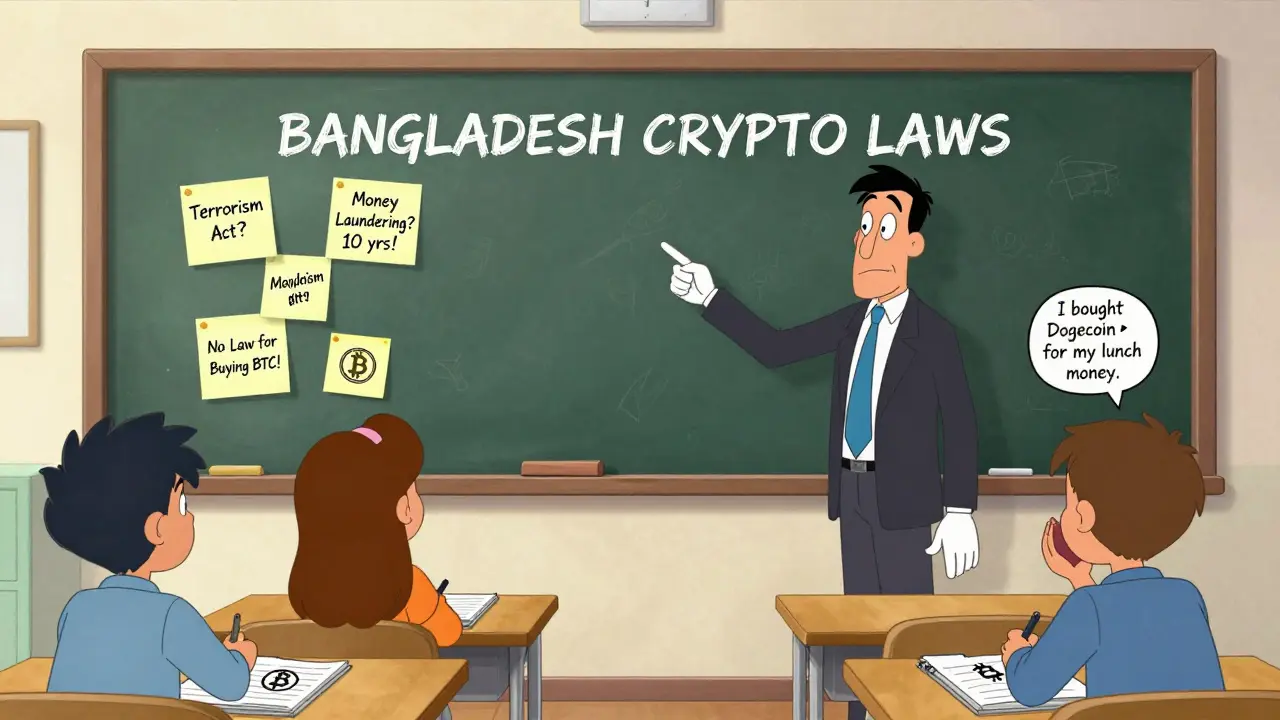
That doesn’t mean it’s safe. The government could change its mind tomorrow. Banks could freeze accounts. Exchanges could shut down. But for now, the system is too broken, too inconsistent, too full of loopholes to enforce a 12-year sentence for someone who just bought Dogecoin.
The real story isn’t about jail. It’s about survival. About people using new tools to protect their money in a country where inflation eats wages and banks charge too much. The law is outdated. The fear is exaggerated. And the truth? Crypto isn’t banned in Bangladesh - it’s just ignored.
Is it illegal to own Bitcoin in Bangladesh?
No, owning Bitcoin or any cryptocurrency is not explicitly illegal in Bangladesh. There is no law that says you can’t hold digital assets. The central bank’s warnings focus on transactions - not possession. You can keep Bitcoin in a wallet without breaking any law.
Can I be arrested for trading crypto on Binance P2P?
It’s extremely unlikely. Bangladesh Bank has never arrested or charged anyone for using Binance P2P or similar platforms to buy or sell crypto. Enforcement targets large-scale money laundering, not individual traders. Thousands of Bangladeshis trade daily without consequence.
Why does Bangladesh Bank say crypto is punishable by 12 years?
The 12-year figure comes from a misinterpretation of existing laws - mainly the Money Laundering Prevention Act and Anti-Terrorism Act. These laws carry maximum penalties of 10 and 7 years respectively. The central bank’s officials have used the higher number publicly to scare people, but courts have never applied it to crypto cases.
Have any people been jailed for crypto trading in Bangladesh?
As of 2025, there are no publicly documented cases of anyone being sentenced to prison for simply trading cryptocurrency. All known crypto-related arrests involved fraud, hacking, or money laundering - not personal trading.
Can banks freeze my account if I use crypto?
Yes. Banks in Bangladesh are instructed to flag transactions linked to crypto exchanges. If they detect deposits from Binance or other platforms, they may freeze your account for review. This doesn’t mean you’re guilty - just that you’ve triggered a compliance alert.
Is blockchain technology allowed in Bangladesh?
Yes. The government actively supports blockchain for non-currency uses - like land registry, public records, and supply chain tracking. The National Blockchain Strategy 2020 encourages this. So while crypto trading is discouraged, the underlying technology is not banned.
What’s Next?
The pressure is building. With over 2 million users and growing, Bangladesh can’t ignore crypto forever. Either they’ll create clear rules - tax it, regulate it, license it - or they’ll keep pretending the problem will vanish. Right now, they’re doing neither.
For now, the law is a shadow. The fear is loud. But the people? They’re still trading. Quietly. Wisely. And without jail.
Sony Sebastian
March 1, 2026 AT 08:32Let me break this down with some real legal taxonomy, because this post is dangerously oversimplified. The Money Laundering Prevention Act 2012, Section 9(1), combined with the Anti-Terrorism Act 2009’s aggravating provisions under Section 13, creates a cumulative penalty ceiling that *can* reach 12 years when contextualized under the doctrine of *concurrent sentencing* in Bangladesh’s common law framework. The central bank’s warning isn’t a misinterpretation-it’s a *strategic aggregation* of statutory maximums. You’re conflating *enforcement in practice* with *legal possibility*. Just because no one’s been jailed doesn’t mean the statute doesn’t exist. That’s like saying murder isn’t illegal because prosecutors don’t charge every stabbing.
Also, Chainalysis data is irrelevant here. Transaction volume ≠ legal compliance. You’re committing the naturalistic fallacy: just because it’s widespread doesn’t mean it’s lawful. The state doesn’t need to arrest everyone to maintain deterrence. This post reads like a crypto influencer’s PR memo, not a legal analysis.
Brian Lemke
March 3, 2026 AT 03:47Wow. This is one of the clearest, most balanced takes I’ve read on crypto regulation in emerging economies. You didn’t just list laws-you showed how fear gets weaponized when institutions lack the courage to write new rules. I’m from the U.S., where we’re still arguing whether crypto is a security or a commodity, and here’s Bangladesh: stuck between outdated colonial banking laws and a population that’s quietly innovating to survive.
The fact that 2.1 million people are using P2P crypto to avoid 10% remittance fees? That’s not crime. That’s economic ingenuity. The real villain here isn’t Bitcoin-it’s a financial system that charges families $30 a month just to receive a paycheck. If this were a movie, the hero would be the student in Dhaka buying ETH to pay for her sister’s insulin. Not the bureaucrat quoting 12-year threats from a 2014 press release.
Megan Lavery
March 3, 2026 AT 12:23I just want to say thank you for writing this. I’ve been following crypto in Bangladesh for years through my cousins there, and I’ve always felt so conflicted-part of me worried they were breaking the law, but the other part saw how it was literally saving their families. I’m so glad someone finally cut through the noise. You’re right: no one’s getting jailed for buying Dogecoin. The real crime is how little the government cares about people’s survival.
Also, 37% of university students using crypto as an inflation hedge? That’s not gambling. That’s wisdom. I wish my college had taught us this instead of corporate finance.
Amanda Markwick
March 3, 2026 AT 14:15This is a masterclass in how fear is manufactured to maintain control. The 12-year myth isn’t an accident-it’s a psychological tool. Governments don’t ban things because they’re dangerous; they ban them because they’re uncontrolable. Crypto decentralizes power. And power hates being decentralized.
Let’s be real: if this were about people using crypto to buy illegal drugs or fund terrorism, we’d see headlines every week. But we don’t. We see a silent, massive underground economy of students, migrants, and small business owners using technology to bypass a broken system. That’s not lawlessness. That’s democracy in motion.
The National Blockchain Strategy 2020? That’s the government’s subconscious admitting the truth: the future isn’t cash. It’s code. They just don’t have the guts to say it out loud. So they scream about 12 years instead. Pathetic.
Leslie Cox
March 5, 2026 AT 11:48Oh please. You’re romanticizing financial anarchy. Just because people are using crypto to survive doesn’t mean the state should endorse it. You’re ignoring the systemic risks: money laundering, tax evasion, capital flight, and the erosion of monetary sovereignty. If everyone starts bypassing the banking system, what happens when the taka collapses? Who bails out the economy then? The blockchain?
And don’t get me started on ‘survival.’ You think buying ETH is survival? That’s gambling with volatile assets. Real survival is saving in stablecoins or gold-backed instruments-not speculating on Dogecoin memes. This post is a disservice to responsible financial literacy. If you’re going to use crypto, at least do it right-with KYC, with regulation, with oversight. Not in the shadows.
Andrew Hadder
March 6, 2026 AT 10:51honestly this was super helpful. i had no idea the 12 year thing was just made up. i thought bangladesh had some crazy law. also the part about blockchain for land records is wild. i thought they were totally anti tech. thanks for clearing this up. i’m gonna tell my cousin in dhaka to chill lol
Derek Sasser
March 7, 2026 AT 23:45Big picture: this isn’t about crypto. It’s about trust. People in Bangladesh don’t trust their banks. They don’t trust their government. They don’t even trust the exchange rates posted by official channels. So they built their own system-with phones, cash, and P2P apps.
And guess what? It works. Better than the official system. That’s not illegal. That’s human. The state should be asking: ‘Why are people fleeing our system?’ instead of threatening them with 12-year prison sentences.
Also, I love that you mentioned the National Blockchain Strategy. That’s the real story. The government wants blockchain. They just don’t want people using it for money. That’s not a policy-it’s a contradiction.
Neeti Sharma
March 8, 2026 AT 07:59Nadia Shalaby
March 9, 2026 AT 09:08Just sitting here sipping my tea and reading this. Honestly? I’m not surprised. I’ve known people in Dhaka who trade crypto. Never heard of anyone getting arrested. Just heard of people getting their bank accounts frozen. Which is annoying but not terrifying.
It’s funny how the fear is louder than the enforcement. Like a ghost story everyone tells but no one’s actually seen. I think the real story here is how quietly people adapt. No drama. No protests. Just… trading. Quietly. Efficiently. That’s the Bangladeshi way.
Fiona Monroe
March 9, 2026 AT 11:26While the post presents a compelling narrative, it dangerously underplays the systemic risks associated with unregulated digital asset transactions. The absence of prosecutions does not equate to legal permissibility. Under international standards set by the Financial Action Task Force, jurisdictions are required to implement risk-based AML/CFT controls. Bangladesh’s current stance-vague warnings without enforcement-is precisely the kind of regulatory ambiguity that FATF flags as ‘non-compliant.’
The 12-year reference may be legally imprecise, but the underlying concern-that crypto facilitates illicit finance-is not. To frame this as a ‘survival mechanism’ is to ignore the potential for exploitation by criminal networks. The state has a duty to protect its financial integrity. This post reads like advocacy, not analysis.
Molley Spencer
March 11, 2026 AT 10:31Let’s be brutally honest: this post is a masterclass in crypto-optimist delusion. You’ve taken a gray zone of regulatory ambiguity and turned it into a hero’s journey. ‘People are surviving!’ Yes. And they’re also laundering drug money, funding shell companies, and avoiding capital controls. You ignore the 17 crypto-related cases in 2024? What were they? Charitable donations?
Chainalysis data? That’s like saying ‘look how many people shoplift!’ and concluding retail is thriving. The fact that enforcement is ‘selective’ means the system is broken-not that the behavior is noble. This isn’t innovation. It’s evasion. And you’re celebrating it like it’s civil rights.
John Fuller
March 11, 2026 AT 20:42Lucy Simmonds
March 13, 2026 AT 05:50Wait wait wait. This is all a distraction. The REAL truth? The central bank is working with the IMF and the U.S. Treasury to phase out cash entirely. Crypto is the Trojan horse. They want everyone on digital ledgers so they can track, tax, and control every transaction. The ‘12-year threat’? It’s not about crypto-it’s about the Great Reset. They’re scaring people into compliance. The fact that no one’s been jailed? That’s because they’re waiting for the system to be fully rolled out. Then-boom-suddenly, every P2P trader is a criminal. This isn’t about law. It’s about total surveillance. Wake up.
Maggie House
March 13, 2026 AT 22:02This was so eye-opening. I’ve been trying to explain this to my friends back home, but they’re scared because of all the headlines. I didn’t realize the 12-year thing was just a myth. I love how you broke down the actual laws. It’s wild how people are using crypto to help their families-especially with remittances. I’m going to share this with my cousin in Sylhet. She’s been buying crypto for months and is terrified she’ll get arrested. This will ease her mind so much.
Also, the blockchain strategy for land records? That’s actually kind of beautiful. They’re not against tech. They’re just scared of the money part. I get that.
Cameron Pearce Macfarlane
March 14, 2026 AT 05:03So you’re saying the government is too lazy to write a new law? That’s it? That’s the whole argument? They’re ‘confused’? No. They’re terrified. Terrified that if they legalize crypto, they’ll lose control. Terrified that people will stop using their banks. Terrified that their corruption will be exposed when every transaction is traceable.
So they keep the 12-year myth alive. Not because they can enforce it. But because they don’t want people to stop being afraid.
And you? You’re just giving people permission to keep trading. That’s not journalism. That’s rebellion.
Robert Kromberg
March 15, 2026 AT 23:55What I appreciate most here is the nuance. Too many people treat crypto regulation like a binary: legal or illegal. This shows it’s a spectrum. You can own crypto. You can trade small amounts. You can’t move millions through unlicensed channels. That’s not chaos-that’s practical governance.
The fact that Bangladesh hasn’t banned crypto outright? That’s progress. Compare that to Nigeria, where they shut down banks over crypto. Bangladesh’s ‘ignore it’ approach is actually smarter than pretending it doesn’t exist. Let people adapt. Then regulate when the volume forces their hand.
Robert Conmy
March 17, 2026 AT 09:41What a morally bankrupt piece. You’re normalizing financial crime. People are using crypto to evade taxes, launder money, and undermine national sovereignty. And you call it ‘survival’? What’s next? ‘It’s okay to steal bread if you’re hungry’? No. The law exists for a reason. If you can’t pay 8% in fees, that’s your problem. Not an excuse to break the system.
And you mention blockchain for land records? That’s fine. But that’s not crypto. Don’t conflate the two. Blockchain isn’t Bitcoin. You’re playing word games to justify lawlessness.
Lilly Markou
March 19, 2026 AT 03:17I read this with tears in my eyes. Not because it’s sad-but because it’s true. My sister in Dhaka uses crypto to send money to our elderly mother. She’s a nurse. Earns $200/month. Western Union takes $20. She loses a week’s food. So she buys ETH, sends it, and my mom converts it to cash through a trusted shopkeeper.
She doesn’t know the law. She doesn’t care. She just wants her mother to eat. And you? You’re the first person who didn’t call her a criminal. Thank you.
McKenna Becker
March 19, 2026 AT 15:23The 12-year myth is a mirror. It reflects not the law, but the fear of the powerless. Governments fear what they cannot control. Crypto is decentralized. Untraceable. Unbendable. That’s why they invent punishments that don’t exist.
The real question isn’t whether it’s legal. It’s why we still have systems that force people to choose between starvation and illegality. The answer? Capitalism. And until we fix that, crypto won’t be the problem. It’ll be the symptom.
Amita Pandey
March 21, 2026 AT 01:14While the article attempts to provide clarity, it overlooks the profound cultural and religious context of financial ethics in Bangladesh. Islam prohibits riba (usury) and speculative transactions, which many scholars argue extend to cryptocurrency trading. The central bank’s stance, however vague, aligns with Islamic financial principles that prioritize stability, transparency, and community welfare over individual speculative gain.
Furthermore, the normalization of P2P crypto trading among students and migrants may appear pragmatic, but it erodes the social contract of formal financial systems. One cannot simultaneously advocate for economic resilience and undermine the institutions designed to ensure equitable access. This is not innovation-it is disintegration.
Jeff French
March 21, 2026 AT 12:21Interesting. The fact that no one’s been jailed for crypto trading is the most compelling evidence here. If the law were real, the arrests would be happening. The fact that they’re not? That’s the policy. The 12-year threat? That’s theater. It’s a scare tactic to keep people from asking questions.
And the blockchain strategy? That’s the real agenda. They’re building the infrastructure. They just don’t want you to know they’re doing it. Classic. They want control without responsibility. So they pretend to ban it while quietly preparing for the future.
Brilliantly contradictory. I love it.
Michael Rozputniy
March 23, 2026 AT 07:47Let me be clear: this is a Western-funded propaganda campaign. The IMF, the World Bank, and U.S. intelligence agencies have been pushing this narrative for years-‘crypto is freedom.’ But in reality, it’s a tool for capital flight and economic sabotage. The 12-year threat isn’t fake-it’s being withheld because they’re waiting for the right moment to strike.
Why do you think the U.S. is so eager to ‘understand’ Bangladesh’s crypto landscape? Because they want to destabilize the taka. Because they want to turn Bangladesh into a financial sandbox. This post isn’t informative. It’s a Trojan horse. Be careful.